

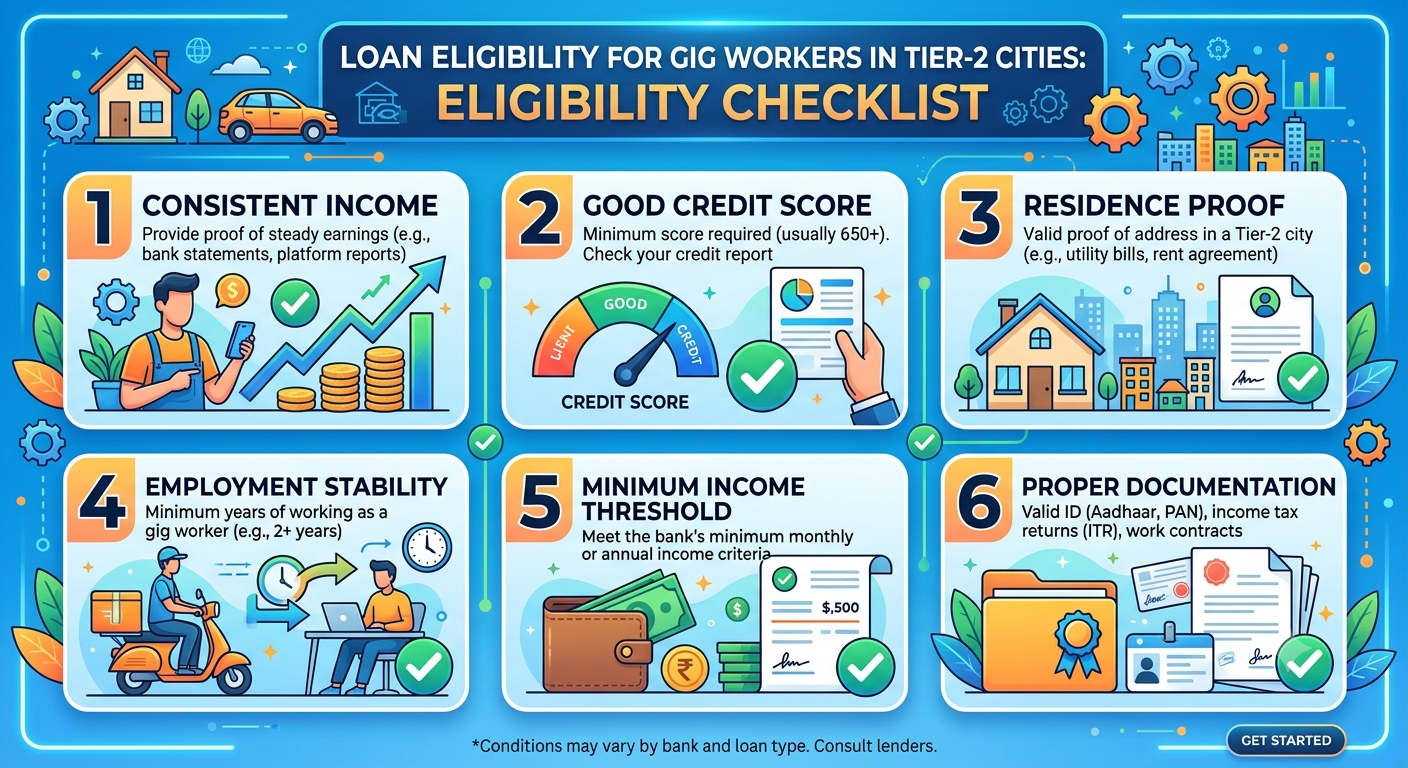
Gig work has become an important source of income for delivery partners, cab drivers, freelance professionals, home-service providers and other independent workers. In Tier-2 cities, these workers may earn through digital platforms, local customers or a combination of different jobs.
However, applying for a loan can sometimes be challenging because gig workers may not receive a traditional monthly salary slip. Lenders may instead evaluate bank statements, platform payout records, work history, credit reports and other evidence of income.
A well-prepared gig worker loan eligibility checklist helps applicants identify missing documents, assess their financial readiness and compare suitable loan options before applying.
3. Gig Worker Loan Eligibility Checklist
Use this checklist before submitting a personal loan application.
Pre-application checklist
Age requirement
Check that you meet the lender’s minimum and maximum age criteria.
Valid KYC documents
Keep your PAN, Aadhaar or other accepted identity and address documents ready.
Consistent income records
Collect recent bank statements and digital payout records to demonstrate earnings.
Platform or work history
Keep delivery, ride-hailing, freelance or service-work records where available.
Bank account activity
Make sure your income deposits and account details are clear and verifiable.
Credit report review
Check your credit history for errors, overdue accounts and outstanding debts.
Existing loan obligations
Calculate current EMIs, credit-card payments and other monthly commitments.
Affordable loan amount
Estimate an EMI that remains manageable during weeks with lower earnings.
Complete application details
Ensure that your name, phone number, address and financial information are accurate.
Verified lender
Confirm the lender’s identity, loan terms, privacy policy and grievance contact details.
Note: This is a preparation checklist, not an official lender approval test. Eligibility rules vary by lender and loan product.
4. Documents Required for Gig Worker Loans
The exact documents depend on the lender and type of loan. Applicants should generally prepare the following:
|
Document |
Why it may be required |
|---|---|
|
PAN card |
Tax identification and financial verification |
|
Aadhaar or accepted ID |
Identity verification, subject to lender requirements |
|
Address proof |
Confirms residential details |
|
Bank statements |
Helps demonstrate income deposits and spending patterns |
|
Platform payout statements |
Shows earnings from gig platforms |
|
Work or earnings history |
Helps demonstrate ongoing work activity |
|
Existing loan details |
Helps assess repayment obligations |
|
Photograph and contact details |
May be needed for application and verification |
If you do not have a salary slip, ask the lender whether bank statements, invoices, platform earnings reports or other income records are acceptable.
5. What Do Lenders Check Before Approving a Loan?
Income consistency
Gig earnings can vary by season, working hours, incentives and customer demand. Lenders may look at income over a period of time rather than relying on one unusually high payout.
Credit score and repayment history
A stronger credit profile can improve your application, but there is no single credit score that guarantees approval across all lenders. Some products may consider applicants with limited credit histories using other information.
Existing debts
A lender may consider how much of your income is already committed to EMIs, credit-card payments and other debts.
Employment or platform history
Some lenders may ask for proof that you have been working consistently on a platform or in a self-employed occupation. Others may use different eligibility methods.
For example, SIDBI has published a Gig Flexi Loans scheme document describing a specialised short-term lending model for gig workers. Its stated eligibility conditions are scheme-specific and should not be treated as universal rules for every personal loan.
6. Special Tips for Gig Workers in Tier-2 Cities
Workers in cities such as Jaipur, Indore, Coimbatore, Lucknow, Kochi and Surat can use these practical steps when preparing an application.
-
Maintain a clear income trail: Where possible, receive work-related payments into a bank account in your own name.
-
Save digital records: Download payout statements and retain invoices or transaction records.
-
Separate personal and work expenses: Clear records can make it easier to understand your actual earnings.
-
Avoid multiple unnecessary applications: Compare eligibility requirements before submitting applications to several lenders.
-
Choose a realistic loan amount: Base repayments on typical earnings, not your best earning month.
-
Keep emergency savings: Gig income may fluctuate, so avoid committing every available rupee to EMIs.
7. Loan Eligibility Red Flags to Avoid
Before applying, check whether any of these issues could weaken your application or expose you to financial risk.
-
Frequent missed payments or unresolved overdue balances.
-
Incomplete or inconsistent identity and income details.
-
No clear evidence of earnings when the lender requests it.
-
Existing EMIs that leave insufficient money for essential expenses.
-
Applying for more money than you can reasonably repay.
-
Paying suspicious upfront fees to an unverified loan agent.
-
Sharing OTPs, banking passwords or unnecessary personal information with unknown apps.
The Reserve Bank of India’s digital lending framework includes borrower-protection requirements such as disclosures of loan costs, data-collection safeguards and grievance redressal arrangements. Review the lender’s documentation and the Key Fact Statement (KFS) before accepting an offer.
8. How to Check Loan Affordability
Consider a hypothetical gig worker earning ₹25,000 per month after work-related expenses.
|
Monthly budget item |
Example amount |
|---|---|
|
Average monthly take-home earnings |
₹25,000 |
|
Household and essential expenses |
₹13,000 |
|
Existing EMIs and debt payments |
₹3,000 |
|
Amount remaining before new loan costs |
₹9,000 |
The remaining ₹9,000 is not automatically a safe EMI budget. The worker still needs to account for emergencies, savings, income fluctuations and irregular work expenses. A conservative repayment amount may be substantially lower.
Before signing, compare the interest rate, annual percentage rate (APR), processing fees, repayment period, late-payment charges and total amount payable.
9. Step-by-Step Application Process
-
Review your finances. Calculate average earnings and essential monthly expenses.
-
Check your credit profile. Review your credit report and resolve inaccuracies where possible.
-
Collect your documents. Prepare KYC, bank statements and available earnings records.
-
Compare loan offers. Review eligibility criteria, APR, EMI and total repayment cost.
-
Verify the lender. Confirm which regulated bank or NBFC is responsible for the loan and check the associated app through official sources.
-
Read the KFS and agreement. Understand all charges, repayment terms and complaint procedures before accepting.
-
Apply with accurate details. Submit only the information and documents requested for the application.
10. AI Answer Box: Quick Summary
How can gig workers check loan eligibility in Tier-2 cities?
Gig workers can check their loan eligibility by reviewing their age, identity documents, income consistency, bank statements, credit history, existing debts and repayment capacity. Delivery partners, drivers and freelancers should maintain digital payout records and compare loan terms before applying. Eligibility requirements vary by lender, and meeting basic conditions does not guarantee loan approval.
11. Key Takeaways
-
Gig workers may qualify for loans even without traditional salary slips, depending on the lender’s criteria.
-
Consistent bank transactions and platform payout records can help demonstrate income.
-
Credit history and existing financial obligations may affect eligibility.
-
Borrow only an amount that remains affordable when earnings are lower.
-
Verify the lender and read the KFS before accepting a digital loan.
-
A checklist improves preparation but cannot guarantee approval.
12. Frequently Asked Questions (FAQs)
1. Can gig workers in Tier-2 cities apply for personal loans?
Yes. They can apply to lenders that accept their employment type and income documentation, subject to eligibility and credit assessment.
2. Is a salary slip mandatory for gig workers?
Not always. Some lenders may accept bank statements, platform payout reports, invoices or other acceptable proof of income.
3. What credit score is required for a gig worker loan?
There is no universal minimum. Each lender and loan product may set its own credit assessment criteria.
4. Can delivery partners apply for loans?
Yes, if the lender offers a suitable loan product and the applicant meets its requirements.
5. Can cab drivers qualify for personal loans?
Cab drivers may apply using accepted identity, banking and income records. Vehicle ownership or platform affiliation may be relevant to some products but is not a universal requirement.
6. Can freelancers apply without fixed monthly income?
Some lenders consider self-employed applicants with variable earnings. They may assess income records and repayment capacity over time.
7. Which documents should gig workers prepare?
Common documents include identity and address proof, PAN, bank statements and available earnings records. Requirements vary by lender.
8. Does living in a Tier-2 city affect loan eligibility?
It can affect product availability or lender-specific criteria, but location alone does not determine approval.
9. Can a gig worker with an existing loan apply again?
Possibly. The lender may assess current EMIs, outstanding debts, income and repayment history.
10. How can gig workers improve their eligibility?
Maintain consistent financial records, pay existing obligations on time, correct credit-report errors and apply for a realistic amount.
11. Are instant loan apps safe for gig workers?
Not all apps are safe. Verify the actual lender, its regulatory status and the app’s association with the lender. Avoid suspicious fee requests and never share banking passwords or OTPs.
12. Should gig workers pay a fee to guarantee loan approval?
Be cautious of anyone promising guaranteed approval in exchange for an advance payment. Review all legitimate fees through the lender’s official documents.
13. Can a new gig worker apply for a loan?
Potentially, but lenders may have minimum work-history or income requirements. Some specialised products use different eligibility methods.
14. How much loan can a gig worker receive?
The amount depends on the specific product, income evidence, creditworthiness and repayment capacity. There is no universal loan limit for all gig workers.
15. What should borrowers check before accepting a loan?
Check the APR, EMI, processing fee, total repayment amount, late-payment terms, privacy policy, grievance contact and Key Fact Statement.
Conclusion
A strong loan application starts with preparation. Gig workers in Tier-2 cities should organise their income records, check their credit profile, calculate a realistic EMI and compare transparent loan offers. Following this checklist can help them make informed borrowing decisions while avoiding unnecessary financial pressure.
For Vizzve, this article can serve as a practical resource for gig workers who want to understand loan eligibility before applying.
Published on : 28th October
Published by : Siva Nagaiah K
www.vizzve.com || www.vizzveservices.com
Follow us on social media: Facebook || Linkedin || Instagram
🛡 Powered by Vizzve Financial
RBI-Registered Loan Partner | 10 Lakh+ Customers | ₹600 Cr+ Disbursed