

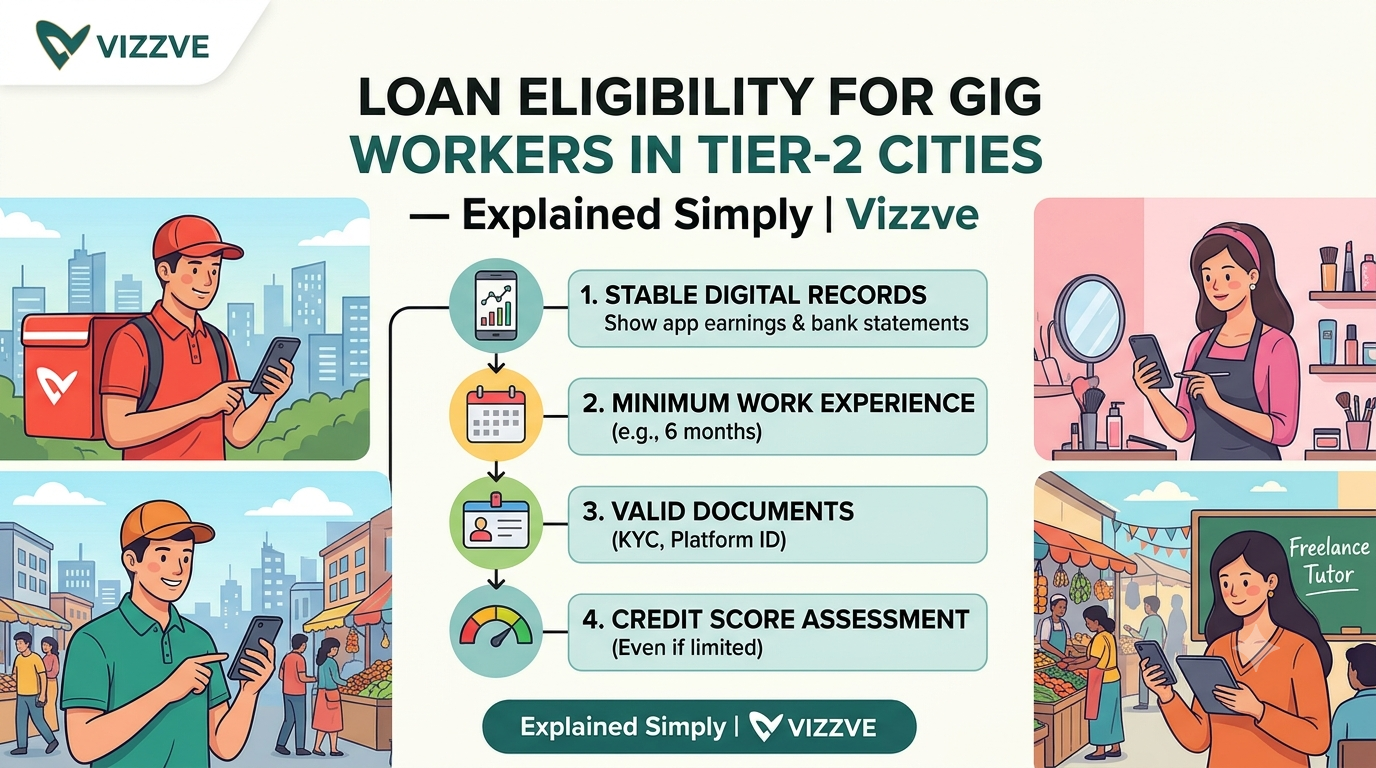
Gig work is creating earning opportunities in many Indian cities beyond the major metropolitan centres. Delivery partners, app-based drivers, freelancers, home-service professionals and other platform workers may earn through daily tasks, weekly payments or multiple clients.
However, irregular income can make loan applications confusing. A gig worker may have regular earnings but no conventional salary slip or employer-issued income certificate.
The good news is that not having a salary slip does not automatically mean you cannot qualify for a loan. Some lenders may accept bank statements, platform earnings records or other income documents. Approval still depends on the lender's policies, credit assessment and repayment-capacity checks.
This guide explains loan eligibility for gig workers in Tier-2 cities in simple language, including the factors lenders may consider, documents to prepare and steps to borrow safely.
What Is Loan Eligibility?
Loan eligibility means the conditions a bank, non-banking financial company (NBFC) or other authorised lending provider uses to decide whether an applicant qualifies for credit.
For gig workers, lenders may assess:
-
Age and identity verification
-
Monthly or average income
-
Consistency of earnings
-
Bank statements and other income evidence
-
Credit history and existing loans
-
Ability to repay the proposed EMI
-
Residential location and service availability
-
Accuracy of the application and supporting documents
There is no single eligibility rule that applies to every lender. The required income, credit score, age range, documents and loan amount may vary by product.
Who Is a Gig Worker?
A gig worker earns through temporary assignments, individual tasks, freelance projects or platform-based work rather than a traditional permanent employment arrangement.
Common examples include:
1. Delivery Partners
Food, grocery, parcel and e-commerce delivery workers may receive payments based on completed orders, incentives and working hours.
2. App-Based Drivers
Cab and other transport workers may earn through ride-based payments, incentives and other permitted services.
3. Freelancers
Graphic designers, writers, developers, consultants and other independent professionals may earn from multiple clients or projects.
4. Home-Service Professionals
Cleaning professionals, repair workers, beauty-service providers and other independent workers may receive payment for individual jobs.
5. Other Platform Workers
Workers who find assignments through digital platforms may also fall within gig or platform work arrangements, depending on their work structure.
Eligibility depends on the lender's accepted employment categories and income-verification process.
Why Tier-2 City Gig Workers May Need Different Loan Guidance
Tier-2 cities have varied employment markets, living costs, service availability and access to financial services. Gig workers in these locations may work across delivery, transport, local commerce, home services and online freelancing.
Examples of cities commonly described as Tier-2 include Jaipur, Lucknow, Indore, Nagpur, Coimbatore, Surat, Bhopal, Patna and Bhubaneswar. City classifications can differ between organisations and contexts.
Workers should focus less on the city label and more on whether the lender serves their location, accepts their work type and can verify their income.
Main Loan Eligibility Criteria for Gig Workers
| Factor | What it means |
|---|---|
| Age | The applicant must meet the lender's minimum and maximum age rules |
| Income | Earnings must meet the lender's requirements and be sufficiently verifiable |
| Bank statements | Transactions may help show income patterns and existing financial commitments |
| Credit history | Previous borrowing and repayment behaviour may affect assessment |
| Existing EMIs | Current debt payments reduce the income available for another loan |
| Work history | Platform statements or client records may help demonstrate earnings over time |
| Address | The applicant must meet location and address-verification requirements |
| Documents | Details should be accurate, consistent and accepted by the lender |
Meeting these conditions does not guarantee approval. Lenders may use additional eligibility and risk-assessment criteria.
Can Gig Workers Get a Loan Without a Salary Slip?
Yes, some lenders may consider applications without a traditional salary slip. They may accept alternative records to assess income, but acceptance varies.
Possible documents include:
-
Recent bank statements
-
Platform earnings statements
-
Payment histories from work apps
-
Freelance invoices and client receipts
-
Income-tax returns, where applicable
-
Other financial records accepted by the lender
For example, a delivery partner who receives earnings directly into a bank account may be able to show transaction records alongside platform statements. The lender decides whether those records meet its verification requirements.
Never edit bank statements or create false income documents to improve an application.
Documents to Prepare Before Applying
Identity and Address Documents
Depending on the lender, you may need PAN details, Aadhaar or another accepted identity document, address proof and digital verification.
Income Records
Prepare bank statements and available earnings records for the period requested by the lender. Freelancers may also need invoices or payment receipts.
Bank Account Information
Use accurate bank account details and check that the information on your application matches your supporting documents.
Existing Loan Details
Keep track of outstanding loans, EMIs and repayment dates. Lenders may consider these commitments when assessing your capacity to repay.
Credit Report
Review your credit report for errors or unfamiliar accounts. If you find incorrect information, contact the relevant credit bureau or lender to raise a dispute.
Only submit personal information through verified channels and provide documents that the lender actually requires.
How to Improve Your Loan Eligibility
Maintain Clear Income Records
Keep platform statements, invoices and bank records organised. Consistent documentation can make your earnings easier to assess.
Track Take-Home Income
Calculate earnings after work expenses such as fuel, vehicle maintenance, mobile data, supplies and platform-related costs. Gross earnings alone may overstate the amount available for repayments.
Pay Existing EMIs on Time
Timely repayments can support a positive credit history when payment information is reported to credit bureaus. Contact your lender early if you expect difficulty making a payment.
Avoid Taking More Debt Than Necessary
Borrow only the amount required for a clear purpose. A smaller loan may be easier to repay when income fluctuates.
Review Your Credit Report
Correct errors before applying where possible. Avoid assuming that one particular credit score guarantees approval.
Apply Selectively
Compare lenders' requirements before submitting applications. Multiple applications in a short period may result in several credit enquiries, depending on the lender and product.
Step-by-Step Loan Application Process
Step 1: Calculate your income. Review several months of earnings where available and estimate your average take-home amount.
Step 2: Check the lender's eligibility rules. Confirm age requirements, accepted income documents, location coverage and credit criteria.
Step 3: Organise your documents. Prepare the records required by the lender and check that the information is consistent.
Step 4: Set a realistic loan amount. Work out how much you need rather than choosing the largest amount offered.
Step 5: Estimate the EMI. Consider essential household costs, existing EMIs, work expenses, savings and lower-income weeks.
Step 6: Apply through a verified channel. Check the identity of the actual bank or NBFC providing the loan.
Step 7: Review the offer. Read the Key Facts Statement, interest rate, annual percentage rate (APR), processing fee, repayment schedule and applicable charges.
Step 8: Keep your records. Save the agreement, repayment schedule and payment receipts after accepting the loan.
Understanding Loan Costs
Before borrowing, compare the overall cost rather than focusing only on a headline interest rate.
| Loan term | Why it matters |
|---|---|
| Interest rate | Determines interest charged on the outstanding principal |
| APR | Helps communicate the annualised cost of borrowing under the applicable calculation |
| Processing fee | May increase the total cost or reduce the amount disbursed |
| Tenure | A longer repayment period can lower the EMI but increase total interest |
| Late-payment charges | May add to the amount owed after a missed or delayed payment |
| Prepayment terms | Explain any applicable conditions or charges for early repayment |
| Net disbursal | Shows the amount you receive after any permitted deductions |
Illustrative EMI Example
Suppose a gig worker borrows ₹25,000 at an illustrative interest rate of 18% per year for 12 months, using a standard monthly reducing-balance calculation.
-
Approximate monthly EMI: ₹2,292
-
Approximate total of 12 EMIs: ₹27,504
-
Approximate interest paid: ₹2,504
These figures are estimates and exclude possible fees or other charges. Actual lender terms may differ.
Before accepting an offer, check whether the EMI remains affordable during a week or month when your earnings are lower than usual.
Examples of Tier-2 City Loan Considerations
| City | Example gig work | What applicants can prepare |
|---|---|---|
| Jaipur | Delivery, transport and freelance services | Bank statements and earnings records |
| Lucknow | Delivery partners, drivers and home services | Platform statements and address documents |
| Indore | Food delivery, local services and online projects | Income history and existing EMI details |
| Nagpur | Transport, courier and delivery work | Bank credits and available work records |
| Coimbatore | Delivery, independent services and freelancing | Payment statements and client invoices |
| Bhopal | Delivery, driving and local service work | Accepted identity, address and income documents |
These are examples of work types, not claims that any particular lender offers a loan in every listed city. Confirm service availability directly with the lender.
Safe Borrowing and Digital Loan Checklist
The Reserve Bank of India issued the Reserve Bank of India (Digital Lending) Directions, 2025, covering requirements for regulated entities and digital lending arrangements. Borrowers should still verify the actual lender and read the terms of each offer. Read the RBI's Digital Lending Directions, 2025.
Before accepting a digital loan:
-
Verify the bank or NBFC named in the agreement.
-
Check relevant information in the RBI's public directory of digital lending apps, where applicable.
-
Read the Key Facts Statement and review the APR and applicable charges.
-
Do not pay unknown agents who promise guaranteed approval.
-
Never share your OTP, UPI PIN or banking password.
-
Review app permissions and provide only necessary information.
-
Keep a copy of the loan agreement and repayment schedule.
-
Use the lender's official grievance channel if you encounter a problem.
For suspected cyber fraud in India, visit the National Cyber Crime Reporting Portal or call 1930 for the cybercrime helpline.
Common Reasons for Loan Rejection
A gig worker's application may be rejected if:
-
Income cannot be verified to the lender's satisfaction.
-
Documents are missing or contain inconsistent information.
-
Existing EMIs leave insufficient repayment capacity.
-
Credit history does not meet the lender's requirements.
-
The requested loan amount is too high for the applicant's profile.
-
The applicant's location is outside the lender's service area.
-
The applicant does not meet another product-specific requirement.
If your application is rejected, review the reason, correct any errors and reconsider the amount requested. Avoid applying repeatedly without understanding the issue.
Real-World Example: A Delivery Partner in Jaipur
Consider a hypothetical delivery partner who earns ₹24,000 in an average month before work-related expenses. After fuel, maintenance and other costs, take-home earnings are approximately ₹17,000.
The worker pays ₹2,000 toward an existing EMI and spends ₹10,000 on essential household expenses. That leaves ₹5,000 before savings and unexpected costs.
A new EMI of ₹3,500 would use most of the remaining amount. Rather than accepting the offer immediately, the worker should review the budget, maintain an emergency buffer and consider a smaller loan—or postpone borrowing if repayment would be difficult.
This example is illustrative only. It does not represent a lender's eligibility formula or an approval promise.
Benefits and Limitations of Loans for Gig Workers
Potential Benefits
-
Access to funds for planned expenses or emergencies.
-
An opportunity to build repayment history when payments are reported and made on time.
-
Some lenders may accept alternative income records.
-
Digital applications may make it easier to submit documents remotely.
Limitations
-
Irregular income can make fixed EMIs difficult to manage.
-
Interest rates and fees vary by lender and product.
-
A limited credit history may affect available options.
-
Frequent borrowing can increase financial pressure.
-
Digital application convenience does not guarantee approval or affordability.
Key Takeaways
-
Gig workers in Tier-2 cities may qualify for loans if they meet the lender's requirements.
-
A traditional salary slip is not the only possible form of income evidence.
-
Bank statements, platform earnings records and invoices may help where accepted.
-
Eligibility depends on verified income, credit history, existing debt and repayment capacity.
-
Compare APR, fees, tenure and total repayment before accepting an offer.
-
Verify the actual lender and protect your financial information.
-
Choose an EMI that remains manageable even when earnings fluctuate.
Frequently Asked Questions
1. Can gig workers in Tier-2 cities get personal loans?
Some lenders may offer personal loans to eligible gig workers. Approval depends on the lender's policies, income verification, credit profile and repayment capacity.
2. Can I get a loan without a salary slip?
Possibly. Some lenders accept bank statements, platform earnings records, invoices or other income documents instead of a conventional salary slip.
3. Which documents are required for a gig worker loan?
Requirements vary, but may include identity and address proof, bank statements, income records and PAN details where required.
4. Is a credit score compulsory for gig workers?
Requirements differ by lender and product. Credit history may be considered alongside income, existing obligations and other factors.
5. Can delivery partners apply for loans?
Delivery partners may apply for products that accept their work and income type, subject to the lender's eligibility requirements.
6. Can freelancers apply for loans in smaller cities?
Some lenders accept freelancer or self-employed income. They may ask for bank statements, invoices, tax documents or other proof.
7. Does my city affect loan eligibility?
It can. Lenders may have specific service areas and address-verification requirements. Confirm availability for your location before applying.
8. How much loan can a gig worker get?
There is no universal amount. The lender may consider income, existing EMIs, credit history, requested tenure and its own product limits.
9. How can I improve my chances of approval?
Maintain clear income records, review your credit report, manage existing debt, submit accurate documents and request a realistic loan amount.
10. Are instant loan apps safe?
Some are operated through legitimate lending arrangements, but borrowers should verify the actual regulated lender, read the agreement and avoid suspicious advance-fee requests.
11. What if my monthly income changes?
Keep records of your earnings over time and calculate an average take-home amount. Make sure the EMI remains affordable during lower-income periods.
12. Should I take the maximum loan amount offered?
Not necessarily. Choose the amount needed for your purpose and ensure the EMI fits your budget after essential expenses and existing repayments.
13. What should I check before accepting a loan?
Review the APR, interest rate, processing fee, EMI, total repayment, late-payment charges, prepayment terms and the lender's identity.
14. What should I do if my loan is rejected?
Ask for the reason where available, correct any document or credit-report errors and reassess your repayment capacity before applying elsewhere.
15. Does Vizzve guarantee loan approval?
No borrower should assume approval is guaranteed. Eligibility, terms and disbursal depend on the actual lending provider's assessment and applicable conditions. Check current product details and lender information before applying.
Conclusion
Loan eligibility for gig workers in Tier-2 cities becomes easier to understand when applicants focus on a few key areas: verified income, accurate documents, credit history and repayment capacity.
Whether you are a delivery partner in Jaipur, a driver in Lucknow, a freelancer in Indore or a platform worker in another growing city, check the lender's requirements before applying. Compare the total cost, protect your personal information and avoid borrowing more than you can comfortably repay.
Vizzve encourages informed borrowing: understand the terms, verify the lender and choose a repayment plan that can withstand fluctuations in your income.
Published on : 27th October
Published by : Siva Nagaiah K
www.vizzve.com || www.vizzveservices.com
Follow us on social media: Facebook || Linkedin || Instagram
🛡 Powered by Vizzve Financial
RBI-Registered Loan Partner | 10 Lakh+ Customers | ₹600 Cr+ Disbursed