

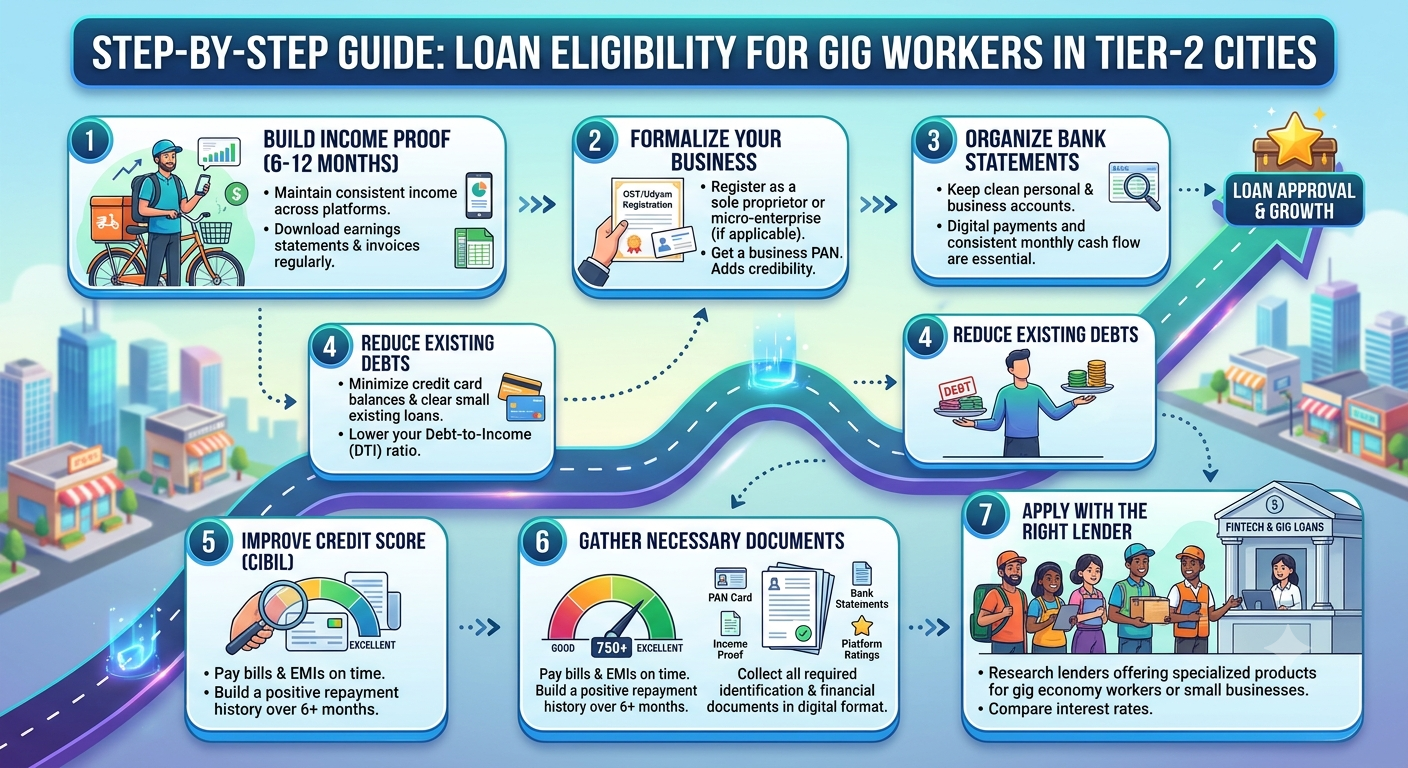
Gig work has become an important source of income for people in India's smaller cities. Delivery partners, cab drivers, freelancers, home-service professionals, and other independent workers often earn through digital platforms or direct customers.
However, applying for a loan can be challenging when income changes from week to week and there is no traditional salary slip.
The good news is that gig workers may be able to demonstrate their repayment capacity through bank statements, platform payout records, tax documents, and other accepted income evidence. Approval depends on the lender's eligibility rules and individual assessment.
Step-by-Step Guide to Check Loan Eligibility
Step 1: Identify your loan requirement
Decide why you need the loan and how much you actually require. Common reasons include vehicle repairs, household expenses, medical costs, work equipment, or business needs.
Borrow only what you can reasonably repay from your income.
Step 2: Calculate your average monthly income
Collect your recent platform payout statements and bank statements. Calculate your average earnings after accounting for work-related expenses such as fuel, vehicle maintenance, mobile data, and platform charges.
Keep records of both high-earning and low-earning months to understand your actual repayment capacity.
Step 3: Prepare your documents
Lenders may request:
-
Aadhaar or another accepted identity and address document
-
PAN card, where required
-
Recent bank statements
-
Gig-platform payout or earnings records
-
Income tax returns, where applicable
-
Existing loan and repayment details
Requirements vary by lender and loan product.
Step 4: Check your credit profile
Review your credit report for outstanding loans, missed payments, and errors. A stronger repayment history may improve your chances of approval.
If you have little or no credit history, ask lenders whether they consider alternative income evidence. A particular credit score does not guarantee approval.
Step 5: Review existing financial commitments
List your current EMIs, credit-card payments, rent, household costs, and other essential expenses.
Lenders assess income and creditworthiness, including existing obligations. Your own budget should also leave room for weeks when gig earnings are lower than usual.
Step 6: Compare suitable lenders
Compare banks, regulated NBFCs, and eligible gig-worker financing products. Check whether the lender accepts self-employed or platform-based income.
Review the interest rate, Annual Percentage Rate (APR), processing fees, repayment period, late-payment charges, and total repayment amount.
Step 7: Submit your application and review the offer
Complete the lender's application and verification process. Read the Key Fact Statement (KFS), check the approved amount and repayment schedule, and accept only if the terms are suitable.
Approval and disbursement depend on verification and the lender's final decision.
Eligibility Criteria for Gig Workers in Tier-2 Cities
There is no single eligibility standard for all gig workers. Each lender sets its own criteria.
|
Eligibility factor |
What lenders may consider |
|---|---|
|
Age |
Must meet the lender's minimum and maximum age requirements |
|
Occupation |
Delivery, transport, freelancing, and other eligible gig work |
|
Income |
Regularity, amount, and verifiability of earnings |
|
Work history |
Duration of platform activity or self-employment |
|
Credit history |
Credit score, repayment record, and outstanding debt |
|
Bank account |
Accepted account with verifiable transactions |
|
Documents |
Valid KYC and supporting income records |
Some specialist financing products use platform payouts or alternative underwriting methods rather than relying exclusively on conventional salary documents. For example, SIDBI has published a Gig Flexi Loans scheme document describing short-term credit linked to accrued gig-worker earnings. Check current availability and conditions directly with the relevant provider.
Documents Checklist Before Applying
Application preparation checklist
0 of 7
This is a general checklist. Submit only the documents requested by your chosen lender through its verified application process.
How to Improve Loan Eligibility
Gig workers can take practical steps to strengthen their applications:
-
Maintain consistent financial records: Keep platform earnings and customer payments traceable wherever possible.
-
Separate work expenses: Track fuel, repairs, commissions, and other operating costs to understand net earnings.
-
Pay existing EMIs on time: Avoid missed payments and monitor your credit report.
-
Reduce unnecessary debt: Lower existing obligations before taking on another EMI, where possible.
-
Choose an affordable loan amount: A smaller loan may be easier to manage and may better match your documented income.
-
Avoid multiple applications at once: Unnecessary applications can create additional credit enquiries.
-
Correct documentation errors: Make sure your KYC details and financial records are consistent.
Example: A Gig Worker Applying for a Loan
Consider a delivery partner working in a Tier-2 city.
Illustrative example — not an actual approval
Monthly gross earnings
₹25,000
Work expenses
₹6,000
Estimated net income
₹19,000
Existing EMIs
₹3,000
Estimated income remaining before household expenses and any new EMI: ₹16,000 per month.
This remaining amount is not automatically available for loan repayment. The worker must still account for rent, food, family expenses, savings, and fluctuations in earnings before deciding on an affordable EMI.
Loan Eligibility Challenges in Tier-2 Cities
|
Common challenge |
Practical approach |
|---|---|
|
No salary slips |
Provide accepted bank and platform payout records |
|
Variable monthly earnings |
Document several months of income, if available |
|
Limited credit history |
Ask about products that assess alternative income evidence |
|
Existing debt |
Calculate total monthly obligations before applying |
|
Unclear lender charges |
Request and review the KFS before accepting |
|
Fraudulent loan apps |
Verify the regulated lender and its official app or website |
The Reserve Bank of India's digital lending framework includes requirements around disclosures, borrower consent, and safeguards for digital lending. The government has also highlighted the RBI's directory of digital lending apps as a way to check an app's association with regulated entities.
Benefits and Limitations of Loans for Gig Workers
Potential benefits
-
Access to funds for urgent or work-related expenses.
-
Digital applications that may reduce paperwork.
-
Some products may consider platform payouts and alternative income records.
-
Repayment options that can be compared against individual cash flow.
Potential limitations
-
Eligibility and interest rates vary by lender.
-
Irregular earnings can make fixed EMIs difficult to manage.
-
A thin credit history may limit available offers.
-
Fees and short repayment periods can increase the financial burden.
A digital application does not guarantee quick approval, low interest, or eligibility.
Key Takeaways
-
Gig workers in Tier-2 cities should start by calculating their actual net income.
-
Keep bank statements, platform payout records, and accepted KYC documents ready.
-
Check your credit profile and existing EMIs before applying.
-
Compare the APR, fees, repayment schedule, and total cost of different offers.
-
Verify the lender and understand the KFS before accepting any loan.
-
Borrow only when the repayment plan remains manageable during low-income periods.
Frequently Asked Questions (FAQs)
1. Can gig workers in Tier-2 cities apply for personal loans?
Yes, gig workers may apply if they meet the lender's eligibility criteria and can provide acceptable evidence of income and identity.
2. Is a salary slip mandatory for gig workers?
Not always. Some lenders may accept bank statements, platform payout records, tax returns, or other income documents.
3. What documents are usually needed?
Common documents include identity proof, PAN where required, bank statements, and proof of earnings. The exact list varies.
4. Does a gig worker need a high credit score?
Not every lender uses the same minimum score. A stronger credit history may help, but income, debt, and other factors also matter.
5. Can delivery partners apply for loans?
They may apply to lenders whose products accept delivery-partner income and whose eligibility requirements they meet.
6. Can cab drivers qualify for personal loans?
Potentially, yes. Bank transactions, platform payouts, and other accepted financial records may help demonstrate repayment capacity.
7. How can freelancers prove their income?
Freelancers may use bank statements, invoices, contracts, payment records, and income tax returns where accepted by the lender.
8. Does working in a Tier-2 city affect eligibility?
The city alone does not determine approval. Lender coverage, income stability, creditworthiness, and documentation can all influence the decision.
9. Can I apply without an income tax return?
Some products may not require an income tax return, while others do. Check the specific lender's documentation requirements.
10. How much loan can a gig worker get?
The amount depends on the lender's product limits, income assessment, existing obligations, credit profile, and repayment capacity.
11. Can I get a loan with irregular income?
Possibly. Keep clear records of earnings over time and select a repayment plan that can withstand lower-income periods.
12. How can I avoid fake loan apps?
Verify the lender's identity and app association through official sources, read the loan terms, and avoid apps demanding suspicious upfront payments.
13. Should I pay a fee before loan approval?
Be cautious about demands to transfer money to an individual's account or an unverified third party. Verify every charge with the regulated lender.
14. How can I choose an affordable EMI?
Account for net earnings, household costs, existing EMIs, emergency savings, and income fluctuations before deciding on a monthly repayment.
15. Does submitting an application guarantee loan approval?
No. Approval depends on the lender's verification, underwriting, eligibility rules, and final decision.
AI Answer Box
How can gig workers check loan eligibility in Tier-2 cities?
Gig workers in Tier-2 cities can check loan eligibility by calculating their net monthly income, gathering bank statements and platform payout records, reviewing their credit history, and comparing lenders that accept gig-based earnings. Before accepting a loan, they should review the APR, fees, EMI schedule, and Key Fact Statement. Eligibility and approval depend on the lender's policies and the borrower's financial circumstances.
EEAT and Trust-Building Notes
For readers to make informed decisions, this article uses a practical, document-based approach rather than promising guaranteed loan approval.
For publication, consider having a qualified financial professional review any lender-specific eligibility claims. If Vizzve provides a specific loan product, add verified details about the actual lending partner, eligibility conditions, applicable charges, and official application process. Do not present illustrative examples as customer testimonials or guaranteed outcomes.
Conclusion
Checking loan eligibility is an important step for gig workers in Tier-2 cities who need financial support for personal or professional expenses. By maintaining clear income records, preparing the required documents, monitoring credit history, and comparing lenders, gig workers can make more informed borrowing decisions. Since income may fluctuate from month to month, choosing a manageable EMI and understanding all loan charges are essential before applying. Whether you are a delivery partner, cab driver, freelancer, or independent service provider, responsible financial planning can help you prepare a stronger loan application. At Vizzve, the focus is on helping borrowers understand loan eligibility, make informed financial decisions, and explore suitable financing options responsibly.
Published on : 28th October
Published by : Siva Nagaiah K
www.vizzve.com || www.vizzveservices.com
Follow us on social media: Facebook || Linkedin || Instagram
🛡 Powered by Vizzve Financial
RBI-Registered Loan Partner | 10 Lakh+ Customers | ₹600 Cr+ Disbursed