

Introduction
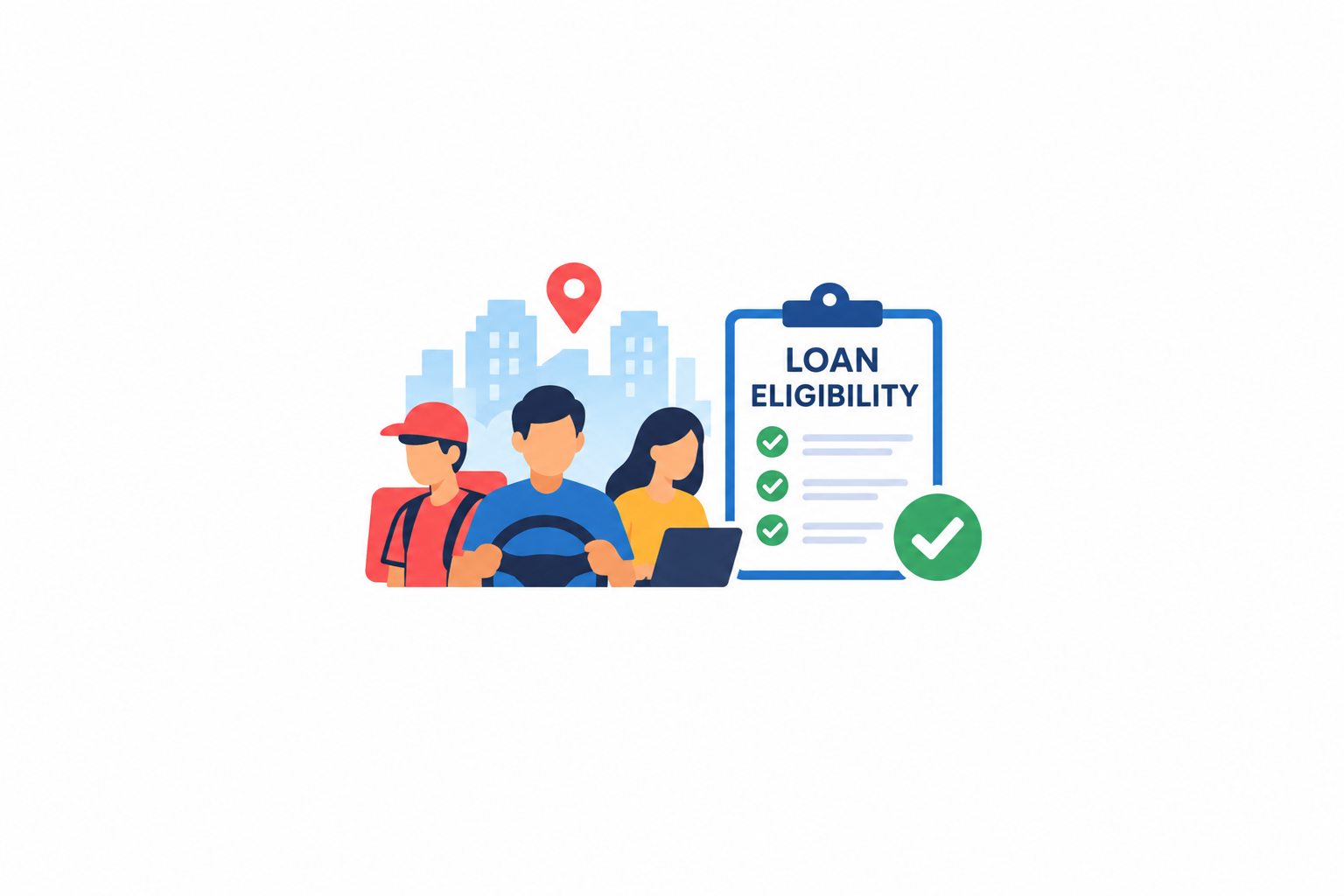
Gig work is becoming a popular way to earn money in India's Tier-2 cities. Delivery partners, cab drivers, freelance professionals, and online service providers can earn through flexible work schedules. However, applying for a personal loan may be challenging when income changes from week to week or month to month.
Unlike salaried employees, gig workers may not have a fixed monthly salary slip or a traditional employment letter. Lenders may therefore assess their bank statements, earnings history, credit profile, and repayment capacity before approving a loan.
If you work in a Tier-2 city such as Coimbatore, Madurai, Mysuru, Vijayawada, Jaipur, or Lucknow, understanding the eligibility requirements can help you prepare before applying.
This guide explains the key factors gig workers should check before applying for a loan and how to make a more informed borrowing decision.
What Is Loan Eligibility for Gig Workers?
Loan eligibility refers to the conditions a lender uses to decide whether an applicant qualifies for a loan. These conditions may include income, age, credit history, existing EMIs, repayment capacity, and identity verification.
For gig workers, lenders may also consider income received from delivery platforms, ride-hailing services, freelance assignments, or other independent work.
Important: Eligibility criteria vary by lender and loan product. Working as a gig worker does not automatically disqualify you, but approval is not guaranteed.
1. Key Factors That Affect Loan Eligibility
Income consistency
Gig workers may earn different amounts depending on working hours, customer demand, incentives, and seasonal changes. Lenders may review recent bank statements and platform payout records to understand income consistency.
Credit score and repayment history
Your CIBIL or other credit bureau report may influence loan approval, the amount offered, and the interest rate. A stronger credit history can help, but each lender follows its own eligibility criteria.
Existing EMIs and monthly expenses
Lenders may assess how much income remains after existing EMIs and essential expenses. If you already have multiple loans, your repayment capacity may be lower.
Age and identity verification
Applicants must meet the lender's age requirements and complete the required Know Your Customer (KYC) process.
Work history
Some lenders may consider how long you have worked with a delivery platform, ride-hailing service, or freelance client. The required work history varies by lender.
2. Documents Gig Workers Should Check Before Applying
Keep the following documents ready, depending on the lender's requirements.
|
Document |
Why it may be required |
|---|---|
|
PAN card |
Identity and credit verification |
|
Aadhaar or other accepted KYC document |
Identity verification |
|
Recent bank statements |
To assess income and cash flow |
|
Platform payout statements |
To demonstrate gig earnings |
|
Income Tax Returns (ITRs) |
To support declared income, if applicable |
|
Address proof |
To verify residential details |
|
Existing loan details |
To assess current repayment obligations |
You may not need every document listed above. Check the specific lender's requirements before submitting an application.
3. Does Living in a Tier-2 City Affect Loan Eligibility?
Living in a Tier-2 city does not automatically make you eligible or ineligible for a personal loan. Lenders may consider your income, credit profile, address verification, and the locations they serve.
For example, a delivery partner in Coimbatore and a freelance designer in Jaipur may have different income patterns, but both can explore suitable loan products if they meet the lender's criteria.
Before applying, check:
-
Whether the lender serves your city and PIN code.
-
Whether your occupation is accepted.
-
Whether your income meets the minimum requirement.
-
Whether your bank account shows verifiable earnings.
-
Whether the repayment schedule suits your cash flow.
4. How Can Gig Workers Improve Their Loan Eligibilble
Maintain clear income records
Receive platform payouts into a bank account where transactions can be tracked. Keep payout statements and relevant tax records organised.
Check your credit report
Review your credit history for overdue accounts or errors. Dispute incorrect information through the relevant credit bureau.
Choose an affordable loan amount
Calculate the EMI you can manage during a low-income month, not only when earnings are high.
Avoid multiple applications at once
Compare eligibility and costs before applying. Several formal credit enquiries within a short period may affect how lenders assess your application.
5. How to Calculate Your Repayment Capacity
Before applying, estimate your available monthly income after work-related expenses and essential household spending.
Consider this illustrative example:
|
Monthly budget |
Amount |
|---|---|
|
Average gig earnings received |
₹30,000 |
|
Fuel, maintenance and work expenses |
₹5,000 |
|
Essential household expenses |
₹12,000 |
|
Existing EMIs |
₹3,000 |
|
Remaining amount |
₹10,000 |
The remaining ₹10,000 is not automatically a safe EMI budget. You should also account for emergencies, income fluctuations, and savings before deciding how much to borrow.
6. Compare Loan Offers Before Applying
Do not select a loan based only on how quickly it is approved.
|
Factor |
What to check |
|---|---|
|
Interest rate |
Fixed or floating, where applicable |
|
APR |
Overall annualised borrowing cost |
|
Processing fee |
Fee and applicable taxes |
|
Loan tenure |
Total repayment period |
|
EMI |
Monthly repayment obligation |
|
Late-payment charges |
Costs if payment is delayed |
|
Foreclosure and prepayment |
Applicable conditions and charges |
|
Lender details |
Name of the regulated bank or NBFC |
For digital loans, review the Key Facts Statement (KFS) and the loan agreement before accepting the offer. RBI-regulated lenders must assess creditworthiness and provide applicable disclosures under the relevant digital lending requirements.
7. Common Reasons for Loan Rejection
A gig worker's application may be rejected for several reasons:
-
Income is insufficient or difficult to verify.
-
Existing EMIs are high compared with income.
-
Credit history includes missed payments or defaults.
-
KYC information does not match the application.
-
Required documents are missing.
-
The applicant does not meet the lender's age, location, or employment criteria.
If your application is rejected, identify the reason and address it before applying again. Avoid paying unofficial agents who promise guaranteed loan approval.
8. How to Identify a Safe Digital Loan App
Before sharing personal or financial information, verify the actual lender behind the offer.
-
Check the lender's official website and regulatory details.
-
Verify the app or lending service through the lender's official channels.
-
Review the interest rate, APR, fees, and repayment terms.
-
Read the privacy policy and understand how your data will be used.
-
Never share your OTP, UPI PIN, or banking password with an agent.
-
Avoid apps that demand unnecessary access to your contacts or call logs.
The Reserve Bank of India and the Government of India have strengthened digital lending safeguards and consumer protection measures. Borrowers should still independently verify the lender and the terms of each offer.
Key Takeaways
-
Gig workers in Tier-2 cities can explore personal loans if they meet the lender's requirements.
-
Regular, verifiable earnings can help demonstrate repayment capacity.
-
Bank statements, platform payouts, KYC documents, and tax records may support an application.
-
Credit history and existing EMIs can influence approval.
-
Compare the total borrowing cost rather than choosing the lowest advertised EMI.
-
Borrow only an amount you can repay during periods of lower earnings.
Frequently Asked Questions (FAQs)
1. Can gig workers in Tier-2 cities get a personal loan?
Yes. Some lenders accept gig workers and freelancers, subject to their income, credit profile, documentation, and other eligibility conditions.
2. Can I apply for a loan without a salary slip?
Yes, some lenders accept alternative income evidence, such as bank statements, platform payout records, and ITRs.
3. Is a CIBIL score mandatory for gig workers?
Requirements vary by lender. A credit bureau check may form part of the eligibility assessment, and applicants with limited credit history may be assessed differently.
4. How much income do I need to qualify?
There is no single minimum income applicable to every lender. Check the minimum income requirement for your chosen loan product.
5. Can delivery partners apply for personal loans?
Yes, some lenders consider delivery partners, depending on their earnings, work history, credit profile, and documentation.
6. Can an Ola or Uber driver apply for a loan?
Drivers may be eligible with lenders that accept gig or self-employed applicants. Platform earnings and bank records may help verify income.
7. Can freelancers apply without ITRs?
Some lenders may accept other income documents, while others require ITRs or additional proof. Confirm the requirements before applying.
8. Does living in a Tier-2 city reduce my loan eligibility?
Not necessarily. Your location may affect lender availability, but approval depends on the lender's criteria and your financial profile.
9. Will existing EMIs affect my application?
Yes. Existing repayment obligations may reduce the amount you can comfortably borrow and may influence the lender's decision.
10. Can I get a loan with an irregular monthly income?
Possibly. A lender may review your income history and cash flow to determine whether repayments are manageable.
11. Does checking my CIBIL score reduce it?
Checking your own credit report is generally a soft enquiry and does not reduce your score. A lender's formal credit application enquiry may have an effect.
12. How can I improve my chances of approval?
Maintain accurate documents, keep track of income, repay existing loans on time, review your credit report, and apply for an affordable amount.
13. Should I choose a short or long loan tenure?
A shorter tenure generally means higher EMIs but potentially lower total interest. A longer tenure may reduce monthly payments while increasing the total interest paid.
14. What should I check before accepting a digital loan?
Review the lender's identity, KFS, APR, processing fees, EMI schedule, late-payment charges, privacy terms, and applicable prepayment conditions.
15. Is instant loan approval guaranteed for gig workers?
No. An advertised instant process does not guarantee approval or disbursal. The lender must complete its eligibility and verification process.
Conclusion
Loan eligibility for gig workers in Tier-2 cities depends on more than just monthly earnings. Income consistency, verifiable bank transactions, credit history, existing EMIs, and documentation can all influence a lender's decision.
Before applying, compare available loan offers, check the complete borrowing cost, and select an EMI that remains manageable even when your earnings fluctuate. A careful approach can help gig workers make informed borrowing decisions and avoid unnecessary financial pressure.
At Vizzve, understanding loan eligibility and responsible borrowing can help you prepare better before exploring available credit options.
Published on : 28th October 2026
Published by : monisha
www.vizzve.com || www.vizzveservices.com
Follow us on social media: Facebook || Linkedin || Instagram
🛡 Powered by Vizzve Financial
RBI-Registered Loan Partner | 10 Lakh+ Customers | ₹600 Cr+ Disbursed