

Introduction
Gig workers in Tier-3 cities often depend on flexible jobs such as food delivery, bike taxi services, freelance work, online services, and local transportation to earn their income. Unlike salaried employees, they may not receive a fixed monthly salary or traditional salary slips.
This can make getting a personal loan slightly more challenging. However, gig workers may still qualify for loans if they can demonstrate regular income, maintain a healthy credit history, and meet the lender's eligibility requirements.
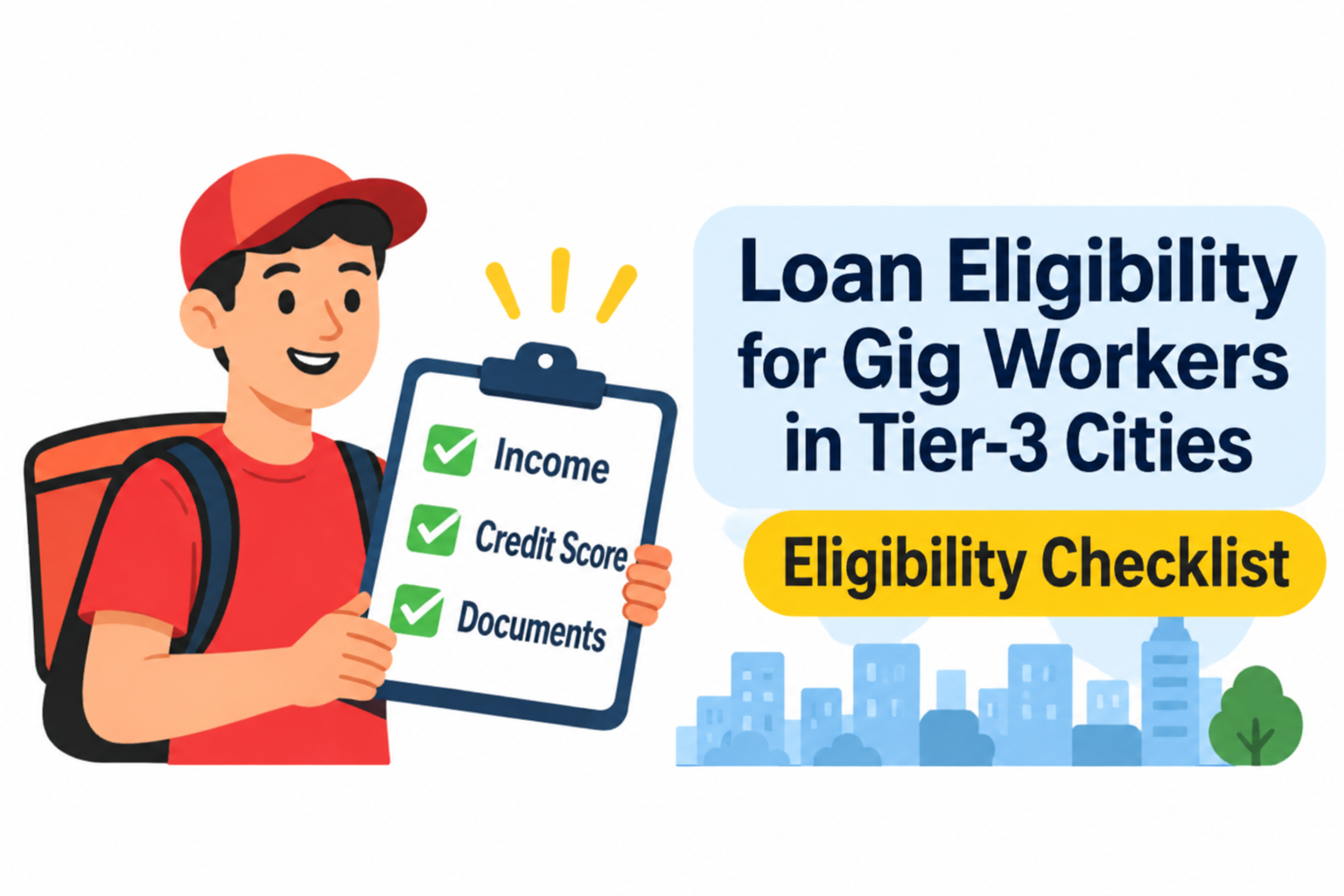
This guide explains the important loan eligibility checklist for gig workers in Tier-3 cities, including income proof, bank statements, credit scores, documents, and responsible borrowing practices.
1. Who Is a Gig Worker?
A gig worker is someone who earns money through temporary, flexible, freelance, or task-based employment rather than a permanent salaried job.
Examples include:
-
Food delivery partners.
-
Bike taxi and cab drivers.
-
Freelance designers and writers.
-
Online tutors.
-
Local service providers.
-
Independent sales agents.
-
E-commerce delivery partners.
-
Part-time digital workers.
Gig workers in smaller cities can apply for personal loans if they meet the lender's requirements.
2. Why Is Loan Eligibility Important for Gig Workers?
Loan eligibility helps lenders understand whether a borrower can repay the loan comfortably.
For gig workers, lenders may consider:
-
Monthly income consistency.
-
Bank transaction history.
-
Credit score and repayment history.
-
Existing loan obligations.
-
Employment or gig-work stability.
-
Age and residential details.
-
Loan amount and repayment capacity.
Eligibility criteria differ between banks, NBFCs, and regulated digital lending providers.
3. Eligibility Checklist for Gig Workers in Tier-3 Cities
Before applying for a personal loan, gig workers should check the following eligibility factors.
1. Age Requirement
Most lenders specify a minimum and maximum age for personal loan applicants.
-
Be within the lender's permitted age range.
-
Have valid identity and address proof.
-
Ensure your KYC details are updated.
Note: Age requirements vary depending on the lender and loan product.
2. Regular Monthly Income
A fixed salary is not always necessary. However, lenders may want evidence that you earn consistently.
Possible income proofs include:
-
Monthly bank statements.
-
UPI transaction history.
-
Delivery partner payout statements.
-
Freelance payment records.
-
Platform earning reports.
-
Client payment receipts.
3. Bank Account History
An active bank account helps demonstrate your income and financial activity.
Check the following:
-
Your bank account is active.
-
Your income is regularly credited.
-
Your account details are accurate.
-
You avoid unnecessary cheque bounces and payment defaults.
-
Your bank statements reflect genuine transactions.
4. Credit Score
Your credit score is an important factor in loan assessment.
Before applying:
-
Check your latest credit report.
-
Pay existing EMIs on time.
-
Avoid unnecessary loan applications.
-
Clear overdue payments where possible.
-
Correct errors in your credit report.
A stronger credit history may improve your chances of approval, but approval is never guaranteed.
5. Work Experience and Income Stability
Lenders may check how long you have been working as a gig worker.
Keep supporting records such as:
-
Platform registration details.
-
Work ID or partner ID.
-
Previous earning statements.
-
Monthly payout history.
-
Client invoices for freelance work.
6. Existing Loan Obligations
If you already have personal loans, credit card dues, or other EMIs, lenders may consider these obligations.
Calculate your available monthly income after essential expenses and existing repayments before choosing a new EMI.
4. Documents Required for Gig Workers
The following documents may be requested by lenders.
|
Document |
Purpose |
|---|---|
|
Aadhaar card |
Identity and KYC |
|
PAN card |
Financial verification |
|
Bank statements |
Income verification |
|
Address proof |
Residential verification |
|
Platform ID |
Work verification |
|
Payout statements |
Earnings verification |
|
Credit report |
Credit history |
|
UPI or payment records |
Additional income evidence |
Not every lender requires all these documents. Requirements depend on its verification policy.
5. Special Eligibility Checklist for Tier-3 City Borrowers
Gig workers living in smaller cities should pay attention to a few additional factors.
-
Use a bank account that you regularly operate.
-
Keep your mobile number updated with your bank.
-
Maintain digital records of earnings.
-
Ensure your residential address is correct.
-
Keep your Aadhaar and PAN information consistent.
-
Check whether the lender serves your location.
-
Understand the complete loan cost before accepting an offer.
e-Shram registration: Eligible unorganised workers, including gig and platform workers, can register on the government's e-Shram portal. It provides a Universal Account Number (UAN), which can help document their registration as an unorganised worker. However, e-Shram registration does not guarantee loan approval.
6. How to Improve Loan Eligibility
Gig workers can take these practical steps to strengthen their loan applications.
-
Maintain consistent earnings wherever possible.
-
Deposit platform earnings into your bank account.
-
Pay existing EMIs and credit card bills on time.
-
Avoid applying to multiple lenders simultaneously.
-
Maintain proper income and work records.
-
Choose a loan amount based on repayment capacity.
-
Avoid taking new loans to repay existing loans.
7. Example: Loan Eligibility of a Gig Worker in a Tier-3 City
Consider a delivery partner living in a small town who earns through a food delivery platform.
|
Particulars |
Illustrative details |
|---|---|
|
Monthly earnings |
₹22,000 |
|
Essential monthly expenses |
₹10,000 |
|
Existing EMI |
₹2,000 |
|
Remaining amount |
₹10,000 |
The borrower should not assume that the entire remaining ₹10,000 can be used for a new EMI. Emergency savings, irregular earnings, and other financial responsibilities must also be considered.
The lender will independently assess the application before deciding the eligible loan amount.
8. Safety Checklist Before Applying for a Digital Loan
Before submitting your application, verify the following:
-
Check whether the lender is an RBI-regulated bank or NBFC.
-
Verify the loan app's association with the regulated lender.
-
Read the Key Facts Statement (KFS).
-
Compare the Annual Percentage Rate (APR).
-
Check processing fees and other charges.
-
Understand the EMI amount and repayment schedule.
-
Read the privacy policy.
-
Never share your OTP or UPI PIN.
-
Avoid apps promising guaranteed loans without verification.
RBI's Digital Lending Directions, 2025 provide important requirements covering transparency, borrower consent, data protection, and digital lending arrangements.
9. Common Reasons for Loan Rejection
Gig workers may face loan rejection for several reasons:
-
Irregular income records.
-
Low or poor credit history.
-
Multiple existing EMIs.
-
Incorrect KYC information.
-
Insufficient repayment capacity.
-
Incomplete loan application.
-
Lender does not serve the applicant's location.
Understanding these reasons can help borrowers prepare better before applying.
10. Frequently Asked Questions (FAQs)
1. Can gig workers in Tier-3 cities apply for personal loans?
Yes. Gig workers can apply if they meet the lender's income, credit, documentation, and other eligibility requirements.
2. Can I get a loan without a salary slip?
Yes, some lenders accept bank statements, platform payout records, and other alternative income documents.
3. Is a CIBIL score mandatory for gig workers?
Lenders may check credit history and scores as part of their assessment. Their requirements differ.
4. What is the minimum income required for a gig worker loan?
There is no universal minimum income requirement. Each lender determines its own criteria.
5. Can delivery partners apply for personal loans?
Yes. Delivery partners may apply using their income and work records.
6. Can freelancers apply for loans in small cities?
Yes. Freelancers can provide bank statements, invoices, and client payment records as income evidence.
7. Does e-Shram registration improve loan eligibility?
It can help establish unorganised-worker registration, but it does not automatically improve creditworthiness or guarantee loan approval.
8. Can I apply without a fixed monthly salary?
Yes, some lenders consider variable income if sufficient evidence of earnings is available.
9. Do existing EMIs affect loan eligibility?
Yes. Existing financial obligations may reduce your available repayment capacity.
10. Which documents should gig workers prepare?
Aadhaar, PAN, bank statements, address proof, platform ID, and income records may be required.
11. Can gig workers with low credit scores get loans?
Some lenders may consider additional factors, but a low credit score can reduce approval chances or affect loan terms.
12. Is a bank statement important for gig workers?
Yes. It can help demonstrate regular income and financial transactions.
13. Can bike taxi drivers apply for personal loans?
Yes, subject to the lender's eligibility and documentation requirements.
14. How can gig workers improve their loan eligibility?
Maintain regular income records, pay EMIs on time, reduce outstanding debt, and provide accurate documents.
15. Is it safe to apply through digital loan apps?
It can be safe when the app is associated with a legitimate RBI-regulated lender and follows applicable digital lending requirements.
11. Key Takeaways
-
Gig workers can apply for personal loans without traditional salary slips.
-
Regular income records are important.
-
Bank statements and platform payout reports can support applications.
-
Credit history and existing EMIs influence eligibility.
-
e-Shram registration can help document gig-worker status.
-
Always compare loan interest rates, APR, fees, and repayment terms.
-
Borrow only an amount that you can comfortably repay.
Conclusion
Loan eligibility for gig workers in Tier-3 cities depends on several factors, including income consistency, credit history, bank transactions, and repayment capacity. Although gig workers may not receive traditional salary slips, they can use platform earnings, bank statements, and digital payment records to demonstrate their income.
By following a proper eligibility checklist and maintaining responsible financial habits, gig workers can prepare stronger loan applications and make informed borrowing decisions.
Vizzve encourages responsible borrowing, transparent loan comparisons, and better financial awareness for gig workers across India.
Published on : 03rd November
Published by : monisha
www.vizzve.com || www.vizzveservices.com
Follow us on social media: Facebook || Linkedin || Instagram
🛡 Powered by Vizzve Financial
RBI-Registered Loan Partner | 10 Lakh+ Customers | ₹600 Cr+ Disbursed