

Introduction
Gig work is becoming a popular source of income in India's Tier-3 cities. Many people earn money through food delivery, ride-hailing services, freelancing, online platforms, and other independent jobs. However, getting a personal loan can sometimes be challenging because gig workers may not receive a fixed monthly salary.
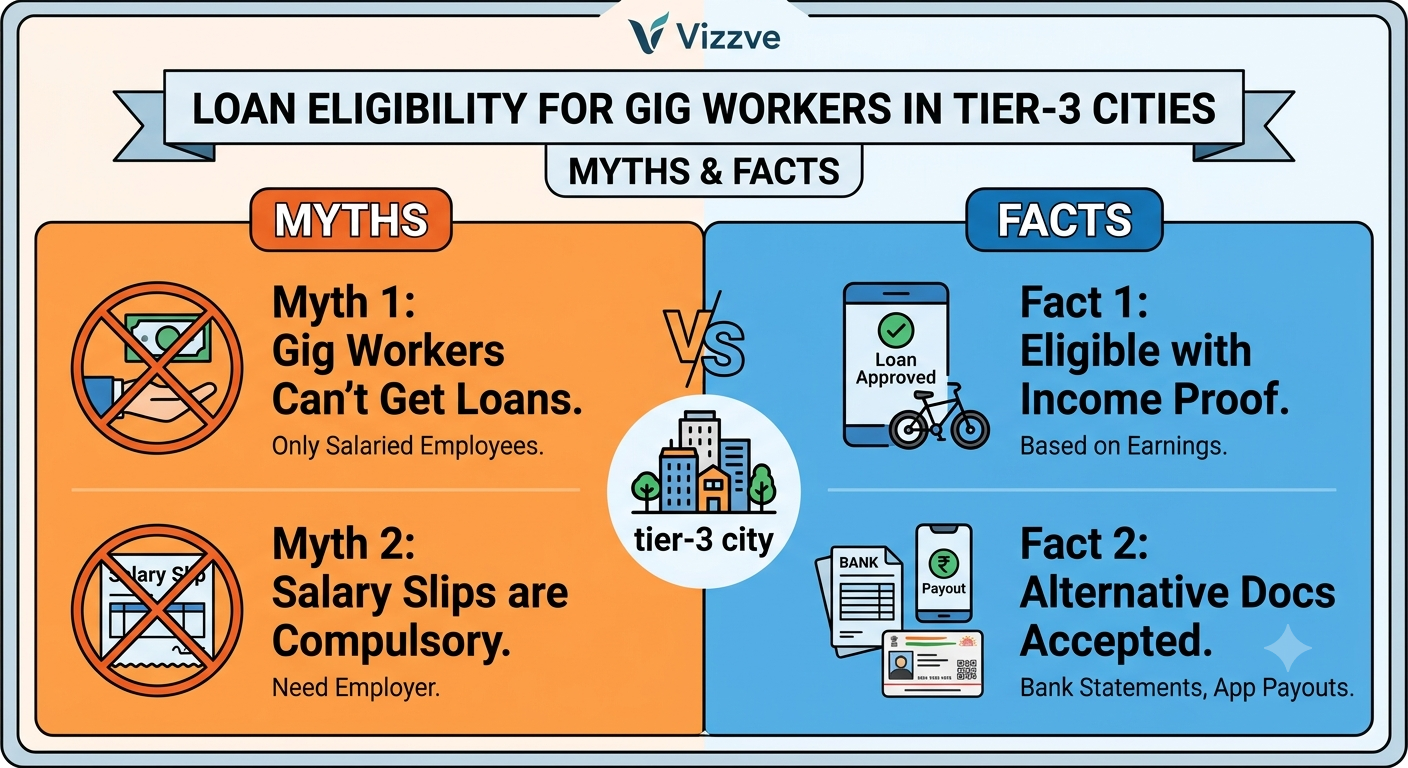
There are several misconceptions about loan eligibility for gig workers. Some believe that only salaried employees can get loans, while others think that irregular income automatically leads to loan rejection.
The reality is different. Banks and Non-Banking Financial Companies (NBFCs) may consider gig workers for personal loans based on their income consistency, bank statements, repayment capacity, credit history, and lender-specific eligibility requirements.
In this guide, let's understand the common myths and facts about loan eligibility for gig workers in Tier-3 cities.
1. Common Myths and Facts About Gig Worker Loans
|
Myth |
Fact |
|---|---|
|
Only salaried employees can get personal loans. |
Some lenders consider self-employed and gig workers. |
|
Gig workers cannot prove their income. |
Bank statements and platform payment records may help. |
|
A fixed monthly salary is compulsory. |
Some lenders assess average income and consistency. |
|
A low credit score always means rejection. |
Approval depends on the lender's credit assessment. |
|
Tier-3 city residents cannot get digital loans. |
Eligible applicants may access digital lending services. |
|
Every loan app is safe. |
Borrowers should verify the regulated lender and app details. |
|
Loan approval is guaranteed with regular earnings. |
Approval depends on multiple eligibility factors. |
2. Myth: Gig Workers Cannot Get Personal Loans
Fact: Gig workers may qualify for personal loans even without traditional employment.
Lenders may assess:
-
Monthly or average income.
-
Bank account transactions.
-
Work history and payment records.
-
Existing loan obligations.
-
Credit score and repayment history.
Eligibility criteria differ between banks and NBFCs. Having a gig job does not automatically make someone ineligible.
3. Myth: Salary Slips Are Mandatory
Fact: Salary slips are not the only way to demonstrate income.
Gig workers may be able to provide alternative documents, depending on lender requirements:
-
Bank statements.
-
UPI and digital payment records.
-
Delivery or ride-hailing platform earnings.
-
Freelance payment receipts.
-
Income tax returns, where applicable.
These documents can help lenders understand the applicant's earning pattern.
4. Myth: Irregular Income Means Automatic Rejection
Fact: Irregular income does not always result in loan rejection.
For example, a delivery partner may earn ₹18,000 in one month and ₹22,000 in another. A lender may examine average earnings over several months instead of looking at only one month's income.
Maintaining consistent work and organised financial records can improve the applicant's ability to demonstrate repayment capacity.
5. Myth: Gig Workers in Tier-3 Cities Have Fewer Loan Options
Fact: Digital lending has made loan applications more accessible beyond major cities.
Gig workers in smaller cities may apply through eligible banks and NBFCs offering digital application facilities. However, service availability, eligibility conditions, loan amounts, and interest rates vary by lender.
Applicants should always check whether the actual lender is regulated by the RBI.
6. Myth: A Low CIBIL Score Always Means Loan Rejection
Fact: A low credit score can affect loan approval, but it does not always mean automatic rejection.
Lenders may also consider:
-
Recent repayment behaviour.
-
Existing EMI commitments.
-
Monthly income stability.
-
Outstanding loan balances.
-
Overall credit profile.
Gig workers should check their credit reports regularly and correct any inaccurate information.
7. Myth: Small Loan Amounts Do Not Require Proper Documentation
Fact: Even small personal loans involve eligibility checks.
Depending on the lender, applicants may need:
-
PAN card.
-
Aadhaar or other accepted identity proof.
-
Bank account details.
-
Income proof.
-
Address proof.
-
Employment or gig-work details.
Borrowers should submit accurate information during the application process.
8. Myth: Digital Loan Approval Is Always Guaranteed
Fact: Digital applications do not guarantee loan approval.
Lenders assess an applicant's repayment capacity and creditworthiness before approving a loan. The RBI's Digital Lending Directions, 2025, require regulated lenders to collect relevant borrower information, including occupation and income details, to assess creditworthiness.
An online application may be convenient, but final approval depends on the lender's policies.
9. Myth: Gig Workers Do Not Need to Check Loan Charges
Fact: Understanding loan charges is important before accepting any offer.
Borrowers should carefully review:
-
Interest rate.
-
Annual Percentage Rate (APR).
-
Processing fees.
-
Late payment charges.
-
Repayment schedule.
-
Foreclosure or prepayment conditions.
The RBI requires regulated entities to provide a Key Facts Statement (KFS) containing important loan information.
10. Myth: All Instant Loan Apps Are Genuine
Fact: Not every loan application available online is trustworthy.
Before applying, gig workers should:
-
Identify the bank or NBFC providing the loan.
-
Check the lender's RBI registration or regulatory status.
-
Verify the app's association with the regulated lender.
-
Read the privacy policy.
-
Avoid apps demanding unnecessary permissions.
-
Never pay suspicious upfront fees to personal accounts.
The RBI's Digital Lending App directory can help borrowers check an app's reported association with regulated entities.
11. How Can Gig Workers Improve Loan Eligibility in Tier-3 Cities?
Gig workers can take practical steps to strengthen their loan applications.
Maintain Consistent Bank Transactions
Try to receive earnings through a regular bank account and maintain clear transaction records.
Keep Income Proof Ready
Save platform earnings statements, payment receipts, bank statements, and other accepted income documents.
Build a Good Credit History
Pay existing EMIs and credit card bills on time. Avoid unnecessary loan applications.
Reduce Existing Debt
High monthly EMI commitments can reduce the amount available for another loan.
Choose an Affordable Loan Amount
Apply for an amount that fits your average income and monthly expenses.
Compare Different Lenders
Compare interest rates, APR, processing fees, eligibility requirements, and repayment periods before accepting a loan.
12. Example: Understanding Gig Worker Loan Eligibility
Consider a delivery partner living in a Tier-3 city who earns money through an online delivery platform.
|
Particulars |
Example |
|---|---|
|
Average monthly income |
₹20,000 |
|
Monthly household expenses |
₹9,000 |
|
Existing EMI |
₹2,000 |
|
Remaining amount |
₹9,000 |
|
Income source |
Delivery platform |
This worker may be considered for a personal loan if the lender accepts the income documents and finds the repayment capacity sufficient.
However, this example does not guarantee loan approval. The lender will assess credit history, income stability, existing obligations, and other eligibility conditions.
13. Loan Eligibility Checklist for Gig Workers
Before applying for a personal loan, check the following:
14. Benefits of Understanding Loan Myths and Facts
Knowing the difference between myths and facts helps gig workers make better financial decisions.
|
Benefit |
How It Helps |
|---|---|
|
Better awareness |
Understands actual lender requirements. |
|
Proper documentation |
Makes income verification easier. |
|
Safer borrowing |
Helps avoid fraudulent loan apps. |
|
Better planning |
Encourages affordable borrowing. |
|
Improved credit habits |
Supports responsible repayment. |
15. Key Takeaways
-
Gig workers are not automatically excluded from personal loans.
-
A salary slip is not necessarily the only accepted income proof.
-
Bank statements and platform earnings records may support income verification.
-
Irregular income does not always mean loan rejection.
-
Credit history and repayment capacity are important.
-
Tier-3 city applicants should compare lender-specific eligibility conditions.
-
Always verify the regulated lender before applying.
-
Read the KFS and understand the total borrowing cost.
16. Frequently Asked Questions (FAQs)
1. Can gig workers in Tier-3 cities get personal loans?
Yes. Eligible gig workers may apply for personal loans through banks and NBFCs, depending on their income, credit profile, and lender requirements.
2. Is a salary slip compulsory for gig workers?
No. Some lenders may accept bank statements, platform earnings reports, and other income documents.
3. Can delivery partners apply for personal loans?
Yes. Delivery partners may apply if they meet the lender's eligibility requirements.
4. Does irregular income affect loan eligibility?
It can affect eligibility, but some lenders consider average income and earning consistency.
5. Can gig workers with low CIBIL scores get loans?
They may still be considered, but a low score can reduce approval chances or affect loan terms.
6. Are personal loans available in Tier-3 cities?
Yes. Some banks and NBFCs offer digital loan application facilities to eligible applicants in smaller cities.
7. What documents are required for gig workers?
Commonly requested documents include identity proof, bank statements, PAN, and income records.
8. Can freelancers apply for personal loans?
Yes. Freelancers may qualify if they can demonstrate sufficient income and repayment capacity.
9. Does having multiple income sources improve eligibility?
Multiple documented income sources may help demonstrate repayment capacity, subject to lender assessment.
10. Can gig workers apply through loan apps?
Yes, where the app facilitates lending through a legitimate regulated lender.
11. Is loan approval guaranteed with regular income?
No. Lenders also consider credit history, existing debt, and other eligibility conditions.
12. How can gig workers improve their loan eligibility?
Maintain bank records, pay existing EMIs on time, reduce outstanding debt, and provide accurate income information.
13. Can a new gig worker apply for a personal loan?
Yes, but limited income history may make it harder to demonstrate repayment capacity.
14. Should gig workers compare loan interest rates?
Yes. Compare APR, processing fees, repayment terms, and other charges.
15. How can gig workers identify genuine loan apps?
Check the actual lender's regulatory status and verify its association with the app using RBI resources.
Conclusion
Loan eligibility for gig workers in Tier-3 cities is often misunderstood because many people believe that personal loans are available only to salaried employees. In reality, some banks and NBFCs consider gig workers based on their income records, banking transactions, credit history, and repayment capacity.
Understanding common loan myths and facts can help delivery partners, freelancers, drivers, and other independent workers make informed borrowing decisions.
At Vizzve, the focus is on promoting financial awareness, responsible borrowing, and better understanding of digital lending. Before applying for a personal loan, always compare lenders, check eligibility conditions, and choose an EMI that fits your budget.
Published on : 6th November 2026
Published by : monisha
www.vizzve.com || www.vizzveservices.com
Follow us on social media: Facebook || Linkedin || Instagram
🛡 Powered by Vizzve Financial
RBI-Registered Loan Partner | 10 Lakh+ Customers | ₹600 Cr+ Disbursed