

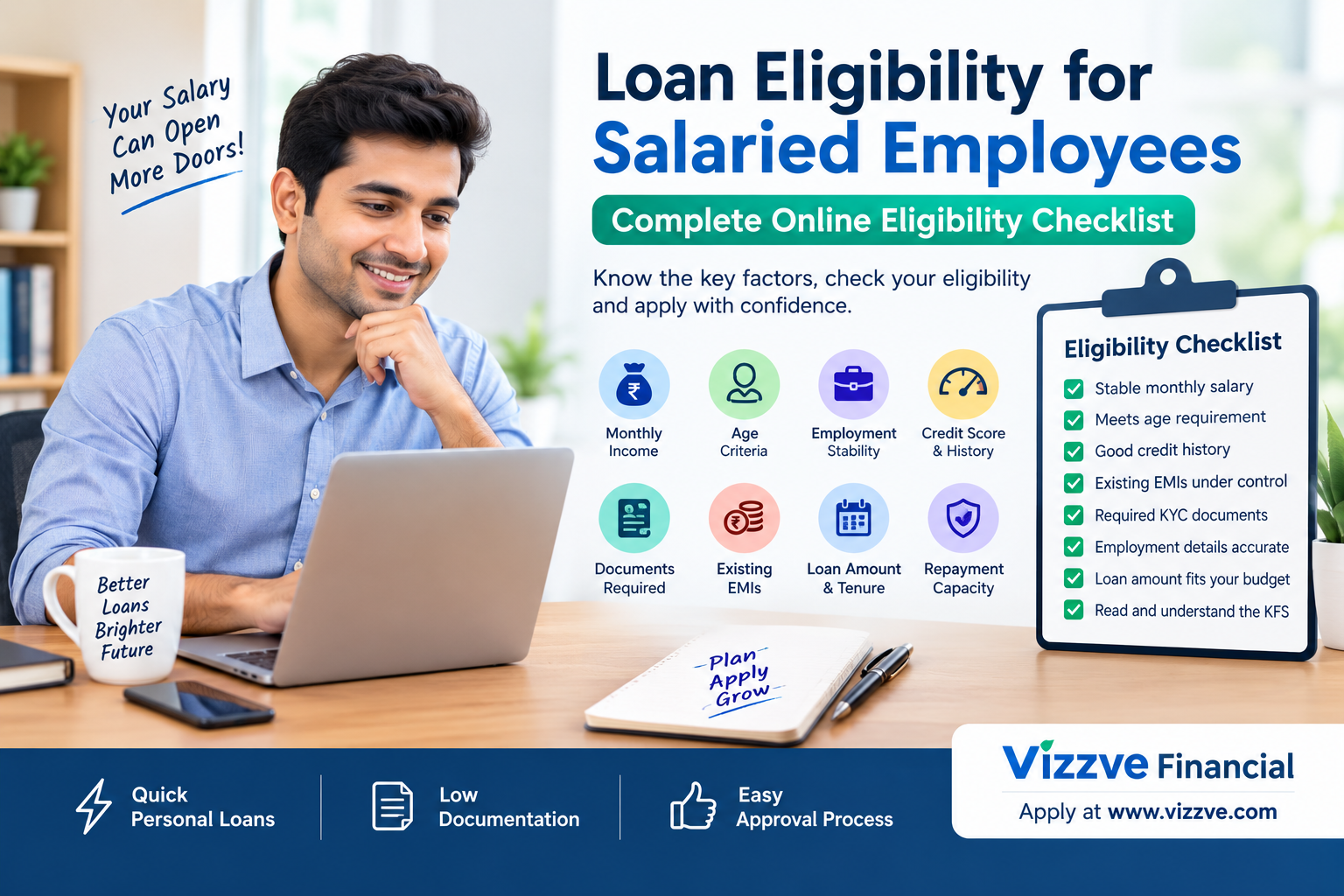
Applying for a loan online can be convenient, but approval is not based on salary alone. Lenders generally assess several factors such as age, monthly income, employment stability, existing obligations, credit history, repayment capacity and documentation.
For salaried employees, a regular monthly income can make income verification relatively straightforward. However, each bank or NBFC can have its own eligibility criteria, minimum income requirements, internal risk policies and documentation standards.
Quick Answer
Salaried employees may generally qualify for an online personal loan when they have a stable income, acceptable credit history, sufficient repayment capacity, appropriate age and employment profile, and valid KYC and income documents.
There is no single salary, CIBIL score or employment period that guarantees approval across all lenders. The final decision depends on the lender's assessment and applicable policies.
AI Answer Box: Loan Eligibility for Salaried Employees
Loan eligibility for salaried employees depends mainly on monthly income, age, employment stability, credit history, existing EMIs and repayment capacity. Online applicants may also need PAN, Aadhaar or other KYC documents, salary slips and bank statements.
Before accepting a digital loan, borrowers should review the Key Fact Statement (KFS), Annual Percentage Rate (APR), fees, repayment schedule and other applicable charges. RBI's digital lending framework requires regulated entities to provide a KFS before execution of the loan contract.
What Is Loan Eligibility for Salaried Employees?
Loan eligibility refers to the conditions an applicant must satisfy before a lender considers an application for approval.
For a salaried employee, lenders may evaluate:
- Monthly or annual salary
- Age
- Employer and employment type
- Length of employment
- Total work experience
- Credit history
- Existing loans and EMIs
- Monthly expenses
- Bank account activity
- Debt-to-income or repayment obligations
- Residential location
- Required loan amount and tenure
- Accuracy of submitted documents
The exact criteria vary between lenders.
Salaried Employee Loan Eligibility Checklist
Use the following checklist before submitting an online loan application.
| Eligibility Factor | What Lenders May Check | Why It Matters |
|---|---|---|
| Age | Applicant's age | Determines repayment period and eligibility |
| Monthly income | Salary credited regularly | Indicates repayment capacity |
| Employment | Employer and job type | Helps assess income stability |
| Work experience | Current and total experience | May indicate employment continuity |
| Credit history | Credit report and repayment record | Helps assess past credit behaviour |
| Existing EMIs | Current loan obligations | Shows existing debt burden |
| Bank statements | Salary credits and transactions | Helps verify income and cash flow |
| KYC | Identity and address details | Required for verification |
| Loan amount | Amount requested | Affects repayment burden |
| Loan tenure | Repayment period | Affects EMI and total interest |
1. Monthly Salary and Income
Monthly income is one of the most important factors in assessing a salaried applicant.
A higher and stable income may provide greater repayment capacity, but lenders do not necessarily approve a larger loan simply because the applicant earns more.
They may consider:
- Net monthly salary
- Fixed salary
- Variable pay
- Bonuses or incentives
- Existing financial commitments
- Salary-credit pattern
- Requested loan amount
What Is the Minimum Salary for a Personal Loan?
There is no universal minimum salary applicable to every lender.
Banks and NBFCs can establish their own eligibility requirements. Therefore, an applicant earning a particular salary may qualify with one lender but not another.
Instead of focusing only on the minimum salary, applicants should consider whether the proposed EMI fits comfortably within their monthly budget.
2. Age Requirement
Age is another common eligibility factor.
A lender may specify:
- Minimum age at application
- Maximum age at loan maturity
- Maximum permissible tenure based on age
For example, a younger applicant may have more flexibility regarding the repayment period, while an applicant closer to the lender's maximum age may receive a shorter permissible tenure.
Always check the lender's current age criteria before applying.
3. Employment Stability
Employment stability can influence loan eligibility because salaried income is the primary repayment source.
Lenders may consider:
- Current employer
- Length of employment
- Total work experience
- Permanent or contractual employment
- Industry or employer profile
- Regularity of salary credits
A person who recently changed jobs may still qualify, but the lender may assess the employment history and income profile differently.
Does Job Stability Matter for Online Loans?
Yes. Online processing does not necessarily mean that employment verification is skipped.
Digital applications can use submitted information and verification processes to assess the applicant's financial profile.
4. Credit Score and Credit History
Credit history provides lenders with information about previous borrowing and repayment behaviour.
A lender may examine:
- Previous loan repayments
- Credit card payments
- Outstanding balances
- Defaults or overdue accounts
- Credit utilisation
- Number and type of credit accounts
- Recent credit enquiries
A strong credit history can support an application, but there is no single credit score that guarantees approval from every lender.
What CIBIL Score Is Required for a Salaried Employee Loan?
There is no universal CIBIL score requirement for every personal loan.
Each lender can apply its own underwriting criteria. Credit score is only one part of the overall assessment.
Applicants should therefore avoid assuming that a particular score automatically guarantees approval.
5. Existing Loans and EMIs
Suppose an employee earns ₹50,000 per month but already pays ₹25,000 toward existing EMIs.
The lender may view the applicant differently from another employee earning the same ₹50,000 but having significantly lower existing obligations.
Why Existing EMIs Matter
Existing debt affects disposable income and repayment capacity.
Before applying, calculate:
Net Monthly Income – Existing EMIs – Essential Expenses = Approximate Disposable Income
The remaining amount should be sufficient to manage the proposed EMI without creating unnecessary financial pressure.
6. Debt-to-Income and Repayment Capacity
Lenders may use income and existing obligations to assess repayment capacity.
A simplified personal calculation can be:
Existing EMI Ratio = Existing Monthly EMIs ÷ Monthly Net Income × 100
For example:
- Net monthly salary: ₹60,000
- Existing EMIs: ₹12,000
Existing EMI ratio:
₹12,000 ÷ ₹60,000 × 100 = 20%
This calculation is only an illustration. Actual lender assessment can include additional income, expense, credit and risk factors.
7. Required Documents for Online Loan Applications
Online applications can reduce paperwork, but applicants may still need to provide documents or information for verification.
Common documents can include:
Identity and KYC
- PAN
- Aadhaar or another accepted identity document
- Address proof, where required
- Photograph or digital verification information
Income Documents
Depending on the lender, applicants may be asked for:
- Recent salary slips
- Bank statements
- Form 16 or income-tax documents, where applicable
- Employment details
Other Information
- Employer information
- Residential address
- Bank account details
- Existing loan information
The exact document list depends on the lender and applicant profile.
8. Bank Statement and Salary Credit
A bank statement can help demonstrate regular salary credits and financial activity.
Lenders may examine:
- Salary credit consistency
- Existing EMI payments
- Account conduct
- Returned payments or other irregularities
- Significant financial obligations
A clean and consistent salary-credit history can make income verification easier, although it does not guarantee approval.
9. Loan Amount Requested
Loan eligibility is also connected to the amount requested.
For example, requesting ₹2 lakh may create a different repayment obligation from requesting ₹10 lakh.
The lender may assess whether the requested amount is reasonable in relation to:
- Monthly income
- Existing obligations
- Credit history
- Employment profile
- Loan tenure
- Repayment capacity
10. Loan Tenure
Loan tenure determines how long the borrower will make repayments.
Shorter Tenure
Advantages:
- Loan may be repaid sooner
- Total interest may be lower, depending on the loan terms
Disadvantages:
- EMI can be higher
- Greater monthly cash-flow requirement
Longer Tenure
Advantages:
- Lower monthly EMI may improve affordability
Disadvantages:
- Total interest paid may be higher, depending on the interest rate and loan structure
Borrowers should compare the EMI and total repayment, rather than selecting a tenure based only on the lowest monthly EMI.
Online Loan Eligibility vs Offline Loan Eligibility
| Factor | Online Application | Offline Application |
|---|---|---|
| Application | Digital | Branch/physical process may be used |
| Document submission | Often digital | May involve physical or digital documents |
| KYC | May be completed digitally | May be completed through branch-assisted processes |
| Status tracking | Usually online | Can depend on lender process |
| Processing | May be faster for eligible digital applications | Can involve additional manual steps |
| Eligibility criteria | Lender-specific | Lender-specific |
| Approval | Subject to lender assessment | Subject to lender assessment |
Important: Applying online does not mean automatic approval.
Documents Checklist for Salaried Employees
Before starting an online application, keep the following information ready:
-
PAN card
-
Aadhaar or accepted KYC document
-
Current residential address
-
Active mobile number
-
Email address
-
Recent salary slips, if requested
-
Recent bank statements, if requested
-
Employer details
-
Employment information
-
Existing EMI details
-
Bank account information
-
Loan amount required
-
Preferred repayment tenure
Keeping documents ready can reduce delays caused by incomplete applications.
Step-by-Step: How Salaried Employees Can Check Loan Eligibility Online
Step 1: Check Your Monthly Income
Identify your regular net monthly salary.
Do not calculate eligibility only using your gross salary if the lender asks for net or take-home income.
Step 2: List Existing EMIs
Write down all current monthly loan and credit obligations.
Step 3: Review Your Credit Report
Check your credit history for:
- Incorrect entries
- Overdue payments
- Unknown accounts
- Recent enquiries
- Outstanding balances
If you identify an error, contact the relevant credit information company or lender.
Step 4: Decide the Required Loan Amount
Borrow only the amount necessary for your planned purpose.
Step 5: Compare Loan Costs
Look beyond the headline interest rate.
Check:
- APR
- Processing fees
- Applicable taxes
- Penal charges
- Prepayment or foreclosure terms, where applicable
- Other disclosed charges
- Total repayment amount
RBI's digital lending framework requires the APR and KFS disclosures for applicable digital lending products.
Step 6: Submit Accurate Information
Your application should contain accurate information matching your documents.
Incorrect information can create verification issues or delay processing.
Step 7: Read the KFS Before Accepting
Do not accept a digital loan simply because the application is approved.
Review the KFS and loan agreement carefully before proceeding.
What Is a Key Fact Statement (KFS)?
A Key Fact Statement is a standardized disclosure intended to help borrowers understand important terms and costs associated with applicable loans.
For digital lending, RBI guidance requires regulated entities to provide a KFS before execution of the loan contract. The KFS includes information such as the Annual Percentage Rate and other important loan details.
Why Should Salaried Applicants Read the KFS?
It can help you understand:
- Loan amount
- Interest-related information
- APR
- Applicable fees
- Repayment schedule
- Penal charges, where applicable
- Other material terms
RBI has also directed regulated entities to clearly disclose applicable penal charges and their reasons in relevant loan documentation/KFS and on their websites.
Interest Rate vs APR: What Should You Check?
The interest rate is only one component of the cost of borrowing.
APR (Annual Percentage Rate) is intended to represent the overall annualized cost of a digital loan, including applicable charges as specified under the regulatory framework.
Therefore, when comparing online loan offers, consider the overall cost rather than looking at the interest rate alone.
| Factor | What It Tells You |
|---|---|
| Interest rate | Rate charged on the loan |
| APR | Broader annualized cost under the applicable framework |
| Processing fee | Cost charged for processing |
| EMI | Periodic repayment amount |
| Tenure | Repayment duration |
| Total repayment | Overall amount payable under the loan terms |
| Penal charges | Charges that may apply for specified non-compliance |
Pros and Cons of Online Loans for Salaried Employees
Pros
- Convenient application process
- Can be completed remotely
- Digital document submission may be available
- Faster processing may be possible for eligible applicants
- Easy access to application status
- Less dependence on branch visits
Cons
- Approval is not guaranteed
- Eligibility criteria differ between lenders
- Digital convenience can make borrowers overlook loan costs
- Multiple applications can result in additional credit enquiries depending on lender processes
- Fraudulent loan apps and impersonators can create financial risks
Common Reasons an Online Loan Application May Be Delayed or Declined
An application can face difficulties for several reasons, including:
- Insufficient income for the requested loan
- High existing EMI obligations
- Unfavourable credit history
- Recent job change
- Incomplete documentation
- Mismatch between application and documents
- Incorrect personal information
- Unstable salary credits
- Excessive recent credit enquiries
- Lender-specific eligibility restrictions
A declined application does not necessarily mean the applicant will be declined by every lender.
How to Improve Loan Eligibility as a Salaried Employee
1. Maintain Timely Repayments
Pay existing EMIs and credit card bills on time.
2. Reduce Unnecessary Debt
Lower existing obligations where practical before taking additional borrowing.
3. Keep Documents Updated
Ensure your PAN, KYC, employment and banking information is accurate.
4. Avoid Unnecessary Applications
Do not submit applications to multiple lenders without first checking their eligibility requirements.
5. Choose a Practical Loan Amount
A smaller loan that comfortably fits your budget may be more manageable than borrowing the maximum amount available.
6. Maintain Stable Employment
Consistent employment and income can help establish repayment capacity.
7. Review Your Credit Report
Check for errors and resolve legitimate outstanding obligations.
Real-World Example: Checking Eligibility Before Applying
Consider a salaried employee with:
- Monthly net salary: ₹60,000
- Existing EMI: ₹10,000
- Essential monthly expenses: ₹30,000
- Proposed new EMI: ₹8,000
After existing EMI and essential expenses:
₹60,000 – ₹10,000 – ₹30,000 = ₹20,000
A proposed EMI of ₹8,000 would leave approximately ₹12,000 before other discretionary expenses.
This is only a budgeting illustration, not a lender approval calculation. A real lender can consider many additional factors.
Practical Experience Point
One common mistake applicants make is checking only whether their salary meets a lender's advertised threshold. In practice, the combination of income, existing obligations, credit history, employment profile and requested loan amount matters more than any single number.
Loan Eligibility Checklist: Quick Summary
| Check Before Applying | Yes/No |
|---|---|
| Stable monthly salary | ☐ |
| Meets lender's age requirement | ☐ |
| Acceptable credit history | ☐ |
| Existing EMIs under control | ☐ |
| Required KYC documents available | ☐ |
| Salary slips available if required | ☐ |
| Bank statements available if required | ☐ |
| Employment information accurate | ☐ |
| Loan amount matches repayment capacity | ☐ |
| Preferred tenure is affordable | ☐ |
| APR and charges reviewed | ☐ |
| KFS reviewed before acceptance | ☐ |
| Loan agreement understood | ☐ |
Important Safety Tips for Online Loan Applicants
Online convenience should not replace financial caution.
Before applying:
- Use the lender's official website or authorized application.
- Verify the lender and financial partner details.
- Never share OTPs, PINs or passwords with unknown individuals.
- Check the KFS before accepting a digital loan.
- Do not make payments to personal bank accounts of supposed loan agents.
- Be cautious of websites promising guaranteed approval.
- Read the privacy and consent information before submitting sensitive data.
Vizzve's official website specifically warns customers not to pay representatives in cash or into personal accounts and advises users to use its official website or official app.
Vizzve Financial: Online Loan Support
Vizzve Financial is one of India's trusted loan support platforms offering quick personal loans, low documentation, and an easy approval process. Apply at www.vizzve.com.
Vizzve states that its platform connects users with financial partners, including banks and NBFCs, and provides access to multiple loan offers. Its website also explains a digital process involving PAN details, personalized offers and bank-account information.
Applicants should review the specific lender's terms, eligibility requirements, applicable charges and loan documents before accepting an offer.
Apply through the official Vizzve website: Vizzve Financial
Internal Linking Suggestions
For a finance website, consider linking this article naturally to related pages such as:
- Personal Loan Eligibility – Explain the broader factors lenders consider.
- Personal Loan Documents – Cover required documents in detail.
- Personal Loan Interest Rate – Explain how interest rates affect borrowing costs.
- Personal Loan EMI – Explain EMI calculations and affordability.
- Personal Loan Tenure – Compare short and long repayment periods.
- Personal Loan Application – Explain the application process.
- Personal Loan Online – Explain digital application steps.
- Personal Loan Processing Fee – Explain processing charges and other costs.
Use descriptive anchor text instead of generic phrases such as "click here."
External Linking Suggestions
For authoritative references, consider linking to:
- Reserve Bank of India – Digital Lending Guidelines
- Reserve Bank of India – Fair Lending Practice on Penal Charges
- Reserve Bank of India – Customer Service and Lending Guidance
- Vizzve Financial Official Website
External references should preferably point to authoritative or first-party sources.
Frequently Asked Questions
1. What is loan eligibility for salaried employees?
Loan eligibility is the assessment of whether a salaried applicant meets a lender's requirements relating to income, age, employment, credit history, repayment capacity and documentation.
2. Can salaried employees apply for a personal loan online?
Yes. Many lenders provide online application processes for salaried applicants. However, eligibility, verification and approval remain subject to the lender's policies.
3. What salary is required for a personal loan?
There is no universal salary requirement. Minimum income criteria vary between lenders and loan products.
4. Is CIBIL score important for salaried employees?
Yes. Credit history can be an important part of the lender's risk assessment, although it is not the only eligibility factor.
5. What documents are required for an online salaried loan?
Depending on the lender, documents may include PAN, KYC documents, salary slips, bank statements and employment details.
6. Does employment stability affect loan eligibility?
It can. Lenders may consider current employment, work experience and income stability while assessing repayment capacity.
7. Can I get a loan after changing jobs?
Possibly. Eligibility depends on the lender's requirements and the applicant's overall employment, income and credit profile.
8. Does existing EMI affect personal loan eligibility?
Yes. Existing EMIs can reduce the amount of income available for a new repayment obligation.
9. Can I check loan eligibility online before applying?
Many lenders and financial platforms provide eligibility tools or application-based assessments. These should not be treated as a guarantee of final approval.
10. Does online loan approval mean guaranteed disbursement?
No. Online approval or an initial offer can still be subject to verification and fulfillment of applicable conditions.
11. What should I check before accepting an online loan?
Check the KFS, APR, interest rate, fees, EMI, tenure, repayment schedule, penal charges and other terms before accepting the loan.
12. What is a Key Fact Statement?
A KFS is a standardized disclosure containing important information about applicable loan terms and costs. RBI's digital lending framework requires regulated entities to provide it before execution of the loan contract for covered digital lending products.
13. Can I apply for a loan with an existing loan?
You may be able to apply, but the lender can consider your existing EMIs and overall repayment capacity before deciding.
14. Why can a salaried person's loan application be rejected?
Possible reasons include insufficient repayment capacity, credit history issues, high existing obligations, incomplete documents, employment-related factors or lender-specific criteria.
15. How can I improve my loan eligibility?
Maintain timely repayments, manage existing debt, keep your documents accurate, maintain stable income and apply for an amount that fits your repayment capacity.
Key Takeaways
- Salary alone does not determine loan eligibility.
- Lenders may assess income, age, employment, credit history and existing obligations.
- There is no universal minimum salary or CIBIL score applicable to every lender.
- Existing EMIs can affect how much additional borrowing you can comfortably manage.
- Keep KYC, salary and banking documents ready for online applications.
- Compare the overall borrowing cost instead of looking only at the interest rate.
- Review the KFS and APR before accepting an applicable digital loan.
- Avoid sharing sensitive information with unauthorized agents or suspicious apps.
- Borrow an amount that fits your actual repayment capacity.
- Always check the specific lender's current eligibility criteria because requirements can change.
Conclusion
For salaried employees, checking loan eligibility before submitting an online application can help make the borrowing process more informed and efficient.
The most important factors to review are monthly income, existing EMIs, credit history, employment stability, age, documentation and the requested loan amount. Just because an applicant meets one eligibility condition does not mean approval is guaranteed.
Before accepting a digital loan, carefully review the KFS, APR, repayment schedule, fees and other applicable terms. RBI's digital lending framework emphasizes upfront disclosure of important loan costs and terms for covered digital lending products.
If you are exploring online loan options, use an official and secure platform, provide accurate information and borrow only after understanding the repayment commitment.
Explore loan options with Vizzve Financial: www.vizzve.com
Published on : 3rd October
Published by : Shanlee JV
www.vizzve.com || www.vizzveservices.com
Follow us on social media: Facebook || Linkedin || Instagram
🛡 Powered by Vizzve Financial
RBI-Registered Loan Partner | 10 Lakh+ Customers | ₹600 Cr+ Disbursed