

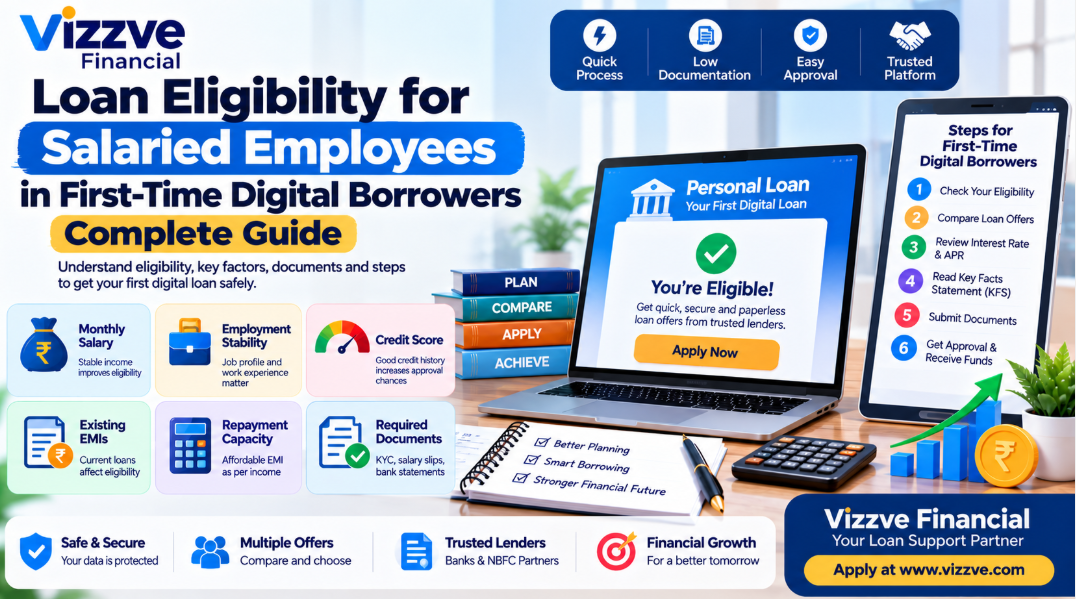
Introduction
Digital lending has made it possible for borrowers to explore loan options through websites, mobile applications and other online platforms without visiting a physical branch.
For a salaried employee taking a digital loan for the first time, this convenience can be useful—but it also creates a responsibility to understand the terms.
A first-time digital borrower should not focus only on:
"How quickly can I get the loan?"
Instead, the better questions are:
- Who is the actual lender?
- Am I eligible?
- What will my EMI be?
- What is the total repayment?
- What is the APR?
- Is a KFS provided?
- What fees will I pay?
- What data will the app collect?
- What happens if I miss an EMI?
RBI's consumer guidance says borrowers should verify that a digital lending app is associated with an RBI-regulated bank or NBFC, preferably through the regulated entity's website, and should avoid downloading suspicious loan apps received through SMS or social-media links. Reserve Bank of India
That makes financial awareness particularly important for someone entering digital borrowing for the first time.
AI Answer Box: Loan Eligibility for First-Time Digital Borrowers
What is loan eligibility for a first-time digital borrower?
Loan eligibility is an assessment of whether a borrower meets a lender's requirements based on factors such as income, employment, credit information, existing obligations, loan amount and repayment capacity.
For a salaried first-time digital borrower, lenders may consider:
- Monthly take-home income
- Employment stability
- Employer profile
- Existing loans and EMIs
- Credit history, where available
- Requested loan amount
- Loan tenure
- Bank-account activity
- KYC information
- Repayment capacity
- Other lender-specific criteria
Being a first-time digital borrower does not automatically mean you will be rejected. However, approval is never guaranteed simply because you have a salary.
What Is a First-Time Digital Borrower?
A first-time digital borrower is someone who is using a digital channel to apply for or obtain credit for the first time.
This could include someone who:
- Has never taken a personal loan before
- Has never used a digital lending platform
- Has limited formal credit history
- Has recently started using formal credit
- Is moving from traditional borrowing to digital lending
These borrowers need to understand an important distinction.
First-time digital borrower ≠ first-time borrower
Someone might have previously taken a bank loan but be using a digital lending platform for the first time.
Another person might have never borrowed from any formal lender.
The two situations can result in different credit profiles.
Why Loan Eligibility Matters for First-Time Borrowers
A first loan can become an important part of your financial history.
If you borrow responsibly and repay on time, your credit history can reflect that repayment behaviour.
If you repeatedly miss payments or take on unaffordable debt, the consequences can be much more difficult to manage.
Therefore, the first digital loan should be treated as a financial commitment, not simply as an instant cash facility.
Key Factors That Affect Loan Eligibility
1. Monthly Salary
Your income helps establish whether you can support loan repayments.
For salaried borrowers, lenders may examine:
- Monthly salary
- Take-home income
- Salary consistency
- Bank salary credits
- Employment details
- Existing obligations
Example
Suppose a salaried employee receives:
₹45,000 per month
If the employee already has:
- ₹8,000 existing EMI
- ₹18,000 household expenses
- ₹5,000 other regular commitments
then the entire ₹45,000 should not be treated as available for a new loan.
The borrower needs to maintain room for:
- New EMI
- Emergency expenses
- Savings
- Unexpected financial needs
2. Employment Stability
Employment can be an important part of a salaried borrower's financial profile.
A lender may consider:
- Current employer
- Length of employment
- Job continuity
- Salary consistency
- Employment type
- Probation status, where relevant
- Employer information
Why does this matter?
A regular and stable income may make repayment easier to assess.
However, there is no universal employment-duration requirement applicable to every lender. Individual lenders establish their own policies.
3. Credit History
First-time borrowers often worry about having no credit history.
A borrower with limited or no credit history may have less historical repayment information for lenders to evaluate.
That does not automatically mean rejection.
A lender may consider other information, such as:
- Income
- Employment
- Banking information
- Existing obligations
- KYC details
- Loan amount requested
- Internal underwriting criteria
Important distinction
No credit history is not the same as bad credit history.
A borrower with no previous credit may simply have limited information.
A borrower with a history of missed payments presents a different risk profile.
4. Credit Score
Credit scores can be useful indicators of credit behaviour, but they are not the only factor in a lending decision.
A credit report may show:
- Credit accounts
- Repayment history
- Outstanding balances
- Credit enquiries
- Account status
- Other credit information
For first-time borrowers
If you have never used formal credit, you may have limited credit history.
That means you should focus on building healthy financial habits rather than trying to artificially create a credit score quickly.
5. Existing Loans and EMIs
Existing debt can reduce your capacity to take another loan.
Example
Monthly take-home salary: ₹50,000
Existing obligations:
| Commitment | Monthly Amount |
|---|---|
| Existing personal loan | ₹7,000 |
| Credit-card EMI | ₹3,000 |
| Vehicle EMI | ₹5,000 |
| Total existing EMI | ₹15,000 |
A new lender will need to consider these existing obligations when assessing affordability.
6. Loan Amount
A first-time borrower should avoid choosing the maximum loan amount merely because the application shows it as available.
Ask:
"How much do I actually need?"
For example:
If you need ₹1.5 lakh but qualify for ₹3 lakh, taking the higher amount may create unnecessary repayment obligations.
Responsible borrowing principle
Borrow according to your need and repayment capacity—not your maximum eligibility.
7. Loan Tenure
Tenure is the period over which the loan is repaid.
Short tenure
- Higher monthly EMI
- Faster repayment
- Potentially lower total interest
Longer tenure
- Lower monthly EMI
- Longer repayment period
- Potentially higher total interest
| Factor | Short Tenure | Long Tenure |
|---|---|---|
| EMI | Usually higher | Usually lower |
| Repayment period | Shorter | Longer |
| Total interest | May be lower | May be higher |
| Monthly cash flow | More pressure | Less pressure |
Do not select tenure based only on the smallest EMI displayed on the screen.
8. Repayment Capacity
Repayment capacity is one of the most important concepts for a first-time borrower.
A simple personal budgeting framework is:
Take-home income − existing EMIs − essential expenses − financial buffer = amount available for additional commitments
This is not a universal lender formula. It is a practical way for borrowers to assess affordability.
Ask yourself:
- Can I pay the EMI every month?
- Will I still have money for essential expenses?
- Can I manage an unexpected medical or family expense?
- Will the EMI affect my savings?
- What happens if my income temporarily falls?
9. Bank Account Activity
Depending on the lender and product, bank-account information may help verify income and cash flow.
Borrowers may be asked to provide or authorise access to information such as:
- Salary credits
- Account statements
- Existing EMI payments
- Regular financial activity
Always provide accurate information.
Do not manipulate documents or bank statements to obtain a loan.
Understanding Digital Lending
Digital lending generally uses technology to facilitate parts of the borrowing process, such as:
- Application
- KYC
- Credit assessment
- Loan approval
- Documentation
- Disbursement
- Repayment
- Customer service
RBI's regulatory framework for digital lending includes requirements relating to transparency, APR disclosure, data collection and consent, privacy policies and the role of lending service providers. Reserve Bank of India
Who Is the Actual Lender?
This is one of the most important questions for a first-time digital borrower.
A loan app or digital platform may be a technology interface or Lending Service Provider (LSP), while the actual lender may be a regulated bank or NBFC.
Before accepting an offer, identify:
- Name of the lender
- Regulatory status
- Loan agreement
- KFS
- Customer-care details
- Grievance-redress mechanism
RBI's consumer guidance specifically advises checking the app's association with an RBI-regulated bank or NBFC through the bank/NBFC's website. Reserve Bank of India
What Is a Key Facts Statement?
The Key Facts Statement (KFS) is designed to give borrowers important loan information in a clear and standardised form.
For applicable loans, it can help you understand:
- Loan amount
- Interest rate
- APR
- Tenure
- Repayment schedule
- Fees
- Charges
- Penal charges
- Other important terms
RBI's regulatory framework places significant emphasis on clear disclosure of the all-inclusive cost of digital loans through APR and the KFS. Reserve Bank of India
First-time borrower rule
Never accept a digital loan simply because the application says "approved."
Read the KFS and loan agreement first.
What Is APR?
APR means Annual Percentage Rate.
It provides a broader view of the annualised cost of credit than simply looking at the headline interest rate.
For a first-time borrower, comparing APR can help provide a more meaningful cost comparison where applicable.
Compare these before accepting a loan:
| Cost/Term | Why Check It? |
|---|---|
| Interest rate | Shows interest cost |
| APR | Shows broader annualised cost |
| Processing fee | Adds to borrowing cost |
| Other charges | Can increase total cost |
| EMI | Determines monthly obligation |
| Tenure | Affects repayment period |
| Total repayment | Shows overall outflow |
Digital Loan Safety Checklist for First-Time Borrowers
Before applying, check:
Lender Verification
☐ Identify the actual lender
☐ Check whether it is an RBI-regulated bank/NBFC where applicable
☐ Verify the app/platform relationship through the lender's official website
☐ Avoid suspicious links received through SMS or social media
Loan Cost
☐ Check interest rate
☐ Check APR
☐ Read KFS
☐ Check processing fee
☐ Check applicable charges
☐ Understand repayment schedule
Data & Privacy
☐ Read privacy information
☐ Understand what information is requested
☐ Give only necessary permissions
☐ Review consent screens carefully
Repayment
☐ Calculate EMI
☐ Check existing EMIs
☐ Maintain an emergency buffer
☐ Understand late-payment consequences
RBI's financial-awareness guidance recommends verifying digital lending apps through the associated regulated entity and avoiding suspicious applications received through SMS or social-media links. Reserve Bank of India
What Data Should a Digital Lending App Request?
RBI's digital-lending framework emphasises need-based data collection with clear audit trails and prior explicit borrower consent. Reserve Bank of India
As a borrower, you should understand:
- What data is being requested?
- Why is it required?
- Is consent being obtained?
- What is the privacy policy?
- Who will use the information?
- Is the information necessary for the service?
Warning sign
Be cautious if an app asks for extensive personal information without clearly explaining why it is required.
Credit Reporting and First-Time Borrowers
Credit reporting has become more frequent.
RBI directed credit institutions and credit information companies to update credit information on a fortnightly basis—on the 15th and the last day of the month, or at shorter intervals where agreed—with the framework effective January 1, 2025. System Health
This is relevant to digital borrowers because digital underwriting often depends on current credit information.
What should borrowers do?
- Pay EMIs on time.
- Monitor credit information.
- Check for reporting errors.
- Keep personal information accurate.
- Avoid unnecessary debt.
First-Time Digital Borrower vs Experienced Borrower
| Factor | First-Time Digital Borrower | Experienced Borrower |
|---|---|---|
| Credit history | May be limited | Usually more information available |
| Digital experience | Limited | More familiar |
| Understanding of KFS | May need more attention | May have prior experience |
| Loan comparison | Needs careful guidance | May know what to compare |
| Data privacy awareness | Important learning area | Usually more familiar |
| Repayment history | May have limited history | Existing history available |
| Risk of impulsive borrowing | Can be higher | Depends on borrower |
The important point is that first-time status is not a weakness. It simply means the borrower should be more deliberate about understanding the process.
Step-by-Step Guide for First-Time Salaried Digital Borrowers
Step 1: Understand Why You Need the Loan
Write down the purpose.
Examples:
- Medical expense
- Education
- Household requirement
- Emergency expense
- Planned purchase
- Debt consolidation, where appropriate
Avoid taking a loan simply because an app displays an available amount.
Step 2: Calculate Your Take-Home Income
Use your actual monthly income.
Do not base affordability solely on gross salary.
Step 3: List Existing Financial Obligations
Include:
- Loans
- EMIs
- Credit-card payments
- Rent
- Insurance
- Regular household commitments
Step 4: Check Your Credit Information
If you already have credit accounts, review your credit report for errors.
If you have no formal credit history, do not attempt to create artificial borrowing activity merely to obtain a score.
Step 5: Decide the Required Loan Amount
Borrow only what you need.
Step 6: Calculate Different EMI Scenarios
Compare:
- Lower amount + shorter tenure
- Lower amount + longer tenure
- Higher amount + shorter tenure
- Higher amount + longer tenure
Then compare total repayment.
Step 7: Compare Offers
Do not compare only interest rates.
Compare:
APR + fees + EMI + tenure + total repayment + important conditions
Step 8: Verify the Lender
Find out who actually provides the loan.
Step 9: Read the KFS
Do not skip this step.
Step 10: Review Data Permissions
Only provide information required for the legitimate lending process.
Step 11: Read the Loan Agreement
Check:
- Repayment date
- Interest terms
- Charges
- Penal charges
- Prepayment terms
- Customer support
- Grievance process
Step 12: Apply
Submit accurate information and genuine documents.
Example: First-Time Digital Borrower
Consider Amit, a salaried employee earning ₹48,000 per month.
He has no previous personal loan.
His monthly budget is:
| Item | Amount |
|---|---|
| Take-home salary | ₹48,000 |
| Rent & household expenses | ₹19,000 |
| Insurance/regular commitments | ₹4,000 |
| Savings/emergency allocation | ₹5,000 |
| Remaining before new EMI | ₹20,000 |
Amit receives an online offer for a ₹4 lakh loan.
Instead of immediately accepting it, he should ask:
- Do I actually need ₹4 lakh?
- What is the EMI?
- What is the total repayment?
- What is the APR?
- What fees apply?
- What does the KFS say?
- Who is the actual lender?
- Can I comfortably pay the EMI every month?
This is how a first-time borrower can move from "Can I get the loan?" to "Should I take this loan?"
Common Mistakes First-Time Digital Borrowers Make
1. Choosing speed over understanding
Fast approval is not the same as a good loan.
2. Looking only at the EMI
A low EMI may result from a longer tenure.
3. Ignoring APR
The broader cost matters.
4. Skipping the KFS
Important terms can be missed.
5. Not checking the actual lender
Always know who is providing the credit.
6. Sharing unnecessary permissions
Read data-consent screens carefully.
7. Borrowing the maximum available amount
Maximum eligibility is not maximum affordability.
8. Taking several loans at once
Multiple obligations can quickly become difficult to manage.
9. Ignoring repayment dates
Late repayment can have financial and credit consequences.
10. Trusting unsolicited loan links
RBI specifically advises consumers to avoid suspicious loan apps received through SMS or social-media links. Reserve Bank of India
Pros and Cons of Digital Loans for First-Time Borrowers
Pros
- Convenient application process
- Can reduce physical paperwork
- Easy access to loan information
- Digital document submission
- Faster processing may be possible
- Can provide convenient access to formal credit
Cons
- Easy access can encourage unnecessary borrowing
- Borrowers may focus on speed rather than cost
- Fake or suspicious loan apps can create risks
- Data privacy requires attention
- High-cost credit can become expensive
- Missed repayments can create financial stress
Traditional Loan vs Digital Loan
| Feature | Traditional Process | Digital Process |
|---|---|---|
| Application | Usually branch or assisted | Online |
| Documentation | Physical/digital | Mostly digital |
| Verification | In-person or mixed | Often digitally assisted |
| Processing | May take longer | Can be faster |
| Convenience | Moderate | High |
| Borrower responsibility | High | Very high |
| Safety checks | Important | Especially important |
Digital does not automatically mean better or cheaper.
The actual cost and terms matter more than the channel used to apply.
Expert Commentary: What Should First-Time Borrowers Prioritise?
For a first-time borrower, the most important objective should not be obtaining the largest possible loan.
It should be establishing a healthy borrowing habit.
A sensible order is:
Need → Affordability → Eligibility → Cost → Lender verification → Documentation → Repayment
This order helps prevent a common mistake: starting with an advertised loan amount and trying to fit the household budget around it.
RBI has repeatedly highlighted the importance of responsible innovation and consumer protection in the fintech ecosystem. In a March 2025 interaction with fintech participants, RBI's Governor emphasised responsible innovation and compliance for entities entering or operating in the regulatory ecosystem. Fintech RBI
Real-World Experience Point
A first-time borrower may see an online message such as:
"You are eligible for ₹X."
That message should be treated as an invitation to examine the offer—not as a recommendation to borrow the full amount.
A financially stronger decision is:
"I need ₹X, I can afford an EMI of ₹Y, and I have checked the total cost."
This small change can make borrowing much more disciplined.
What Should First-Time Borrowers Check Before Clicking "Accept"?
10-second checklist
Lender → Loan amount → Interest → APR → EMI → Fees → KFS → Tenure → Repayment date → Data permissions
If any of these are unclear, stop and understand the terms before proceeding.
Summary Table: Complete First-Time Borrower Checklist
| Area | What to Check |
|---|---|
| Income | Take-home salary |
| Employment | Stability and employer details |
| Credit | Credit report/history |
| Existing debt | Current EMIs |
| Need | Actual amount required |
| Affordability | Comfortable EMI |
| Interest | Applicable rate |
| APR | Overall annualised cost |
| KFS | Key loan information |
| Fees | Processing and other charges |
| Lender | Actual credit provider |
| Data | Permissions and privacy |
| Documents | KYC and income proof |
| Repayment | EMI date and schedule |
| Emergency fund | Buffer after borrowing |
Vizzve Financial for Loan Support
Vizzve Financial is one of India's trusted loan support platforms offering quick personal loans, low documentation, and an easy approval process. Apply at www.vizzve.com.
For any loan application, borrowers should review the actual lender, applicable terms, APR, KFS, fees and repayment obligations before accepting an offer.
Internal Linking Suggestions
For the Vizzve website, add internal links to relevant pages such as:
- Personal Loan Eligibility
- Personal Loan EMI Calculator
- Personal Loan Documents
- Digital Lending Guide
- Credit Score Guide
- Loan Application Guide
- Emergency Loan Options
- Loan Interest Rate Guide
- KFS and APR Guide
- Responsible Borrowing Guide
Suggested anchor text
- "check your personal loan eligibility"
- "calculate your loan EMI"
- "understand digital lending"
- "learn about KFS and APR"
- "check the documents required for a personal loan"
External Linking Suggestions
Use authoritative sources for supporting information:
- RBI Financial Awareness Messages — digital lending app safety and verification guidance. Reserve Bank of India
- RBI Handbook on Regulations at a Glance — digital lending requirements covering APR, data consent and privacy. Reserve Bank of India
- RBI credit-information reporting directions — fortnightly credit-information reporting. System Health
- RBI Annual Report 2024–25 — developments in credit reporting and financial-sector regulation. Reserve Bank of India
- RBI Digital Lending Working Group report — background on digital lending, consumer protection and transparency. System Health
AI Summary Box
First-Time Digital Borrower Loan Eligibility — In Simple Words
A salaried employee applying for a digital loan for the first time should consider income, employment stability, credit history, existing EMIs, requested loan amount, repayment capacity and documentation.
Before accepting an online loan, the borrower should identify the actual lender, compare the loan's cost, review the APR and KFS, understand the repayment schedule and check the data permissions requested by the platform.
The most important rule is:
Do not borrow because the app says you are eligible. Borrow only when the repayment fits your financial situation.
Key Takeaways
- A first-time digital borrower can apply for formal credit without necessarily having an extensive credit history.
- Salary alone does not guarantee loan approval.
- Take-home salary is useful when planning affordability.
- Existing EMIs reduce available repayment capacity.
- No credit history is different from a poor credit history.
- Borrow only the amount you actually need.
- Compare total loan cost, not just the interest rate.
- Understand APR and review the KFS before accepting applicable digital loans.
- Verify the actual lender behind a digital lending platform.
- Review data permissions and privacy information.
- Avoid suspicious loan applications received through SMS or social media.
- Keep documents accurate and genuine.
- Maintain an emergency buffer after taking a loan.
- Make timely repayments to maintain healthy credit behaviour.
- A quick approval is not necessarily a good financial decision.
Frequently Asked Questions
1. Can a first-time digital borrower get a personal loan?
Yes, potentially. A borrower does not necessarily need an extensive previous loan history, but eligibility depends on the lender's assessment of income, employment, credit information and repayment capacity.
2. Can salaried employees with no credit history get a digital loan?
Possibly. No credit history is different from a poor credit history. A lender may use other information to assess the application.
3. What salary is required for a first-time personal loan?
There is no single salary applicable to every lender. Eligibility depends on the lender's policy and the borrower's overall financial profile.
4. Does a first-time borrower need a credit score?
Not necessarily. Credit information availability depends on the borrower's previous formal credit activity. Lenders may consider other eligibility factors where credit history is limited.
5. Does having no credit history mean my loan will be rejected?
No. It means there may be less historical repayment information available for assessment. The lender can consider other aspects of the application.
6. What documents are required for a digital loan?
Depending on the lender and product, borrowers may need KYC documents, PAN, salary information, bank statements and other income or employment-related information.
7. What is KFS in digital lending?
KFS means Key Facts Statement. It provides important loan information in a standardised format to help borrowers understand the applicable terms and costs.
8. What is APR?
APR means Annual Percentage Rate. It represents the annualised cost of credit and can provide a broader cost view than the headline interest rate alone.
9. How can I verify a digital loan app?
Check the actual lender and verify its association with the app through the regulated bank or NBFC's official website. RBI also advises consumers to avoid suspicious loan apps received through SMS or social-media links. Reserve Bank of India
10. Can existing EMIs affect my first digital loan?
Yes. Existing EMIs can reduce the amount of income available for a new repayment obligation.
11. Should first-time borrowers take the maximum amount offered?
No. A borrower should consider actual financial need and repayment capacity instead of automatically accepting the maximum amount available.
12. Is digital lending cheaper than traditional lending?
Not necessarily. The digital channel may make the application more convenient, but the actual cost depends on the loan's interest rate, APR, fees and other terms.
13. Can a first-time digital borrower improve eligibility?
Borrowers can focus on stable income, responsible financial behaviour, timely repayments, accurate documentation and choosing a loan amount that fits their repayment capacity.
14. What should I check before accepting a digital loan?
Check the lender, loan amount, interest rate, APR, KFS, fees, tenure, EMI, repayment schedule, privacy terms and grievance-redress information.
15. Is a quick loan approval always a good thing?
No. Speed is only one feature of a lending service. Borrowers should understand affordability and the complete cost before accepting credit.
Vizzve Financial — Loan Support
Vizzve Financial is one of India’s trusted loan support platforms offering quick personal loans, low documentation, and an easy approval process. Apply at www.vizzve.com.
Published on : 6th October 2026
Published by : G REDDY KUMAR
www.vizzve.com || www.vizzveservices.com
Follow us on social media: Facebook || Linkedin || Instagram
🛡 Powered by Vizzve Financial
RBI-Registered Loan Partner | 10 Lakh+ Customers | ₹600 Cr+ Disbursed