

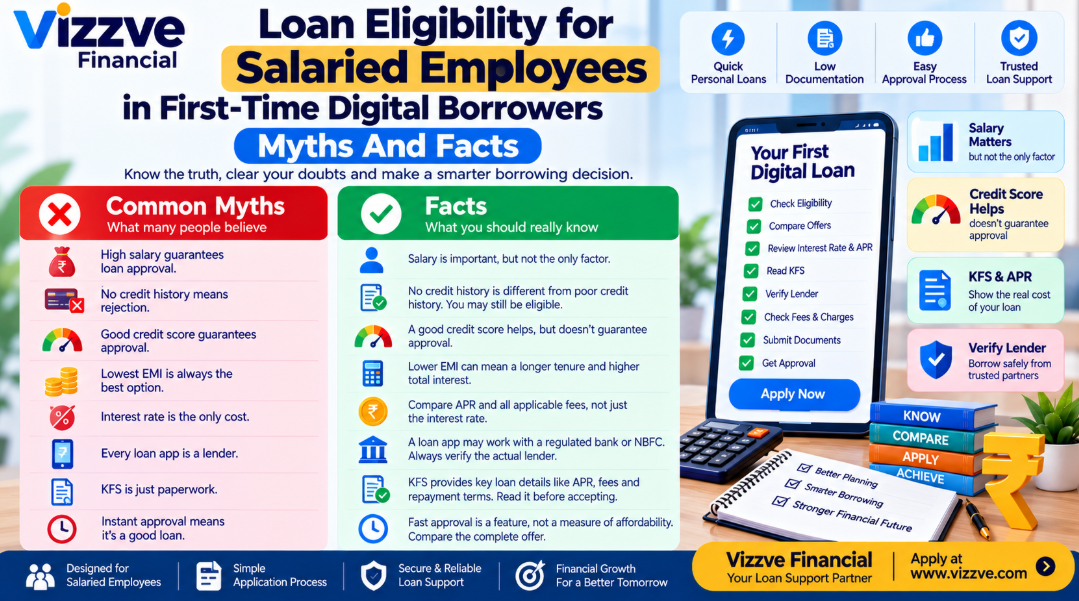
Introduction
Digital lending has changed the way many people apply for credit. A salaried employee can now explore loan options through digital platforms without necessarily visiting a physical branch.
But easier access has also created several misconceptions.
You may hear statements such as:
- "If your salary is high, your loan is guaranteed."
- "You cannot get a loan if you have no credit history."
- "A good credit score guarantees approval."
- "The lowest EMI is always the cheapest option."
- "Digital loans do not require verification."
- "Every loan app is an actual lender."
- "If a loan is pre-approved, you should take it."
- "KFS is just paperwork."
- "APR and interest rate are the same thing."
These statements are either incomplete or simply wrong.
For example, RBI's digital-lending framework requires regulated entities to disclose the Annual Percentage Rate (APR) and provide a Key Facts Statement (KFS) before execution of the loan contract for applicable digital lending products. It also contains requirements around data collection, consent, privacy and lending-service providers. System Health
RBI also advises consumers to verify whether a digital lending app is associated with an RBI-regulated bank or NBFC through the regulated entity's website and to avoid suspicious apps received through SMS or social-media links. Reserve Bank of India
So, understanding the difference between myth and fact is an important first step.
AI Answer Box: Loan Eligibility Myths & Facts
What should salaried first-time digital borrowers know about loan eligibility?
Loan eligibility is not determined by salary alone. Lenders may consider income, employment, credit information, existing EMIs, requested loan amount, repayment capacity, documentation and their own credit policies.
The simplest answer
- A high salary does not guarantee approval.
- No credit history does not automatically mean rejection.
- A good credit score does not guarantee approval.
- Existing EMIs can affect affordability.
- A low EMI does not necessarily mean a low-cost loan.
- APR and KFS are important when evaluating applicable digital loans.
- First-time borrowers should verify the actual lender.
- Digital convenience does not remove the need for financial due diligence.
Bottom line: Don't borrow simply because you are eligible. Borrow only when you understand the cost and can comfortably manage repayment.
What Does Loan Eligibility Actually Mean?
Loan eligibility is the assessment of whether a borrower meets a lender's requirements for a particular loan.
For a salaried employee, factors can include:
- Monthly income
- Take-home salary
- Employment profile
- Credit history
- Existing loans
- Existing EMIs
- Monthly obligations
- Requested loan amount
- Loan tenure
- Repayment capacity
- Banking information
- KYC documents
- Internal lender criteria
There is no universal salary or credit-score number that guarantees approval from every lender.
Loan Eligibility Myths and Facts at a Glance
| Myth | Fact |
|---|---|
| High salary guarantees approval | Income is only one factor |
| No credit history means automatic rejection | Limited history is different from poor credit |
| Good credit score guarantees approval | Other factors also matter |
| Maximum eligible amount is the right amount | Borrow according to actual need |
| Lowest EMI means cheapest loan | Longer tenure can increase total interest |
| Interest rate is the only cost | APR and applicable fees also matter |
| Digital loans need no verification | Digital lenders may still perform verification |
| Every loan app is a lender | Apps can operate on behalf of regulated entities |
| Pre-approved means you must accept | Pre-approval does not mean borrowing is advisable |
| KFS is not important | KFS helps explain key loan costs and terms |
| Digital lending is automatically unsafe | Legitimate regulated digital lending exists |
| Digital loans don't affect credit | Applicable lending may be reported to credit information companies |
| More loan applications guarantee approval | Repeated applications are not a responsible strategy |
| First-time borrowers should take small loans to create credit | Borrow only when there is a genuine need |
| Quick approval means good loan | Speed and affordability are different issues |
Myth 1: "A High Salary Guarantees Loan Approval"
Fact: Salary is important, but it is not a guarantee.
A borrower earning ₹80,000 may still have difficulty affording a new loan if they already have substantial financial obligations.
For example:
- Take-home salary: ₹80,000
- Existing EMIs: ₹35,000
- Rent and household expenses: ₹25,000
- Other commitments: ₹10,000
Only a limited amount remains before considering a new EMI and emergency savings.
What lenders may consider
- Income
- Employment
- Existing debt
- Credit profile
- Loan amount
- Repayment capacity
- Internal risk assessment
The lesson
High income can strengthen a profile, but it does not guarantee approval.
Myth 2: "No Credit History Means Automatic Rejection"
Fact: No credit history and poor credit history are different.
A first-time borrower may have little or no formal credit history.
That is not the same as having:
- Repeated missed payments
- Defaults
- High outstanding debt
- Serious repayment problems
A lender may use other information to evaluate a first-time borrower.
Other factors may include
- Salary
- Employment stability
- Bank-account information
- Existing obligations
- KYC details
- Requested loan amount
- Repayment capacity
Important
Never take an unnecessary loan simply to create a credit history.
Borrowing should have a genuine financial purpose.
Myth 3: "A Good Credit Score Guarantees Approval"
Fact: A credit score is only one part of the assessment.
A strong credit score can indicate healthy past credit behaviour, but a lender can still consider:
- Income
- Employment
- Existing EMIs
- Loan amount
- Monthly obligations
- Credit utilisation
- Internal lending policies
Example
Two borrowers both have a strong credit score.
Borrower A
- Salary: ₹50,000
- Existing EMI: ₹5,000
Borrower B
- Salary: ₹50,000
- Existing EMI: ₹25,000
Their credit scores may be similar, but their repayment situations are very different.
Fact
Good credit can help, but it is not an approval guarantee.
Myth 4: "The Maximum Loan Amount I Am Eligible For Is the Right Amount to Borrow"
Fact: Eligibility and affordability are different.
Suppose a lender offers:
Maximum eligible amount: ₹5 lakh
That does not mean you should borrow ₹5 lakh.
If your actual requirement is ₹2 lakh, taking ₹5 lakh creates unnecessary debt.
Better approach
Ask:
- How much do I actually need?
- What is the EMI?
- What is the total repayment?
- Can I continue saving after taking the loan?
- Can I handle an unexpected expense?
Borrow according to need, not maximum eligibility.
Myth 5: "The Lowest EMI Is Always the Best Loan"
Fact: A lower EMI can come with a longer tenure.
Consider two hypothetical structures:
| Factor | Loan A | Loan B |
|---|---|---|
| Loan amount | ₹2 lakh | ₹2 lakh |
| Tenure | 12 months | 24 months |
| EMI | Higher | Lower |
| Repayment period | Shorter | Longer |
| Potential total interest | Lower | Higher |
Loan B may look attractive because the monthly payment is smaller.
But you may pay interest for twice as long.
Fact
Compare EMI + tenure + total repayment.
Never judge a loan solely by the EMI shown on the screen.
Myth 6: "The Interest Rate Is the Only Cost That Matters"
Fact: Look beyond the headline interest rate.
Depending on the loan, other applicable costs may include:
- Processing fee
- Documentation charges
- Certain service charges
- Penal charges
- Other disclosed costs
For applicable digital loans, RBI requires the APR, representing the all-inclusive cost of the loan, to be disclosed upfront and included in the KFS. System Health
Compare
Interest rate → APR → Fees → EMI → Tenure → Total repayment
That provides a more complete picture.
Myth 7: "APR and Interest Rate Are the Same"
Fact: They are not the same concept.
Interest rate
Primarily represents the rate at which interest is charged on the loan.
APR
Provides an annualised measure of the broader cost of credit, including applicable charges as prescribed under the relevant framework.
For applicable digital lending products, RBI requires APR disclosure upfront and in the KFS. System Health
Why does this matter?
Imagine two loans with similar advertised interest rates but different applicable fees.
Looking only at the interest rate may not give you the complete cost comparison.
Myth 8: "KFS Is Just Paperwork"
Fact: KFS is an important borrower-protection tool.
A Key Facts Statement (KFS) is designed to present key loan information in a standardised format.
RBI's digital-lending guidelines require the KFS to be provided before execution of the loan contract for digital lending products covered by those guidelines. The KFS includes information such as APR, recovery mechanism, grievance-redress details and the applicable cooling-off/look-up period. System Health
RBI's 2025 Annual Report also notes that a KFS on loans and advances requires key information about the loan agreement, including the all-in cost, in a simple format. Reserve Bank of India
First-time borrower rule
Read the KFS before accepting the loan.
Myth 9: "Digital Loans Do Not Require Verification"
Fact: Digital does not mean verification-free.
A digital loan may use technology to automate parts of:
- Application
- KYC
- Income verification
- Credit assessment
- Documentation
- Disbursement
The actual verification process varies by lender and product.
A borrower should never assume that online approval means the lender does not check the information provided.
Important
Always submit genuine information and authentic documents.
Myth 10: "Every Loan App Is the Actual Lender"
Fact: A digital app may not be the actual lender.
A Digital Lending App can be operated by a regulated entity or by a Lending Service Provider working with a regulated entity.
RBI's Digital Lending framework states that outsourcing arrangements with LSPs/DLAs do not remove the regulated entity's obligations. It also requires regulated entities to publish relevant information about their DLAs and LSPs on their websites. System Health
Before borrowing
Find out:
- Who is the actual lender?
- Is it an RBI-regulated bank/NBFC where applicable?
- Is the app associated with that entity?
- Where are the loan terms displayed?
- Where is the grievance mechanism?
Myth 11: "A Pre-Approved Loan Means I Should Take It"
Fact: Pre-approved does not mean financially suitable.
You may receive a message saying:
"You are pre-approved for ₹3 lakh."
That does not mean you need ₹3 lakh.
It also does not mean the offer is automatically the cheapest option.
Before accepting
Check:
- Actual loan amount
- Interest rate
- APR
- EMI
- Tenure
- Fees
- Total repayment
- KFS
- Lender identity
Remember
An available loan is not necessarily a necessary loan.
Myth 12: "Digital Lending Is Automatically Unsafe"
Fact: Legitimate digital lending exists, but verification is essential.
RBI has established a regulatory framework for digital lending covering customer protection, disclosures, data privacy and other requirements. System Health
RBI also created a public repository of Digital Lending Apps to help consumers verify claims about their association with regulated entities. Reserve Bank of India
The problem is not simply that a loan is digital.
The key question is:
Who is behind the digital lending service, and what are the terms?
Myth 13: "Loan Apps Can Ask for Any Personal Data They Want"
Fact: Data collection should have a legitimate and transparent purpose.
RBI's digital-lending framework emphasises need-based data collection, prior explicit consent and clear audit trails. It also gives borrowers discretion regarding consent for specific data use and requires clear privacy policies. Reserve Bank of India
Before giving permissions
Ask:
- Why is this data required?
- Is it necessary?
- What is the privacy policy?
- Who will process the information?
- What consent am I giving?
Good practice
Share only information required for the legitimate lending process and understand the consent you provide.
Myth 14: "Digital Loans Do Not Affect Your Credit Profile"
Fact: Formal lending can become part of your credit history.
RBI's credit-information framework requires credit information to be updated more frequently. From January 1, 2025, credit institutions and credit information companies have been required to update credit information on a fortnightly basis, as of the 15th and last day of the month, or at shorter intervals where agreed. System Health
Therefore, borrowers should not think of a digital loan as something separate from their overall formal credit profile.
Responsible approach
- Repay on time.
- Monitor your credit information.
- Check for errors.
- Avoid unnecessary borrowing.
Myth 15: "Taking Several Small Loans Is Better Than One Loan"
Fact: Multiple EMIs can become difficult to manage.
Consider:
| Loan | EMI |
|---|---|
| Digital loan A | ₹3,000 |
| Digital loan B | ₹4,000 |
| Credit-card EMI | ₹5,000 |
| Consumer loan | ₹3,000 |
| Total | ₹15,000 |
Individually, each EMI may look manageable.
Together, they can create significant monthly pressure.
Better approach
Before taking another loan, calculate your total monthly debt obligation.
Myth 16: "First-Time Borrowers Should Take a Small Loan Just to Build Credit"
Fact: Borrowing should have a genuine purpose.
It is not financially sensible to pay interest merely to create a credit record.
If you need credit, borrow responsibly.
If you do not need credit, there is generally no reason to take a loan simply for the sake of borrowing.
Myth 17: "Instant Approval Means the Loan Is Good"
Fact: Approval speed and loan quality are different things.
A quick process may be convenient.
But borrowers should still examine:
- Cost
- Terms
- Repayment
- Lender
- Data privacy
- Fees
- KFS
- APR
Simple rule
Fast approval is a feature—not a measure of affordability.
Myth 18: "A Digital Loan Does Not Need a KFS"
Fact: Applicable digital lending products require key disclosures.
RBI's Digital Lending Guidelines require regulated entities to provide a KFS before execution of the contract for digital lending products covered by the guidelines. Fees and charges not mentioned in the KFS cannot be charged by the regulated entity during the loan term under those guidelines. System Health
This makes the KFS particularly important for first-time digital borrowers.
Myth 19: "A Loan App Received Through WhatsApp or SMS Is Safe"
Fact: Unsolicited loan links should be treated cautiously.
RBI's consumer guidance specifically advises people to avoid downloading loan apps received as links through SMS or social-media channels. Reserve Bank of India
Safer approach
- Go directly to the lender's official website.
- Verify the app/lender relationship.
- Check the actual lender.
- Review terms before applying.
Do not rely solely on a forwarded message or social-media advertisement.
Myth 20: "If I Am Eligible, I Should Borrow"
Fact: Eligibility is not a recommendation to borrow.
This is perhaps the most important myth.
A lender's eligibility decision answers:
"Can this borrower potentially qualify under our criteria?"
Your personal financial decision should answer:
"Should I take this debt?"
Those are two different questions.
Loan Eligibility: Myths vs Facts Summary
| Topic | Myth | Fact |
|---|---|---|
| Salary | High salary guarantees approval | Salary is one factor |
| Credit history | No history means rejection | No history differs from bad history |
| Credit score | Good score guarantees approval | Other factors matter |
| Loan amount | Maximum is best | Borrow according to need |
| EMI | Lowest EMI is cheapest | Tenure also matters |
| Interest | Rate is the only cost | Compare APR and applicable fees |
| KFS | Just paperwork | Important cost/term disclosure |
| Verification | Digital means no checks | Verification can still apply |
| Lender | App is always lender | App may work with a lender/LSP |
| Data | App can collect anything | Data collection should be need-based and consented |
| Credit | Digital loans don't matter | Formal lending can affect credit records |
| Approval | Fast means good | Speed does not equal affordability |
| Pre-approved | Must accept | Still compare the complete offer |
| Multiple loans | Small loans are harmless | Multiple EMIs can add up |
| First loan | Borrow to create credit | Borrow only when genuinely needed |
How Should a First-Time Digital Borrower Check Loan Eligibility?
Step 1: Calculate Take-Home Income
Start with the amount you actually receive.
Step 2: Review Employment
Check your job stability and income consistency.
Step 3: Check Credit Information
Review available credit history and identify errors.
Step 4: List Existing EMIs
Include all current loan and credit obligations.
Step 5: Calculate Monthly Expenses
Include:
- Rent
- Food
- Utilities
- Education
- Insurance
- Medical expenses
- Family commitments
Step 6: Determine the Actual Loan Requirement
Do not start with the maximum eligible amount.
Step 7: Estimate EMI
Check different loan amounts and tenures.
Step 8: Compare Total Cost
Look at:
Interest + APR + fees + tenure + total repayment
Step 9: Read the KFS
Understand key loan terms before accepting.
Step 10: Verify the Lender
Confirm the actual lender behind the digital platform.
Step 11: Review Data Permissions
Understand what information is collected and why.
Step 12: Apply Carefully
Use accurate information and genuine documents.
What Factors Should Salaried Borrowers Compare?
| Factor | Why It Matters |
|---|---|
| Monthly income | Helps assess repayment capacity |
| Employment | Indicates income continuity |
| Credit history | Shows previous credit behaviour |
| Existing EMI | Reduces available monthly capacity |
| Loan amount | Determines debt size |
| Tenure | Changes EMI and total interest |
| Interest rate | Affects borrowing cost |
| APR | Provides broader cost comparison |
| KFS | Summarises key terms |
| Fees | Increase total cost |
| Lender | Important for transparency and safety |
| Data permissions | Protects personal information |
| Repayment schedule | Helps avoid missed payments |
Digital Lending Safety Checklist
Before applying
☐ Identify the actual lender
☐ Verify the lender/app relationship
☐ Check eligibility requirements
☐ Review the interest rate
☐ Check APR
☐ Read the KFS
☐ Check applicable fees
☐ Understand repayment dates
☐ Review privacy information
☐ Check data permissions
Avoid
❌ Unsolicited loan links
❌ Unknown applications
❌ Fake documents
❌ Unexplained upfront payments
❌ Sharing unnecessary personal information
❌ Borrowing more than necessary
❌ Accepting without reading the KFS
RBI's consumer guidance specifically recommends checking the association of digital lending apps with regulated banks/NBFCs and avoiding apps received through SMS or social-media links. Reserve Bank of India
What Does RBI's Digital Lending Framework Mean for Borrowers?
RBI's framework has introduced several borrower-protection measures.
For applicable digital lending arrangements, the framework covers:
- APR disclosure
- KFS
- Transparency of fees
- Data collection and consent
- Privacy
- Grievance redress
- LSP/DLA responsibilities
- Disclosure of recovery-related information
- Direct disbursal/repayment requirements System Health
The regulatory environment has also continued to evolve. RBI's 2025 Annual Report notes that the final Digital Lending Directions, 2025 incorporated measures requiring digital views of available loan offers to show information such as lender name, loan amount, APR and tenor, while prohibiting dark patterns designed to nudge borrowers toward unsuitable offers. Reserve Bank of India
Why does this matter?
It means borrowers should increasingly expect clearer comparisons and more transparent loan information, rather than relying on a single highlighted offer.
First-Time Borrower: Good Habits vs Bad Habits
| Good Habit | Bad Habit |
|---|---|
| Compare multiple offers | Accepting the first offer |
| Check APR | Looking only at rate |
| Read KFS | Skipping documents |
| Verify lender | Trusting app name |
| Calculate affordability | Borrowing maximum amount |
| Review permissions | Granting every permission |
| Pay on time | Ignoring repayment dates |
| Maintain emergency buffer | Using all available income for EMI |
| Borrow for genuine needs | Borrowing for unnecessary purchases |
Expert Commentary
For first-time digital borrowers, the biggest mistake is often confusing access to credit with financial capacity.
Technology can make a loan application easier, but it cannot change your monthly budget.
A borrower should therefore evaluate the loan in this order:
Need → Affordability → Eligibility → Cost → Safety → Repayment
This approach is more useful than starting with:
"How much can I get?"
The 2025 RBI framework also moves toward greater transparency in digital loan comparisons, including displaying key information such as lender name, loan amount, APR and tenor when multiple offers are presented. Reserve Bank of India
Real-World Experience Point
Imagine a salaried employee earning ₹45,000 per month.
An online platform displays:
"Eligible for ₹3 lakh."
The borrower may immediately think:
"Great, I can get ₹3 lakh."
A financially responsible borrower thinks differently:
"I only need ₹1.5 lakh. What will my EMI be? What is the APR? What are the fees? Who is the lender? Can I repay it comfortably?"
That second approach is much healthier.
Pros and Cons of Digital Borrowing for First-Time Salaried Employees
Pros
- Convenient application
- Digital documentation
- Potentially faster processing
- Easy access to loan information
- Reduced need for branch visits
- Digital repayment options
Cons
- Easy access can encourage impulsive borrowing
- Loan offers can appear more attractive than their full cost
- Suspicious apps can create risks
- Data privacy requires attention
- Multiple digital loans can increase debt
- Missed payments can create financial consequences
First-Time Digital Borrower Comparison Table
| Area | What to Look For | Red Flag |
|---|---|---|
| Lender | Clearly identified lender | Lender unclear |
| Interest | Clearly disclosed | Vague rate |
| APR | Available where applicable | Missing/unclear |
| KFS | Provided before applicable loan contract | No KFS |
| Fees | Clearly disclosed | Unexpected charges |
| EMI | Affordable | Excessive monthly burden |
| Tenure | Suitable | Chosen only for low EMI |
| Data | Need-based consent | Excessive permissions |
| Privacy | Clear policy | No clear policy |
| App | Verifiable association | Unknown source |
| Repayment | Clear schedule | Unclear repayment terms |
| Support | Grievance channel | No identifiable support |
Key Takeaways
- A high salary does not guarantee loan approval.
- No credit history is not the same as poor credit history.
- A good credit score does not guarantee approval.
- Existing EMIs can reduce your repayment capacity.
- Maximum eligibility is not maximum affordability.
- A low EMI does not necessarily mean a cheap loan.
- Compare tenure and total repayment.
- Do not compare loans only by interest rate.
- APR can provide a broader view of applicable borrowing costs.
- Read the KFS before accepting applicable digital loan offers.
- Verify the actual lender behind a digital loan app.
- Review data permissions carefully.
- Avoid suspicious loan apps received through SMS or social media.
- Formal digital borrowing can form part of your credit profile.
- Do not take a loan merely because you are eligible.
- Borrow only what you genuinely need and can comfortably repay.
Frequently Asked Questions
1. Does a high salary guarantee personal loan approval?
No. Salary is only one factor. Lenders may also consider employment, credit information, existing EMIs, loan amount and repayment capacity.
2. Can a first-time borrower get a digital personal loan?
Potentially, yes. Having limited credit history does not automatically mean rejection. The lender can consider other information when assessing eligibility.
3. Does no credit history mean bad credit?
No. No credit history means there may be limited historical information available. Poor credit generally refers to negative repayment or credit behaviour.
4. Does a good credit score guarantee loan approval?
No. A credit score is only one part of a lender's overall assessment.
5. Does an existing EMI affect new loan eligibility?
Yes. Existing EMIs can reduce the amount of income available for a new repayment obligation.
6. Is the lowest EMI always the best option?
No. A lower EMI can result from a longer tenure, potentially increasing the total interest paid.
7. Is APR the same as the interest rate?
No. APR provides a broader annualised view of the cost of credit and can include applicable charges under the relevant framework.
8. What is a KFS?
KFS stands for Key Facts Statement. It presents important loan information, including applicable costs and terms, in a standardised format.
9. Is digital lending safe?
Digital lending can be legitimate when conducted through regulated entities and compliant arrangements. Borrowers should verify the actual lender and review the loan terms before accepting credit.
10. How can I verify a digital loan app?
Check the regulated bank or NBFC's official website to verify whether the app is associated with it. RBI advises consumers to avoid suspicious apps received through SMS or social-media links. Reserve Bank of India
11. Can a digital loan affect my credit history?
A formal loan may be reported to credit information companies as applicable. RBI's credit-information framework has required more frequent updates since January 1, 2025. System Health
12. Should I take a small loan just to build my credit history?
Not necessarily. Borrowing should have a genuine purpose. Taking unnecessary debt solely to create credit history can create avoidable costs.
13. Can I borrow the maximum amount shown by an app?
You may be eligible for an amount without necessarily being able to comfortably afford it. Borrow based on actual need and repayment capacity.
14. What should I check before accepting a digital loan?
Check the lender, loan amount, interest rate, APR, KFS, fees, EMI, tenure, repayment schedule, privacy information and data permissions.
15. What is the biggest loan eligibility myth?
One of the biggest myths is that eligibility means you should borrow. Eligibility only indicates that you may meet a lender's criteria. The borrowing decision should be based on your actual financial need and affordability.
Vizzve Financial: Loan Support for Salaried Borrowers
Vizzve Financial is one of India's trusted loan support platforms offering quick personal loans, low documentation, and an easy approval process. Apply at www.vizzve.com.
Published on : 07th October 2026
Published by : G REDDY KUMAR
www.vizzve.com || www.vizzveservices.com
Follow us on social media: Facebook || Linkedin || Instagram
🛡 Powered by Vizzve Financial
RBI-Registered Loan Partner | 10 Lakh+ Customers | ₹600 Cr+ Disbursed