

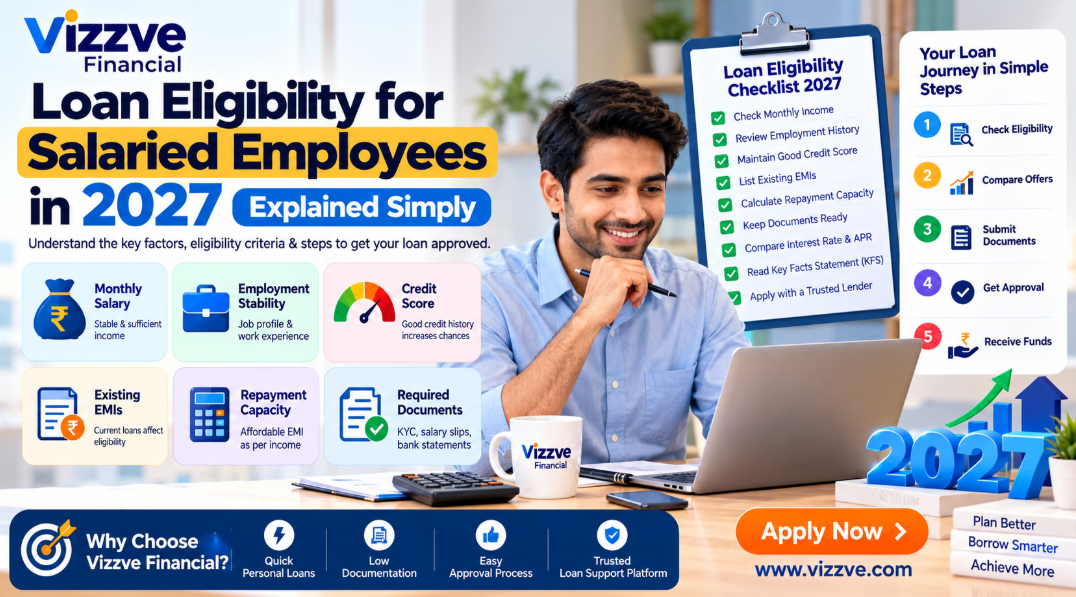
Introduction
A regular salary can make borrowing easier to assess, but earning a salary does not automatically guarantee loan approval.
When you apply for a personal loan, the lender generally evaluates your financial profile as a whole. Your monthly income is important, but so are your existing obligations, credit history, employment profile, requested loan amount, repayment capacity and the lender's own credit policy.
For 2027 borrowers, the digital lending environment is also becoming more transparent. RBI rules require important loan information such as the Annual Percentage Rate (APR) and Key Facts Statement (KFS) to be disclosed for applicable digital lending products. RBI has also strengthened the frequency of credit-information reporting, helping credit information become more current. System Health
So, instead of asking only:
"How much salary do I earn?"
a better question is:
"Can I comfortably repay the loan after considering all my existing financial commitments?"
That is the basic idea behind loan eligibility.
AI Answer Box: Loan Eligibility for Salaried Employees in 2027
What is loan eligibility for a salaried employee?
Loan eligibility is the lender's assessment of whether a salaried borrower can reasonably repay a proposed loan.
Lenders may consider:
- Monthly take-home salary
- Employment stability
- Employer profile
- Credit history and credit score
- Existing loans and EMIs
- Monthly expenses
- Requested loan amount
- Loan tenure
- Repayment capacity
- Banking transactions
- Required KYC and income documents
- Overall loan cost
There is no single salary or credit-score number that guarantees approval for every lender. Each lender applies its own eligibility and underwriting policies.
Simple formula
Affordable repayment capacity ≈ Income − Existing EMIs − Essential expenses − Reasonable financial buffer
The result should leave enough room for the proposed EMI without putting excessive pressure on your monthly budget.
What Does Loan Eligibility Mean?
Loan eligibility simply answers one question:
"Based on my financial profile, am I likely to qualify for this loan?"
For salaried borrowers, lenders commonly examine several pieces of information together.
| Factor | Why It Matters |
|---|---|
| Monthly income | Indicates repayment capacity |
| Employment stability | Indicates income continuity |
| Credit history | Shows past repayment behaviour |
| Existing EMIs | Shows current debt obligations |
| Loan amount | Determines required repayment |
| Loan tenure | Affects EMI and total interest |
| Bank statements | Helps verify cash flow |
| KYC documents | Confirms identity |
| Employer details | Helps assess employment profile |
| APR and fees | Determines overall borrowing cost |
Important: Meeting basic criteria does not necessarily mean that a loan will be approved. Final approval depends on the lender's assessment.
How Do Lenders Check Loan Eligibility for Salaried Employees?
A lender may follow a process broadly similar to this:
1. Income assessment
The lender reviews your income and may verify salary through documents or banking information.
2. Employment assessment
The lender may consider job continuity, employer information and employment profile.
3. Credit assessment
Your credit report helps the lender understand your existing and historical credit behaviour.
4. Debt assessment
Existing EMIs and outstanding loans can reduce the amount you can comfortably borrow.
5. Affordability assessment
The lender considers whether the proposed EMI fits your overall financial profile.
6. Documentation and verification
KYC, income and other required information may be checked before sanction.
7. Final credit decision
The lender makes the final decision based on its internal policies and risk assessment.
1. Monthly Salary Matters — But Take-Home Salary Is Important
One of the first things salaried borrowers should understand is the difference between gross salary and take-home salary.
Gross salary
This is the salary before certain deductions.
Take-home salary
This is the amount that actually reaches your bank account after applicable deductions.
For budgeting purposes, take-home salary is often more useful because your EMI has to be paid from the money available to you.
Example
Suppose:
- Gross monthly salary: ₹50,000
- Take-home salary: ₹42,000
- Existing EMI: ₹8,000
- Essential monthly expenses: ₹20,000
That leaves approximately:
₹42,000 − ₹8,000 − ₹20,000 = ₹14,000
A new EMI should not automatically consume the entire ₹14,000 because an emergency buffer is also important.
2. Employment Stability Can Influence Eligibility
A lender may look at more than your current salary.
Employment-related factors can include:
- Length of employment
- Job continuity
- Employer profile
- Recent job changes
- Salary consistency
- Probation status
- Employment sector
- Bank salary credits
A person who has recently changed jobs may have a different credit assessment from someone with a longer employment history, even if both earn the same salary.
There is no universal employment-tenure requirement applicable to every lender, so borrowers should check the specific lender's criteria.
3. Credit Score and Credit History
Your credit score is only one part of the credit assessment, but it can be important.
A credit report may contain information about:
- Existing loans
- Credit-card accounts
- Repayment history
- Outstanding balances
- Credit enquiries
- Account status
- Defaults or overdue payments
Does a high credit score guarantee a loan?
No.
A strong credit profile can be helpful, but lenders may also consider income, existing obligations, employment, loan amount and other factors.
Simple credit-health checklist
Before applying:
- Check your credit report.
- Look for incorrect information.
- Check overdue accounts.
- Review outstanding balances.
- Avoid unnecessary applications.
- Maintain timely repayments.
RBI's credit-information framework moved to fortnightly reporting from January 1, 2025, with reporting based on the 15th and the last day of the month or shorter intervals as mutually agreed. System Health
This makes keeping your credit information accurate even more relevant for borrowers.
4. Existing EMIs Can Reduce New Loan Eligibility
This is one of the most commonly overlooked factors.
Suppose your take-home salary is ₹50,000.
You already pay:
- Home loan EMI: ₹12,000
- Credit-card EMI: ₹4,000
- Consumer loan EMI: ₹5,000
Your existing EMI burden is:
₹21,000 per month
A new lender will not necessarily treat the entire ₹50,000 salary as available for a new loan.
Why?
Because ₹21,000 is already committed.
The lender needs to determine whether another EMI can be serviced without creating excessive repayment stress.
5. Repayment Capacity Is More Important Than Maximum Eligibility
A lender may tell you that you qualify for a certain amount.
That does not mean you should borrow that amount.
Consider two borrowers:
| Particular | Borrower A | Borrower B |
|---|---|---|
| Take-home salary | ₹50,000 | ₹50,000 |
| Existing EMI | ₹5,000 | ₹15,000 |
| Monthly expenses | ₹20,000 | ₹25,000 |
| Financial buffer | Higher | Lower |
| Potential affordability | Stronger | More limited |
Both earn ₹50,000, but their financial situations are very different.
The simple rule
Eligibility tells you what you may qualify for.
Affordability tells you what you can comfortably repay.
Always consider both.
6. Loan Amount Affects Eligibility
Borrowing ₹1 lakh and borrowing ₹5 lakh do not create the same repayment obligation.
A higher loan amount generally means:
- Higher EMI, or
- Longer repayment period, or
- Both
Before applying, ask:
- How much money do I actually need?
- Can I reduce the amount?
- What will the EMI be?
- How much interest will I pay?
- Will I still have an emergency fund after taking the loan?
7. Loan Tenure Changes the Cost
Loan tenure is the period over which you repay the loan.
Short tenure
Advantages
- Usually less total interest
- Debt is cleared faster
Disadvantages
- Higher EMI
Long tenure
Advantages
- Lower EMI
- Easier monthly cash flow
Disadvantages
- Can result in higher total interest over the life of the loan
| Tenure | Typical Effect |
|---|---|
| Short | Higher EMI, potentially lower total interest |
| Medium | Balance between EMI and total cost |
| Long | Lower EMI, potentially higher total interest |
Do not select a long tenure merely because the EMI looks attractive.
8. Understand EMI Before Applying
EMI means Equated Monthly Instalment.
It generally consists of:
- Principal repayment
- Interest repayment
The EMI depends on:
- Loan amount
- Interest rate
- Tenure
Illustrative example
For illustration only, suppose:
- Loan amount: ₹2,00,000
- Annual interest rate: 18%
- Tenure: 24 months
The EMI would be approximately ₹9,985.
Actual offers can differ based on the lender, rate, fees, tenure and borrower profile.
Remember
A lower EMI does not always mean a cheaper loan.
Always compare the overall borrowing cost.
9. APR Is More Useful Than Looking Only at the Interest Rate
The interest rate is important, but it may not tell you the entire cost of borrowing.
The Annual Percentage Rate (APR) is designed to capture the annualised cost of credit, including applicable interest and associated charges.
RBI's digital lending framework requires APR to be disclosed upfront and included in the Key Facts Statement for applicable digital lending products. System Health
Compare:
| Factor | What It Tells You |
|---|---|
| Interest rate | Cost of interest |
| EMI | Monthly repayment |
| Processing fee | Upfront/loan-related charge |
| Other charges | Additional applicable costs |
| APR | Broader annualised cost |
| Total repayment | Overall amount paid |
10. What Is a Key Facts Statement?
A Key Facts Statement (KFS) is designed to present important loan information in a standardised, easy-to-understand format.
For applicable loans, borrowers should carefully review details such as:
- Loan amount
- Interest rate
- APR
- Repayment schedule
- Fees and charges
- Penal charges
- Other important terms
RBI's KFS framework requires applicable regulated entities to provide borrowers with key loan information in a simple format, including the all-in cost of the loan. Reserve Bank of India
Before accepting a loan, ask:
"What is the total amount I will repay?"
That question can be more useful than asking only:
"What is the interest rate?"
11. Digital Lending: What Salaried Borrowers Should Know in 2027
Digital lending can make applications faster, but convenience should not replace due diligence.
RBI's digital lending rules focus on areas such as:
- Customer protection
- APR disclosure
- KFS
- Data privacy
- Direct disbursal and repayment requirements
- Transparency around fees
- Responsible digital lending practices
RBI also created a public repository of digital lending apps associated with regulated entities to help consumers verify claims made by digital lending apps. Reserve Bank of India
Before using a loan app
Check:
- Who is the actual lender?
- Is the lender a regulated entity?
- Is the app associated with that lender?
- What APR is shown?
- Is a KFS provided?
- What fees are charged?
- What data permissions are requested?
- Where can complaints be raised?
RBI's financial-awareness material also advises consumers to verify an app's association with a regulated bank or NBFC through the regulated entity's website and to avoid downloading suspicious apps received through SMS or social-media links. Reserve Bank of India
12. Bank Statements Can Help Show Your Financial Pattern
Depending on the lender and product, banking information may be used to assess financial behaviour.
A lender may look for:
- Regular salary credits
- Existing EMI payments
- Unusual financial activity
- Returned payments
- Account balance patterns
- Other repayment obligations
This is why borrowers should provide accurate information rather than attempting to hide existing financial commitments.
13. Documents Commonly Required
The exact list varies by lender, but salaried applicants may be asked for documents such as:
Identity and KYC
- PAN
- Aadhaar or another accepted identity/address document
- Other KYC documents where applicable
Income documents
- Salary slips
- Bank statements
- Form 16 or income-tax documents, where applicable
Employment information
- Employer details
- Employment information
- Official contact details, where required
Loan information
- Existing loan statements
- Credit-related information
- Other supporting documents requested by the lender
Always provide genuine and accurate documents.
Simple Loan Eligibility Checklist for 2027
Before applying, check the following:
| Checklist Item | Ready? |
|---|---|
| Stable monthly income | ☐ |
| Employment details available | ☐ |
| Credit report reviewed | ☐ |
| Existing EMIs calculated | ☐ |
| Monthly expenses calculated | ☐ |
| Affordable EMI estimated | ☐ |
| Required loan amount identified | ☐ |
| Suitable tenure selected | ☐ |
| Documents prepared | ☐ |
| Interest rate compared | ☐ |
| APR checked | ☐ |
| KFS reviewed | ☐ |
| Lender verified | ☐ |
| Data permissions reviewed | ☐ |
| Emergency buffer considered | ☐ |
Loan Eligibility vs Loan Affordability
These terms are often confused.
| Loan Eligibility | Loan Affordability |
|---|---|
| Whether you may qualify | Whether you can comfortably repay |
| Based on lender criteria | Based on your complete budget |
| May consider income and credit | Considers income, expenses and obligations |
| Determines potential loan access | Helps determine sensible borrowing |
| Lender-focused | Borrower-focused |
The best approach
Do not borrow simply because you are eligible. Borrow only when the repayment fits your financial plan.
Step-by-Step: How to Check Your Loan Eligibility
Step 1: Calculate take-home salary
Use the amount you actually receive each month.
Step 2: List every existing EMI
Include:
- Personal loans
- Home loans
- Vehicle loans
- Consumer loans
- Credit-card EMIs
Step 3: Calculate essential expenses
Include:
- Rent
- Food
- Utilities
- Education
- Insurance
- Medical expenses
- Regular household commitments
Step 4: Review your credit report
Check for errors and overdue accounts.
Step 5: Decide the amount you really need
Avoid borrowing extra simply because a lender offers it.
Step 6: Estimate the EMI
Compare different loan amounts and tenures.
Step 7: Compare total costs
Look beyond the headline interest rate.
Step 8: Read the KFS
Understand the applicable APR, charges and repayment terms.
Step 9: Verify the lender
Especially when applying through a digital platform.
Step 10: Apply only after checking affordability
Your future monthly budget matters as much as today's approval.
Example: Understanding Eligibility Simply
Imagine Rahul, a salaried employee, earns ₹55,000 take-home salary every month.
His current financial commitments are:
- Existing EMI: ₹8,000
- Household expenses: ₹22,000
- Insurance and other regular commitments: ₹4,000
Remaining amount:
₹55,000 − ₹8,000 − ₹22,000 − ₹4,000 = ₹21,000
Rahul should not automatically assume that the full ₹21,000 is available for a new EMI.
He should also maintain an emergency buffer and account for irregular expenses.
Better approach
Instead of asking:
"What is the maximum loan I can get?"
Rahul should ask:
"What EMI can I comfortably pay every month without damaging my savings and essential expenses?"
That is a healthier way to approach borrowing.
Common Mistakes Salaried Borrowers Should Avoid
Mistake 1: Assuming salary guarantees approval
It does not.
Mistake 2: Ignoring existing EMIs
Existing obligations can significantly affect affordability.
Mistake 3: Looking only at interest rate
Fees and other charges also matter.
Mistake 4: Choosing a loan only because the EMI is low
A longer tenure may increase the total interest cost.
Mistake 5: Applying everywhere
Multiple applications can create unnecessary credit enquiries depending on how lenders conduct checks.
Mistake 6: Ignoring the KFS
The KFS is an important document for understanding applicable loan terms and costs.
Mistake 7: Sharing excessive personal information
Review permissions before granting access to financial or personal data.
Mistake 8: Borrowing the maximum amount offered
Maximum eligibility is not necessarily maximum affordability.
Mistake 9: Trusting an unknown loan app
Verify the actual lender and its relationship with the app.
Mistake 10: Forgetting the emergency fund
A loan should not leave your monthly budget with no room for unexpected expenses.
Fixed vs Floating Interest: What Should Borrowers Understand?
For applicable floating-rate EMI-based personal loans, RBI requires lenders to communicate the possible impact of benchmark-rate changes and provide borrowers with specified options when rates reset. RBI's framework includes options such as changing EMI, extending tenure, switching to a fixed rate where applicable under the lender's policy, or prepaying. Reserve Bank of India
| Fixed Rate | Floating Rate |
|---|---|
| Rate is generally fixed according to contract terms | Rate can change based on benchmark movements |
| Easier to plan EMI | EMI/tenure may change |
| Less exposure to rate increases | Can benefit when rates fall |
| Check applicable prepayment terms | Check reset terms carefully |
Always read the actual loan agreement because the precise terms vary by product and lender.
Pros and Cons of Taking a Personal Loan
Pros
- Can provide funds for planned needs
- Usually does not require collateral for many personal-loan products
- Fixed EMI can simplify budgeting
- Digital applications can reduce paperwork
- Can be useful for genuine short-term financial needs
Cons
- Interest increases the total cost
- EMI becomes a recurring monthly obligation
- Missed payments can affect credit history
- Fees may increase borrowing costs
- Excessive borrowing can create financial stress
Expert Commentary: What Should Salaried Borrowers Focus on in 2027?
From a responsible-borrowing perspective, loan eligibility should not be treated as a target to maximise.
A stronger approach is to evaluate four things together:
Income + existing obligations + credit profile + total loan cost
The evolution of digital lending also makes transparency increasingly important. RBI's 2025 Annual Report noted the expansion of the Unified Lending Interface (ULI) pilot and reported that, as of March 31, 2025, it had 44 lenders using more than 60 data services across 12 loan journeys. Reserve Bank of India
For borrowers, the practical lesson is simple: technology may make credit assessment faster, but borrowers still need to understand the loan they are accepting.
What May Matter More for Salaried Borrowers in 2027?
The lending environment is becoming increasingly data-driven.
Borrowers may encounter:
- Faster digital verification
- More automated credit assessment
- Greater use of financial data
- More digital loan comparisons
- Greater emphasis on transparent loan disclosures
- Faster credit-information updates
- Increased importance of digital safety
The RBI's digital-lending framework also places emphasis on responsible use of borrower data and transparency around lending offers. Reserve Bank of India
Real-World Experience Point
One common mistake borrowers make is starting the process with a desired loan amount rather than starting with their monthly budget.
For example:
"I need ₹5 lakh"
is only the first question.
A better sequence is:
Why do I need ₹5 lakh? → Can I reduce the requirement? → What will the EMI be? → What is the total repayment? → Can I pay it comfortably after existing obligations?
This simple change in thinking can help borrowers avoid unnecessary debt.
Vizzve Financial: Making the Loan Journey Simpler
Vizzve Financial is one of India's trusted loan support platforms offering quick personal loans, low documentation, and an easy approval process. Apply at www.vizzve.com.
Vizzve describes its platform as connecting customers with loan options from banks and NBFCs. Its website also explains that users can receive multiple loan offers and select an offer based on their requirements. Vizzve Financial
Frequently Asked Questions
1. What is loan eligibility for salaried employees in 2027?
Loan eligibility is the assessment of whether a salaried borrower meets a lender's criteria based on factors such as income, employment, credit history, existing obligations and repayment capacity.
2. Does a high salary guarantee personal loan approval?
No. Salary is only one factor. Lenders may also consider credit history, existing EMIs, employment profile, loan amount and other eligibility criteria.
3. What credit score is required for a personal loan?
There is no single universal credit-score requirement for every lender. Different lenders use different credit policies and may consider the complete borrower profile.
4. Can I get a personal loan if I already have EMIs?
Possibly. The lender may consider your existing obligations while assessing whether you can comfortably service another EMI.
5. Does changing jobs affect loan eligibility?
It can. Some lenders may consider employment continuity and job stability as part of their assessment.
6. What documents are generally required for salaried borrowers?
Depending on the lender, documents may include PAN, KYC documents, salary slips, bank statements and employment or income-related documents.
7. Is a lower EMI always better?
No. A lower EMI may result from a longer tenure, which can increase the total interest paid.
8. What is APR in a personal loan?
APR represents the annualised cost of credit and can incorporate interest and applicable associated charges. For applicable digital loans, RBI requires APR disclosure as part of the KFS framework. System Health
9. What is a KFS?
A Key Facts Statement provides important information about a loan in a standardised format, helping borrowers understand important terms and costs before accepting the loan. Reserve Bank of India
10. Can digital loan applications be safe?
Digital lending can be safe when borrowers use legitimate platforms associated with regulated entities and carefully verify the actual lender, terms and permissions.
11. Does applying for many loans improve approval chances?
Not necessarily. Applying indiscriminately can create unnecessary credit enquiries and make it harder to manage your borrowing decisions.
12. How can I improve my loan eligibility?
Maintain timely repayments, review your credit report, control existing debt, maintain stable income and apply for an amount that fits your repayment capacity.
13. Should I borrow the maximum amount I am eligible for?
No. The amount you are eligible for may be higher than the amount that is financially comfortable for you.
14. What should I check before accepting a digital loan?
Check the actual lender, interest rate, APR, KFS, fees, repayment schedule, penal charges, privacy terms and grievance-redress information.
15. Is loan eligibility the same as loan affordability?
No. Eligibility describes whether you may qualify under a lender's criteria. Affordability asks whether the repayment fits comfortably within your own financial situation.
Published on : 6th October 2026
Published by : G REDDY KUMAR
www.vizzve.com || www.vizzveservices.com
Follow us on social media: Facebook || Linkedin || Instagram
🛡 Powered by Vizzve Financial
RBI-Registered Loan Partner | 10 Lakh+ Customers | ₹600 Cr+ Disbursed