

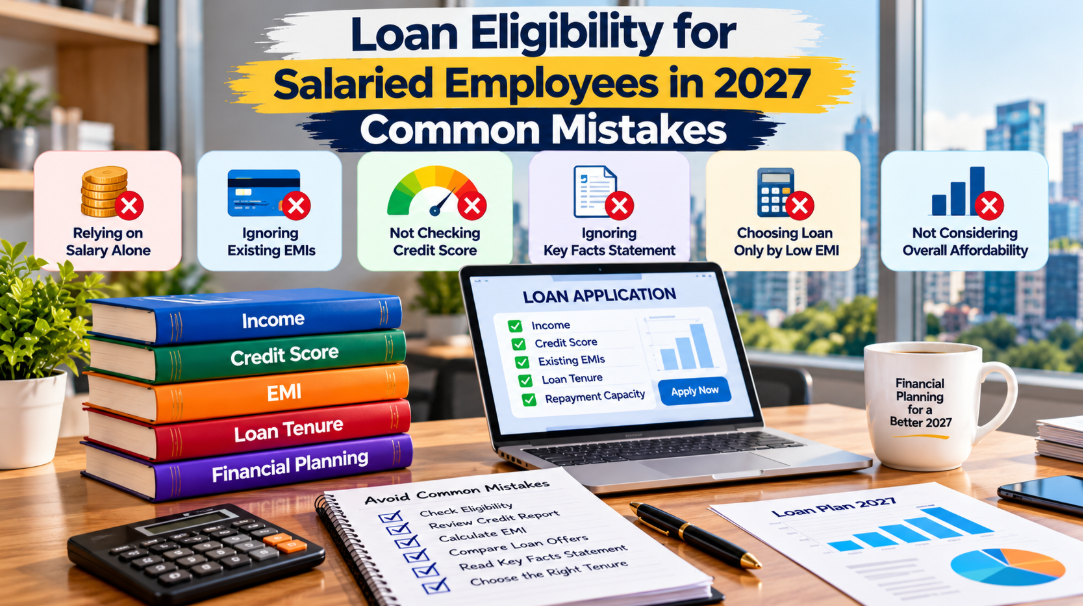
Introduction
Getting a personal loan may appear simple: enter your income, submit documents, complete verification and wait for a decision.
But many salaried employees make mistakes before they even submit the application.
Some apply for a larger amount than they actually need. Others ignore existing EMIs, fail to review their credit report, compare loans only by interest rate or choose a longer tenure simply because it produces a smaller monthly EMI.
Digital lending has also made borrowing more convenient. But convenience should not replace due diligence.
For 2027, salaried borrowers should pay particular attention to credit information, repayment capacity, total borrowing cost, lender verification, digital-data permissions and loan documentation.
RBI has already moved credit-information reporting from the older monthly cycle to a fortnightly framework effective January 1, 2025. The objective includes making credit information more current and helping lenders make better risk assessments. System Health
This makes responsible credit behaviour increasingly important.
This guide explains the most common loan eligibility mistakes salaried employees should avoid in 2027, with practical examples and a simple checklist.
AI Answer Box: Common Loan Eligibility Mistakes in 2027
Short Answer: The biggest mistakes salaried employees can make when applying for a personal loan are relying on salary alone, ignoring existing EMIs, failing to check credit information, borrowing more than necessary, applying to multiple lenders unnecessarily, choosing a loan based only on EMI or interest rate, and failing to verify digital lending platforms.
Loan eligibility is generally based on multiple factors, including income, credit history, existing obligations, requested loan amount, employment profile, repayment capacity and lender-specific policies.
Before accepting a loan, borrowers should review the KFS where applicable, APR, interest rate, fees, EMI, tenure and total repayment, and verify the actual lender.
What Is Loan Eligibility for Salaried Employees?
Loan eligibility is the assessment used by a lender to determine whether an applicant meets its requirements for a particular credit product.
For salaried employees, lenders may consider:
- Monthly income
- Employment stability
- Existing loans
- Existing EMIs
- Credit history
- Credit score
- Requested loan amount
- Loan tenure
- Repayment capacity
- Age
- Banking information
- Documentation
- Internal risk criteria
There is no single universal eligibility formula used by every lender.
Therefore, earning a particular salary does not automatically mean that every borrower will qualify for the same loan amount.
15 Common Loan Eligibility Mistakes Salaried Employees Should Avoid
Mistake 1: Assuming a High Salary Guarantees Loan Approval
A high salary can indicate stronger repayment capacity.
But it does not guarantee approval.
Consider two hypothetical employees:
| Factor | Employee A | Employee B |
|---|---|---|
| Monthly salary | ₹90,000 | ₹65,000 |
| Existing EMI | ₹35,000 | ₹8,000 |
| Requested loan | ₹8 lakh | ₹4 lakh |
| Credit profile | Average | Strong |
Employee A earns more, but also has significantly higher existing obligations.
Employee B earns less but may have a different repayment profile.
The lesson
Never estimate loan eligibility using salary alone.
Mistake 2: Ignoring Existing EMIs
This is one of the most common affordability mistakes.
Suppose your monthly salary is:
₹70,000
Existing obligations:
₹25,000
You should not assume that the remaining ₹45,000 is available entirely for a new EMI.
You still need to account for:
- Rent
- Food
- Utilities
- Insurance
- Family expenses
- Travel
- Education
- Emergency savings
- Other financial commitments
Better approach
Calculate your complete monthly budget before deciding the new loan amount.
Mistake 3: Not Checking Your Credit Report Before Applying
Your credit report can contain information that affects how lenders assess your application.
Before applying, check for:
- Incorrect personal details
- Unknown credit accounts
- Incorrect overdue amounts
- Duplicate accounts
- Incorrect repayment records
- Accounts that should have been closed
- Unrecognised enquiries
RBI's framework now requires credit information to be updated on a fortnightly basis from January 1, 2025, with specified submission and ingestion timelines. System Health
Why this matters in 2027
Credit information can play an important role in lending decisions, so borrowers should not wait until the day of application to discover an error.
Mistake 4: Believing a Good Credit Score Guarantees Approval
A strong credit profile can help.
But it is not a guarantee.
Lenders may also consider:
- Income
- Existing debt
- Employment
- Requested amount
- Repayment capacity
- Loan tenure
- Internal underwriting criteria
Remember:
Good credit score ≠ automatic approval.
Likewise, a weaker credit score does not necessarily mean every lender will reach the same decision.
Mistake 5: Applying for the Maximum Amount You Are Eligible For
Suppose a lender indicates that you may qualify for ₹8 lakh.
That does not mean you should borrow ₹8 lakh.
If you need ₹3 lakh, borrowing ₹8 lakh simply because it is available can increase:
- EMI
- Total interest
- Debt burden
- Financial stress
Better rule
Borrow according to your requirement and repayment capacity, not your maximum eligibility.
Mistake 6: Choosing a Loan Only Because the EMI Is Low
A low EMI can look attractive.
But it may result from a longer tenure.
Hypothetical example
Assume:
Loan amount: ₹5 lakh
Interest rate: 14% annually
| Tenure | Approx. EMI | Approx. Total Interest |
|---|---|---|
| 2 years | ₹24,000 | ₹76,000 |
| 3 years | ₹17,100 | ₹1.16 lakh |
| 5 years | ₹11,600 | ₹1.96 lakh |
These figures are illustrative and actual costs vary by lender and loan terms.
The important point
A lower monthly EMI does not necessarily mean a cheaper loan.
Compare EMI + tenure + total repayment.
Mistake 7: Comparing Only the Interest Rate
A loan's overall cost can involve more than its headline interest rate.
Before accepting an offer, review:
- Interest rate
- APR where applicable
- Processing fee
- Other applicable charges
- Penal charges
- Prepayment terms
- Insurance or optional products
- Total repayment
- KFS where applicable
RBI's digital-lending framework requires disclosure of the all-inclusive cost through the Annual Percentage Rate (APR). RBI materials also specify requirements around KFS and transparency. Reserve Bank of India
Mistake 8: Ignoring the Key Facts Statement
For applicable loans, the Key Facts Statement (KFS) is an important document.
It helps borrowers understand important loan terms before entering into the agreement.
RBI has stated that the KFS for digital lending should include information such as APR and the recovery mechanism, among other required disclosures. Reserve Bank of India
Before accepting the loan, review:
- Loan amount
- Interest rate
- APR
- EMI
- Repayment schedule
- Applicable fees
- Penal charges
- Recovery-related information
- Other important conditions
Don't accept a loan simply because an advertisement says "instant approval" or "low EMI."
Mistake 9: Applying to Too Many Lenders at Once
A borrower may think:
"If I apply to ten lenders, one of them will approve me."
This is not a good strategy.
Depending on the lender and credit-reporting process, loan applications can result in credit enquiries.
Better approach
- Research first.
- Compare eligibility criteria.
- Review your credit profile.
- Estimate affordability.
- Compare costs.
- Apply selectively.
Mistake 10: Not Understanding Why the Loan Is Needed
A personal loan can be useful for a genuine financial requirement.
But borrowing for unnecessary spending can create long-term repayment obligations.
Before applying, ask:
- Is the expense necessary?
- Can I pay for it from savings?
- Can I postpone it?
- Is there a lower-cost financing option?
- Can I comfortably manage the EMI?
A loan should solve a financial requirement, not create another financial problem.
Mistake 11: Assuming Digital Loans Require No Verification
Digital lending can make applications faster.
But digital does not mean verification-free.
RBI defines digital lending apps as applications that facilitate digital lending services, including apps operated by regulated entities or their lending service providers. System Health
Applicants may still undergo:
- Identity verification
- Income verification
- Credit assessment
- Bank-account verification
- Employment verification
- Fraud checks
Mistake 12: Not Verifying the Actual Lender
This is particularly important when using digital lending platforms.
RBI's financial-awareness material advises consumers to check whether a digital lending app is associated with an RBI-regulated bank or NBFC and warns against downloading suspicious loan apps received through SMS or social-media links. Reserve Bank of India
RBI has also established a public repository initiative for Digital Lending Apps to help consumers identify unauthorised apps. Reserve Bank of India
Before using a loan app
Check:
- Who is the actual lender?
- Is the lender clearly identified?
- Is it a regulated bank/NBFC where applicable?
- Is the platform's role explained?
- Are loan costs clearly disclosed?
- Is customer support available?
- Are data permissions reasonable?
Mistake 13: Giving Excessive Data Permissions
Convenience should not mean giving unrestricted access to personal information.
RBI's digital-lending framework includes requirements around need-based data collection, explicit borrower consent and privacy policies. RBI's handbook also states that DLAs/LSPs should not store personal information beyond specified minimum information, subject to the applicable framework. Reserve Bank of India
Be careful about apps requesting unnecessary access to:
- Contacts
- Photos
- Messages
- Call logs
- Files
- Location
Review the permission request carefully before proceeding.
Mistake 14: Ignoring Employment Stability
A salary amount is only part of the employment picture.
A lender may assess information relating to:
- Current employer
- Length of employment
- Recent job changes
- Probation status
- Income consistency
An employee who recently changed jobs should not automatically assume that the new salary alone determines eligibility.
Mistake 15: Taking a Loan Without an Emergency Buffer
One of the biggest personal-finance mistakes is using nearly all available monthly income to service debt.
Imagine a borrower has:
Salary: ₹80,000
Existing EMI: ₹15,000
New EMI: ₹20,000
The combined EMI becomes:
₹35,000 per month
That may or may not be manageable depending on rent, family responsibilities and other expenses.
Better approach
Maintain a reasonable emergency reserve and leave room for unexpected expenses.
Common Mistakes vs Better Practices
| Mistake | Better Practice |
|---|---|
| Salary alone determines eligibility | Consider complete financial profile |
| Ignore existing EMIs | Calculate total monthly debt |
| Skip credit-report review | Check report before applying |
| Apply everywhere | Compare and apply selectively |
| Choose lowest EMI | Compare total repayment |
| Look only at interest rate | Review APR and applicable charges |
| Borrow maximum eligible amount | Borrow only what you need |
| Assume digital means no verification | Expect appropriate verification |
| Trust every loan app | Verify the actual lender |
| Ignore KFS | Read applicable loan disclosures |
| Give every app permission | Provide only necessary consent |
| Ignore employment changes | Review employment stability |
| Use all monthly income for EMIs | Maintain financial breathing room |
How to Improve Loan Eligibility in 2027
1. Maintain Timely Repayments
Payment history is an important part of responsible credit management.
2. Review Your Credit Information
Check your credit report periodically and raise corrections if necessary.
3. Reduce Unnecessary Debt
Lower existing obligations can improve financial flexibility.
4. Avoid Unnecessary Applications
Research before applying.
5. Keep Income Documents Ready
Maintain accurate salary slips, bank statements and employment records where relevant.
6. Request a Realistic Loan Amount
Don't borrow more simply because a lender indicates a higher eligibility amount.
7. Choose a Sensible Tenure
Balance monthly affordability against total borrowing cost.
8. Compare Complete Loan Costs
Look beyond the advertised interest rate.
Step-by-Step Guide: What to Do Before Applying for a Loan
Step 1: Determine the Actual Need
Write down exactly how much money you require.
Step 2: Calculate Existing Debt
List all current EMIs and credit obligations.
Step 3: Review Your Credit Report
Identify errors or outstanding issues.
Step 4: Calculate the Proposed EMI
Estimate how the new EMI would affect your monthly budget.
Step 5: Compare Loan Offers
Review:
- Interest rate
- APR
- Processing fee
- Tenure
- EMI
- Total repayment
Step 6: Verify the Lender
Especially for digital applications.
Step 7: Read the KFS
Understand the applicable loan terms before signing.
Step 8: Apply Carefully
Submit your application only after completing the above checks.
Example: Two Salaried Borrowers
Consider two hypothetical employees in Noida.
Borrower A
- Monthly salary: ₹75,000
- Existing EMI: ₹25,000
- Requested loan: ₹6 lakh
- Credit profile: Average
Borrower B
- Monthly salary: ₹65,000
- Existing EMI: ₹8,000
- Requested loan: ₹4 lakh
- Credit profile: Strong
It would be incorrect to assume that Borrower A must automatically receive a better loan offer because the salary is higher.
The complete financial profile matters.
This is why salaried borrowers should focus on repayment capacity rather than salary alone.
2027 Digital Lending Safety Checklist
Before using an online loan platform, check:
Lender
- Actual lender identified
- Regulated entity relationship verified where applicable
- Platform role clearly disclosed
Cost
- Interest rate checked
- APR checked where applicable
- Processing fee checked
- Other charges checked
- Total repayment understood
Documentation
- KFS reviewed where applicable
- Loan agreement read
- Repayment schedule understood
Data
- Privacy policy reviewed
- Data permissions understood
- Unnecessary permissions rejected
Repayment
- EMI fits the budget
- Existing EMIs considered
- Emergency reserve maintained
Pros and Cons of Taking a Personal Loan
| Pros | Cons |
|---|---|
| Can provide funds for genuine needs | Creates a new repayment obligation |
| Fixed EMI may simplify budgeting | Interest increases total cost |
| Digital processing can be convenient | Digital fraud risks require caution |
| Can help manage planned expenses | Missed payments can affect credit history |
| Multiple products may be available | Easy access can encourage over-borrowing |
Expert Commentary: What Should Salaried Borrowers Prioritise?
The strongest loan application is not necessarily the one with the highest salary.
A financially stronger borrower generally focuses on three things:
Eligibility
"Can I qualify under the lender's criteria?"
Affordability
"Can I comfortably pay the EMI every month?"
Value
"Is this loan worth the total amount I will repay?"
This three-part approach is more useful than simply searching for the highest loan amount.
2027 Outlook: Why Borrower Discipline Will Matter
The lending environment is becoming increasingly digital and data-driven.
RBI's Annual Report has highlighted developments such as the Unified Lending Interface (ULI), which connects lenders and data service providers through standardised APIs to streamline credit assessment and decision-making. As of March 31, 2025, RBI reported 44 lenders using more than 60 data services across 12 loan journeys on the platform. Reserve Bank of India
For borrowers, this points toward a future in which:
- Verification can become faster.
- Financial data can become more useful in underwriting.
- Credit information can be updated more frequently.
- Digital loan journeys can become more automated.
- Transparency and data protection remain important.
However, faster underwriting does not mean borrowers should stop checking the terms.
What Salaried Employees Should Check Before Applying in 2027
Financial Checklist
- Monthly net salary
- Existing EMI obligations
- Credit-card outstanding
- Credit history
- Required loan amount
- Emergency savings
- Monthly household expenses
- Expected EMI
- Loan tenure
- Total repayment
Lender Checklist
- Actual lender
- Eligibility criteria
- Interest rate
- APR where applicable
- Processing charges
- KFS
- Repayment schedule
- Prepayment terms
- Penal charges
- Grievance mechanism
Digital Safety Checklist
- Official app/website
- Regulated lender relationship
- Privacy policy
- Data permissions
- Secure repayment channel
- Customer support
AI Summary Box: Common Loan Eligibility Mistakes
Salaried employees applying for personal loans in 2027 should avoid relying on salary alone, ignoring existing EMIs, skipping credit-report checks, borrowing the maximum eligible amount and comparing loans only by EMI or interest rate.
The better approach is to:
- Check credit information.
- Calculate existing debt.
- Determine the actual loan requirement.
- Estimate affordability.
- Compare complete borrowing costs.
- Read the applicable KFS.
- Verify the actual lender.
- Review digital-data permissions.
- Apply selectively.
- Maintain enough financial room for emergencies.
Key Takeaways
- High salary does not guarantee loan approval.
- Existing EMIs can reduce additional repayment capacity.
- Credit history should be reviewed before applying.
- A good credit score is helpful but not a guarantee.
- Don't borrow the maximum amount simply because you qualify for it.
- A low EMI can come with a longer and more expensive repayment period.
- Compare total repayment, not just interest rate.
- Review APR and KFS where applicable.
- Digital lending still involves verification.
- Verify the actual lender before using a loan app.
- Avoid unnecessary data permissions.
- Don't submit applications to many lenders without comparing first.
- Maintain an emergency financial buffer.
- Loan eligibility and affordability are two different things.
- Responsible borrowing is more important than simply getting approved.
Frequently Asked Questions
1. What are the biggest loan eligibility mistakes salaried employees make?
Common mistakes include relying on salary alone, ignoring existing EMIs, failing to check credit information, applying unnecessarily to multiple lenders and borrowing more than needed.
2. Does a high salary guarantee personal loan approval?
No. Income is important, but lenders can consider several other factors, including existing obligations, credit history, loan amount and repayment capacity.
3. Can existing EMIs reduce my loan eligibility?
Yes. Existing EMIs can reduce the amount of additional repayment capacity available for a new loan.
4. Should I check my credit report before applying?
Yes. Reviewing your credit information can help you identify potential errors or issues before submitting an application.
5. Does a high credit score guarantee a personal loan?
No. A strong credit history can support an application, but approval remains subject to the lender's criteria.
6. Should I take the maximum amount offered by the lender?
No. Borrow according to your actual requirement and comfortable repayment capacity.
7. Is a lower EMI always better?
No. A lower EMI may result from a longer tenure, which can increase total interest paid.
8. What should I compare before accepting a personal loan?
Compare the interest rate, APR where applicable, EMI, tenure, processing fee, other applicable charges and total repayment.
9. What is the KFS for a loan?
The Key Facts Statement provides important information about applicable credit terms and costs. RBI's digital-lending framework requires specified disclosures including APR. Reserve Bank of India
10. Are digital personal loans verification-free?
No. Digital processing can make applications faster, but lenders may still perform identity, income, credit and other checks.
11. How can I verify a digital lending app?
Identify the actual lender and check its relationship with the app/platform. RBI advises consumers to verify whether a digital lending app is associated with an RBI-regulated bank or NBFC. Reserve Bank of India
12. Can unnecessary loan applications affect my credit profile?
Depending on the lender and reporting process, applications can create credit enquiries. It is therefore sensible to compare first and apply selectively.
13. Does changing jobs affect loan eligibility?
It can. Lenders may consider employment stability, current employment and income continuity as part of their assessment.
14. Why is credit information updated more frequently?
RBI introduced fortnightly reporting to provide a more up-to-date picture of borrowers' indebtedness and help lenders make better risk assessments. The framework took effect from January 1, 2025. System Health
15. What is the biggest mistake to avoid in 2027?
The biggest mistake is treating loan eligibility as an invitation to borrow the maximum amount. The better approach is to borrow only what you need and can comfortably repay.
Published on : 5th October 2026
Published by : G REDDY KUMAR
www.vizzve.com || www.vizzveservices.com
Follow us on social media: Facebook || Linkedin || Instagram
🛡 Powered by Vizzve Financial
RBI-Registered Loan Partner | 10 Lakh+ Customers | ₹600 Cr+ Disbursed