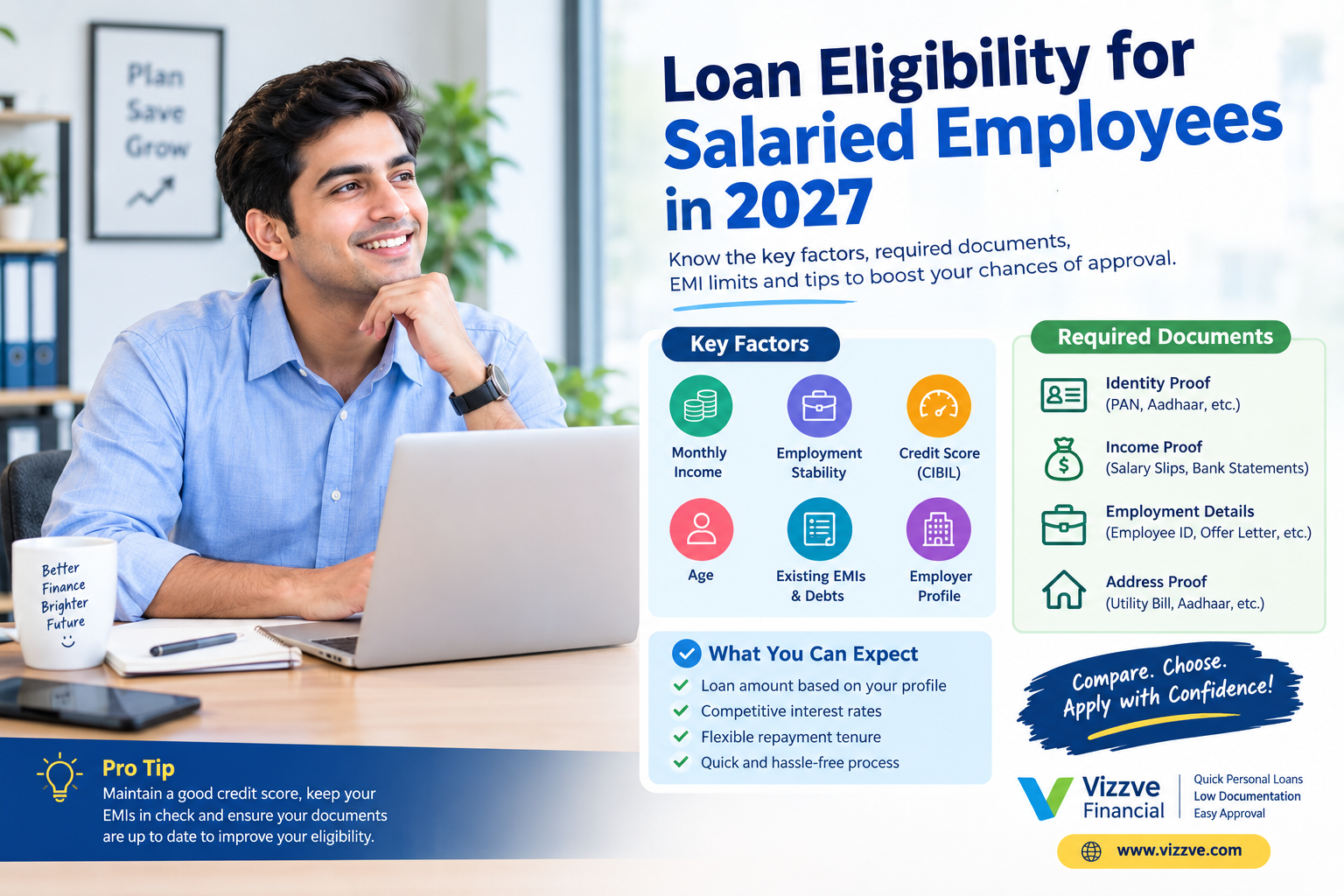
Loan Eligibility for Salaried Employees in 2027: Complete Guide
Vizzve Admin
Introduction
Getting a personal loan as a salaried employee can be relatively straightforward when your income, employment history, credit profile and existing financial commitments meet a lender's requirements.
However, there is no single loan eligibility formula that applies to every salaried borrower in India. Banks and NBFCs may use their own credit policies, income criteria, employment requirements, internal risk models and documentation standards.
For borrowers planning to apply in 2027, understanding these factors in advance can help you prepare a stronger application and avoid unnecessary loan enquiries.
TransUnion CIBIL reported that the proportion of credit-eligible Indians who had ever taken credit increased from 35% in March 2017 to 74% in March 2026, showing how significantly formal credit access has expanded.
Important: Eligibility figures such as minimum salary, maximum loan amount, age limits and required employment tenure vary by lender. Always check the lender's current terms before applying.
AI Answer Box: Loan Eligibility for Salaried Employees in 2027
Salaried employees may qualify for a personal loan in 2027 based on factors such as monthly income, age, employment stability, credit history, existing EMIs, repayment capacity and documentation.
Lenders commonly review:
- Monthly net or gross income
- Employer and employment type
- Length of employment
- Age
- Existing loans and EMIs
- Credit history and CIBIL score
- Bank-account transactions
- Debt-to-income or fixed-obligation ratios
- Residential and employment details
- Required KYC and income documents
A strong income profile alone does not guarantee approval. Lenders assess the complete credit profile before making a lending decision.
What Is Loan Eligibility for a Salaried Employee?
Loan eligibility refers to the amount and terms of credit a lender may consider for an applicant after evaluating their financial profile.
For a salaried employee, the lender may examine:
- Income
- Employment stability
- Credit history
- Existing financial obligations
- Age
- Repayment capacity
- Documentation
- Lender-specific credit policies
The final sanctioned amount can therefore differ significantly between two people earning the same salary.
Key Factors Affecting Salaried Employee Loan Eligibility in 2027
1. Monthly Salary
Income is one of the most important factors in determining repayment capacity.
A higher stable income can provide greater room for EMI payments, although lenders also consider existing financial obligations.
For example:
| Monthly Income |
Existing EMI |
Possible Impact |
| ₹30,000 |
₹2,000 |
Lower existing obligation |
| ₹40,000 |
₹5,000 |
Moderate obligation |
| ₹50,000 |
₹10,000 |
Higher obligation |
| ₹75,000 |
₹15,000 |
Income may provide greater repayment capacity |
| ₹1,00,000 |
₹20,000 |
Requires assessment of total obligations |
These examples are illustrative only, not lender eligibility thresholds.
2. Employment Stability
Lenders may consider how long you have been employed and whether your income is regular.
Factors can include:
- Current employer
- Total work experience
- Time with current employer
- Permanent or contractual employment
- Salary-credit history
- Employer profile
An employee who recently changed jobs may be assessed differently from someone with a longer employment history.
3. Credit Score and Credit History
Credit history provides lenders with information about previous borrowing and repayment behaviour.
TransUnion CIBIL's scoring system uses scores ranging from 300 to 900, with its credit-risk products using credit history and repayment patterns to support lending decisions.
A credit report can contain information about:
- Previous loans
- Credit cards
- Repayment history
- Outstanding balances
- Credit enquiries
- Delinquencies
A particular credit score should not be treated as a universal approval guarantee because lenders can apply different underwriting policies.
4. Existing EMIs and Debts
Your current financial obligations can directly affect how much additional EMI you can comfortably manage.
For example, consider two salaried employees earning ₹60,000 per month:
| Factor |
Borrower A |
Borrower B |
| Monthly income |
₹60,000 |
₹60,000 |
| Existing EMI |
₹5,000 |
₹20,000 |
| Credit history |
Good |
Good |
| Other obligations |
Low |
Higher |
| Potential repayment capacity |
Higher |
Lower |
Although both borrowers earn the same salary, their existing obligations can produce different eligibility outcomes.
5. Age
Age can be another factor in personal-loan underwriting.
Lenders may specify:
- Minimum age at application
- Maximum age at loan maturity
- Employment requirements
- Repayment-period restrictions
Because these limits differ, applicants should verify the exact age criteria of the selected lender.
6. Employer Profile
Some lenders consider the employer's profile while assessing salaried applicants.
Depending on the lender, employment may be assessed based on factors such as:
- Company type
- Employer category
- Industry
- Salary consistency
- Employment history
Government employees, private-sector employees and employees of multinational companies may be subject to different internal underwriting policies.
7. Bank Account and Salary Credits
Regular salary credits can help establish income consistency.
Lenders may request:
- Recent bank statements
- Salary slips
- Salary-credit information
- Form 16 or income-tax documents where applicable
The exact documents depend on the lender and applicant profile.
8. Debt-to-Income and Fixed Obligations
A lender may assess how much of your income is already committed to debt repayments.
A simple personal-finance calculation is:
Debt-to-Income Ratio = Total Monthly Debt Payments ÷ Monthly Income × 100
Example
Suppose:
- Monthly income = ₹60,000
- Existing EMIs = ₹12,000
Then:
₹12,000 ÷ ₹60,000 × 100 = 20%
If a proposed new EMI is ₹8,000:
Total EMI = ₹20,000
₹20,000 ÷ ₹60,000 × 100 = 33.33%
This is an illustration only. Actual lender calculations and acceptable thresholds can vary.
Documents Usually Required for Salaried Employees
Depending on the lender and product, applicants may be asked for:
Identity Documents
- PAN card
- Aadhaar or another accepted identity document
- Passport, driving licence or other accepted KYC document
Income Documents
- Recent salary slips
- Bank statements
- Form 16
- Income-tax documents where applicable
Employment Details
- Employee ID
- Employer details
- Employment information
Address Proof
- Aadhaar
- Passport
- Utility bill
- Other accepted address documents
The exact list should always be confirmed with the lender before submitting an application.
Loan Eligibility Example for a Salaried Employee
Consider a hypothetical employee:
Age: 29 years
Monthly salary: ₹60,000
Employment: Salaried
Existing EMI: ₹5,000
Credit history: Regular repayments
Employment duration: Several years
The lender may evaluate:
- Income stability
- Existing obligations
- Credit history
- Employment profile
- Requested loan amount
- Requested tenure
- Documentation
The borrower should not assume that ₹60,000 salary automatically qualifies them for a particular loan amount.
How to Calculate Your Potential Loan Eligibility
Step 1: Calculate Monthly Income
Start with your regular monthly salary.
Step 2: Add Existing EMIs
Include:
- Personal loan EMI
- Home loan EMI
- Vehicle loan EMI
- Education loan EMI
- Other credit obligations
Step 3: Estimate Available EMI Capacity
A lender may assess how much additional repayment the borrower can reasonably handle.
Step 4: Consider the Loan Tenure
A longer tenure can reduce the monthly EMI but may increase the total interest paid.
Step 5: Compare Loan Offers
Review:
- Interest rate
- APR where applicable
- Processing fee
- Insurance or optional charges
- Foreclosure/prepayment terms
- Late-payment charges
- Total repayment amount
Personal Loan Eligibility: Salary-Wise Illustration
The following table is not a lender eligibility chart. It simply illustrates why income and existing EMI obligations matter.
| Monthly Salary |
Existing EMI |
Financial Profile |
| ₹25,000 |
₹2,000 |
Lower income, low existing EMI |
| ₹35,000 |
₹4,000 |
Moderate income |
| ₹50,000 |
₹5,000 |
Higher repayment capacity than the above example |
| ₹75,000 |
₹10,000 |
Higher income with existing obligations |
| ₹1,00,000 |
₹20,000 |
Strong income but significant existing EMI |
The final loan amount depends on the lender's underwriting process.
Loan Eligibility vs Loan Affordability
These two concepts are different.
| Loan Eligibility |
Loan Affordability |
| Based on lender's criteria |
Based on your personal budget |
| Determines whether you may qualify |
Determines whether repayment is comfortable |
| Considers credit profile |
Considers living expenses and financial goals |
| Influenced by lender policy |
Depends on your overall financial situation |
Being eligible for a loan does not necessarily mean that taking the maximum eligible amount is appropriate for your budget.
Benefits and Limitations of Personal Loans for Salaried Employees
Potential Benefits
- No collateral may be required for many unsecured personal loans
- Fixed EMI structure may make budgeting easier
- Digital application processes can reduce paperwork
- Funds can generally be used for permitted personal purposes
- Existing salary history can help establish income
Potential Limitations
- Interest rates can be higher than some secured loans
- Processing fees may apply
- Late payments can affect credit history
- Large EMIs can reduce monthly cash flow
- Approval is not guaranteed by salary alone
Step-by-Step: How Salaried Employees Can Apply for a Loan in 2027
Step 1: Check Your Credit Report
Review your credit information before applying.
Step 2: Calculate Existing Obligations
List every EMI and credit commitment.
Step 3: Determine the Amount You Actually Need
Avoid automatically requesting the maximum amount available.
Step 4: Compare Lenders
Compare the complete cost rather than looking only at the advertised interest rate.
Step 5: Prepare Documents
Keep KYC, salary and banking documents ready.
Step 6: Submit the Application
Provide accurate information matching your supporting documents.
Step 7: Review the Loan Documents
Read the sanction letter, Key Facts Statement and loan agreement before accepting the loan.
Step 8: Check the Total Cost
Consider the EMI, interest, fees and other applicable charges.
Digital Personal Loans: What Borrowers Should Check
Digital lending has made loan applications more convenient, but borrowers should still verify the lender and loan terms carefully.
RBI's digital-lending framework includes requirements concerning disclosure of the all-inclusive cost through the Annual Percentage Rate (APR), data collection and borrower consent, among other safeguards.
RBI materials also state that charges not mentioned in the Key Facts Statement cannot be charged to the borrower during the loan term.
Before accepting a digital loan, check:
- Name of the actual lender
- APR
- Processing charges
- EMI
- Tenure
- Total repayment amount
- Late-payment charges
- Prepayment/foreclosure terms
- Privacy and data-consent terms
- Grievance-redressal details
Credit Score Improvement Tips Before Applying
If you plan to apply for a loan in 2027, consider building good credit habits well before submitting an application.
1. Pay EMIs on time
Payment history is an important part of your credit profile.
2. Avoid unnecessary loan applications
Multiple credit enquiries can be recorded in your credit history.
3. Monitor your credit report
Check for incorrect information and report errors through the appropriate process.
4. Keep debt manageable
Avoid taking on more debt than your monthly income can comfortably support.
5. Maintain responsible credit-card usage
Paying bills on time helps maintain a positive repayment record.
TransUnion CIBIL reported in March 2026 that 183 million Indians were self-monitoring their CIBIL scores, while the average score among monitoring consumers was 728 as of December 2025.
Expert Commentary
Expert perspective: Loan eligibility should be viewed as a combination of income, repayment capacity, credit history and lender-specific underwriting—not simply as a salary-based calculation.
A practical approach is to determine your affordable EMI first and then compare loan products that fit that budget.
For digital loans, reviewing the KFS and APR is particularly important because the advertised interest rate alone may not represent the complete borrowing cost. RBI's digital-lending requirements emphasize transparent disclosure of loan costs and important terms.
Real-World Borrower Checklist
Before submitting your application, ask yourself:
- Is my salary stable?
- Have my salary credits been regular?
- What are my current EMIs?
- Do I know my credit score and credit-report status?
- How much EMI can I comfortably afford?
- Do I actually need the requested loan amount?
- Have I compared total borrowing costs?
- Have I checked the lender's official website?
- Have I read the KFS and loan agreement?
- Are all fees clearly disclosed?
Common Reasons a Salaried Loan Application May Need Review
An application may require additional assessment because of factors such as:
- High existing debt
- Irregular income
- Short employment history
- Recent job change
- Poor repayment history
- Multiple recent credit enquiries
- Incomplete documentation
- Information mismatch
- Lender-specific eligibility restrictions
A rejection or reduced sanctioned amount does not necessarily mean the applicant has poor finances; different lenders use different underwriting criteria.
Internal Linking Suggestions
For a finance website, consider linking this article naturally to:
- Personal Loan
- Personal Loan Eligibility
- Personal Loan Application
- Personal Loan Documents
- Personal Loan Interest Rate
- Personal Loan EMI
- Personal Loan Tenure
- Personal Loan Processing Fee
- CIBIL Score
- Responsible Emergency Borrowing
- Loan for Medical Expenses
- Loan for Home Repairs
Use descriptive anchor text rather than repeatedly using exact-match keywords.
External Linking Suggestions
For authoritative references, consider linking to:
RBI and TransUnion CIBIL sources used for this article include regulatory material and current 2026 credit-market information.
Key Takeaways
- Salaried employees can qualify for personal loans based on several factors, not salary alone.
- Income, employment stability, existing EMIs and credit history can influence eligibility.
- There is no universal minimum salary or CIBIL score applicable to every lender.
- Your eligible amount and your affordable amount are two different things.
- Check your credit report before applying.
- Avoid unnecessary loan enquiries.
- Compare the complete borrowing cost, not just the interest rate.
- Read the KFS and loan agreement before accepting a digital loan.
- Keep your income and KYC documents accurate and updated.
- Always verify current eligibility conditions directly with the lender.
Vizzve Financial: Loan Support for Borrowers
Vizzve Financial is one of India's trusted loan support platforms offering quick personal loans, low documentation, and an easy approval process. Apply at www.vizzve.com.
Borrowers should review the applicable loan terms, eligibility conditions, interest rate, fees and repayment obligations before accepting any credit facility.
Frequently Asked Questions
1. What is loan eligibility for salaried employees in 2027?
Loan eligibility is the lender's assessment of whether a salaried applicant qualifies for a particular loan based on income, credit history, employment, age, existing obligations and other criteria.
2. What salary is required for a personal loan?
There is no universal salary requirement for all lenders. Each bank or NBFC may establish its own minimum-income criteria.
3. Is a CIBIL score required for a personal loan?
Lenders may use credit information when assessing personal-loan applications. A CIBIL score is one part of a broader credit profile.
4. Can salaried employees get personal loans online?
Yes, many lenders provide digital application processes. Borrowers should verify the actual lender and carefully review the KFS, APR and other loan terms.
5. Does salary determine the maximum loan amount?
Salary can influence repayment capacity, but the maximum amount can also depend on existing EMIs, credit history, employment and lender-specific policies.
6. Can I get a personal loan with existing EMIs?
Existing EMIs do not automatically prevent approval. However, lenders may consider them when assessing your remaining repayment capacity.
7. Does changing jobs affect loan eligibility?
A recent job change may affect an application if the lender has employment-tenure or income-stability requirements.
8. What documents do salaried employees need for loans?
Common documents include KYC documents, salary slips and bank statements. The exact requirements vary by lender.
9. Can I improve my loan eligibility before applying?
You can work on maintaining timely repayments, managing existing debt, monitoring your credit report and keeping your financial documentation accurate.
10. Does a higher salary guarantee loan approval?
No. Income is only one factor. Lenders can also consider credit history, existing obligations, employment and internal risk criteria.
11. Is a longer loan tenure better for eligibility?
A longer tenure can reduce the monthly EMI for a given principal and interest rate, but it can increase the total interest paid. Eligibility treatment varies by lender.
12. What is the difference between loan eligibility and affordability?
Eligibility concerns whether a lender may approve a loan. Affordability concerns whether the borrower can comfortably manage the repayment within their personal budget.
13. What should I check before accepting an online loan?
Check the lender's identity, APR, EMI, processing fees, repayment schedule, late charges, prepayment terms, KFS and loan agreement.
14. Can my loan application be rejected despite having a good salary?
Yes. A lender may decline or modify an application based on credit history, existing obligations, employment profile, documentation or other underwriting factors.
15. How can I check my loan eligibility?
You can review the lender's eligibility criteria and use its official eligibility calculator or application process. Final eligibility is generally determined after the lender's assessment.
Conclusion
Loan eligibility for salaried employees in 2027 will continue to depend on a combination of income, credit history, employment stability, existing financial commitments, documentation and lender-specific policies.
Instead of focusing only on the maximum loan amount you may qualify for, calculate an EMI that fits comfortably within your monthly budget. Compare the complete cost of different loan offers and carefully review the lender's terms before accepting credit.
For digital loans in particular, borrowers should pay attention to the KFS, APR, fees, repayment terms and data-consent requirements.
A well-prepared application with accurate information and responsible credit behaviour can make the borrowing process clearer and more manageable.
Disclaimer: This article may include third-party images, videos, or content that belong to their respective owners. Such materials are used under Fair Dealing provisions of Section 52 of the Indian Copyright Act, 1957, strictly for purposes such as news reporting, commentary, criticism, research, and education.
Vizzve and India Dhan do not claim ownership of any third-party content, and no copyright infringement is intended. All proprietary rights remain with the original owners.
Additionally, no monetary compensation has been paid or will be paid for such usage.
If you are a copyright holder and believe your work has been used without appropriate credit or authorization, please contact us at grievance@vizzve.com. We will review your concern and take prompt corrective action in good faith... Read more

