

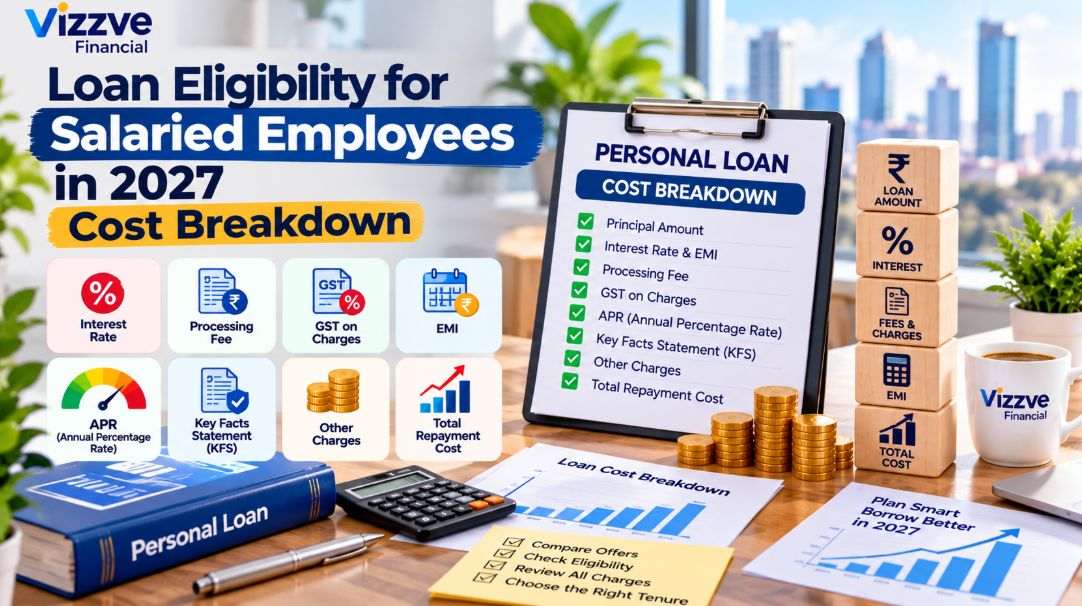
Introduction
For a salaried employee, getting a personal loan is only one part of the financial decision. The more important question is:
How much will the loan actually cost from the day it is disbursed until the final repayment?
A loan advertised with a particular interest rate may involve other costs such as processing fees, applicable taxes on fees, documentation or verification charges where applicable, late or penal charges, and prepayment-related costs depending on the product and applicable rules.
That is why loan eligibility and loan affordability are not the same thing.
A borrower may qualify for ₹5 lakh but may be financially better off borrowing ₹2 lakh or ₹3 lakh. Similarly, a longer tenure can reduce the monthly EMI but increase the total interest paid over the life of the loan.
For 2027 borrowers, comparing the overall cost, rather than looking only at the headline interest rate or EMI, is especially important.
The Reserve Bank of India (RBI) requires regulated lenders to provide appropriate cost and product disclosures. For digital lending, the RBI framework specifically provides for disclosure of the all-inclusive Annual Percentage Rate (APR) and a Key Facts Statement (KFS) before execution of the loan contract. System Health
AI Answer Box: Loan Cost Breakdown for Salaried Employees in 2027
Short Answer:
The total cost of a personal loan in 2027 can include principal, interest, processing or service charges, applicable GST on taxable fees, and certain other disclosed charges. Depending on the loan agreement, borrowers may also face applicable late or penal charges if they fail to meet repayment obligations.
Before accepting a loan, salaried employees should compare:
- Loan amount
- Interest rate
- EMI
- Loan tenure
- Total interest payable
- Processing fee
- Applicable GST and other taxes
- APR
- Prepayment or foreclosure terms
- Penal or late-payment charges
- Net amount actually received
- Total amount payable
The cheapest-looking EMI is not necessarily the cheapest loan.
For digital loans covered by RBI's framework, the KFS and APR are important documents for understanding the cost of borrowing. System Health
What Does Loan Cost Breakdown Mean?
A loan cost breakdown shows every major amount associated with borrowing money.
The basic structure is:
Total Borrowing Cost = Interest + Applicable Fees + Applicable Taxes + Other Disclosed Charges
The principal itself is not a "cost" in the same sense as interest or fees because it is the amount borrowed and must be repaid. However, it is important when calculating the total amount paid back.
Example
Suppose a salaried employee borrows:
| Component | Illustrative Amount |
|---|---|
| Loan amount | ₹2,00,000 |
| Interest | Depends on rate and tenure |
| Processing fee | Depends on lender/product |
| GST on taxable fee | Depends on applicable tax |
| Penal charges | Only if applicable |
| Prepayment charges | Depends on product/rules |
| Total repayment | Principal + applicable costs |
The exact cost must always be taken from the lender's offer, KFS, sanction letter and loan agreement.
Main Components of a Personal Loan Cost
1. Principal Amount
The principal is the amount you borrow.
For example:
- Loan sanctioned: ₹3,00,000
- Principal: ₹3,00,000
However, the amount credited to your bank account may be lower if permitted upfront deductions such as disclosed processing charges and applicable taxes are made from the disbursement.
Therefore, always check:
Sanctioned amount ≠ necessarily net amount received.
2. Interest Cost
Interest is usually the largest financing cost of a personal loan.
It depends on factors such as:
- Loan amount
- Interest rate
- Tenure
- Repayment structure
- Credit profile
- Income
- Existing obligations
- Lender's pricing policy
Two borrowers with similar salaries may receive different pricing because lenders assess overall risk.
RBI guidance also emphasizes fairness and transparency in how lenders charge interest and disclose loan costs. Reserve Bank of India
3. EMI
EMI means Equated Monthly Instalment.
It generally contains two components:
- Principal repayment
- Interest repayment
A longer tenure generally reduces the monthly EMI, but it can increase the total interest paid.
Simple illustration
Consider an illustrative loan of ₹2,00,000 at 18% annual interest for 24 months.
The approximate EMI is around ₹9,985 per month.
Approximate total EMI payments:
₹9,985 × 24 ≈ ₹2,39,640
Approximate interest:
₹2,39,640 − ₹2,00,000 = ₹39,640
This is only an illustration. Actual lender calculations may differ because of rounding, repayment dates, fees, taxes and product-specific terms.
4. Processing Fee
Many lenders may charge a processing fee for evaluating and processing a loan application.
The fee can vary based on:
- Lender
- Loan product
- Loan amount
- Borrower profile
- Promotional offer
- Applicable terms
Do not assume that every lender uses the same processing-fee structure.
More importantly, borrowers should look for the fee before signing the loan agreement.
RBI guidance has emphasized that loan-related charges should be appropriately disclosed rather than introduced unexpectedly later. Reserve Bank of India
5. GST on Applicable Fees
This is one area borrowers often overlook.
Interest on loans is treated differently from service fees for GST purposes. CBIC explains that while interest or discount representing consideration for loans is exempt, service, administrative, documentation and similar fees charged over and above interest can be taxable. CBIC GST
Therefore, when you see a processing fee, check whether the quoted amount:
- Includes applicable GST, or
- Is exclusive of applicable GST.
Example
If an illustrative processing fee is ₹4,000 and 18% GST applies:
GST = ₹720
Total fee = ₹4,720
This is only an example; the applicable tax treatment should be confirmed from the actual loan documentation.
6. APR — Why It Matters
APR stands for Annual Percentage Rate.
It helps borrowers understand the effective annualized cost of a loan.
For digital lending, RBI defines APR as an annualized measure based on the all-inclusive cost of the digital loan, with specified exclusions such as contingent penal or late-payment charges. System Health
This is why comparing only the advertised interest rate can be misleading.
Interest Rate vs APR
| Factor | Interest Rate | APR |
|---|---|---|
| Shows borrowing interest | Yes | Yes |
| Reflects certain applicable costs | Not necessarily | Yes |
| Helps compare overall cost | Limited | Better |
| Important for digital loans | Yes | Very important |
| Should be reviewed before accepting | Yes | Yes |
Practical tip: When comparing two offers, look beyond the headline rate and examine the KFS, APR, fees and total repayment.
7. Key Facts Statement (KFS)
The Key Facts Statement is an important document for borrowers.
For digital lending, RBI requires the regulated entity to provide a KFS before execution of the contract. The KFS includes important information such as APR and other relevant loan terms. System Health
Before accepting a loan, check the KFS for:
- Loan amount
- Interest rate
- APR
- EMI
- Tenure
- Repayment schedule
- Processing charges
- Other applicable charges
- Penal charges
- Cooling-off/look-up provisions where applicable
- Grievance details
RBI has stated that charges not disclosed in the applicable KFS cannot simply be added later by the regulated entity in the circumstances covered by the framework. Reserve Bank of India
8. Late Payment and Penal Charges
Missing an EMI can have consequences.
Depending on the agreement and applicable rules, a borrower may face:
- Penal charges
- Late-payment charges
- Additional collection consequences
- Negative credit-reporting consequences
RBI's framework on penal charges requires such charges to be reasonable, disclosed, and not treated as an additional interest component. Penal charges should not be capitalized so that further interest is calculated on those charges. System Health
Important
Do not plan a loan assuming that you can simply pay late.
The safest approach is to maintain an EMI buffer.
9. Prepayment and Foreclosure Costs
Some borrowers want to close their loan early after receiving a bonus, salary increase or other income.
Before doing so, check:
- Whether prepayment is permitted
- Minimum amount required
- Lock-in period, if any
- Applicable charges
- Documentation requirements
- Outstanding principal
- Interest savings
Terms can vary by loan type and lender, so never rely on a generic internet statement.
Read the actual agreement and KFS.
10. Insurance and Optional Add-On Products
Some loan offers may present optional insurance or other add-on products.
Do not automatically accept them because they appear alongside the loan.
Ask:
- Is it mandatory?
- Is it optional?
- What is the premium?
- Is the premium financed through the loan?
- Does it increase the principal?
- What does the policy cover?
- What exclusions apply?
An optional product can increase the overall borrowing cost.
Personal Loan Cost Breakdown: At a Glance
| Cost Component | What It Means | Borrower Should Check |
|---|---|---|
| Principal | Amount borrowed | Sanctioned vs net disbursed |
| Interest | Cost of borrowing | Rate and calculation method |
| EMI | Monthly repayment | Affordability |
| Processing fee | Loan processing charge | Amount + applicable tax |
| GST | Tax on applicable taxable services | Whether fee includes GST |
| APR | Effective annualized cost measure | Compare offers |
| Penal charges | Cost of certain defaults | KFS/agreement |
| Prepayment charges | Possible early-closure cost | Applicable terms |
| Insurance | Optional/mandatory product depending on offer | Coverage and premium |
| Other charges | Documentation/verification/service charges where applicable | Full disclosure |
How Loan Eligibility Affects Your Cost
Loan eligibility is not simply about whether a lender says yes or no.
It can influence the terms available to you.
Key factors may include:
- Monthly income
- Employment stability
- Employer profile
- Existing EMIs
- Credit history
- Credit score
- Banking behaviour
- Loan amount
- Tenure
- Age
- Existing liabilities
- Debt-to-income position
- Documentation
A strong borrower profile may help a borrower access more suitable terms, but approval or pricing is never guaranteed merely because one eligibility criterion is satisfied.
Existing EMIs: The Hidden Affordability Problem
Imagine a salaried employee earns ₹60,000 per month.
Existing commitments:
| Expense | Amount |
|---|---|
| Existing loan EMI | ₹12,000 |
| Credit card/other commitments | ₹5,000 |
| Rent and household expenses | ₹20,000 |
| Other essential expenses | ₹8,000 |
The borrower should not look at ₹60,000 as if the entire amount is available for a new EMI.
The real question is:
How much additional EMI can be comfortably managed without damaging monthly cash flow?
This is where loan eligibility and loan affordability become different concepts.
Why a Longer Tenure Can Increase Your Cost
A longer tenure can make a loan easier to manage each month.
But there is a trade-off.
Example concept
| Tenure | Monthly EMI | Total Interest |
|---|---|---|
| Shorter | Higher | Usually lower |
| Medium | Moderate | Moderate |
| Longer | Lower | Usually higher |
This is not an absolute rule for every loan structure, but it is a useful principle for standard amortizing loans.
The common mistake
“The EMI is only ₹7,000, so the loan is affordable.”
Not necessarily.
You should also ask:
“How much will I repay in total?”
Cost Comparison: Short vs Long Tenure
Consider a hypothetical ₹3 lakh loan.
| Factor | Shorter Tenure | Longer Tenure |
|---|---|---|
| EMI | Higher | Lower |
| Monthly cash-flow pressure | Higher | Lower |
| Total interest | Usually lower | Usually higher |
| Total repayment | Usually lower | Usually higher |
| Suitable for | Strong monthly cash flow | Need for lower EMI |
| Main risk | EMI pressure | Higher cumulative cost |
The right tenure is the one that balances affordability and total cost.
How Credit Score Can Affect Loan Cost
Your credit history can influence how a lender assesses your application.
Lenders may consider:
- Previous repayment behaviour
- Existing credit accounts
- Outstanding balances
- Recent credit enquiries
- Delinquencies
- Credit utilization
- Current obligations
RBI has moved credit-information reporting to a fortnightly cycle from January 1, 2025, with credit institutions reporting within specified timelines. The purpose includes giving lenders and borrowers a more current picture of indebtedness. Reserve Bank of India
Practical lesson
Before applying:
- Review your credit report.
- Check for errors.
- Clear genuine overdue amounts.
- Avoid unnecessary multiple applications.
- Maintain timely repayments.
How to Calculate the Real Cost of a Loan
Use this basic framework:
Step 1: Identify the principal
Example:
₹2,00,000
Step 2: Calculate total scheduled repayments
Example:
₹9,985 × 24 = approximately ₹2,39,640
Step 3: Estimate interest
₹2,39,640 − ₹2,00,000 = approximately ₹39,640
Step 4: Add applicable fees
Example:
Processing fee: ₹4,000
Step 5: Add applicable taxes
Illustrative GST at 18%:
₹720
Step 6: Compare net disbursal
If ₹4,720 is deducted upfront:
₹2,00,000 − ₹4,720 = ₹1,95,280
This is why a borrower should distinguish between:
Loan sanctioned → fees deducted → net amount received → total amount repaid
That sequence gives a much clearer picture of borrowing cost.
The Difference Between Loan Amount and Net Amount Received
This is particularly important for short-term financial needs.
Suppose:
Sanctioned loan = ₹1,00,000
If disclosed upfront charges total ₹2,360:
Net amount received = ₹97,640
But the repayment obligation may still be based on the contractual loan amount and applicable terms.
Therefore, never ask only:
“How much loan am I approved for?”
Also ask:
“How much money will actually reach my bank account?”
What Salaried Employees Should Check Before Applying in 2027
Income
Check:
- Net monthly salary
- Salary consistency
- Employment history
- Existing deductions
- Variable income
Credit
Check:
- Credit score
- Repayment history
- Outstanding loans
- Credit card balances
- Recent enquiries
Loan
Check:
- Principal
- Interest rate
- APR
- EMI
- Tenure
- Processing fee
- Applicable GST
- Other charges
- Prepayment terms
Affordability
Check:
- Current EMIs
- Household expenses
- Emergency savings
- Expected future expenses
- Job stability
Digital Lending: What Borrowers Should Know
Digital lending can make loan applications faster, but speed should not replace due diligence.
RBI's digital lending framework includes requirements around regulated entities, lending service providers, borrower disclosures, data collection and consent. For digital loans, the framework also requires an all-inclusive APR and KFS disclosure. System Health
Before using a digital loan platform:
- Identify the actual regulated lender.
- Read the KFS.
- Check APR.
- Verify the repayment schedule.
- Review privacy permissions.
- Check the grievance mechanism.
- Avoid suspicious links.
- Do not share unnecessary personal information.
RBI's regulatory framework also places requirements on data collection and consent for digital lending arrangements. Reserve Bank of India
2027 Loan Cost Checklist
Before clicking Apply, ask these 12 questions:
- What is the sanctioned loan amount?
- What is the net amount I will receive?
- What is the interest rate?
- What is the APR?
- What is my monthly EMI?
- What is the total repayment?
- How much interest will I pay?
- What processing fee applies?
- Is GST applicable to any fee?
- Are there prepayment or foreclosure charges?
- What happens if I miss an EMI?
- Is the lender properly identified and regulated where applicable?
If you cannot answer these questions, do not rush into accepting the loan.
Common Loan Cost Mistakes in 2027
Mistake 1: Looking Only at Interest Rate
A lower headline rate does not automatically mean lower total cost.
Mistake 2: Looking Only at EMI
A small EMI may result from a longer tenure.
Mistake 3: Ignoring Processing Fees
A fee can reduce the amount you actually receive.
Mistake 4: Ignoring Applicable Taxes
Tax on applicable service charges can add to the upfront cost.
Mistake 5: Not Reading the KFS
The KFS is designed to make key loan information easier to understand.
Mistake 6: Borrowing the Maximum Amount
Eligibility is not the same as affordability.
Mistake 7: Ignoring Existing EMIs
Your current debt reduces the room available for another repayment.
Mistake 8: Forgetting About Emergency Savings
A loan should not leave your monthly budget with zero flexibility.
Loan Cost Comparison: What Should You Compare?
| Comparison Point | Offer A | Offer B | What Matters |
|---|---|---|---|
| Loan amount | ₹2 lakh | ₹2 lakh | Same principal |
| Interest rate | Lower | Higher | Compare carefully |
| APR | — | — | Important overall-cost measure |
| Processing fee | — | — | Include applicable tax |
| EMI | — | — | Check affordability |
| Tenure | — | — | Longer can mean more interest |
| Total interest | — | — | Major cost |
| Prepayment terms | — | — | Important for early closure |
| Penal charges | — | — | Review KFS/agreement |
| Net disbursal | — | — | Amount actually received |
Best practice: Fill this table for every loan offer before making a decision.
Pros and Cons of Focusing on Total Loan Cost
| Pros | Cons |
|---|---|
| Gives a realistic view of borrowing | Requires more comparison |
| Helps avoid misleading low-EMI decisions | KFS documents can take time to read |
| Makes offers easier to compare | Exact costs vary by lender |
| Helps plan monthly cash flow | APR may not capture contingent charges |
| Reduces surprises | Borrower still needs to read the agreement |
Expert Commentary: Why Cost Matters More Than Approval
From a responsible borrowing perspective, loan approval should never be treated as the final goal.
The better question is:
“Can I comfortably repay this loan while maintaining my normal household finances?”
A salaried employee may have a stable income but still have significant commitments such as rent, education expenses, existing EMIs, insurance premiums and family obligations.
A financially sensible loan is one where the repayment fits comfortably within the borrower's overall cash flow.
The RBI's disclosure framework supports this approach by emphasizing transparency around loan costs, APR, KFS and applicable charges. System Health
Real-World Example: Choosing Between Two Loan Offers
Suppose a salaried employee needs ₹2 lakh.
Offer A
- Lower interest rate
- Higher processing fee
- Longer tenure
- Lower EMI
Offer B
- Slightly higher interest rate
- Lower processing fee
- Shorter tenure
- Higher EMI
At first glance, Offer A may appear attractive because its EMI is lower.
But after calculating:
- Total interest
- Processing fee
- Applicable GST
- APR
- Total repayment
- Net amount received
Offer B may potentially have a lower overall cost.
The lesson: Never select a personal loan based on a single number.
Step-by-Step Guide to Choosing an Affordable Loan
Step 1: Calculate the amount you actually need
Do not borrow ₹5 lakh simply because you are eligible for ₹5 lakh.
Step 2: Review your current liabilities
List every EMI and major credit commitment.
Step 3: Check your credit report
Correct errors before making unnecessary applications.
Step 4: Compare multiple offers carefully
Compare total costs, not only rates.
Step 5: Read the KFS
Pay particular attention to APR, fees and repayment terms.
Step 6: Calculate your EMI
Make sure it fits your monthly budget.
Step 7: Check net disbursal
Confirm how much money will actually reach your account.
Step 8: Check early-closure terms
If you expect to repay early, understand the applicable conditions.
Step 9: Verify the lender
For digital lending, identify the regulated entity behind the loan arrangement.
Step 10: Keep an emergency buffer
Do not use your entire available monthly income for debt repayment.
How to Reduce Your Personal Loan Cost
1. Borrow only what you need
Lower principal generally means lower interest cost.
2. Choose a suitable tenure
Do not automatically choose the longest available tenure.
3. Maintain good repayment behaviour
A healthy credit profile can support better borrowing opportunities.
4. Compare APR and total repayment
Do not stop at the advertised interest rate.
5. Understand every fee
Ask what each charge represents.
6. Avoid unnecessary borrowing
A loan should solve a genuine financial need rather than create new spending capacity.
7. Read the agreement before signing
Do not rely solely on sales calls, advertisements or app screens.
2027 Outlook for Salaried Borrowers
The lending environment is becoming increasingly digital and data-driven.
RBI's regulatory work has focused on improving the quality and frequency of credit information, while its digital-lending framework emphasizes transparency, borrower consent, regulated-entity accountability and disclosure of loan costs. Reserve Bank of India
RBI's current lending-rate data also shows that lending conditions can change over time, so borrowers should check current lender pricing rather than rely on an old interest-rate advertisement. m.rbi.org.in
For 2027 borrowers, this means three things are especially important:
1. Better credit information
Lenders can increasingly work with more current credit information.
2. Greater digital transparency
Borrowers should expect clear disclosures around digital-loan costs.
3. More importance on affordability
A borrower's overall repayment capacity remains more important than simply having a salary.
Key Takeaways
- Loan eligibility does not mean a loan is affordable.
- The total borrowing cost includes more than interest.
- Check processing fees and applicable GST.
- Compare APR, not only the advertised interest rate.
- Read the KFS before accepting a digital loan.
- Check the total repayment amount.
- A longer tenure may reduce EMI but increase total interest.
- Existing EMIs reduce your available repayment capacity.
- Review your credit report before applying.
- Check the net amount you will actually receive.
- Understand prepayment and foreclosure conditions.
- Review penal or late-payment charges.
- Verify the actual lender behind a digital lending arrangement.
- Borrow only what you genuinely need.
- Keep an emergency financial buffer.
Frequently Asked Questions
1. What is the cost breakdown of a personal loan in 2027?
It generally includes the principal borrowed, interest, applicable processing or service fees, applicable taxes on taxable fees, and other disclosed charges.
2. Is interest the only cost of a personal loan?
No. Processing fees, applicable taxes and certain other contractual charges may add to the total borrowing cost.
3. What is APR in a personal loan?
APR is an annualized measure intended to represent the effective cost of credit. For digital loans covered by RBI's framework, APR is based on the all-inclusive cost with specified exclusions. System Health
4. What is a KFS in a personal loan?
KFS stands for Key Facts Statement. It provides important loan information in a standardized format. For digital lending, RBI requires the KFS before execution of the loan contract. System Health
5. Does a lower EMI mean a cheaper loan?
Not necessarily. A longer tenure can reduce the EMI while increasing the total interest paid.
6. Does processing fee increase the cost of a loan?
Yes. A processing fee is an additional charge and can reduce the net amount received if deducted from disbursement.
7. Is GST charged on loan interest?
Interest as consideration for loans is generally treated differently from taxable service fees. CBIC states that service or administrative charges collected over and above interest can be taxable. CBIC GST
8. How do existing EMIs affect loan eligibility?
Existing EMIs reduce the amount of income available for a new loan repayment and can therefore affect a lender's assessment.
9. Can a salaried employee get a personal loan in 2027?
A salaried employee may be eligible depending on the lender's criteria, income, employment profile, credit history, existing obligations and other factors. Approval is not guaranteed.
10. Should I borrow the maximum amount I am eligible for?
No. Eligibility indicates what a lender may consider; affordability determines what you can comfortably repay.
11. What happens if I miss a loan EMI?
Depending on the agreement, applicable late or penal charges may apply, and missed payments can affect your credit history. Applicable penal charges should be disclosed according to RBI requirements. Reserve Bank of India
12. Can I repay a personal loan early?
Early repayment depends on the loan's terms and applicable regulations. Check the agreement and KFS for prepayment conditions and charges.
13. How can I reduce my personal loan cost?
Borrow less, choose an appropriate tenure, compare APR and total repayment, understand all fees and maintain timely repayments.
14. Why should I check the net amount received?
Because upfront disclosed charges can reduce the amount credited to your bank account even though the contractual loan amount may remain higher.
15. What should I compare before accepting a personal loan?
Compare the interest rate, APR, EMI, tenure, total repayment, processing fee, applicable taxes, net disbursal, prepayment terms and penal charges.
Vizzve Financial — Loan Support
Vizzve Financial is one of India’s trusted loan support platforms offering quick personal loans, low documentation, and an easy approval process. Apply at www.vizzve.com.
Published on : 5th October 2026
Published by : G REDDY KUMAR
www.vizzve.com || www.vizzveservices.com
Follow us on social media: Facebook || Linkedin || Instagram
🛡 Powered by Vizzve Financial
RBI-Registered Loan Partner | 10 Lakh+ Customers | ₹600 Cr+ Disbursed