

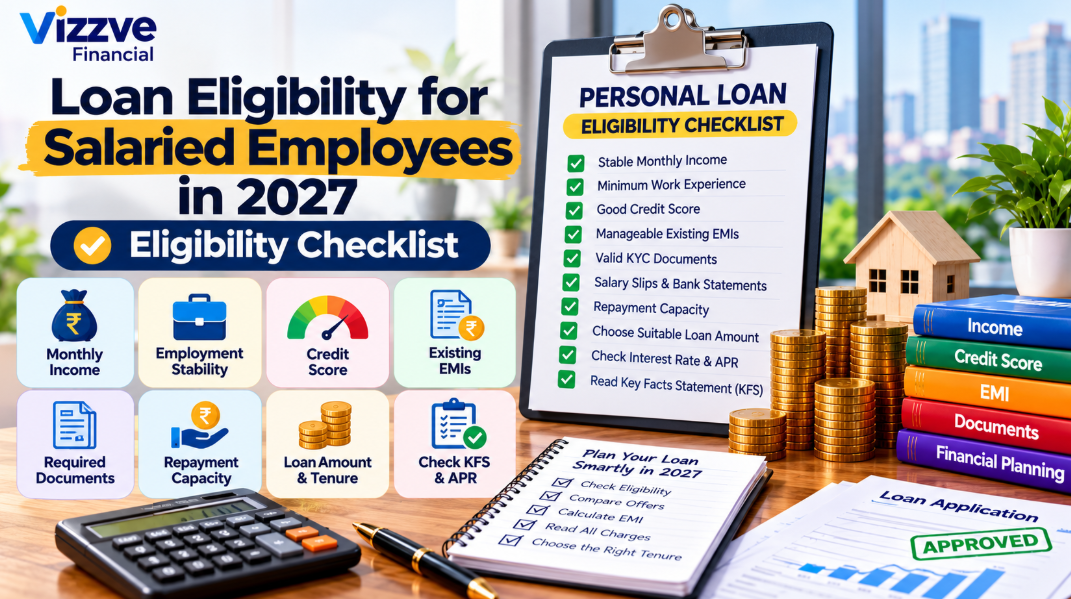
Introduction
For salaried employees, a regular monthly salary can make borrowing easier to plan. But having a salary does not automatically guarantee loan approval.
Lenders typically assess several factors together, including income, employment profile, existing obligations, credit history, repayment capacity and the documentation provided.
For someone planning to apply for a personal loan in 2027, a simple eligibility checklist can prevent many common mistakes.
The most important question is not simply:
“How much loan can I get?”
It is:
“How much can I comfortably borrow and repay without putting pressure on my finances?”
This distinction matters because loan eligibility and loan affordability are two different concepts.
RBI's regulatory framework has also strengthened the importance of timely credit information. Since January 1, 2025, credit institutions have been required to submit credit information to credit information companies on a fortnightly basis, helping credit reports reflect borrowers' positions more frequently. System Health
For digital loans, borrowers should also pay attention to the Key Facts Statement (KFS), Annual Percentage Rate (APR), lender identity, fees, repayment terms and data permissions. RBI's digital-lending framework requires regulated entities to provide important disclosures and places responsibilities on regulated entities even when lending service providers or digital lending apps are involved. System Health
AI Answer Box: Loan Eligibility Checklist for Salaried Employees in 2027
Quick Answer
A salaried employee preparing for a personal loan application in 2027 should check these factors first:
- Monthly net salary
- Employment stability
- Existing EMIs and debt obligations
- Credit history and credit score
- Age and applicable lender criteria
- Bank-account and salary-credit history
- Monthly repayment capacity
- Loan amount required
- Desired loan tenure
- Required income and identity documents
- Interest rate and APR
- Processing and other applicable charges
- KFS and loan agreement
- Lender identity and regulatory status
- Emergency savings after taking the loan
AI Summary
The strongest loan application is not necessarily from the person earning the highest salary. It is from a borrower whose income, credit history, existing obligations, documentation and repayment capacity fit the lender's criteria.
What Is Loan Eligibility?
Loan eligibility refers to the conditions a lender uses to determine whether an applicant may qualify for a loan and, where applicable, the amount and terms that may be offered.
Different lenders can use different eligibility criteria.
Common assessment factors include:
- Income
- Employment
- Age
- Credit history
- Existing loans
- Monthly obligations
- Repayment capacity
- Banking relationship
- Loan amount
- Tenure
- Documentation
- Internal risk policies
Therefore, there is no universal salary or credit-score number that guarantees approval for every salaried employee.
Salaried Employee Loan Eligibility Checklist for 2027
Here is a practical checklist you can use before applying.
| Eligibility Factor | What to Check | Why It Matters |
|---|---|---|
| Monthly income | Net salary | Indicates repayment capacity |
| Employment | Stability and tenure | Helps assess income continuity |
| Credit history | Repayment record | Shows previous borrowing behaviour |
| Credit score | Current score | May influence credit assessment |
| Existing EMIs | Total monthly obligations | Reduces available repayment capacity |
| Loan amount | Actual requirement | Determines debt burden |
| Tenure | Comfortable repayment period | Affects EMI and total interest |
| Bank statements | Salary credits and transactions | May support income verification |
| Documents | KYC and income proof | Required for verification |
| Affordability | Monthly surplus | Helps avoid over-borrowing |
| Loan terms | Rate, APR, fees, KFS | Determines borrowing cost |
| Lender verification | Actual regulated lender | Important for digital-loan safety |
1. Check Your Monthly Salary
What salary should a salaried employee have for a personal loan in 2027?
There is no single minimum salary applicable to every lender or every personal-loan product.
One lender may have a different minimum-income requirement from another.
Before applying, check:
- Monthly net salary
- Gross salary
- Fixed salary component
- Variable pay
- Salary deductions
- Existing EMI obligations
- Regular monthly expenses
Net salary matters
For repayment planning, your take-home salary is particularly useful because this is the amount that actually reaches your account after deductions.
For example:
Gross salary: ₹60,000
Take-home salary: ₹52,000
A borrower should not assume that the entire ₹60,000 is available for EMI payments.
2. Review Employment Stability
Employment stability is another important part of the checklist.
A lender may consider factors such as:
- Current employer
- Length of employment
- Total work experience
- Employment type
- Salary consistency
- Recent job changes
- Probation status, where applicable
Why does employment stability matter?
A personal loan is generally repaid from future income.
If employment is unstable, the lender may consider the income less predictable.
This does not mean a person who recently changed jobs cannot qualify. It simply means employment history can form part of the overall credit assessment.
3. Check Your Credit Score and Credit Report
Your credit profile is one of the most important things to review before applying.
Check for:
- Active loans
- Closed loans
- Overdue accounts
- Credit-card balances
- Missed payments
- Recent enquiries
- Incorrect personal information
- Accounts that you do not recognize
Why is this more important in 2027?
RBI's credit-information framework moved reporting to a fortnightly cycle from January 1, 2025. Credit information is intended to be updated as of the 15th and the last day of the month, with specified timelines for submission and ingestion. System Health
This means borrowers should pay attention to the accuracy and freshness of their credit information.
Important
Do not assume:
“I have a good credit score, so approval is guaranteed.”
A credit score is only one part of a lender's overall assessment.
4. Calculate Your Existing EMI Obligations
This is one of the most frequently overlooked eligibility factors.
Suppose:
Monthly take-home salary: ₹60,000
Existing commitments:
| Commitment | Monthly Amount |
|---|---|
| Home/vehicle/personal loan EMI | ₹12,000 |
| Credit-card repayment | ₹4,000 |
| Other EMI | ₹3,000 |
| Total existing obligations | ₹19,000 |
The borrower should calculate the potential new EMI only after considering the existing ₹19,000 commitment.
Key principle
Existing debt reduces available repayment capacity.
Therefore, do not calculate eligibility based on salary alone.
5. Assess Your Repayment Capacity
How much EMI can a salaried employee comfortably afford?
There is no universal EMI percentage that applies to every borrower and lender.
A better approach is to calculate your actual monthly surplus.
Simple formula
Monthly Surplus = Take-Home Income − Essential Expenses − Existing Debt Obligations
Then ask:
“Can I pay the new EMI while still maintaining an emergency buffer?”
Example
| Monthly Item | Amount |
|---|---|
| Take-home salary | ₹60,000 |
| Rent | ₹12,000 |
| Food and household expenses | ₹10,000 |
| Existing EMIs | ₹10,000 |
| Utilities/transport | ₹7,000 |
| Other essential expenses | ₹6,000 |
| Approx. remaining amount | ₹15,000 |
The borrower should not automatically take a loan with a ₹15,000 EMI simply because the calculation leaves zero surplus.
A safer financial plan normally leaves room for:
- Unexpected medical expenses
- Job-related disruptions
- Family expenses
- Repairs
- Education
- Insurance
- Inflation
- Other emergencies
6. Decide the Loan Amount You Actually Need
Loan eligibility should never be confused with the maximum amount a lender is willing to offer.
Ask yourself:
- What is the purpose of the loan?
- How much do I actually need?
- Can I reduce the amount?
- Can I fund part of the requirement from savings?
- Will the loan create excessive monthly pressure?
Example
If you need ₹2 lakh, getting an eligibility indication for ₹5 lakh does not mean you should borrow ₹5 lakh.
Borrow according to need and repayment capacity—not maximum eligibility.
7. Choose the Right Loan Tenure
Tenure determines how long you will repay the loan.
Shorter tenure
Advantages:
- Faster repayment
- Usually lower cumulative interest for the same rate and principal
- Debt ends sooner
Disadvantages:
- Higher EMI
- Greater monthly cash-flow pressure
Longer tenure
Advantages:
- Lower EMI
- More manageable monthly cash flow
Disadvantages:
- Usually higher total interest
- Debt remains for longer
| Factor | Short Tenure | Long Tenure |
|---|---|---|
| EMI | Higher | Lower |
| Total interest | Usually lower | Usually higher |
| Repayment period | Shorter | Longer |
| Monthly pressure | Higher | Lower |
| Total borrowing cost | Often lower | Often higher |
The best tenure is one that balances affordability and total cost.
8. Prepare the Required Documents
What documents are required for salaried employees?
Requirements differ by lender, but commonly requested documents may include:
Identity and KYC
- PAN
- Aadhaar or another accepted identity document
- Address proof, where required
- Photograph, where applicable
Income-related documents
- Recent salary slips
- Bank statements
- Form 16 or income-tax documentation, where applicable
- Employment information
Other information
- Existing loan details
- Contact information
- Employer details
- Bank-account details
Digital lenders may use electronic verification processes, but borrowers should still understand what information is being requested and why.
9. Check Your Salary Account
Your bank statement can provide useful evidence of:
- Regular salary credits
- Existing EMIs
- Recurring expenses
- Returned payments
- Cash-flow patterns
- Existing debt obligations
Before applying, review your recent statements for obvious issues.
For example:
- Frequent EMI bounces
- Unpaid obligations
- Irregular salary credits
- Excessive overdraft usage
may raise questions during financial assessment, depending on the lender's process.
10. Understand Interest Rate and APR
Do not compare loans only by the advertised interest rate.
For digital loans, RBI defines APR as an effective annualized rate based on the all-inclusive cost of the digital loan, with specified exclusions such as contingent penal charges. System Health
Interest rate vs APR
| Item | Interest Rate | APR |
|---|---|---|
| Represents borrowing interest | Yes | Yes |
| Reflects certain applicable costs | Not necessarily | Yes |
| Useful for comparing overall cost | Limited | Better |
| Should be reviewed before accepting | Yes | Yes |
A borrower should also check the KFS and actual loan agreement.
11. Read the Key Facts Statement
What should salaried employees check in the KFS?
RBI's KFS framework requires regulated entities to provide key loan information in a simple and understandable format for applicable loans. The KFS is intended to help borrowers understand the all-in cost and important terms before entering the contract. Reserve Bank of India
Check:
- Loan amount
- Interest rate
- APR
- EMI
- Tenure
- Repayment schedule
- Processing fee
- Applicable charges
- Penal charges
- Prepayment conditions
- Other relevant terms
Simple rule
Do not accept a loan you have not understood.
12. Check Processing Fees and Other Charges
The interest rate is not necessarily the complete cost of borrowing.
Potential charges may include:
- Processing fee
- Applicable taxes
- Verification-related charges where applicable
- Documentation charges where applicable
- Prepayment/foreclosure charges where applicable
- Penal charges for certain defaults
The actual charges depend on the lender, product and applicable rules.
For digital lending, RBI requires APR and KFS disclosures and specifies that fees payable to lending service providers should not be charged directly to borrowers by the LSP. System Health
13. Verify the Actual Lender
This is particularly important when applying through an app or online platform.
A borrower should identify:
Who is actually providing the loan?
A digital platform may facilitate an application, but the actual lender may be a bank or NBFC.
RBI's digital-lending framework makes clear that outsourcing to a lending service provider does not remove the regulated entity's responsibilities. System Health
RBI has also created a public repository initiative for digital lending apps so consumers can verify claimed associations between apps and regulated entities. Reserve Bank of India
Safety checklist
Before using a digital loan app:
- Check the lender's identity.
- Visit the lender's official website.
- Verify the app's association.
- Read the KFS.
- Check APR.
- Review privacy permissions.
- Avoid suspicious SMS/social-media links.
RBI's financial-awareness guidance specifically advises borrowers to verify whether a digital lending app is associated with an RBI-regulated bank/NBFC and to avoid downloading apps received through SMS or social-media links. Reserve Bank of India
14. Review Data and Privacy Permissions
A digital loan application may request access to personal information.
Do not approve permissions automatically.
Check:
- What data is being requested?
- Why is it required?
- Is the request relevant to the service?
- What does the privacy policy say?
- Can you decline unnecessary permissions?
RBI's digital-lending framework emphasizes need-based data collection, explicit borrower consent and privacy requirements. Reserve Bank of India
15. Check Floating vs Fixed Interest Terms
If the loan is floating-rate, the interest rate can change according to the applicable benchmark and loan terms.
RBI's framework for EMI-based floating-rate personal loans requires regulated entities to communicate the potential impact of benchmark changes on EMI and/or tenure. Reserve Bank of India
RBI's FAQ also explains that borrowers in covered floating-rate EMI-based personal loans must be given specified options when interest-rate resets affect repayment, subject to applicable policies and terms. Reserve Bank of India
Before accepting a floating-rate loan, ask:
- What is the benchmark?
- How frequently can the rate reset?
- Can EMI increase?
- Can tenure increase?
- What happens if rates rise?
- What options are available to me?
Complete 2027 Loan Eligibility Checklist
Use this checklist before applying.
Income
- Confirm monthly take-home salary
- Check salary consistency
- Review salary deductions
- Calculate monthly surplus
Employment
- Check current employment duration
- Review recent job changes
- Confirm employment documentation
- Check probation status, if applicable
Credit
- Review credit report
- Check repayment history
- Check outstanding balances
- Review recent enquiries
- Correct inaccurate information
Existing Debt
- List all current EMIs
- Check credit-card obligations
- Review other recurring debt payments
- Calculate total monthly debt commitments
Loan
- Decide the amount actually needed
- Compare available tenures
- Calculate EMI
- Check interest rate
- Check APR
- Review processing fee
- Check other charges
Documentation
- PAN
- Accepted identity/address documents
- Salary slips
- Bank statements
- Other documents requested by lender
Safety
- Verify actual lender
- Read KFS
- Read loan agreement
- Check privacy policy
- Review data permissions
- Avoid suspicious loan links
Loan Eligibility Checklist: Quick Comparison Table
| Area | Green Signal | Warning Sign |
|---|---|---|
| Salary | Stable monthly income | Irregular income |
| Employment | Stable employment | Frequent recent job changes |
| Credit | Timely repayments | Recent defaults |
| EMIs | Manageable obligations | Heavy existing debt |
| Savings | Emergency buffer available | No emergency savings |
| Documents | Complete and accurate | Missing/inconsistent documents |
| Loan amount | Based on actual need | Borrowing maximum available |
| EMI | Comfortable | Very high relative to cash flow |
| Loan terms | Fully understood | Unclear charges |
| Digital lender | Verified | Unclear lender identity |
| KFS | Reviewed | Not provided/understood |
| Privacy | Relevant permissions | Excessive/unexplained access |
How to Improve Loan Eligibility Before Applying
1. Pay Existing EMIs on Time
Consistent repayment behaviour can help maintain a healthy credit profile.
2. Reduce Unnecessary Debt
Lower existing obligations can improve your available repayment capacity.
3. Check Your Credit Report
Identify errors before submitting a new application.
4. Avoid Unnecessary Loan Applications
Do not submit applications to many lenders simply to see what happens.
5. Keep Documents Ready
Accurate documents can make verification smoother.
6. Borrow a Sensible Amount
A smaller loan may be easier to manage than a maximum-eligibility loan.
7. Maintain an Emergency Fund
Do not commit every rupee of monthly surplus to debt repayment.
How Credit Reporting Changes Matter to 2027 Borrowers
RBI's decision to increase credit-information reporting frequency was designed to give lenders and borrowers a more up-to-date picture of indebtedness. The fortnightly framework became effective January 1, 2025. Reserve Bank of India
Why this matters
Suppose a borrower repays a loan.
Under more frequent reporting, the credit-information ecosystem can reflect changes sooner than under a purely monthly cycle, subject to the applicable reporting and ingestion timelines.
This can be helpful when:
- A loan has been repaid
- An outstanding balance has changed
- A borrower needs a more current credit profile
- Lenders assess current indebtedness
Borrowers should still allow appropriate processing time and verify their credit report rather than assuming every update appears instantly.
Digital Lending and the 2027 Eligibility Checklist
Digital underwriting is becoming increasingly important in modern lending.
RBI's 2025 Annual Report discussed developments in digital lending and the Unified Lending Interface (ULI). As of March 31, 2025, RBI reported 44 lenders using more than 60 data services across 12 loan journeys on ULI, with plans to expand its scope. Reserve Bank of India
This points toward a lending environment where:
- More data can support credit assessment.
- Digital verification can become faster.
- Borrowers may see more streamlined application journeys.
- Transparency and responsible data use remain important.
However, faster underwriting should not mean faster impulsive borrowing.
What Can Cause a Loan Application to Be Rejected?
There is no single rejection reason that applies to every lender.
Possible reasons can include:
- Insufficient income under the lender's criteria
- High existing debt
- Weak credit history
- Recent repayment problems
- Unstable employment profile
- Incomplete documents
- Inconsistent information
- Internal risk criteria
- Loan amount inconsistent with repayment capacity
- Recent multiple credit applications
- Other lender-specific factors
A rejection does not necessarily mean that the borrower can never qualify for credit.
The appropriate response is to understand the likely issue rather than immediately applying repeatedly.
Common Loan Eligibility Mistakes Salaried Employees Should Avoid
Mistake 1: Assuming Salary Guarantees Approval
Salary is important, but it is only one factor.
Mistake 2: Ignoring Existing EMIs
Existing obligations directly affect affordability.
Mistake 3: Applying for the Maximum Amount
Eligibility is not a recommendation to borrow the maximum.
Mistake 4: Ignoring Credit History
A high score alone does not explain your complete credit profile.
Mistake 5: Comparing Only Interest Rates
Compare APR, fees, tenure and total repayment.
Mistake 6: Choosing a Loan Because the EMI Looks Small
A longer tenure may increase total interest.
Mistake 7: Skipping the KFS
Important costs and terms can be missed.
Mistake 8: Trusting Every Loan App
Verify the actual lender and association.
Mistake 9: Giving Excessive Data Permissions
Only provide information that is relevant and properly consented to.
Mistake 10: Taking a Loan Without an Emergency Buffer
Unexpected expenses can make EMI repayment difficult.
Pros and Cons of Checking Eligibility Before Applying
| Pros | Cons |
|---|---|
| Helps identify potential issues | Requires preparation |
| Encourages responsible borrowing | Credit reports may take time to review |
| Helps estimate affordability | Lender criteria can differ |
| Reduces documentation surprises | Eligibility cannot guarantee approval |
| Makes loan comparison easier | Some factors remain lender-specific |
Expert Commentary: Eligibility Should Mean More Than Approval
A responsible approach to borrowing starts before the loan application.
In practical financial planning, a borrower should treat eligibility as a screening exercise—not as permission to borrow the maximum available amount.
For example, two employees may earn the same salary but have very different financial situations:
Employee A
- No existing EMI
- Strong savings
- Stable employment
- Low monthly expenses
Employee B
- Multiple EMIs
- High credit-card balance
- Large household commitments
- Minimal savings
Their borrowing capacity may be very different despite having identical salaries.
That is why a good eligibility checklist should consider the whole financial picture.
Real-World Example: Two Salaried Employees
Suppose two employees each earn ₹50,000 take-home salary.
Employee A
- Existing EMI: ₹5,000
- Emergency savings: Available
- Credit history: Consistent
- Monthly expenses: Moderate
Employee B
- Existing EMI: ₹15,000
- Credit-card balance: High
- Emergency savings: Limited
- Recent repayment delays
Although both earn ₹50,000, their financial profiles are not identical.
The key lesson is:
Income is an important starting point, not the complete eligibility calculation.
Step-by-Step Loan Eligibility Process for 2027
Step 1: Identify the Purpose
Know why you need the loan.
Step 2: Calculate the Required Amount
Borrow only the amount necessary.
Step 3: Check Your Income
Use realistic take-home income.
Step 4: List Existing Obligations
Include every EMI and significant credit commitment.
Step 5: Review Your Credit Report
Look for errors and overdue accounts.
Step 6: Estimate a Comfortable EMI
Do not simply use the lender's maximum eligible EMI.
Step 7: Gather Documents
Keep KYC and income documents ready.
Step 8: Compare Loan Offers
Review rate, APR, fees, tenure and repayment.
Step 9: Read the KFS
Understand the cost before accepting the offer.
Step 10: Verify the Lender
Especially important for digital loan applications.
Step 11: Read the Agreement
Check all important terms.
Step 12: Apply Only When Ready
Avoid rushing because an advertisement promises instant approval.
2027 Eligibility Checklist for Digital Loans
Before applying through a mobile app or website:
Verify
- Actual lender
- Bank/NBFC relationship
- Official website
- KFS
- APR
- EMI
- Tenure
- Fees
- Repayment account
- Grievance mechanism
- Privacy policy
RBI's digital-lending framework requires loan servicing and repayment to flow directly between the borrower and the regulated entity's bank account rather than through third-party pass-through or pool accounts, subject to specified exceptions. System Health
Key Takeaways
- Loan eligibility is not the same as loan affordability.
- Salary is only one component of eligibility.
- Check your credit report before applying.
- Review all existing EMIs.
- Calculate your actual monthly repayment capacity.
- Borrow only the amount you genuinely need.
- Choose tenure carefully.
- Keep your documents accurate and ready.
- Compare interest rate, APR, fees and total repayment.
- Read the KFS before accepting applicable loans.
- Verify the actual lender behind a digital lending platform.
- Review data and privacy permissions.
- Understand floating-rate implications where applicable.
- Maintain an emergency financial buffer.
- Never treat instant approval as a reason to borrow impulsively.
Frequently Asked Questions
1. What is the loan eligibility checklist for salaried employees in 2027?
It is a pre-application checklist covering salary, employment, credit history, existing EMIs, repayment capacity, documents, loan amount, tenure and lender terms.
2. What salary is required for a personal loan in 2027?
There is no universal salary requirement. Each lender and loan product may set its own eligibility criteria.
3. What credit score is needed for a personal loan?
There is no single RBI-prescribed score that guarantees personal-loan approval. Lenders may use credit scores along with income, repayment history, existing debt and other criteria.
4. Do existing EMIs affect loan eligibility?
Yes. Existing EMIs reduce the income available for another loan repayment and can affect the lender's assessment.
5. Can a salaried employee get a personal loan with existing EMIs?
Potentially, depending on income, existing obligations, credit profile, repayment capacity and the lender's criteria.
6. What documents are commonly required for salaried employees?
Depending on the lender, documents may include PAN, identity/address documents, salary slips, bank statements, employment information and other KYC or income documents.
7. Does employment stability affect loan eligibility?
It can. Lenders may consider employment duration, employer profile, recent job changes and income stability as part of their assessment.
8. Does a good credit score guarantee personal-loan approval?
No. A credit score is only one part of the overall assessment.
9. How can I improve my loan eligibility before applying?
Pay existing obligations on time, review your credit report, reduce unnecessary debt, avoid excessive applications, maintain accurate documents and choose an appropriate loan amount.
10. Should I take the maximum loan amount I am eligible for?
No. Borrow according to your actual requirement and comfortable repayment capacity.
11. What is a KFS?
KFS means Key Facts Statement. It provides important information about a loan in a standardized, easy-to-understand format for applicable loans. RBI's framework covers key information including the all-in cost of the loan. Reserve Bank of India
12. What is APR?
APR, or Annual Percentage Rate, is an annualized measure of the cost of credit. For digital loans under RBI's framework, it is based on the all-inclusive cost with specified exclusions. System Health
13. How do I verify a digital loan app?
Check which bank or NBFC is actually providing the loan, visit that institution's official website and verify the app's association. RBI also advises consumers to avoid suspicious loan-app links received through SMS or social media. Reserve Bank of India
14. Can a floating-rate personal loan change my EMI?
Potentially. RBI requires regulated entities to communicate the possible impact of benchmark-rate changes on EMI and/or loan tenure for covered EMI-based floating-rate personal loans. Reserve Bank of India
15. What is the most important thing to check before applying for a loan?
Check whether the loan is genuinely affordable. Then review the lender, credit terms, APR, KFS, EMI, fees, tenure and total repayment obligations.
Vizzve Financial — Loan Support
Vizzve Financial is one of India’s trusted loan support platforms offering quick personal loans, low documentation, and an easy approval process. Apply at www.vizzve.com.
Published on : 5th October 2026
Published by : G REDDY KUMAR
www.vizzve.com || www.vizzveservices.com
Follow us on social media: Facebook || Linkedin || Instagram
🛡 Powered by Vizzve Financial
RBI-Registered Loan Partner | 10 Lakh+ Customers | ₹600 Cr+ Disbursed