

Applying for a loan online can be much faster than visiting a branch, but the basic question remains the same:
Can you comfortably repay the loan?
For salaried employees, lenders may evaluate income, employment, existing financial obligations, credit history and other information before making a lending decision.
The online application process simply moves much of this assessment into a digital environment.
This means that when a salaried employee applies online, the lender may verify information such as:
- Monthly income
- Salary credits
- Employment details
- Existing loans
- Credit history
- Credit-card obligations
- Identity information
- Bank-account information
- Requested loan amount
- Repayment capacity
RBI's digital-lending framework makes clear that regulated entities remain responsible for activities performed through their lending service providers and digital lending apps. RBI also requires loan servicing and repayment to be handled directly through the regulated entity's bank account rather than a third-party pass-through account.
So, online does not mean "automatic approval."
It means a potentially faster application and verification process, subject to the lender's eligibility and underwriting criteria.
How is loan eligibility checked for salaried employees online?
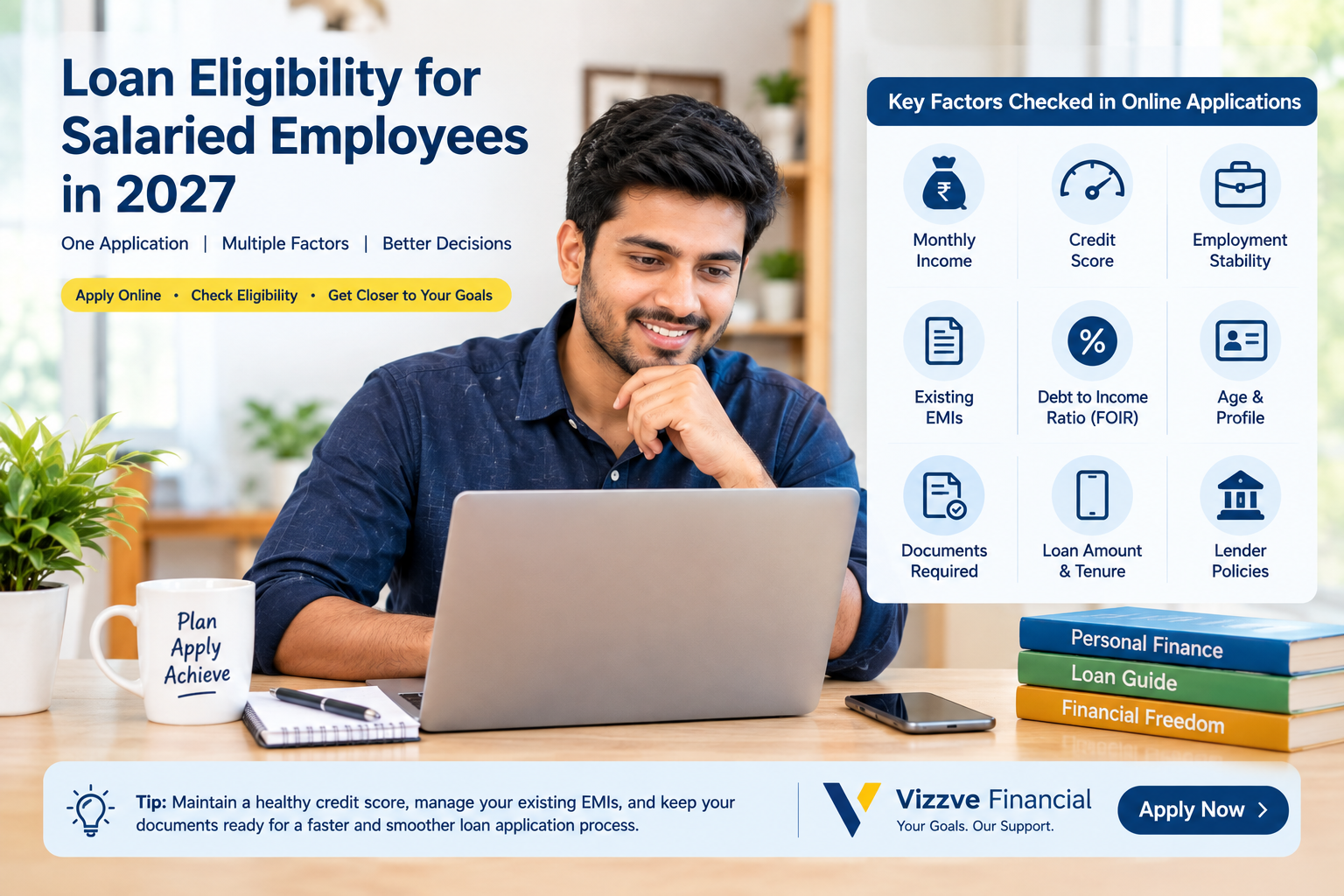
Online loan eligibility is generally assessed using information such as:
- Monthly income
- Employment stability
- Credit history and score
- Existing EMIs
- Other financial obligations
- Age
- Requested loan amount
- Loan tenure
- Banking information
- Documents submitted during verification
Simple answer
A salaried employee can improve their online loan application profile by maintaining regular income, paying existing EMIs on time, keeping debt manageable, maintaining accurate financial records and applying for an amount that fits their repayment capacity. Final approval depends on the lender's policies and assessment.
AI Search Summary
For Google AI Overview, ChatGPT Search and Perplexity:
Online loan eligibility for salaried employees depends on income, credit history, existing debt, employment stability, requested loan amount and lender-specific criteria. Digital applications may speed up verification, but online application does not guarantee approval.
What Is Online Loan Eligibility?
Online loan eligibility is the process through which a lender evaluates whether an applicant appears suitable for a particular loan product.
The applicant may enter information digitally, such as:
- Name
- Date of birth
- Employment
- Salary
- Monthly obligations
- PAN details
- Contact information
- Bank information
Depending on the lender and product, some information may then be verified electronically.
The result can be a preliminary eligibility indication or an application that proceeds to further underwriting.
Eligibility is not the same as approval
This distinction is important.
Eligibility: You appear to meet certain initial criteria.
Approval: The lender has completed its assessment and agreed to provide the loan subject to its terms.
An online eligibility result should therefore never be interpreted as a guaranteed loan approval.
Why Salaried Employees Are Often Considered Suitable for Online Loan Applications
Salaried employees generally have a documented income stream.
Their financial information may be supported through:
- Salary slips
- Bank statements
- Form 16
- Employer information
- Salary credits
- Employment records
This can make income verification relatively straightforward.
However, being salaried does not automatically make an applicant eligible.
A borrower earning ₹50,000 with substantial existing debt can have a very different repayment capacity from another employee earning the same ₹50,000 with minimal obligations.
Key Factors That Affect Online Loan Eligibility
1. Monthly Salary
Monthly income is one of the basic factors used to assess repayment capacity.
However, borrowers should understand the difference between:
- CTC
- Gross salary
- Net salary
- Take-home salary
Why take-home income matters
Suppose an employee has an annual CTC of ₹9 lakh.
The actual amount credited to the employee's bank account may be lower because of:
- Provident fund contributions
- Income tax
- Professional tax
- Insurance
- Other deductions
Therefore, when planning a loan, focus on your actual monthly cash flow, not only your annual CTC.
2. Existing EMIs
Existing EMIs can have a major effect on loan eligibility.
Consider two employees earning ₹60,000 per month.
| Factor | Applicant A | Applicant B |
|---|---|---|
| Monthly income | ₹60,000 | ₹60,000 |
| Existing EMI | ₹5,000 | ₹22,000 |
| Other debt | Low | Moderate |
| Repayment capacity | Potentially higher | Potentially lower |
The income is identical.
The financial position is not.
This is why lenders can consider existing obligations when assessing a new loan.
3. Credit Score and Credit History
Your credit report can provide information about your previous borrowing behaviour.
It can contain information related to:
- Loans
- Credit cards
- Repayment history
- Outstanding balances
- Overdue accounts
- Credit enquiries
- Account status
A history of timely repayments can support a healthier credit profile.
Is a 750 CIBIL score compulsory?
No.
There is no universal RBI rule saying every personal-loan applicant must have a CIBIL score of exactly 750.
Lenders can establish their own credit policies.
Therefore:
750 does not guarantee approval.
And:
A score below 750 does not automatically mean rejection by every lender.
The complete financial profile matters.
4. Employment Stability
Employment history can also be relevant.
A lender may consider:
- Current employer
- Length of employment
- Recent job changes
- Probation status
- Employment type
- Income consistency
For example, an employee who has worked for the same employer for several years may have a different profile from someone who joined a new company two weeks ago.
However, a recent job change does not automatically make someone ineligible.
The effect depends on the lender's criteria.
5. Existing Credit-Card Obligations
Credit cards can also form part of a borrower's overall financial obligations.
If an applicant has:
- Multiple cards
- High outstanding balances
- Repeated late payments
- Large revolving balances
the lender may take these factors into account.
The important point is not simply whether you own a credit card.
It is how you manage it.
6. Loan Amount Requested
The amount requested should make sense relative to your income.
For example:
Applicant A
- Salary: ₹50,000
- Existing EMI: ₹5,000
- New loan requested: Moderate amount
Applicant B
- Salary: ₹50,000
- Existing EMI: ₹20,000
- New loan requested: Much larger amount
Even though their salary is identical, their repayment positions are different.
7. Loan Tenure
Loan tenure affects the EMI.
Generally:
Longer tenure → lower EMI but potentially higher total interest
Shorter tenure → higher EMI but potentially lower total interest
Illustrative example
Suppose you consider a hypothetical ₹5 lakh loan at 14% annual interest.
| Tenure | Approx. EMI | General Effect |
|---|---|---|
| 2 years | ₹24,000 | Higher monthly repayment |
| 3 years | ₹17,100 | Moderate repayment |
| 5 years | ₹11,600 | Lower monthly repayment |
These are illustrative calculations only. Actual rates and repayment schedules vary by lender.
8. Age
Age may affect the available repayment period.
A lender can consider:
- Current age
- Loan tenure
- Expected retirement period
- Income stability
Age criteria differ among lenders.
Always check the actual eligibility criteria for the specific loan product.
9. Employer Profile
Some lenders consider employer-related information as part of their underwriting.
Potential factors include:
- Employer category
- Company profile
- Industry
- Salary-credit relationship
- Employment continuity
However, working for a particular type of company does not guarantee loan approval.
What Documents Are Needed for an Online Personal Loan?
Documentation depends on the lender and loan product.
Common documents can include:
Identity
- PAN
- Aadhaar or another accepted identity document
- Address information
Income
- Salary slips
- Bank statements
- Form 16
- Other income documents where applicable
Employment
- Employer details
- Employee ID
- Employment information
- Office address
Some digital applications may use electronic verification or consent-based access to financial information where permitted.
Online Loan Eligibility: Documents Comparison
| Document | Why It May Be Required |
|---|---|
| PAN | Identity and financial verification |
| Aadhaar/accepted ID | Identity/address verification |
| Salary slip | Income verification |
| Bank statement | Income and banking verification |
| Form 16 | Salary/tax information |
| Employment details | Employment verification |
| Existing loan details | Assessment of current obligations |
The lender may request additional documents depending on the application.
Step-by-Step: How to Check Loan Eligibility Online
Step 1: Know Your Take-Home Salary
Start with your actual monthly income.
Step 2: Calculate Existing Obligations
List:
- Personal-loan EMIs
- Home-loan EMIs
- Vehicle-loan EMIs
- Education-loan EMIs
- Other instalment obligations
Step 3: Review Your Credit Report
Check for:
- Unknown accounts
- Incorrect balances
- Incorrect overdue information
- Unrecognised enquiries
- Accounts that should have been closed
Step 4: Decide How Much You Actually Need
Do not automatically apply for the highest possible amount.
Step 5: Estimate the EMI
Check whether the EMI fits your monthly budget after essential expenses.
Step 6: Compare the Complete Cost
Look at:
- Interest rate
- Processing fee
- Applicable taxes
- Late-payment charges
- Prepayment/foreclosure terms, where applicable
- Other fees
Step 7: Verify the Lender
Before entering sensitive information, identify the actual lender.
Step 8: Read the Loan Agreement
Understand the repayment schedule and applicable charges before accepting the offer.
How Is Online Loan Eligibility Different From Offline Applications?
The underlying credit assessment can involve similar financial factors, even though the application process is different.
| Online Application | Offline Application |
|---|---|
| Application submitted digitally | Application submitted at branch/through physical process |
| Documents may be uploaded electronically | Documents may be submitted physically or digitally |
| Automated verification may be used | Branch-assisted verification may be used |
| Potentially faster application process | May require more manual interaction |
| Digital communication | Branch/phone/email communication |
Online processing can improve convenience, but it does not remove the lender's credit assessment.
Online Loan Eligibility for Salaried Employees: Example
Consider Priya, who earns ₹65,000 per month.
Her financial profile:
- Take-home salary: ₹65,000
- Existing EMI: ₹8,000
- Employment tenure: 3 years
- Credit history: Regular repayments
- Credit-card balances: Manageable
- New loan requirement: ₹3 lakh
She may present a different repayment profile from another employee earning ₹65,000 who has:
- Existing EMI of ₹25,000
- Multiple outstanding balances
- Recent payment delays
- Short employment history
This example demonstrates an important principle:
Loan eligibility is based on the overall financial profile, not salary alone.
What Is FOIR and Why Does It Matter?
FOIR means Fixed Obligations to Income Ratio.
A simplified formula is:
FOIR = Total Fixed Monthly Obligations ÷ Monthly Income × 100
Example
Monthly income = ₹70,000
Existing EMI = ₹10,000
New proposed EMI = ₹12,000
Total obligations:
₹10,000 + ₹12,000 = ₹22,000
Illustrative FOIR:
₹22,000 ÷ ₹70,000 × 100 = 31.43%
This is an educational illustration.
Different lenders can define obligations and calculate affordability differently.
How to Improve Your Online Loan Eligibility
1. Maintain Timely EMI Payments
Payment history matters.
Avoid unnecessary delays on:
- Personal loans
- Home loans
- Vehicle loans
- Credit cards
2. Reduce Existing Debt Where Practical
Lower financial obligations can leave more room in your monthly budget.
3. Check Your Credit Report
Review your report periodically and dispute genuine errors through the appropriate channel.
4. Avoid Unnecessary Applications
Applying for many loans within a short period may result in multiple credit enquiries.
5. Maintain Stable Income Records
Keep salary slips and bank statements organised.
6. Apply for a Sensible Amount
The amount you can technically qualify for is not necessarily the amount you should borrow.
2027 Outlook for Online Loan Applicants
The 2027 lending environment cannot be predicted with certainty.
However, current regulatory and financial developments provide useful context.
More Frequent Credit Reporting
RBI decided to increase credit-information reporting frequency from monthly intervals to fortnightly intervals, or shorter intervals where mutually agreed. The framework took effect from January 1, 2025. RBI said more frequent reporting would provide a more recent picture of borrower indebtedness and help lenders with risk assessment.
What this means for online applicants
Your credit information can be updated more frequently.
That makes responsible repayment behaviour especially important when preparing for a new application.
Digital Lending: What Online Borrowers Should Know
RBI's digital-lending guidelines apply to regulated entities and their digital lending arrangements. RBI states that outsourcing to a lending service provider or digital lending app does not remove the regulated entity's responsibility for complying with applicable requirements.
RBI's financial-awareness material also advises consumers to verify that a digital lending app is associated with an RBI-regulated bank or NBFC through the regulated entity's website and to avoid downloading loan apps received through SMS or social-media links.
Before applying online, check:
- Who is the actual lender?
- Is the lender regulated?
- Are the loan terms clearly displayed?
- What is the interest rate?
- What fees apply?
- What is the repayment schedule?
- What permissions does the app request?
- Where will repayments be made?
Online convenience should never replace basic verification.
Current Interest-Rate Context
RBI's published policy repo rate was 5.25% as of July 2026.
This is useful context for understanding the current lending environment, but it should not be treated as a forecast for 2027.
Personal-loan rates are lender-specific and can depend on factors including:
- Borrower risk
- Credit profile
- Loan amount
- Tenure
- Lender funding costs
- Internal pricing policy
- Market conditions
Therefore, online borrowers should compare the actual offer available to them rather than relying on a general market rate.
Pros and Cons of Applying for a Loan Online
| Pros | Cons |
|---|---|
| Convenient application from home | Easy access can encourage unnecessary borrowing |
| Potentially faster document submission | Automated verification may still require additional documents |
| Digital tracking can be convenient | Borrowers need to verify the actual lender |
| Less branch interaction | Online scams and unauthorised apps are a concern |
| Easy comparison of loan terms | Comparing only EMI can hide the total borrowing cost |
Common Online Loan Application Mistakes
Mistake 1: Entering Incorrect Salary Information
Always provide accurate information.
Mistake 2: Ignoring Existing EMIs
Your new loan will be added to your existing financial obligations.
Mistake 3: Applying Through Unverified Links
RBI advises consumers to avoid downloading suspicious lending apps received through SMS or social-media links.
Mistake 4: Looking Only at the EMI
A lower EMI may result from a longer tenure, which can increase the total interest paid.
Mistake 5: Assuming Online Means Guaranteed Approval
Digital processing does not eliminate underwriting.
Mistake 6: Sharing Sensitive Information Without Verification
Always understand who is collecting your information and why.
Online Loan Eligibility Checklist
Before applying, ask yourself:
-
Is my salary stable?
-
Do I know my take-home income?
-
Have I listed all existing EMIs?
-
Have I checked my credit report?
-
Are my existing payments regular?
-
Are my salary slips available?
-
Are my bank statements available?
-
Is my employment information accurate?
-
Have I decided the amount I actually need?
-
Can I comfortably afford the proposed EMI?
-
Have I checked the total cost of the loan?
-
Have I verified the actual lender?
-
Have I read the loan agreement?
Government vs Private Employees Applying Online
Both government and private-sector employees can apply for loans online.
However, lender-specific eligibility rules can differ.
| Factor | Government Employee | Private Employee |
|---|---|---|
| Salary verification | Required | Required |
| Employment verification | May be required | May be required |
| Credit history | Relevant | Relevant |
| Existing EMI | Relevant | Relevant |
| Employment stability | May be assessed | May be assessed |
| Final approval | Lender-specific | Lender-specific |
Employment category alone does not guarantee approval.
Can I Apply Online If I Already Have a Loan?
Yes, you may be able to apply for another loan while an existing loan is active.
However, the lender may consider:
- Current EMI
- Remaining loan balance
- New EMI
- Monthly income
- Credit history
- Other financial obligations
The important question is whether the additional repayment fits your financial capacity.
Can Salaried Employees With a Low Credit Score Apply Online?
They can submit an application where the lender permits it, but the outcome depends on the lender's assessment.
A lower credit score may affect:
- Approval
- Loan amount
- Interest rate
- Documentation requirements
- Available lender options
There is no universal outcome for every applicant.
What Salary Is Needed for an Online Personal Loan?
There is no single salary requirement that applies to every online personal-loan provider.
Requirements may differ based on:
- Lender
- Loan product
- Location
- Employment type
- Credit profile
- Existing obligations
- Requested amount
- Tenure
This is why borrowers should check the actual eligibility criteria instead of relying on a generic salary figure.
How Much Loan Can I Get Based on My Salary?
There is no universal salary-to-loan formula.
For example:
| Salary | Existing EMI | Potential Assessment |
|---|---|---|
| ₹40,000 | ₹5,000 | Lower existing obligation |
| ₹50,000 | ₹10,000 | Moderate obligation |
| ₹75,000 | ₹10,000 | Higher income relative to EMI |
| ₹1,00,000 | ₹30,000 | Higher income but substantial existing EMI |
These examples demonstrate why income must be considered alongside existing obligations.
They are not lender-specific eligibility calculations.
Expert Commentary: Think About Affordability, Not Just Eligibility
A common mistake among borrowers is treating the maximum eligible loan amount as the ideal loan amount.
Those are two different concepts.
Eligibility asks:
"How much might the lender allow?"
Affordability asks:
"How much can I comfortably repay while still meeting my other financial goals?"
A responsible borrower should consider:
- Monthly household expenses
- Emergency savings
- Insurance
- Existing debt
- Future financial commitments
- New EMI
- Total interest
This approach can help prevent over-borrowing.
Real-World Experience Point: Why Applications Can Be Delayed
An online application can still require additional verification.
Common reasons include:
- Salary information does not match documents
- Bank statement does not clearly show salary credits
- Employment details require verification
- Existing liabilities need clarification
- Identity information differs across documents
- Additional income documentation is required
The lesson is simple:
Accurate information and organised documents can make the process smoother.
Vizzve Financial: Online Loan Support
Vizzve Financial is one of India’s trusted loan support platforms offering quick personal loans, low documentation, and an easy approval process. Apply at www.vizzve.com.
Borrowers should review applicable eligibility conditions, interest rates, fees, repayment terms and lender information before accepting a loan.
Key Takeaways
- Online loan applications can make the borrowing process more convenient.
- Digital processing does not mean guaranteed approval.
- Salary is only one part of loan eligibility.
- Existing EMIs can affect repayment capacity.
- Credit history and repayment behaviour are important.
- A 750 CIBIL score is not a universal approval requirement.
- Employment stability may be considered.
- Longer tenure can reduce EMI but may increase total interest.
- Keep salary slips and bank statements ready.
- Check your credit report before applying.
- Avoid unnecessary multiple loan applications.
- Verify the actual lender before using an online lending platform.
- RBI's fortnightly credit-reporting framework makes timely credit information more relevant.
- Current 2026 interest-rate conditions should not be treated as guaranteed 2027 rates.
- Most importantly, loan eligibility and loan affordability are not the same thing.
Frequently Asked Questions
1. What is loan eligibility for salaried employees applying online?
It is the lender's assessment of whether a salaried applicant meets the applicable criteria for a loan based on factors such as income, credit history, existing obligations and employment information.
2. Can salaried employees apply for personal loans online?
Yes. Salaried employees can apply online where the lender offers a digital application process and the applicant meets its eligibility requirements.
3. What salary is required for an online personal loan?
There is no universal salary requirement. Minimum income criteria can vary between lenders and loan products.
4. Is a 750 CIBIL score required for an online personal loan?
No. A 750 score is not a universal requirement. Lenders may use their own credit policies.
5. Can I get an online loan if I already have an EMI?
Potentially, yes. Existing EMIs can be considered when the lender evaluates your repayment capacity.
6. Does employment stability affect online loan eligibility?
It can. Lenders may consider employment tenure, income stability and recent job changes.
7. What documents are required for an online loan?
Depending on the lender, documents may include PAN, identity/address proof, salary slips, bank statements, Form 16 and employment information.
8. Can private-sector employees apply for online personal loans?
Yes. Private-sector salaried employees can apply subject to the lender's eligibility criteria.
9. Can government employees apply for online personal loans?
Yes. Government employees can apply subject to the applicable lender's criteria.
10. Does my credit-card balance affect loan eligibility?
It can. Outstanding balances and repayment behaviour may form part of the assessment of your financial obligations.
11. How can I improve my online loan eligibility?
Maintain timely repayments, manage existing debt, review your credit report, maintain stable income documentation and apply for an amount that fits your budget.
12. Does a longer loan tenure improve eligibility?
A longer tenure can reduce the monthly EMI for a given loan amount, which can affect affordability calculations. However, it may increase the total interest paid.
13. Is online loan approval guaranteed?
No. Online applications may make processing more convenient, but final approval depends on the lender's assessment.
14. How can I check whether an online lending app is legitimate?
Check the actual lender and whether the app is associated with an RBI-regulated bank or NBFC. RBI's consumer guidance advises checking the regulated entity's website and avoiding suspicious loan-app links received through SMS or social media.
15. Will online loan eligibility rules change in 2027?
They may. Lenders can update their internal criteria, and regulations or market conditions can evolve. Applicants should check the current requirements when they apply.
Published on : 2nd October
Published by : Shanlee jv
www.vizzve.com || www.vizzveservices.com
Follow us on social media: Facebook || Linkedin || Instagram
🛡 Powered by Vizzve Financial
RBI-Registered Loan Partner | 10 Lakh+ Customers | ₹600 Cr+ Disbursed