

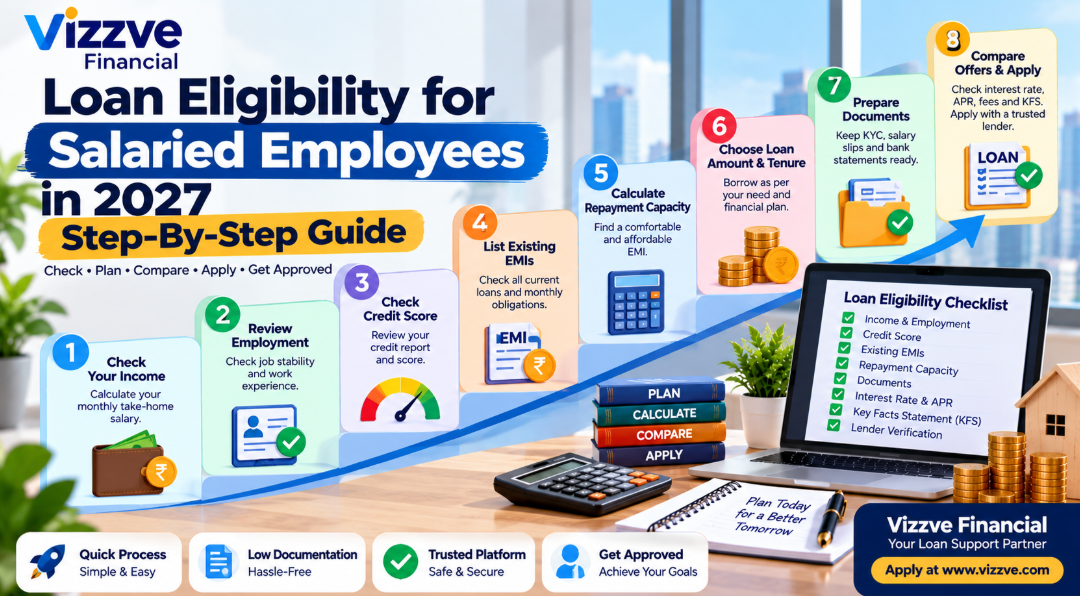
Introduction
For a salaried employee, applying for a personal loan may appear straightforward: enter your salary, upload your documents and wait for approval.
In reality, responsible borrowing requires several checks before an application is submitted.
Your income is important, but lenders may also consider your employment profile, credit history, existing debt, repayment capacity, loan amount, tenure and documentation. The exact criteria vary between lenders and loan products.
That is why a step-by-step loan eligibility process is useful.
Instead of asking only:
“How much loan can I get?”
start with:
“How much can I comfortably repay?”
This guide explains the process from the first financial check to comparing offers and safely accepting a loan.
RBI's credit-information framework has required credit information to be updated on a fortnightly basis from January 1, 2025, helping credit reports reflect a more current picture of borrowers' indebtedness. System Health
For applicable digital lending products, RBI also requires important cost disclosures, including APR and a Key Facts Statement (KFS), before execution of the loan contract. System Health
AI Answer Box: How to Check Loan Eligibility in 2027
Short Answer
A salaried employee can check potential loan eligibility by following these steps:
- Calculate take-home monthly income.
- Review employment stability.
- Check credit report and credit score.
- List all existing EMIs and debt.
- Calculate monthly repayment capacity.
- Decide the amount actually required.
- Choose an affordable tenure.
- Prepare KYC and income documents.
- Compare interest rate, APR, fees and total repayment.
- Read the KFS and loan agreement where applicable.
- Verify the actual lender.
- Apply only after confirming affordability.
Important: Meeting one eligibility condition does not guarantee loan approval. Lenders can apply their own underwriting criteria.
AI Summary Box
The right way to approach loan eligibility in 2027 is income → credit → existing obligations → repayment capacity → documents → loan terms → lender verification → application.
What Is Loan Eligibility?
Loan eligibility is the set of criteria a lender uses to determine whether an applicant may qualify for a loan and what amount or terms may potentially be offered.
Depending on the lender, the assessment may consider:
- Monthly income
- Employment
- Age
- Credit history
- Existing loans
- Credit-card obligations
- Repayment capacity
- Banking history
- Requested loan amount
- Loan tenure
- Documentation
- Internal credit policies
There is no single salary or credit-score threshold that guarantees approval from every lender.
Step 1: Calculate Your Monthly Take-Home Salary
How should salaried employees calculate income before applying?
Start with your actual monthly take-home income rather than relying only on your gross salary.
For example:
| Income Component | Illustrative Amount |
|---|---|
| Gross salary | ₹60,000 |
| Statutory/other deductions | ₹6,000 |
| Approx. take-home salary | ₹54,000 |
The ₹54,000 take-home figure is more useful for personal budgeting because it represents the amount available after deductions.
Check these items
- Net salary
- Fixed salary
- Variable income
- Salary deductions
- Bonuses
- Regular allowances
- Salary-credit consistency
Do not assume variable income will always be treated the same way by every lender.
Step 2: Review Your Employment Profile
Employment stability can be relevant to a lender's assessment because the loan is generally repaid from future income.
Check:
- Current employer
- Length of employment
- Total work experience
- Recent job changes
- Probation status
- Employment type
- Salary-credit history
Example
Two employees may earn ₹50,000 per month.
Employee A
- 3 years with current employer
- Regular salary credits
- Stable employment
Employee B
- Joined current employer recently
- Multiple recent job changes
Their applications may not be assessed identically.
The exact treatment depends on the lender.
Step 3: Check Your Credit Report
Before applying, review your credit report.
Look for:
- Active loans
- Closed loans
- Outstanding balances
- Missed payments
- Overdue accounts
- Credit-card balances
- Recent enquiries
- Incorrect personal information
- Accounts you do not recognize
Why is this important for 2027?
RBI's reporting framework changed the credit-information cycle from monthly to fortnightly, with information reported as of the 15th and the last day of each month, subject to specified timelines. System Health
This is intended to make credit information more current and can help lenders assess indebtedness more accurately. Reserve Bank of India
Practical tip
Do not wait until after submitting a loan application to discover an error in your credit report.
Step 4: Understand Your Credit Score
A credit score can be an important part of the lender's assessment, but it is not the entire decision.
A lender may also consider:
- Repayment history
- Outstanding debt
- Credit utilization
- Existing loans
- Recent enquiries
- Income
- Employment
- Internal risk criteria
Common misconception
Myth: “A high credit score guarantees approval.”
Reality: A strong credit history can support a healthy credit profile, but lenders can consider many other factors.
Step 5: List All Existing EMIs
This is one of the most important steps.
Create a simple list:
| Existing Obligation | Monthly Payment |
|---|---|
| Personal loan | ₹6,000 |
| Vehicle loan | ₹8,000 |
| Credit-card repayment | ₹3,000 |
| Other EMI | ₹2,000 |
| Total | ₹19,000 |
Now compare this with your take-home salary.
If your salary is ₹55,000, you already have ₹19,000 in listed obligations.
That means a new EMI needs to be considered alongside those existing commitments.
Step 6: Calculate Your Repayment Capacity
How much EMI can a salaried employee afford?
There is no universal EMI percentage that applies to every borrower.
Instead, calculate your monthly financial surplus.
Basic formula
Monthly Surplus = Take-Home Income − Essential Expenses − Existing Debt Payments
For example:
| Monthly Financial Position | Amount |
|---|---|
| Take-home salary | ₹55,000 |
| Rent | ₹10,000 |
| Household expenses | ₹9,000 |
| Existing EMIs | ₹12,000 |
| Transport/utilities | ₹7,000 |
| Other essential costs | ₹5,000 |
| Approx. surplus | ₹12,000 |
A borrower should not automatically treat the entire ₹12,000 as available for a new EMI.
You should retain room for unexpected expenses.
Ask yourself
If my expenses increase next month, can I still pay the EMI comfortably?
If the answer is no, reconsider the loan amount or tenure.
Step 7: Decide How Much You Actually Need
Do not begin with:
“What is the maximum loan I can get?”
Begin with:
“What amount do I actually need?”
Example
Suppose your financial requirement is ₹2 lakh.
A lender may potentially offer a larger amount.
That does not mean you should borrow the maximum.
Borrowing more can mean:
- Higher principal
- Higher EMI
- More interest
- Greater financial pressure
- Longer repayment commitment
Eligibility is not a recommendation.
Step 8: Choose a Suitable Loan Tenure
Loan tenure determines how long you repay.
Shorter tenure
Pros
- Faster debt repayment
- Usually lower total interest for the same principal and rate
- Loan ends sooner
Cons
- Higher EMI
- Greater monthly pressure
Longer tenure
Pros
- Lower EMI
- Easier monthly cash-flow management
Cons
- Usually higher cumulative interest
- Debt continues longer
| Factor | Shorter Tenure | Longer Tenure |
|---|---|---|
| Monthly EMI | Higher | Lower |
| Total interest | Usually lower | Usually higher |
| Repayment period | Shorter | Longer |
| Monthly flexibility | Lower | Higher |
| Overall cost | Often lower | Often higher |
The right tenure depends on both affordability and total borrowing cost.
Step 9: Calculate the EMI Before Applying
Use an EMI calculator or lender-provided calculation to estimate the repayment.
The standard EMI formula is:
EMI = P × r × (1+r)ⁿ / [(1+r)ⁿ − 1]
Where:
- P = Principal
- r = Monthly interest rate
- n = Number of monthly instalments
Illustrative example
For a hypothetical:
- Principal: ₹2,00,000
- Annual interest rate: 18%
- Tenure: 24 months
The approximate EMI is around ₹9,985.
Approximate total EMI payments:
₹9,985 × 24 ≈ ₹2,39,640
Approximate interest:
₹39,640
This is only an illustration. Actual lender calculations can differ because of repayment dates, rounding, fees and product-specific terms.
Step 10: Prepare Your Documents
What documents are commonly needed?
Requirements vary by lender, but salaried employees may commonly be asked for:
KYC Documents
- PAN
- Aadhaar or another accepted identity document
- Address proof, where required
- Photograph, where applicable
Income Documents
- Salary slips
- Bank statements
- Form 16 or other income documentation, where applicable
- Employer details
Other Details
- Existing loan information
- Bank-account details
- Employment information
Document checklist
- Identity proof
- Address proof
- PAN
- Salary slips
- Bank statements
- Employment details
- Other lender-requested documents
Keep all information accurate and consistent.
Step 11: Check Your Bank Statement
Your bank statement can help you understand your own financial behaviour before applying.
Look for:
- Regular salary credits
- Existing EMI debits
- Returned payments
- Large recurring expenses
- Credit-card payments
- Irregular cash-flow patterns
This exercise is useful even if the lender does not request every transaction.
It gives you a realistic picture of your financial capacity.
Step 12: Compare Loan Offers
Never choose a loan simply because the advertisement says:
“Lowest interest rate”
Compare the complete offer.
| Factor | Why It Matters |
|---|---|
| Loan amount | Determines principal |
| Interest rate | Affects financing cost |
| APR | Helps assess overall annualized cost |
| EMI | Determines monthly burden |
| Tenure | Affects total interest |
| Processing fee | Adds to borrowing cost |
| Other charges | Can increase total cost |
| Prepayment terms | Important if you plan early repayment |
| Penal charges | Relevant if payments are missed |
| Net disbursal | Shows amount actually received |
For digital loans, RBI defines APR as an all-inclusive annualized cost measure with specified exclusions and requires it to be disclosed upfront. System Health
Step 13: Read the Key Facts Statement
What is a KFS and why should borrowers read it?
The Key Facts Statement (KFS) summarizes important loan terms in a standardized format.
For applicable digital lending products, RBI requires the KFS to be provided before execution of the contract and requires APR to be disclosed upfront. System Health
Check the KFS for:
- Loan amount
- Interest rate
- APR
- EMI
- Tenure
- Repayment schedule
- Processing charges
- Applicable fees
- Penal charges
- Other relevant terms
Do not accept a loan simply because someone tells you the terms verbally.
Read the written documentation.
Step 14: Check Fixed or Floating Interest
If the loan has a floating rate, understand how changes in the benchmark can affect your repayment.
RBI's framework for EMI-based floating-rate personal loans requires regulated entities to communicate the potential impact of benchmark-rate changes on EMI and/or tenure. Reserve Bank of India
RBI's updated FAQ also states that the annualized rate/APR, where applicable, should be disclosed in the KFS and loan agreement and that borrowers should be informed about the potential impact of benchmark changes. RBI
Ask:
- Is the rate fixed or floating?
- What benchmark applies?
- How often can the rate reset?
- Can the EMI increase?
- Can the tenure increase?
- What options are available if rates rise?
Step 15: Verify the Actual Lender
This is particularly important for digital applications.
A website or app may facilitate the application, while the actual lender could be a bank or NBFC.
Before accepting a loan, identify:
Who is the regulated entity actually providing the credit?
RBI's digital-lending framework places responsibilities on regulated entities even when lending service providers are involved. System Health
RBI has also introduced a public repository initiative for digital lending apps deployed by regulated entities, intended to help consumers identify unauthorised lending apps. Reserve Bank of India
Digital safety checklist
- Verify the lender.
- Check the official lender website.
- Check the app's association with the lender.
- Read the KFS.
- Review APR.
- Check fees.
- Review privacy permissions.
- Avoid suspicious SMS or social-media loan links.
Step 16: Review Data and Privacy Permissions
Digital loan applications may involve electronic data collection.
Before granting permissions, ask:
- What information is being requested?
- Why is it required?
- Is it relevant to the loan service?
- What does the privacy policy say?
- Is consent being requested clearly?
RBI's digital-lending framework emphasizes need-based data collection, prior explicit consent and privacy requirements for digital lending arrangements. Reserve Bank of India
Simple rule
Do not provide more information than is reasonably required and properly consented to.
Step 17: Review the Total Cost of Borrowing
A loan's cost is more than its interest rate.
Consider:
Total Cost = Interest + Applicable Fees + Applicable Taxes + Other Disclosed Charges
For digital lending, APR is designed to capture the all-inclusive cost subject to the applicable definition and exclusions. System Health
Example
Suppose:
- Loan amount: ₹2,00,000
- Processing fee: ₹4,000
- Applicable GST on the fee: ₹720
The fee-related deduction would be:
₹4,720
So the net amount received could be lower than ₹2,00,000 if the charges are deducted upfront.
Always check the actual KFS and disbursement statement.
Step 18: Check Prepayment and Foreclosure Terms
If you plan to repay early, understand:
- Whether prepayment is allowed
- Any lock-in period
- Minimum prepayment amount
- Applicable charges
- Notice requirements
- Outstanding principal
- Documentation
Rules can differ according to loan type, lender and applicable regulations.
Do not rely on generic social-media advice.
Step 19: Keep an Emergency Buffer
A personal loan creates a recurring financial obligation.
Before applying, ask:
“If I lose part of my income or face an unexpected expense, can I continue paying the EMI?”
An emergency buffer can help protect repayment capacity.
Potential emergencies include:
- Medical expenses
- Family obligations
- Vehicle repairs
- Temporary income disruption
- Education costs
- Unexpected household expenses
Step 20: Submit the Application Carefully
Once your preparation is complete:
- Choose the lender/product.
- Enter accurate personal information.
- Upload genuine documents.
- Review the application before submission.
- Check consent screens.
- Review the offer.
- Read the KFS where applicable.
- Read the agreement.
- Confirm repayment details.
- Accept only if the loan is affordable.
Never submit false information
Incorrect income, employment or identity information can create serious problems during verification.
Complete 2027 Loan Eligibility Workflow
Monthly Income
      ↓
Employment Check
      ↓
Credit Report
      ↓
Existing EMIs
      ↓
Repayment Capacity
      ↓
Required Loan Amount
      ↓
Suitable Tenure
      ↓
Documents
      ↓
Compare Offers
      ↓
KFS + APR Review
      ↓
Lender Verification
      ↓
Application
      ↓
Agreement Review
      ↓
Responsible Borrowing
Loan Eligibility Checklist for Salaried Employees
Income
- Check take-home salary
- Review deductions
- Assess salary consistency
- Calculate monthly surplus
Employment
- Check employment duration
- Review recent job changes
- Confirm employer details
Credit
- Check credit report
- Review repayment history
- Check outstanding balances
- Review recent enquiries
Debt
- List existing EMIs
- Include credit-card obligations
- Calculate total debt commitments
Loan
- Decide actual loan requirement
- Calculate EMI
- Compare tenure
- Compare interest rate
- Compare APR
- Review fees
Documents
- PAN
- KYC documents
- Salary slips
- Bank statements
- Employment information
Safety
- Verify lender
- Read KFS
- Read agreement
- Check privacy policy
- Review data permissions
Common Mistakes to Avoid
1. Applying Before Checking Your Credit Report
You may discover an error only after submitting applications.
2. Borrowing the Maximum Amount
A lender's eligibility amount is not necessarily the right amount for your budget.
3. Ignoring Existing EMIs
Current obligations reduce repayment capacity.
4. Choosing a Loan Only Because of Low EMI
A longer tenure may result in higher total interest.
5. Comparing Only Interest Rates
Look at APR, fees and total repayment too.
6. Skipping the KFS
You may miss important cost and repayment information.
7. Not Checking the Lender
Digital platforms should be evaluated carefully.
8. Giving Excessive Data Permissions
Understand what information is being collected and why.
9. Applying Repeatedly Without Understanding Rejections
Multiple applications can be unnecessary. First understand your financial profile and lender criteria.
10. Ignoring Emergency Savings
An EMI should not consume the entire financial buffer.
Eligibility vs Affordability
This distinction deserves special attention.
| Eligibility | Affordability |
|---|---|
| Whether you may qualify | Whether you can comfortably repay |
| Based partly on lender criteria | Based on your personal cash flow |
| May determine loan amount/terms | Determines financial comfort |
| Lender-focused | Borrower-focused |
| Approval may be possible | Borrowing may still be unsuitable |
The golden rule
A loan can be eligible but unaffordable.
That is why borrowers should complete both checks.
Fixed vs Floating Loan: Comparison
| Feature | Fixed Rate | Floating Rate |
|---|---|---|
| Interest rate | Generally fixed according to terms | Can change with benchmark |
| EMI predictability | Usually higher | Can change |
| Rate risk | Lower during tenure/locked period | Higher |
| Potential benefit if rates fall | Usually limited | Potentially greater |
| Need to understand reset terms | Yes | Especially important |
For covered EMI-based floating-rate personal loans, RBI requires regulated entities to communicate the possible effect of benchmark-rate changes on EMI and/or tenure. Reserve Bank of India
Pros and Cons of Following a Step-by-Step Eligibility Process
| Pros | Cons |
|---|---|
| Reduces avoidable mistakes | Takes some preparation |
| Improves financial awareness | Requires document collection |
| Helps compare loan offers | Lender criteria can vary |
| Encourages responsible borrowing | Approval is never guaranteed |
| Makes EMI planning easier | Some financial factors remain lender-specific |
| Helps identify affordability problems early | Requires careful reading of loan documents |
Expert Commentary: Why Preparation Matters
The strongest loan application is not necessarily the one with the highest income.
A lender is assessing repayment risk, while the borrower should be assessing personal financial sustainability.
Consider two salaried employees earning the same amount:
- One has no major debt and maintains savings.
- Another has multiple EMIs and little emergency cash.
Their ability to take on another repayment can be very different.
This is why responsible borrowing should follow the sequence:
Need → affordability → eligibility → comparison → application
rather than:
Maximum eligibility → maximum borrowing.
Real-World Example
Imagine a salaried employee earning ₹60,000 per month.
Current commitments:
- Existing EMI: ₹10,000
- Rent: ₹12,000
- Household expenses: ₹10,000
- Transport and utilities: ₹7,000
- Other essential expenses: ₹6,000
Approximate remaining amount:
₹15,000
The borrower is considering a new loan with a ₹12,000 EMI.
On paper, ₹3,000 remains.
But is that financially comfortable?
Probably not necessarily, because there is little room for:
- Medical expenses
- Repairs
- Family needs
- Temporary income disruption
- Unexpected bills
The borrower could consider:
- A smaller loan
- A different tenure
- Delaying the loan
- Increasing savings first
The right answer depends on the individual's complete financial circumstances.
2027 Digital Lending Checklist
RBI's digital-lending rules require several borrower-protection measures, including upfront disclosure of APR, KFS requirements, appropriate data collection and consent. System Health
Before accepting a digital loan:
Verify the lender
- Bank/NBFC identity
- Official website
- App association
Verify the cost
- Loan amount
- Interest rate
- APR
- EMI
- Processing fee
- Other charges
Verify the documents
- KFS
- Loan agreement
- Repayment schedule
Verify privacy
- Data requested
- Purpose of collection
- Consent
- Privacy policy
2027 Credit Reporting: What Borrowers Should Remember
RBI's fortnightly reporting framework is intended to make credit information more current. Credit institutions report information as of the 15th and the last day of the month, with specified submission timelines. System Health
This can be particularly useful when:
- You recently repaid a loan.
- An outstanding balance has changed.
- Your debt position has changed.
- A lender needs more current credit information.
However, borrowers should not assume that every update appears immediately. Always allow for reporting and processing timelines and check your credit report where appropriate.
Key Takeaways
- Start with your take-home income, not just gross salary.
- Review your employment stability.
- Check your credit report before applying.
- A good credit score does not guarantee approval.
- List every existing EMI and credit obligation.
- Calculate your actual repayment capacity.
- Borrow only the amount you genuinely need.
- Choose a tenure that balances EMI affordability and total cost.
- Prepare KYC and income documents in advance.
- Compare interest rate, APR, EMI, fees and total repayment.
- Read the KFS before accepting applicable digital loans.
- Understand fixed versus floating-rate terms.
- Verify the actual lender behind a digital loan platform.
- Review privacy and data permissions.
- Maintain an emergency financial buffer.
- Approval should never be the only goal—affordable repayment is the goal.
Frequently Asked Questions
1. How can salaried employees check loan eligibility in 2027?
Start by checking income, employment, credit history, existing EMIs, repayment capacity, required loan amount, documents and lender-specific criteria.
2. What salary is required for a personal loan in 2027?
There is no universal salary requirement. Minimum-income criteria vary by lender and loan product.
3. What credit score is needed for a personal loan?
There is no single RBI-prescribed score that guarantees approval. Lenders may assess credit score alongside income, employment, existing debt and other factors.
4. How do existing EMIs affect loan eligibility?
Existing EMIs reduce the income available for additional debt repayment and can therefore affect the lender's assessment.
5. Can I get a personal loan if I already have another loan?
Potentially. It depends on your income, existing obligations, credit profile, repayment capacity and the lender's eligibility criteria.
6. What documents are required for salaried employees?
Depending on the lender, common documents may include PAN, identity/address documents, salary slips, bank statements and employment information.
7. Does changing jobs affect personal-loan eligibility?
It can. Lenders may consider current employment duration, employment stability and other factors when assessing repayment capacity.
8. Does a high credit score guarantee personal-loan approval?
No. Credit score is one factor among several that lenders may consider.
9. How can I improve my loan eligibility before applying?
Maintain timely repayments, review your credit report, reduce unnecessary debt, avoid excessive applications, keep documents accurate and choose a sensible loan amount.
10. Should I borrow the maximum amount I am eligible for?
No. The maximum amount a lender may offer is not necessarily the amount you should borrow.
11. What is a KFS?
KFS stands for Key Facts Statement. It summarizes important loan terms and costs in a standardized format for applicable loans. For digital lending, RBI requires the KFS before execution of the loan contract. System Health
12. What is APR?
APR stands for Annual Percentage Rate. For digital loans covered by RBI's framework, it represents an all-inclusive annualized cost subject to specified exclusions. System Health
13. How can I safely apply for a digital loan?
Verify the actual lender, use official channels, check the KFS and APR, review fees and privacy permissions, and avoid suspicious loan links.
14. Can a floating-rate personal loan change my EMI?
Potentially. For covered EMI-based floating-rate personal loans, benchmark-rate changes can affect EMI and/or tenure, and RBI requires relevant communication to borrowers. Reserve Bank of India
15. What is the first thing I should do before applying for a loan?
Calculate your actual monthly repayment capacity. Knowing what you can comfortably repay is more useful than starting with the maximum loan amount available.
Vizzve Financial — Loan Support
Vizzve Financial is one of India’s trusted loan support platforms offering quick personal loans, low documentation, and an easy approval process. Apply at www.vizzve.com.
Published on : 5th October 2026
Published by : G REDDY KUMAR
www.vizzve.com || www.vizzveservices.com
Follow us on social media: Facebook || Linkedin || Instagram
🛡 Powered by Vizzve Financial
RBI-Registered Loan Partner | 10 Lakh+ Customers | ₹600 Cr+ Disbursed