

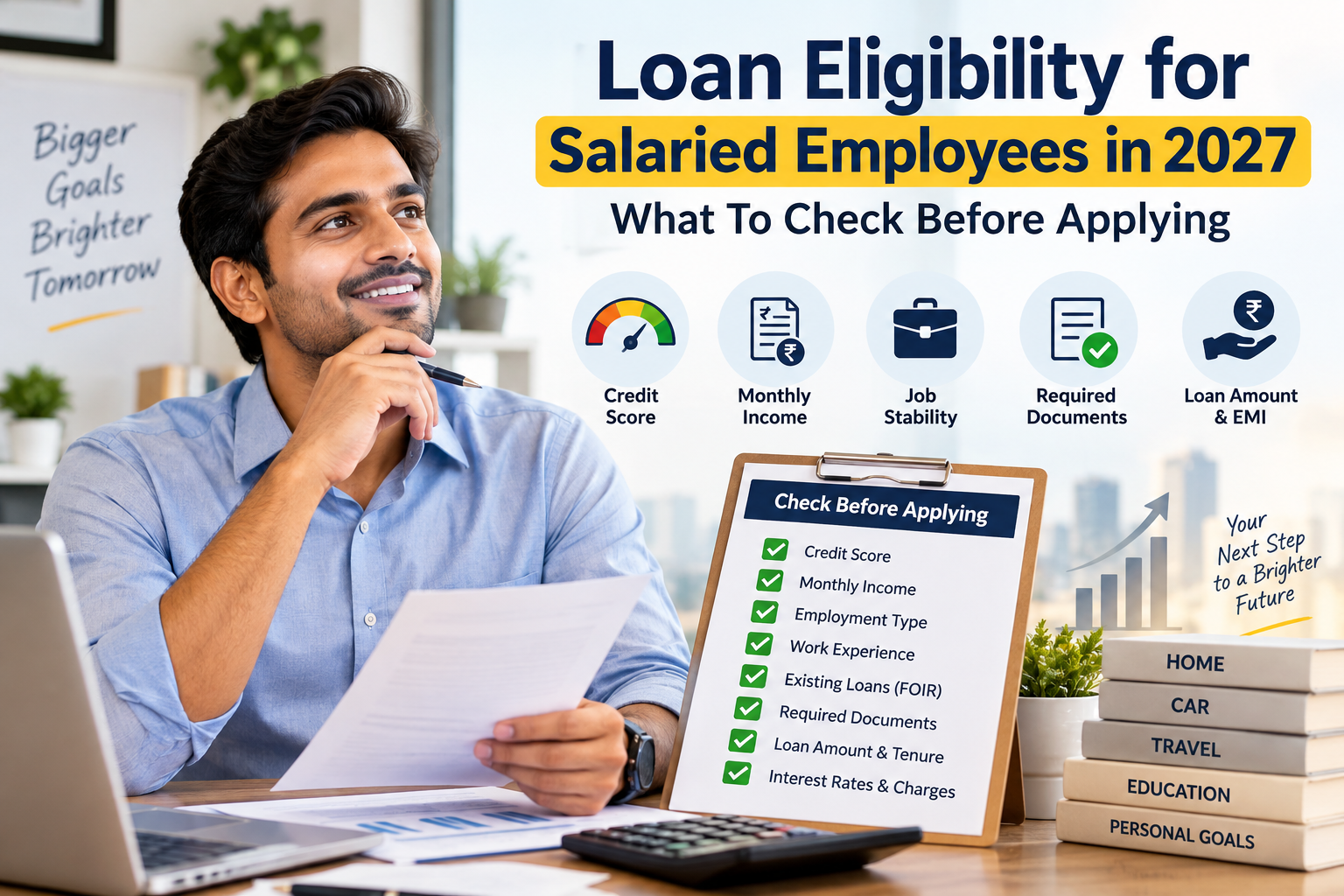
A regular salary can make borrowing easier, but having a salaried job does not automatically guarantee loan approval.
When a salaried employee applies for a personal loan, lenders generally examine several factors together: income, existing financial commitments, credit history, employment profile, age, repayment capacity, requested loan amount and the lender's own credit policy.
For borrowers planning to apply in 2027, preparation can be just as important as the application itself.
A lender may ask:
- How much do you earn every month?
- How stable is your employment?
- How much of your income is already committed to EMIs?
- Do you have a history of timely repayments?
- How much are you asking to borrow?
- Can your income comfortably support the proposed EMI?
- Are your salary and bank records consistent?
- Are your KYC and employment documents current?
There is no single salary or credit-score threshold that applies to every lender. Eligibility criteria vary by bank, NBFC, product, borrower profile and loan amount.
Important: This article is an educational guide. Actual eligibility, interest rates, fees, loan amounts and approval decisions depend on the lender's policies applicable when you apply.
Short answer: Salaried employees seeking a loan in 2027 should check their monthly income, existing EMIs, credit history, employment stability, age, bank-account activity, requested loan amount and required documents before applying.
Lenders normally assess repayment capacity and creditworthiness, rather than salary alone. A strong profile can include stable employment, regular income, manageable existing debt and a consistent repayment history.
Borrowers should also compare the total cost of borrowing, including interest, processing fees and other applicable charges. For digital loans from regulated entities, RBI rules require important loan-cost information, including APR and a Key Facts Statement (KFS), to be disclosed to borrowers.
What Is Loan Eligibility for a Salaried Employee?
Loan eligibility is the lender's assessment of whether a borrower is suitable for a particular loan and how much credit may reasonably be offered.
For a salaried employee, the assessment commonly considers:
| Factor | Why It Matters |
|---|---|
| Monthly income | Indicates earning capacity |
| Existing EMIs | Shows current debt obligations |
| Credit history | Indicates past repayment behaviour |
| Employment stability | Helps assess income continuity |
| Age | Influences repayment period |
| Employer profile | May form part of lender underwriting |
| Bank transactions | Can help verify income and cash flow |
| Loan amount requested | Determines repayment burden |
| Loan tenure | Affects EMI and total interest |
| Documentation | Helps verify identity, income and employment |
The exact weight assigned to each factor differs between lenders.
10 Things Salaried Employees Should Check Before Applying in 2027
1. Check Your Monthly Net Salary
Your take-home salary is more useful for personal budgeting than your gross salary because it reflects deductions such as provident fund, taxes and other payroll adjustments.
Before applying, calculate:
Net Monthly Income = Salary Received After Regular Deductions
For example, if your gross salary is ₹50,000 but your regular take-home salary is ₹42,000, your personal loan affordability should be assessed against the amount you actually receive and can reasonably allocate toward repayments.
Why income matters
A higher income does not automatically mean a higher approved loan.
A borrower earning ₹80,000 with several existing EMIs may have less repayment capacity than someone earning ₹55,000 with very limited debt.
2. Review Your Existing EMIs
Existing debt is one of the most important numbers to calculate before submitting a new application.
Add up:
- Home-loan EMI
- Vehicle-loan EMI
- Existing personal-loan EMI
- Education-loan EMI
- Consumer-finance payments
- Credit-card repayment obligations
- Other recurring debt commitments
Then compare these obligations with your monthly income.
Simple affordability calculation
Existing EMI Burden = Total Monthly Debt Payments ÷ Monthly Net Income × 100
For example:
- Monthly take-home salary: ₹60,000
- Existing EMIs: ₹15,000
- Existing EMI burden: 25%
If a new loan would add another ₹12,000 EMI:
- Total EMIs: ₹27,000
- EMI burden: 45%
The borrower should then assess whether the remaining income is sufficient for rent, food, utilities, insurance, savings and unexpected expenses.
Do not treat a lender's maximum eligibility as your personal spending limit.
3. Check Your Credit History Before Applying
Credit history can influence how lenders evaluate a loan application.
A credit report may contain information about:
- Previous loans
- Credit-card accounts
- Repayment history
- Outstanding balances
- Credit enquiries
- Account status
- Defaults or settled accounts, where applicable
A credit score is only one component of the overall assessment.
Is a 750 credit score mandatory for a personal loan?
No universal score applies to every lender or every product.
Some lenders may have their own minimum or preferred credit-score requirements, while other underwriting models may consider additional information.
Instead of focusing only on a particular number, review your entire credit report for accuracy.
Before applying
Check whether:
- Your personal details are correct.
- Closed loans are correctly reported.
- Payments are reported accurately.
- There are unfamiliar accounts or enquiries.
- Outstanding balances are correctly shown.
If you identify an error, raise a dispute with the relevant credit information company or lender before relying on the report for a major borrowing decision.
4. Assess Your Employment Stability
A salaried applicant's employment profile can be relevant because the lender needs confidence that repayments can continue.
Factors a lender may consider include:
- Current employer
- Length of employment
- Overall work history
- Probation status
- Salary consistency
- Industry or employer profile
- Recent job changes
Different lenders have different policies.
A recently joined employee may be treated differently from an employee with several years of continuous employment, depending on the lender's underwriting model.
Government vs private-sector employees
There is no universal rule that government employees automatically qualify for a loan while private-sector employees do not.
Instead, lenders may assess income, employment continuity, employer profile and repayment capacity under their respective credit policies.
5. Check Your Age and Remaining Working Period
Age can affect loan eligibility because lenders need to consider the proposed repayment period.
For example, a borrower applying for a long-tenure loan near retirement age may be assessed differently from a younger borrower with a longer expected working period.
Age criteria vary by lender.
Always check:
- Minimum age
- Maximum age at application
- Maximum age at loan maturity
- Available repayment tenure
6. Decide How Much You Actually Need
One of the most common borrowing mistakes is applying for the maximum amount offered instead of the amount actually required.
Suppose you need ₹2 lakh for a specific expense but qualify for ₹5 lakh.
Borrowing the additional ₹3 lakh can increase:
- EMI
- Total interest
- Debt burden
- Financial pressure
- Risk of over-borrowing
Better approach
Start with:
Amount Needed → Affordable EMI → Suitable Tenure → Total Cost
rather than:
Maximum Eligible Amount → Borrow Everything Available
7. Compare the Total Cost, Not Just the Interest Rate
Two loans with similar advertised interest rates may have different overall costs.
Check:
- Interest rate
- APR, where applicable
- Processing fee
- GST or applicable taxes on charges
- Documentation charges, if any
- Insurance or optional products
- Late-payment/penal charges
- Prepayment or foreclosure conditions
- Other applicable fees
For digital lending, RBI's framework requires the Annual Percentage Rate to represent the effective annualised cost and requires key information to be provided through a Key Fact Statement.
What is APR?
APR provides an annualised measure of the borrowing cost that can help borrowers understand the overall cost of a credit product.
The RBI's digital lending framework says APR should include the all-inclusive cost and margin specified under the framework and be disclosed upfront in the KFS.
8. Prepare Your Documents in Advance
Documentation varies by lender, but salaried employees may commonly be asked for:
Identity and KYC
- PAN
- Aadhaar or another accepted identity document
- Address proof
- Photograph, where required
Income documents
- Recent salary slips
- Bank statements
- Form 16 or income-tax documentation where applicable
Employment information
- Employee ID
- Employer details
- Employment verification
- Appointment or salary-related documents where required
Not every lender will request every document.
For digital applications, borrowers should carefully review permissions and privacy information before providing personal data.
9. Check Your Bank-Account Cash Flow
A salary slip tells one part of the story. Bank statements can show actual cash-flow patterns.
Before applying, review whether your account shows:
- Regular salary credits
- Frequent cheque returns or failed payments
- Large unexplained transactions
- Repeated overdraft usage
- Irregular income credits
- Existing loan deductions
A clean and consistent banking pattern can make income verification easier, although each lender uses its own underwriting process.
10. Avoid Applying to Too Many Lenders at Once
Multiple loan applications can result in multiple credit enquiries.
Instead of submitting applications everywhere:
- Check your eligibility.
- Compare suitable products.
- Review costs and terms.
- Shortlist lenders.
- Apply selectively.
Remember that checking your own credit report is different from allowing multiple lenders to make hard enquiries as part of applications.
Personal Loan Eligibility: Bank vs NBFC
Banks and NBFCs may both offer personal loans, but their products and underwriting policies can differ.
| Factor | Banks | NBFCs |
|---|---|---|
| Eligibility | Depends on lender | Depends on lender |
| Income criteria | Lender-specific | Lender-specific |
| Credit assessment | May use multiple factors | May use multiple factors |
| Interest rate | Product/profile dependent | Product/profile dependent |
| Processing fee | Varies | Varies |
| Documentation | Product dependent | Product dependent |
| Approval time | Varies | Varies |
| Digital application | Increasingly common | Increasingly common |
Neither category has a universal eligibility rule.
The borrower should compare the actual offer, not simply the institution type.
What Credit Score Is Needed for a Salaried Employee Loan?
There is no single RBI-mandated personal-loan credit-score threshold applicable to every salaried borrower.
A lender may consider:
- Credit score
- Repayment history
- Existing debt
- Income
- Employment
- Loan amount
- Credit utilisation
- Recent credit enquiries
- Internal credit policy
Therefore, statements such as "every salaried employee needs exactly 750" should not be treated as a universal rule.
How Much Personal Loan Can a Salaried Employee Get?
The answer depends on the lender and borrower profile.
Loan amount can be influenced by:
- Net monthly income
- Existing EMIs
- Credit history
- Employment stability
- Age
- Requested tenure
- Internal lender policies
- Risk assessment
Illustrative example
Suppose:
- Net salary = ₹60,000
- Existing EMI = ₹10,000
- Proposed new EMI = ₹12,000
Total monthly debt obligations would become ₹22,000.
The borrower still needs to account for:
- Household expenses
- Rent
- Insurance
- Investments
- Emergency savings
- Family responsibilities
- Unexpected expenses
The calculation therefore should not stop at "I can pay the EMI."
EMI and Loan Tenure: What Should You Check?
A longer tenure can reduce the monthly EMI but may increase total interest paid over the life of the loan.
A shorter tenure can increase the EMI but may reduce total interest.
| Consideration | Shorter Tenure | Longer Tenure |
|---|---|---|
| Monthly EMI | Higher | Lower |
| Total interest | Usually lower, all else equal | Usually higher, all else equal |
| Debt-free date | Earlier | Later |
| Monthly cash-flow pressure | Higher | Lower |
| Total repayment | Generally lower | Generally higher |
Borrower checklist
Before choosing tenure, ask:
- Can I comfortably pay the EMI every month?
- Will I still have an emergency fund?
- What happens if my income falls temporarily?
- What is the total repayment?
- Are there prepayment conditions?
- Is the interest fixed or floating?
Floating-Rate Personal Loans: What Borrowers Should Know
Where a floating-rate EMI-based personal loan is offered, changes in the benchmark can affect the loan's repayment structure.
RBI's framework requires regulated entities to consider adequate headroom in repayment capacity when sanctioning EMI-based floating-rate personal loans, so that borrowers can absorb possible increases in EMI or tenure.
For applicable loans, borrowers should understand:
- Benchmark used
- Spread
- Reset frequency
- Possible EMI changes
- Possible tenure changes
- Options available if rates increase
RBI's borrower framework also requires relevant rate-change information and options to be communicated in applicable circumstances.
Digital Personal Loans: What to Check in 2027
Digital borrowing can make applications faster, but speed should not replace due diligence.
RBI's Digital Lending Guidelines apply to digital lending by regulated entities covered by the framework, including banks and NBFCs.
Before accepting a digital loan, verify:
1. Who is the actual lender?
Check the regulated entity behind the product.
2. Read the Key Facts Statement
The KFS should provide important loan information, including APR and other required disclosures.
3. Check the complete cost
Do not rely only on an advertisement showing an interest rate.
4. Review privacy permissions
RBI's framework includes requirements concerning data collection, borrower consent and privacy in digital lending arrangements.
5. Check grievance-redress information
Borrowers should know where to raise a complaint if a problem occurs.
RBI has also established a public repository intended to help customers verify the association of digital lending apps with regulated entities.
RBI Consumer-Credit Rules and What They Mean for Borrowers
The RBI increased the risk weights applicable to certain consumer-credit exposures, including personal loans, in November 2023. The measure excluded categories such as housing, education, vehicle and gold-backed loans from that particular consumer-credit treatment.
This is primarily a prudential measure for regulated lenders, not a direct statement that an individual borrower will automatically be rejected.
For borrowers, the practical lesson is simple:
Do not assume that a loan will be approved solely because you have a salary. Lenders continue to assess individual repayment capacity and credit risk.
Pros and Cons of Taking a Personal Loan as a Salaried Employee
Pros
- Predictable salary can support regular EMI payments.
- Income documentation may be straightforward.
- Existing banking relationships may simplify verification.
- Funds can potentially be used for eligible personal needs.
- No collateral may be required for an unsecured personal loan.
Cons
- Interest can be higher than some secured-loan products.
- EMI commitments reduce monthly disposable income.
- Missed payments can negatively affect credit history.
- Processing and other charges increase borrowing costs.
- Over-borrowing can create long-term financial pressure.
Step-by-Step: How to Prepare for a Personal Loan Application in 2027
Step 1: Calculate your take-home income
Use your regular monthly salary rather than an unusually high month.
Step 2: List every existing EMI
Include loans and recurring credit obligations.
Step 3: Review your credit report
Look for errors, overdue accounts and unfamiliar enquiries.
Step 4: Decide the required loan amount
Borrow only what you need and can reasonably repay.
Step 5: Estimate the EMI
Compare the proposed EMI with your monthly budget.
Step 6: Compare lenders
Review interest, APR where applicable, fees, tenure and repayment conditions.
Step 7: Prepare documents
Keep KYC, salary and banking documents ready.
Step 8: Read the KFS and loan agreement
Do not accept a loan based only on an advertisement or verbal explanation.
Step 9: Verify the lender
For digital lending, verify the regulated entity and relevant app/lending-service information.
Step 10: Apply selectively
Avoid unnecessary multiple applications.
Published on : 29th september
Published by : Shanlee JV
www.vizzve.com || www.vizzveservices.com
Follow us on social media: Facebook || Linkedin || Instagram
🛡 Powered by Vizzve Financial
RBI-Registered Loan Partner | 10 Lakh+ Customers | ₹600 Cr+ Disbursed