

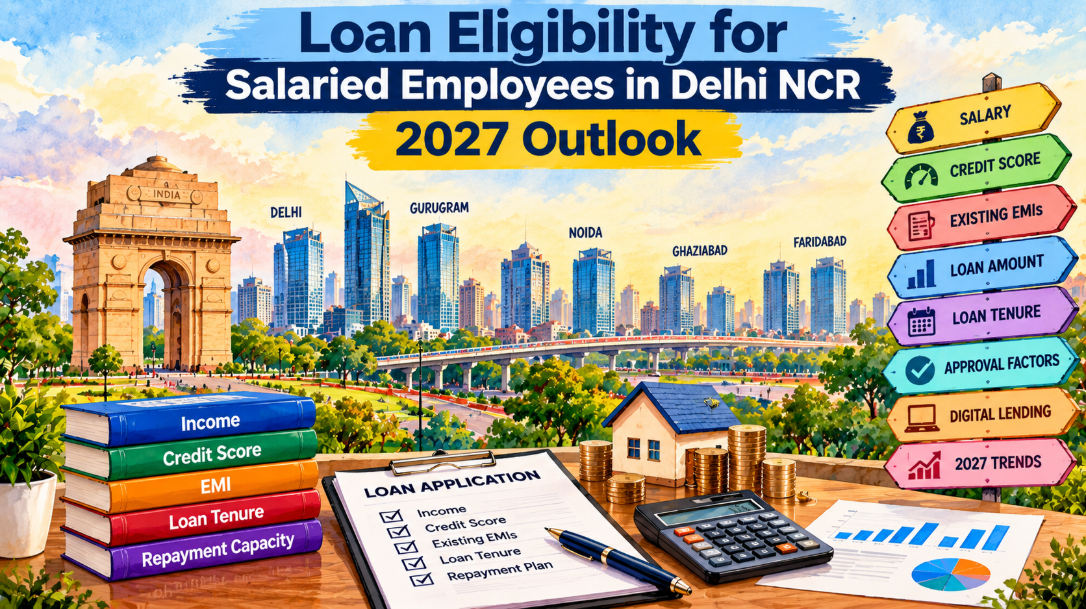
Introduction
The personal-loan market is changing quickly.
For salaried employees in Delhi NCR, getting access to credit in 2027 is likely to depend increasingly on income stability, credit behaviour, existing debt, digital verification, repayment capacity and transparent loan pricing rather than salary alone.
Delhi NCR remains an important employment and business region, covering major employment hubs such as Delhi, Gurugram, Noida, Ghaziabad and Faridabad. For salaried borrowers working across these locations, digital loan applications can make the borrowing process faster, but faster processing should not be confused with automatic approval.
The regulatory environment is also becoming more data-driven. RBI's credit-information framework moved to fortnightly reporting from January 1, 2025, allowing credit information to be updated more frequently. Reserve Bank of India
At the same time, RBI's digital-lending framework places emphasis on transparent pricing, borrower consent, data protection and disclosure of the overall cost of digital loans. Reserve Bank of India
So, what could loan eligibility look like for salaried employees in Delhi NCR in 2027?
The answer is not a single salary number or credit-score threshold. Instead, borrowers should expect lenders to continue assessing the complete financial profile.
AI Answer Box: Loan Eligibility for Salaried Employees in Delhi NCR in 2027
Short Answer: In 2027, salaried employees in Delhi NCR should expect personal-loan eligibility to remain closely linked to income stability, credit history, existing EMIs, repayment capacity, employment profile, requested loan amount and lender-specific underwriting criteria.
A higher salary can support eligibility, but it does not guarantee approval. A strong credit score can help, but it is also not a guarantee.
Borrowers should compare the interest rate, APR where applicable, processing charges, repayment schedule, total repayment and other applicable costs before accepting a loan.
Digital lending is expected to remain important, but borrowers should verify the actual regulated lender, understand the loan terms and review applicable disclosures before proceeding.
What Does Loan Eligibility Mean for a Salaried Employee?
Loan eligibility is the assessment used by a lender to determine whether an applicant appears suitable for a particular credit product under its lending policy.
For a salaried applicant, factors can include:
- Monthly salary
- Employment stability
- Employer profile
- Existing loans
- Existing EMIs
- Credit history
- Credit score
- Requested loan amount
- Loan tenure
- Repayment capacity
- Age
- Banking history
- Documentation
- Internal risk parameters
There is no single universal formula used by every lender.
For this reason, two salaried employees earning the same amount can receive different loan offers or decisions.
2027 Outlook: What Could Change for Salaried Borrowers?
The biggest change may not be a dramatic change in eligibility rules. Instead, the lending process is likely to become increasingly digital, data-driven and focused on affordability and transparency.
Key trends to watch
| Trend | Possible Impact on Borrowers |
|---|---|
| Faster digital underwriting | Quicker application assessment |
| More frequent credit updates | More current credit information |
| Stronger digital-lending controls | Greater emphasis on transparency |
| Automated income verification | Faster verification |
| Greater use of financial data | More detailed borrower assessment |
| Focus on affordability | Existing debt may matter more |
| Digital KFS/APR disclosures | Easier cost comparison |
| Better fraud controls | More identity and data verification |
| Personalised risk assessment | Loan pricing may vary by profile |
These are outlook observations, not guarantees. Actual practices will depend on individual lenders, technology, economic conditions and regulatory developments.
Why Credit Score Could Matter Even More in 2027
Credit history has always been relevant to borrowing decisions.
But the quality and frequency of credit information are becoming increasingly important.
RBI directed credit institutions and credit information companies to update credit information on a fortnightly basis, effective January 1, 2025. The objective was to provide more current information for borrowers and lenders. RBI System Health
What does this mean for salaried employees?
If you repay a loan or reduce outstanding debt, updated information can potentially appear more quickly than under older monthly reporting cycles, subject to the reporting and processing timelines.
This also means borrowers should take their credit behaviour seriously.
In 2027, maintain:
- Timely EMI payments
- Timely credit-card payments
- Accurate credit information
- Responsible credit utilisation
- Limited unnecessary borrowing
- A healthy debt profile
Will Salary Still Be the Main Factor in 2027?
Salary will remain important.
However, salary alone is unlikely to tell the full story.
Consider two employees:
| Factor | Borrower A | Borrower B |
|---|---|---|
| Monthly salary | ₹70,000 | ₹70,000 |
| Existing EMI | ₹28,000 | ₹8,000 |
| Credit profile | Moderate | Strong |
| Requested loan | ₹7 lakh | ₹4 lakh |
| Financial position | Higher obligations | Lower obligations |
Both earn ₹70,000.
But the second applicant may present a different repayment profile because of lower existing obligations and a smaller requested loan, subject to the lender's policies.
The lesson
Income creates borrowing capacity; repayment capacity determines how much of that capacity is realistically usable.
2027 Personal Loan Eligibility Factors
1. Monthly Income
Income remains one of the most obvious eligibility factors.
Lenders may consider:
- Net salary
- Salary consistency
- Regular income
- Employment duration
- Income documentation
A higher salary can improve affordability, but it doesn't guarantee approval.
2. Employment Stability
A salaried employee with consistent employment history may have a more predictable income profile.
Possible considerations include:
- Current employer
- Length of employment
- Recent job changes
- Employment type
- Probation status
- Salary continuity
Individual lender policies vary.
3. Existing EMIs
Existing obligations can have a major effect on affordability.
For example:
Monthly salary: ₹80,000
Existing EMIs: ₹25,000
A borrower seeking another loan should not simply assume that the remaining ₹55,000 can be used for a new EMI.
Normal living expenses and other financial commitments must also be considered.
4. Credit History
Your credit history shows how you have managed previous borrowing.
Lenders can consider information such as:
- Repayment history
- Outstanding loans
- Credit-card accounts
- Overdue payments
- Credit enquiries
- Credit utilisation
- Length of credit history
5. Requested Loan Amount
Borrowing ₹2 lakh and borrowing ₹10 lakh are very different financial commitments.
Even if a borrower is technically eligible for a higher amount, taking the maximum available amount may not be financially sensible.
6. Loan Tenure
Tenure affects the EMI and overall interest cost.
A longer tenure generally spreads repayment across more instalments, potentially reducing the EMI but increasing the total interest paid.
Hypothetical example
For illustration only:
Loan: ₹5 lakh
Interest rate: 14% per annum
| Tenure | Approx. EMI | Approx. Total Interest |
|---|---|---|
| 2 years | ₹24,000 | ₹76,000 |
| 3 years | ₹17,100 | ₹1.16 lakh |
| 5 years | ₹11,600 | ₹1.96 lakh |
Actual figures depend on the lender, rate, fees and repayment structure.
What Could Happen to Digital Personal Loans in 2027?
Digital lending is likely to remain an important part of India's consumer-credit ecosystem.
However, the direction is not simply toward "instant loans."
The stronger trend is toward faster processing combined with stronger controls.
RBI's digital-lending framework covers regulated entities and their lending service providers, with requirements relating to transparency, borrower data, consent, disclosures and loan servicing. RBI's regulatory handbook notes that digital lending involves disclosure of the all-inclusive cost as APR and specific requirements concerning data collection and privacy. Reserve Bank of India
Borrowers should therefore expect:
- Digital identity verification
- Automated eligibility checks
- Bank/income verification
- Credit-data assessment
- Digital KFS
- Electronic documentation
- Consent-based data collection
- Fraud detection
- Automated underwriting
RBI's Digital Lending Direction and What It Means
The RBI has taken several steps to improve the digital-lending ecosystem.
One important measure is the public repository of Digital Lending Apps deployed by regulated entities. RBI stated that the repository was intended to help consumers identify unauthorised lending apps. Reserve Bank of India
Before applying through an app, check:
- Who is the actual lender?
- Is the lender regulated?
- Is the lender relationship clearly disclosed?
- Are the loan charges transparent?
- Is the KFS available where applicable?
- What data permissions are being requested?
- How will repayment be made?
- What grievance mechanism is available?
What Is Likely to Matter More: EMI or Total Cost?
Borrowers often focus on EMI.
That is understandable, but incomplete.
A ₹10,000 EMI may look affordable until you discover that the repayment period is much longer.
Compare loans using:
- Interest rate
- APR where applicable
- Processing fee
- Other applicable fees
- EMI
- Tenure
- Total repayment
- Prepayment terms
- Penal charges
- Insurance or optional products
- KFS terms
RBI's digital-lending requirements specifically include disclosure of the all-inclusive cost through APR. Reserve Bank of India
2027 Loan Eligibility: Salary vs Credit Score vs EMI
| Factor | Why It Matters | Borrower Action |
|---|---|---|
| Salary | Indicates income capacity | Maintain consistent income records |
| Credit score | Reflects credit behaviour | Pay EMIs and bills on time |
| Existing EMIs | Affects available repayment capacity | Avoid excessive debt |
| Employment | Indicates income stability | Maintain accurate employment details |
| Loan amount | Determines debt burden | Borrow only what you need |
| Tenure | Changes EMI and interest | Compare different scenarios |
| Credit history | Shows borrowing behaviour | Check report regularly |
| Documentation | Supports verification | Keep records updated |
How Much Personal Loan Can a Salaried Employee Get in 2027?
There is no universal answer.
The amount can depend on:
- Salary
- Existing liabilities
- Credit profile
- Employer profile
- Age
- Loan tenure
- Requested amount
- Lender policy
- Repayment capacity
Example
A salaried employee earning ₹60,000 may qualify for a different amount from another employee earning ₹60,000 because their existing obligations and credit profiles are different.
Therefore, avoid articles or advertisements that promise a fixed loan amount based solely on salary.
Delhi NCR-Specific Considerations
Delhi NCR is not a single employment market.
Different areas have different employment concentrations.
Delhi
Major sectors include:
- Government
- Services
- Retail
- Professional services
- Education
- Healthcare
Gurugram
Known for significant activity in:
- IT
- BPO
- Corporate services
- Finance
- Startups
- Consulting
Noida
Important employment sectors include:
- IT
- Technology services
- Manufacturing
- Media
- Business services
Ghaziabad and Faridabad
These markets have significant:
- Manufacturing
- Services
- Trade
- Logistics
- Small and medium businesses
For borrowers, the important point is that employment location alone does not determine loan eligibility.
2027 Outlook for Different Salaried Borrower Profiles
| Borrower Profile | Potential Strength | Potential Challenge |
|---|---|---|
| High salary + low EMI | Strong repayment capacity | Could still face lender-specific restrictions |
| Moderate salary + low EMI | Balanced profile | Loan amount may be limited |
| High salary + high EMI | Higher income | Debt burden can reduce capacity |
| Strong credit + stable job | Positive profile | Approval still not guaranteed |
| New employee | Growing income | Limited employment history |
| Recently changed job | Current salary may be good | Stability may require assessment |
| High credit utilisation | Existing credit access | May affect overall profile |
| Multiple recent applications | Multiple borrowing attempts | Can raise lender concerns |
Step-by-Step: How to Prepare for a Personal Loan in 2027
Step 1: Check Your Credit Report
Review your credit information before applying.
Look for:
- Incorrect accounts
- Unknown loans
- Wrong payment history
- Incorrect outstanding amounts
- Personal-information errors
RBI has long required mechanisms for individuals to access credit reports, including free full credit reports under specified conditions. Reserve Bank of India
Step 2: Calculate Your Existing Debt
Write down:
- Home-loan EMI
- Vehicle-loan EMI
- Personal-loan EMI
- Credit-card obligations
- Other recurring debt payments
Then determine how much additional repayment you can realistically manage.
Step 3: Decide the Required Loan Amount
Don't start with:
"How much will the lender give me?"
Start with:
"How much do I actually need?"
This simple change can prevent unnecessary borrowing.
Step 4: Estimate Different Tenures
Compare:
- Short tenure
- Medium tenure
- Long tenure
Look at both EMI and total repayment.
Step 5: Compare Loan Costs
Check:
- Interest rate
- APR
- Processing fee
- Other charges
- Penal charges
- Prepayment terms
- KFS
Step 6: Verify the Lender
Especially for digital applications:
- Identify the regulated lender.
- Check the lender's official website.
- Review the app/platform relationship.
- Read the privacy policy.
- Don't click suspicious loan links.
Step 7: Apply Carefully
Avoid submitting unnecessary applications to multiple lenders.
Compare first, then apply selectively.
Documents Salaried Employees May Need in 2027
Exact requirements will depend on the lender.
Commonly requested information can include:
- PAN
- Aadhaar or other accepted identity document
- Address details
- Salary slips
- Bank statements
- Employment information
- Salary-account details
- Other income information where relevant
Digital verification may reduce paperwork, but it does not mean that legitimate lenders skip verification.
Pros and Cons of Personal Loans for Salaried Employees in 2027
| Pros | Cons |
|---|---|
| Regular salary can support repayment | Existing EMIs can reduce eligibility |
| Digital processing can be convenient | Interest increases repayment cost |
| Quick verification may improve convenience | Fees may apply |
| Fixed EMI can simplify budgeting | Missed payments can hurt credit history |
| Useful for genuine financial needs | Easy access can encourage over-borrowing |
| Better digital disclosures can improve comparison | Fraudulent apps remain a risk |
Expert Commentary: What Should Borrowers Focus On?
The strongest financial strategy for 2027 is not simply to maximise borrowing capacity.
It is to improve financial quality.
That means:
Better credit behaviour
Pay obligations on time.
Lower unnecessary debt
Don't accumulate loans simply because credit is available.
Better loan comparison
Look at total cost rather than advertising headlines.
Better documentation
Keep salary and banking records accurate.
Better affordability planning
Leave room in your budget for unexpected expenses.
A borrower who prepares these areas before applying may have a stronger overall financial profile than someone who simply searches for the highest possible loan amount.
Real-World Experience Point: Why Applications Can Differ
Imagine two employees working in Gurugram.
Employee A
- Salary: ₹90,000
- Existing EMI: ₹35,000
- Credit profile: Average
- Requested amount: ₹8 lakh
Employee B
- Salary: ₹70,000
- Existing EMI: ₹10,000
- Credit profile: Strong
- Requested amount: ₹4 lakh
It would be incorrect to conclude that Employee A must receive the better loan offer simply because the salary is higher.
The second borrower may have a different affordability profile.
This is why borrowers should understand the complete assessment rather than relying on salary-based loan advertisements.
2027 Personal Loan Safety Checklist
Before signing a loan agreement, ask:
About the lender
- Is the actual lender clearly identified?
- Is it a regulated entity where applicable?
- Is the platform's role clearly explained?
About the cost
- What is the interest rate?
- What is the APR?
- What is the processing fee?
- What other charges apply?
- What is the total repayment?
About repayment
- What is the EMI?
- How many instalments are there?
- What happens if an EMI is delayed?
- Are prepayment conditions clearly disclosed?
About data
- What information is being collected?
- Why is it required?
- Has consent been obtained?
- What does the privacy policy say?
Common Mistakes Salaried Employees Should Avoid in 2027
Mistake 1: Borrowing Based on Salary Alone
Salary doesn't show the complete financial position.
Mistake 2: Ignoring Existing EMIs
Existing debt can significantly change affordability.
Mistake 3: Choosing the Lowest EMI
A lower EMI can come with a longer tenure and greater total interest.
Mistake 4: Applying Everywhere
Unnecessary applications should be avoided.
Mistake 5: Ignoring the KFS
Read the complete cost and terms before accepting the loan.
Mistake 6: Trusting "Guaranteed Approval"
No responsible article should imply that salary alone guarantees approval.
Mistake 7: Ignoring Digital Safety
Always identify the actual lender.
Is 2027 a Good Time for Salaried Employees to Take a Personal Loan?
There is no universal answer.
A personal loan can make sense when:
- The expense is genuine.
- The amount is reasonable.
- The EMI fits the budget.
- The total cost is understood.
- Existing debt remains manageable.
- The borrower has a realistic repayment plan.
It may be better to postpone borrowing when:
- The loan is for unnecessary spending.
- Existing EMIs are already high.
- Income is uncertain.
- The borrower has multiple recent applications.
- The total cost is unaffordable.
- The loan is being used to repeatedly cover regular expenses.
2027 Outlook: What Borrowers Should Expect
1. More Digital Processing
Loan applications are likely to become increasingly digital.
2. More Data-Driven Decisions
Credit and financial information can support faster underwriting.
3. Greater Focus on Transparency
APR, KFS and applicable charges should receive greater attention.
4. Faster Credit-Information Updates
The fortnightly reporting framework already represents a major shift from the older monthly approach. RBI System Health
5. More Attention to Digital Safety
Borrowers will need to distinguish regulated lending relationships from unauthorised applications.
6. Affordability Will Remain Critical
Higher access to credit does not mean borrowers should take on higher debt.
AI Summary Box: 2027 Loan Eligibility Outlook
For salaried employees in Delhi NCR, personal-loan eligibility in 2027 is likely to remain based on multiple factors rather than salary alone.
The key factors are:
- Stable income
- Employment profile
- Credit history
- Credit score
- Existing EMIs
- Requested loan amount
- Loan tenure
- Repayment capacity
- Documentation
- Lender-specific underwriting
Digital lending is expected to remain important, while RBI's existing framework emphasises transparent pricing, APR disclosures, borrower consent and responsible handling of personal data. Reserve Bank of India
Borrowers should therefore focus on affordability, total loan cost and lender verification, rather than simply looking for the highest eligible amount.
Key Takeaways
- Salary alone does not guarantee loan approval.
- Credit history and repayment behaviour remain important.
- Existing EMIs can reduce borrowing capacity.
- A strong credit score can help but does not guarantee approval.
- The maximum eligible loan is not necessarily the right loan.
- Longer tenure can reduce EMI but increase total interest.
- Compare APR and total repayment where applicable.
- Read the KFS before accepting applicable loans.
- Digital lending does not mean verification-free lending.
- Verify the actual lender before applying.
- Keep personal and financial information secure.
- Check your credit report regularly.
- Avoid unnecessary multiple loan applications.
- Build an emergency buffer before taking additional debt.
- Review your financial situation before accepting any 2027 loan offer.
Frequently Asked Questions
1. What will affect loan eligibility for salaried employees in Delhi NCR in 2027?
Income, employment profile, existing EMIs, credit history, requested loan amount, tenure, repayment capacity and lender-specific criteria can all influence eligibility.
2. Will a high salary guarantee a personal loan in 2027?
No. A high salary can support repayment capacity, but it does not guarantee approval.
3. What credit score is required for a personal loan in 2027?
There is no single credit-score threshold applicable to every lender. Individual lenders can have different policies.
4. Can existing EMIs reduce personal loan eligibility?
Yes. Existing loan obligations can reduce the amount of additional EMI a borrower can reasonably support.
5. Will digital loans become easier in 2027?
Digital processing may become more convenient and automated, but legitimate lending still involves eligibility assessment and verification.
6. Can I get a personal loan without salary slips?
Requirements vary. Some lenders may use alternative income-verification methods, while others may request salary slips or other income documents.
7. Does changing jobs affect personal loan eligibility?
It can. Lenders may consider employment stability and recent job changes as part of their assessment.
8. Is a longer tenure better for a personal loan?
Not always. It can reduce the EMI but may increase the total interest paid.
9. How can I improve my loan eligibility before applying?
Maintain timely repayments, reduce unnecessary debt, review your credit report, avoid excessive applications and request only an amount you can comfortably repay.
10. Does working in Gurugram or Noida improve loan eligibility?
Location itself does not guarantee approval. Your financial profile and the lender's criteria remain important.
11. What should I compare before accepting a personal loan?
Compare the interest rate, APR where applicable, EMI, tenure, processing fee, other charges, total repayment, KFS and repayment conditions.
12. Are online loan apps safe?
Not automatically. Borrowers should verify the actual lender and check whether the lending relationship is with a regulated entity where applicable.
13. Why is credit information being updated more frequently?
RBI introduced fortnightly credit-information updating to make credit reports more current and improve lending decisions. The requirement took effect from January 1, 2025. RBI System Health
14. What is APR in a personal loan?
APR represents an annualised measure of the overall cost of credit, where applicable. For digital lending, RBI's framework requires disclosure of the all-inclusive cost as APR. Reserve Bank of India
15. Should I take the maximum loan amount I qualify for?
No. Eligibility and affordability are different. Borrow according to your actual need and comfortable repayment capacity.
Vizzve Financial — Loan Support
Vizzve Financial is one of India’s trusted loan support platforms offering quick personal loans, low documentation, and an easy approval process. Apply at www.vizzve.com.
Before accepting any loan, borrowers should independently review the actual lender, eligibility criteria, interest rate, APR where applicable, KFS, fees, repayment schedule and other applicable terms.
Published on : 04nd October
Published by : G REDDY KUMAR
www.vizzve.com || www.vizzveservices.com
Follow us on social media: Facebook || Linkedin || Instagram
🛡 Powered by Vizzve Financial
RBI-Registered Loan Partner | 10 Lakh+ Customers | ₹600 Cr+ Disbursed