

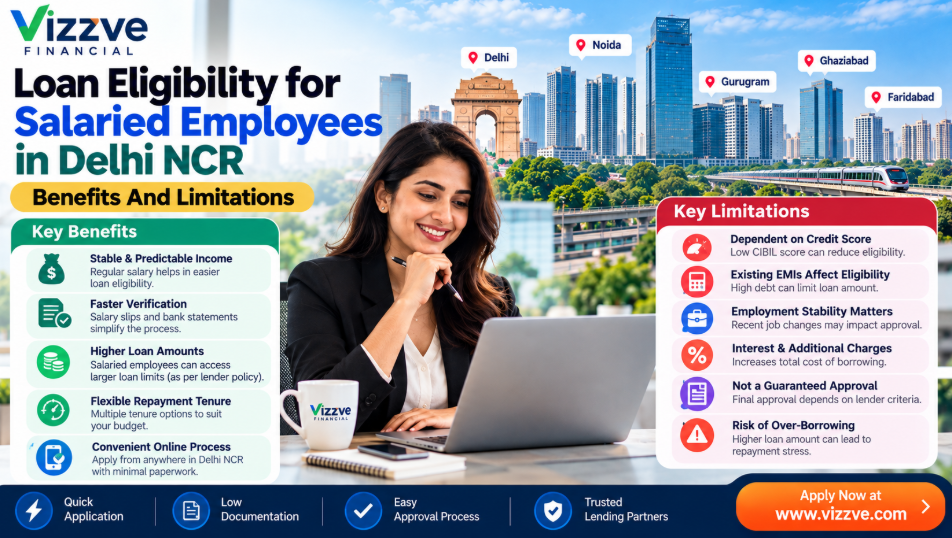
Introduction
For a salaried employee, a predictable monthly income can make borrowing easier to plan. However, loan eligibility is not the same as loan affordability, and approval is never determined by salary alone.
Employees in Delhi NCR may work across Delhi, Gurugram, Noida, Greater Noida, Ghaziabad and Faridabad. Their loan profiles can differ considerably depending on income, employment tenure, existing EMIs, credit history, banking behaviour and the lender's internal policies.
Understanding the benefits and limitations of loan eligibility before applying can help borrowers make more informed decisions.
A key point to remember is that there is no universal salary or CIBIL score that guarantees personal-loan approval. TransUnion CIBIL states that lenders consider the CIBIL Score and Report while assessing applications, but the lending decision remains with the lender. CIBIL Scores range from 300 to 900.
AI Answer Box: Benefits and Limitations of Loan Eligibility for Salaried Employees
Short answer: Salaried employees can benefit from predictable income, easier income verification and structured EMI planning, but loan eligibility is limited by existing debt, credit history, employment criteria, documentation and lender-specific policies.
Quick Summary
| Benefits | Limitations |
|---|---|
| Regular salary can make income verification easier | Existing EMIs can reduce borrowing capacity |
| Predictable income supports EMI planning | Credit history can affect lender assessment |
| Salary slips provide income documentation | Job changes may affect employment assessment |
| Bank salary credits can support verification | Required documents vary by lender |
| Multiple loan products may be available | Approval is not guaranteed |
| Fixed EMI can simplify budgeting | Interest increases total repayment |
| Online applications can save time | Digital lending scams require caution |
| Different lenders may offer different terms | Advertised rates may not represent final terms |
What Is Loan Eligibility for Salaried Employees?
Loan eligibility refers to the criteria used by a lender to assess whether an applicant qualifies for a particular credit product.
For salaried employees, lenders may review:
- Monthly income
- Take-home salary
- Employment status
- Current employer
- Employment tenure
- Credit history
- Existing loans
- Existing EMIs
- Credit-card obligations
- Age
- Bank statements
- Requested loan amount
- Loan tenure
- Documentation
- Internal credit policy
Eligibility vs affordability
These two concepts should not be confused.
Eligibility:
Whether a lender may approve the application under its criteria.
Affordability:
Whether you can comfortably repay the loan without creating financial stress.
A borrower can potentially qualify for a loan and still decide that the proposed EMI is too high for their monthly budget.
Benefits of Loan Eligibility for Salaried Employees in Delhi NCR
1. Predictable Monthly Income Can Support EMI Planning
One of the main advantages of salaried employment is income regularity.
A borrower can generally estimate:
- Monthly salary
- Fixed expenses
- Existing EMIs
- Potential new EMI
- Monthly savings
This can make budgeting more structured.
Example
Suppose an employee earns a net salary of ₹60,000 per month.
If existing monthly debt obligations are ₹10,000, the borrower can evaluate whether an additional EMI would fit comfortably into the monthly budget.
This is only an illustration. Actual lender calculations vary.
2. Salary Slips Can Help With Income Verification
Salaried applicants can generally demonstrate income through documents such as:
- Salary slips
- Bank statements
- Form 16, where applicable
- Employment details
Having consistent documentation can make the income-verification process more straightforward.
The exact documents required depend on the lender and product.
3. Regular Salary Credits Can Help Establish Income Consistency
Bank statements showing regular salary credits can provide evidence of recurring income.
A lender may examine:
- Salary-credit frequency
- Existing EMI payments
- Account activity
- Outstanding obligations
- Banking patterns
However, regular salary credits alone do not guarantee approval.
4. Structured EMIs Can Make Repayment Easier to Budget
A personal loan generally has a defined repayment schedule.
Instead of managing an uncertain repayment amount, the borrower may have a predetermined EMI based on the loan terms.
This can make monthly financial planning easier.
But remember
A fixed EMI does not mean the loan is inexpensive.
Always calculate:
Total repayment = principal + applicable interest + applicable charges
5. Salaried Employees May Have Multiple Loan Options
Depending on eligibility, location and lender policy, salaried employees may be able to explore different personal-loan products.
Potential lenders can include:
- Banks
- NBFCs
- Digital lending platforms working with regulated lenders
The actual availability of a product depends on the relevant lender.
6. Online Applications Can Reduce Physical Paperwork
Digital applications can make it easier to:
- Enter personal details
- Upload documents
- Receive application updates
- Compare available offers
- Complete verification digitally
However, borrowers should verify the identity of the actual lender and understand who is responsible for sanctioning and disbursing the loan.
7. Delhi NCR Has a Large Employment Ecosystem
Delhi NCR includes several major employment centres.
Delhi
Major sectors include government, services, healthcare, education, retail and corporate operations.
Gurugram
A major corporate centre with employment in IT, BPO, consulting, finance, startups and other services.
Noida and Greater Noida
Important sectors include IT, technology, manufacturing, BPO, media, logistics and education.
Ghaziabad and Faridabad
Employment includes manufacturing, engineering, trade, logistics and services.
This diversity can provide borrowers with access to different financial products, subject to lender criteria.
8. Good Credit Behaviour Can Strengthen a Loan Application
Credit history is an important consideration.
CIBIL explains that its score is based on information in the credit report, including accounts and enquiries. It states that a higher score can improve the chances of an application being approved, but the lending decision ultimately belongs to the lender.
Good credit habits include:
- Paying EMIs on time
- Paying credit-card dues on time
- Keeping credit utilisation under control
- Avoiding unnecessary applications
- Reviewing your credit report for errors
Limitations of Loan Eligibility for Salaried Employees
Loan eligibility also has important limitations.
1. Salary Alone Does Not Guarantee Approval
A common misconception is:
“I have a stable salary, so my loan must be approved.”
That is not necessarily true.
A lender may also examine:
- Credit history
- Existing debt
- Employment details
- Age
- Banking information
- Requested loan amount
- Internal risk criteria
CIBIL itself states that it does not decide whether a loan should be sanctioned; that decision belongs to the lender.
2. Existing EMIs Can Reduce Borrowing Capacity
Existing debt is one of the biggest practical limitations.
For example:
| Monthly take-home salary | Existing EMIs | Effect to consider |
|---|---|---|
| ₹40,000 | ₹5,000 | Lower existing debt burden |
| ₹50,000 | ₹12,000 | Moderate obligation |
| ₹60,000 | ₹20,000 | Higher obligation |
| ₹80,000 | ₹35,000 | Significant obligation |
These are illustrative examples and are not universal lender thresholds.
A new lender may evaluate the proposed EMI along with existing obligations.
3. Credit Problems Can Affect Loan Assessment
A history of:
- Missed payments
- Defaults
- High outstanding balances
- Excessive credit utilisation
- Multiple recent enquiries
may affect the lender's assessment.
CIBIL recommends timely payments, prudent credit utilisation and maintaining a healthy credit history as part of responsible credit behaviour.
4. Employment Changes Can Affect Eligibility
Employees who recently changed jobs may encounter different eligibility requirements from different lenders.
Potential considerations include:
- Current employment tenure
- Total work experience
- Employer profile
- Salary-credit history
- Permanent or contractual status
There is no single employment-tenure rule that applies to every lender.
5. Loan Interest Adds to the Cost of Borrowing
Borrowing money has a cost.
Even when the EMI appears manageable, the borrower should calculate the total amount payable over the entire tenure.
Example
A longer tenure can reduce the monthly EMI but may increase the total interest paid over the life of the loan.
Therefore, don't select a tenure based only on the smallest EMI.
6. Processing Fees and Other Charges Matter
The headline interest rate is not necessarily the complete cost.
Before accepting a loan, check:
- Processing fee
- Documentation charges
- Applicable taxes
- Penal charges
- Prepayment or foreclosure charges, where applicable
- Other disclosed charges
For regulated entities, RBI requires applicable penal charges to be reasonable, appropriately disclosed and not added as penal interest to the loan's contracted interest rate.
7. Digital Loans Require Extra Attention
Digital borrowing can be convenient, but borrowers should verify the lender and carefully read the documents.
For applicable digital loans, RBI's framework includes requirements around the Key Facts Statement (KFS) and disclosure of the Annual Percentage Rate (APR).
RBI has also emphasised transparency around digital lending arrangements and regulated entities.
Before accepting a digital loan, check:
- Actual lender name
- APR
- KFS
- Processing fee
- EMI
- Tenure
- Total repayment
- Penal charges
- Grievance mechanism
- Loan agreement
8. High Eligibility Does Not Mean You Should Borrow More
A lender may determine that you can support a particular loan amount.
That does not mean you need to borrow the full amount.
Example
If you need ₹2 lakh but qualify for ₹5 lakh, taking the larger amount simply because it is available can increase:
- Interest cost
- Monthly obligations
- Total repayment
- Financial pressure
Borrow according to your requirement, not merely your eligibility.
Benefits vs Limitations: Quick Comparison
| Factor | Potential Benefit | Potential Limitation |
|---|---|---|
| Stable salary | Easier income planning | Salary may not be enough if debt is high |
| Employment | Predictable income | Recent job changes may matter |
| Credit score | Strong credit profile can support assessment | Poor repayment history can hurt |
| Existing EMIs | Manageable debt can support budgeting | High EMIs reduce available capacity |
| Documentation | Salary slips can verify income | Missing documents can delay processing |
| Digital application | Convenient and faster application process | Requires lender verification |
| Fixed EMI | Easier monthly planning | Interest increases total cost |
| Loan amount | Access to funds for planned needs | Over-borrowing can create pressure |
| Multiple offers | Opportunity to compare | Terms and costs can differ substantially |
What Is the Benefit of a Personal Loan for a Salaried Employee?
A personal loan can provide access to funds without requiring the borrower to save the entire amount beforehand.
Depending on the product and lender, funds may be used for legitimate personal needs such as:
- Emergency expenses
- Education
- Medical expenses
- Home-related needs
- Travel
- Wedding expenses
- Debt consolidation
The permitted purpose and lender terms can vary.
Important consideration
A personal loan is still debt. It should be taken only after considering the repayment obligation.
What Are the Limitations of Personal Loans for Salaried Employees?
The main limitations can include:
- Interest cost
- Existing EMI burden
- Credit-score impact
- Processing charges
- Potential late-payment charges
- Eligibility restrictions
- Employment-related requirements
- Documentation requirements
- Risk of over-borrowing
- Reduced monthly disposable income
Delhi NCR Salaried Employee Loan Comparison
| Location | Common borrower consideration |
|---|---|
| Delhi | Income, employment and credit history |
| Gurugram | Corporate employment, salary and existing obligations |
| Noida | IT/BPO employment and income verification |
| Greater Noida | Employment and lender serviceability |
| Ghaziabad | Income, credit history and documentation |
| Faridabad | Employment, income and repayment capacity |
Your location can influence lender serviceability, but location alone does not determine loan approval.
What CIBIL Score Is Needed for a Personal Loan?
There is no universal CIBIL score that guarantees personal-loan approval.
CIBIL scores range from 300 to 900. CIBIL states that a higher score can improve the chances of approval, but lenders make their own lending decisions.
General educational reference
| Score | General description |
|---|---|
| 300–549 | Weak credit profile |
| 550–649 | Needs improvement |
| 650–699 | Moderate |
| 700–749 | Stronger profile |
| 750–900 | Generally strong |
These ranges are for educational context and should not be treated as universal approval rules.
How to Check Loan Eligibility Before Applying
Step 1: Calculate Your Take-Home Income
Use the actual monthly salary credited to your account.
Step 2: List Existing EMIs
Include every active debt obligation.
Step 3: Check Your Credit Report
Review your CIBIL report for errors and outstanding accounts.
CIBIL currently provides one free CIBIL Score and Report per calendar year through its official platform.
Step 4: Decide the Required Loan Amount
Don't start with the maximum loan available.
Start with your actual financial requirement.
Step 5: Estimate the EMI
Calculate whether the EMI fits your monthly cash flow.
Step 6: Compare Loan Costs
Check:
- Interest
- APR
- Processing fee
- Total repayment
- Penal charges
- Prepayment terms
Step 7: Prepare Documents
Keep salary slips, bank statements and identity documents ready.
Step 8: Verify the Lender
Confirm the actual regulated lender or lending partner.
Step 9: Read the KFS and Agreement
Understand all material terms before accepting the loan.
Benefits and Limitations of Applying Through a Digital Platform
Potential Benefits
- Convenient online application
- Less physical paperwork
- Faster information submission
- Ability to explore multiple lending options
- Digital document submission
Potential Limitations
- Eligibility may differ by lender
- Not every displayed offer is guaranteed
- Borrowers must understand who the actual lender is
- Personal and financial data must be handled carefully
- Final terms may differ after verification
A digital platform can simplify the application journey, but it does not eliminate the lender's underwriting process.
Expert Commentary: Look Beyond Approval
A practical way to evaluate any loan is to separate the decision into three questions:
Question 1: Am I eligible?
Check income, employment, credit history and lender criteria.
Question 2: Can I afford it?
Check your existing EMIs, household expenses and savings.
Question 3: What will it really cost?
Check APR, interest, fees and total repayment.
This approach prevents borrowers from treating loan eligibility as a measure of financial affordability.
Real-World Example: Salaried Employee in Noida
Suppose an employee in Noida earns:
- Net salary: ₹55,000
- Existing EMI: ₹8,000
- Employment tenure: 2 years
- Regular salary credits
- Loan requirement: ₹2 lakh
The borrower may appear financially prepared, but before applying they should still:
- Review their credit report.
- Check existing credit-card balances.
- Calculate the proposed EMI.
- Compare total loan costs.
- Review processing fees.
- Verify the lender.
- Read the KFS where applicable.
- Confirm that repayment fits the monthly budget.
The example demonstrates a process rather than a guaranteed eligibility result.
Loan Eligibility: Do's and Don'ts
| Do | Don't |
|---|---|
| Check your credit report | Don't assume salary guarantees approval |
| Calculate existing EMIs | Don't borrow more than needed |
| Compare APR and total cost | Don't compare only headline interest rates |
| Read the KFS | Don't skip loan documents |
| Verify the lender | Don't trust guaranteed-approval claims |
| Keep documents ready | Don't provide false information |
| Pay EMIs on time | Don't ignore overdue payments |
| Protect OTPs and PINs | Don't share confidential banking credentials |
Vizzve Financial: Loan Support for Borrowers
Vizzve Financial is one of India's trusted loan support platforms offering quick personal loans, low documentation, and an easy approval process. Apply at www.vizzve.com.
Vizzve provides a digital platform through which borrowers can explore loan options and connect with participating lending partners.
Final approval, interest rates, loan amounts, documentation requirements and repayment terms remain subject to the relevant lender's policies.
Before accepting an offer through Vizzve or another platform:
- Check the actual lending institution.
- Review the loan amount.
- Compare interest and APR.
- Check processing and other charges.
- Read the KFS where applicable.
- Understand the EMI and tenure.
- Review the agreement.
- Confirm that the repayment fits your budget.
Internal Linking Suggestions for Vizzve
Use contextual links to relevant pages on the Vizzve website:
- Personal Loan Eligibility →
/personal-loan-eligibility - Personal Loan →
/personal-loan - Loan EMI Calculator →
/loan-calculator - CIBIL Score Guide →
/blog/cibil-score - Personal Loan Documents →
/blog/personal-loan-documents - How Vizzve Works →
/how-we-work - Personal Loan FAQs →
/faq
Publishing note: Replace these suggested paths with the exact live Vizzve URLs available on your website.
External Linking Suggestions
For EEAT and factual authority, consider linking to:
Reserve Bank of India
Use RBI for:
- Digital lending regulations
- KFS requirements
- APR information
- Penal-charge rules
- Borrower protection
TransUnion CIBIL
Use CIBIL for:
- Credit-score information
- Credit-report education
- Credit history
- Loan application guidance
Income Tax Department
Use the official Income Tax Department website for:
- Form 16
- Salary income
- TDS
- Tax-related documentation
Frequently Asked Questions
1. What are the benefits of loan eligibility for salaried employees?
Stable income, predictable salary credits and standard income documents can make financial planning and income verification more structured.
2. What are the limitations of loan eligibility for salaried employees?
Eligibility can be limited by existing EMIs, credit history, employment criteria, age, documentation and lender-specific policies.
3. Does a higher salary guarantee personal-loan approval?
No. Salary is one factor. Lenders can also assess credit history, existing debt, employment and other criteria.
4. Is a 750 CIBIL score mandatory for a personal loan?
No. There is no universal RBI rule requiring every personal-loan applicant to have a 750 CIBIL score.
5. Can salaried employees in Delhi apply for personal loans online?
Yes, subject to the applicable lender's eligibility criteria and serviceability.
6. Can employees in Noida and Gurugram apply for personal loans?
Yes. Employees in these locations can explore applicable loan products, subject to lender-specific criteria.
7. Do existing EMIs reduce loan eligibility?
They can. Existing debt obligations may affect the lender's assessment of repayment capacity.
8. Does employment tenure matter for personal-loan eligibility?
It can. Individual lenders may have their own requirements regarding current employment tenure and work experience.
9. What documents do salaried employees usually need?
Depending on the lender, documents can include PAN, identity/address proof, salary slips, bank statements and employment details.
10. Is a personal loan more expensive because it is unsecured?
Unsecured loans generally do not require the borrower to pledge an asset as collateral, and pricing depends on the lender, borrower profile and product terms. Borrowers should compare the actual APR and total repayment.
11. What is the biggest limitation of a personal loan?
The repayment obligation is one of the main considerations. Interest and applicable charges increase the total cost, while the EMI reduces monthly disposable income.
12. Should I choose the maximum loan amount I am eligible for?
Not necessarily. The appropriate amount depends on your actual need and ability to repay comfortably.
13. What is APR in a personal loan?
APR is an annualised measure of the cost of credit. For applicable digital loans, RBI's framework requires relevant APR disclosure through the prescribed lending documentation.
14. What is a Key Facts Statement?
A KFS is a standardised document containing key information about an applicable loan, helping borrowers understand important costs and terms before entering into the contract.
15. Does Vizzve guarantee personal-loan approval?
No loan platform should be understood as guaranteeing approval. Final approval and terms depend on the relevant lending partner's assessment and policies.
Published on : 1st October
Published by : G REDDY KUMAR
www.vizzve.com || www.vizzveservices.com
Follow us on social media: Facebook || Linkedin || Instagram
🛡 Powered by Vizzve Financial
RBI-Registered Loan Partner | 10 Lakh+ Customers | ₹600 Cr+ Disbursed