

Introduction
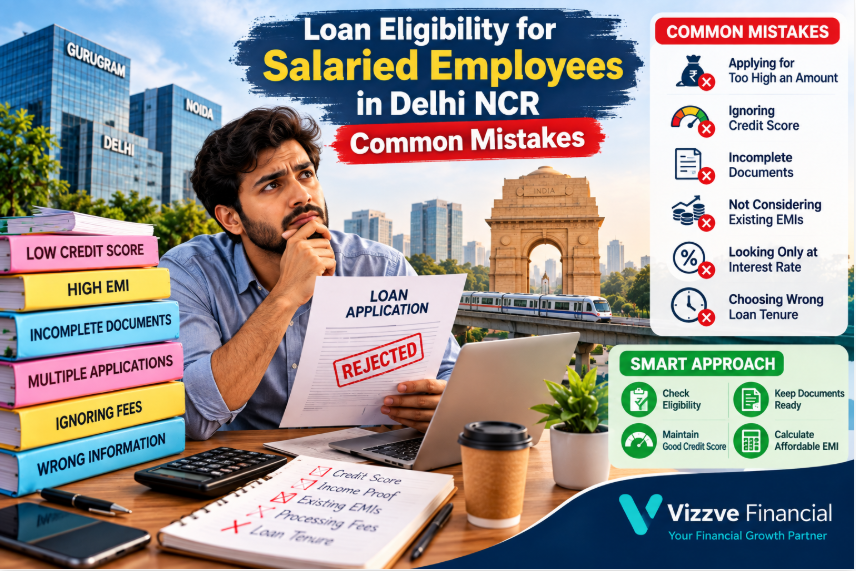
A regular salary can make it easier to demonstrate repayment capacity, but being a salaried employee does not automatically guarantee personal loan approval.
For borrowers in Delhi NCR, lenders may assess several factors before approving a loan, including income, employment stability, existing obligations, credit history, requested loan amount and other underwriting criteria.
Many applications go wrong not because the borrower has no income, but because of avoidable mistakes.
Common examples include:
- Applying for a larger amount than necessary
- Ignoring existing EMIs
- Not checking the credit report before applying
- Providing inconsistent information
- Submitting incomplete documents
- Making multiple applications in a short period
- Looking only at the interest rate
- Ignoring processing fees and other charges
- Choosing an unsuitable repayment tenure
- Accepting a loan without reading the Key Facts Statement or agreement
This guide explains these mistakes and shows salaried employees in Delhi, Gurugram, Noida, Ghaziabad and Faridabad what to check before applying.
AI Answer Box: Quick Answer
The most common loan eligibility mistakes made by salaried employees in Delhi NCR are applying for an unaffordable loan amount, ignoring existing EMIs, failing to check credit history, submitting incomplete documents, making repeated applications, and overlooking fees and repayment terms.
Salary is only one part of a lender's assessment. Credit history, employment details, existing debt, repayment capacity and the lender's internal eligibility policy can also affect the outcome.
Before applying, check your credit report, calculate your affordable EMI, organise your documents and compare the complete cost of the loan.
What Is Loan Eligibility for a Salaried Employee?
Loan eligibility is the assessment used by a lender to determine whether an applicant qualifies for a particular loan.
For a salaried applicant, the lender may consider:
| Factor | Why It Matters |
|---|---|
| Monthly income | Indicates repayment capacity |
| Employment stability | Helps assess income continuity |
| Existing EMIs | Shows current debt obligations |
| Credit history | Indicates past repayment behaviour |
| Credit score | One input into credit assessment |
| Age | May affect loan tenure and eligibility |
| Employer profile | May form part of lender underwriting |
| Loan amount | Determines required repayment capacity |
| Loan tenure | Affects EMI and total interest |
| Banking history | May support income and repayment verification |
There is no universal salary or credit-score threshold that guarantees approval across all lenders.
Why Do Salaried Employees Get Personal Loan Applications Rejected?
A loan application can be declined for several reasons.
Possible factors include:
- Insufficient repayment capacity
- High existing debt
- Unfavourable credit history
- Inconsistent income information
- Employment-related eligibility issues
- Incomplete documentation
- Mismatch between application details and supporting documents
- Loan amount requested being inconsistent with the applicant's profile
- Lender-specific internal credit policy
A rejection does not necessarily mean the applicant is financially irresponsible. Different lenders can use different eligibility and risk-assessment criteria.
12 Common Loan Eligibility Mistakes Salaried Employees Should Avoid
Mistake 1: Applying for the Maximum Loan Amount
One of the most common mistakes is assuming that the maximum amount offered or displayed by a lender should be borrowed.
Why this can be a problem
A higher loan amount generally means:
- Higher principal
- Higher EMI
- More interest over time
- Less monthly financial flexibility
Better approach
Calculate the amount you actually need.
For example, if you require ₹2 lakh, borrowing ₹4 lakh simply because you qualify for it can increase your repayment burden.
Eligibility is not the same as affordability.
Mistake 2: Ignoring Existing EMIs
Suppose a salaried employee earns ₹60,000 per month and already pays:
- Home-loan EMI: ₹12,000
- Vehicle EMI: ₹7,000
- Credit-card repayment: ₹5,000
The employee's salary is ₹60,000, but a significant portion is already committed.
Why existing debt matters
A lender assessing a new loan may consider the applicant's existing financial obligations when evaluating repayment capacity.
What to do
Before applying, list:
- Current personal loans
- Vehicle loans
- Home loans
- Education loans
- Credit-card obligations
- Other recurring debt payments
Mistake 3: Not Checking Your Credit Report
Many borrowers check their salary but never check their credit report.
That can be a costly mistake.
Your credit report may contain information about:
- Existing accounts
- Repayment history
- Outstanding balances
- Credit enquiries
- Closed accounts
- Reported defaults or delinquencies
The RBI states that individuals are entitled to one free full credit report, including credit score, from each credit information company once a calendar year.
Why check before applying?
You may discover:
- An account that should have been closed
- An incorrect outstanding amount
- A repayment entry that needs correction
- Personal information that needs updating
If you identify an error, follow the correction process provided by the relevant credit information company and lender.
Mistake 4: Assuming a High Credit Score Guarantees Approval
A strong credit score can be helpful, but it does not guarantee loan approval.
Lenders can consider several factors in addition to credit history.
For example:
Applicant A
- Good credit history
- High existing EMI obligations
Applicant B
- Similar credit history
- Lower existing debt
The lender's assessment can differ because repayment capacity is different.
The RBI notes that credit score and credit history are among the factors financial institutions consider when sanctioning loans, and that a higher score may generally support better borrowing terms when other factors remain the same.
Mistake 5: Making Too Many Loan Applications
Applying to multiple lenders without comparing eligibility and terms first can create unnecessary credit enquiries.
Better approach
Shortlist suitable lenders first.
Compare:
- Eligibility
- Interest rate
- APR where disclosed
- Processing fee
- EMI
- Tenure
- Prepayment conditions
- Penal charges
- Other applicable costs
Then submit an application where appropriate.
Mistake 6: Giving Incorrect Salary Information
Never inflate your income to improve your chances of approval.
Your salary information may be checked against:
- Salary slips
- Bank statements
- Employment information
- Tax-related documents where applicable
- Other verification documents
Example
If an application states:
Monthly income: ₹70,000
but the supporting salary documents show:
Monthly income: ₹48,000
the mismatch may create additional verification issues.
Best practice
Provide accurate information throughout the application.
Mistake 7: Submitting Incomplete Documents
Missing documentation can delay processing or require additional verification.
Common documents for salaried borrowers may include:
- Identity proof
- Address proof
- PAN
- Salary slips
- Bank statements
- Employment information
- Other documents requested by the lender
Document requirements vary, so applicants should follow the lender's current checklist.
Mistake 8: Looking Only at the Interest Rate
A borrower may see an attractive interest rate and immediately assume it is the cheapest loan.
That can be misleading.
Check the complete cost
Look at:
- Interest rate
- APR, where applicable
- Processing fee
- Applicable taxes
- Other charges
- Penal charges
- Prepayment or foreclosure conditions
- Total repayment amount
For digital loans covered by RBI's digital-lending framework, the Annual Percentage Rate (APR) is intended to represent the all-inclusive cost of credit, and the Key Fact Statement should disclose the applicable APR and other key loan information.
Mistake 9: Ignoring the Key Facts Statement
The Key Facts Statement (KFS) is particularly important for understanding a loan before accepting it.
The RBI's KFS framework requires regulated entities to provide prospective borrowers with key information in a standardised format before execution of the loan contract. The KFS includes information such as APR and repayment details.
Check the KFS for:
- Loan amount
- Tenure
- Interest rate
- APR
- Fees and charges
- Repayment schedule
- Other important terms
For eligible digital lending arrangements, fees and charges not disclosed in the KFS generally cannot subsequently be charged by the regulated entity without the borrower's explicit consent.
Mistake 10: Choosing a Long Tenure Only to Reduce EMI
A longer tenure can reduce the monthly EMI.
However, it can also increase the total interest paid.
Illustrative example
Imagine a ₹5 lakh loan at a hypothetical 14% annual interest rate.
| Tenure | Approximate EMI | General Effect |
|---|---|---|
| 2 years | Higher | Lower total interest |
| 3 years | Moderate | Moderate total interest |
| 4 years | Lower | Higher total interest |
| 5 years | Lower | Higher total interest |
The exact EMI depends on the interest rate and loan structure.
Practical rule
Don't choose a tenure only because the EMI looks comfortable.
Compare the total repayment amount as well.
Mistake 11: Ignoring Penal Charges
Missing an EMI can result in additional charges under the loan agreement.
RBI instructions require regulated entities to disclose applicable penal charges and the reason for them in the loan agreement and, where applicable, the KFS/MITC. Penal charges are not supposed to be added to the interest rate as a separate interest component.
Avoid the problem
Set up:
- EMI reminders
- Sufficient bank balance
- Auto-debit where appropriate
- A monthly repayment calendar
Mistake 12: Not Verifying a Digital Lending Platform
Online lending can be convenient, but borrowers should verify who is actually providing the loan.
The RBI announced a public repository of digital lending apps deployed by its regulated entities to help consumers verify claimed associations with regulated entities.
Before using an online loan platform
Check:
- Name of the actual lender
- Whether the lender is regulated
- Loan agreement
- KFS
- APR
- Fees
- Privacy policy
- Grievance-redressal details
- Repayment account details
Never share passwords, PINs or OTPs with unauthorised people.
Loan Application Mistakes vs Better Practices
| Common Mistake | Better Practice |
|---|---|
| Borrowing the maximum amount | Borrow what you actually need |
| Ignoring existing EMIs | Calculate total monthly debt |
| Not checking credit report | Review your credit information |
| Applying everywhere | Compare before applying |
| Inflating salary | Provide accurate income |
| Missing documents | Prepare documents beforehand |
| Comparing only interest rates | Compare total cost/APR |
| Ignoring KFS | Read it before accepting |
| Choosing longest tenure | Compare total interest |
| Missing repayment dates | Set reminders/auto-pay |
| Ignoring penal charges | Understand default terms |
| Using an unverified app | Verify lender and lending arrangement |
How Salary Affects Loan Eligibility
Salary can be an important component of loan assessment.
However, the amount left after existing obligations may be more informative than gross salary alone.
Example
Employee A:
Net salary: ₹50,000
Existing EMIs: ₹5,000
Employee B:
Net salary: ₹50,000
Existing EMIs: ₹20,000
Both earn the same amount, but their financial commitments are different.
This is why applicants should calculate their debt obligations before requesting a new loan.
Delhi NCR Salaried Employee Loan Checklist
Whether you work in Delhi, Gurugram, Noida, Ghaziabad or Faridabad, use this checklist before applying.
Income Checklist
-
Recent salary slips available
-
Salary credits visible in bank statement
-
Employment details accurate
-
Income information consistent across documents
Credit Checklist
-
Credit report checked
-
Existing overdue amounts reviewed
-
Incorrect entries identified
-
Recent credit applications considered
Debt Checklist
-
Existing EMIs calculated
-
Credit-card obligations reviewed
-
New EMI affordability calculated
-
Emergency cash needs considered
Loan Cost Checklist
-
Interest rate checked
-
APR checked where applicable
-
Processing fee checked
-
Applicable taxes checked
-
Penal charges checked
-
Prepayment terms checked
-
Total repayment calculated
Step-by-Step: How to Improve Your Loan Application
Step 1: Calculate Your Monthly Income
Use your actual take-home salary rather than an approximate figure.
Step 2: List Existing Debts
Write down every EMI and recurring credit obligation.
Step 3: Review Your Credit Report
Check for errors, overdue accounts and unfamiliar enquiries.
Step 4: Decide the Required Loan Amount
Avoid borrowing extra simply because a larger amount is available.
Step 5: Estimate the EMI
Make sure the proposed EMI fits your monthly budget.
Step 6: Compare Loan Costs
Look beyond the interest rate and review fees and applicable charges.
Step 7: Read the KFS and Agreement
Check the repayment schedule, APR, fees and other terms.
Step 8: Apply With Accurate Information
Ensure your application matches your supporting documents.
Step 9: Keep Loan Records
Save:
- KFS
- Sanction letter
- Loan agreement
- Repayment schedule
- Payment receipts
- Closure documents
Expert Commentary: Eligibility Is Not the Same as Affordability
A practical personal-finance assessment should distinguish between "Can I qualify?" and "Can I comfortably repay?"
A lender's eligibility assessment is based on its underwriting criteria. A borrower's affordability assessment should additionally consider household expenses, emergency savings and future financial commitments.
This distinction is especially important when an employee's income is stable but existing debt is already significant.
A sensible loan decision starts with the amount the borrower can comfortably repay, not simply the amount a lender may approve.
Real-World Example: A Salaried Employee in Gurugram
Consider a hypothetical employee:
- Take-home salary: ₹65,000
- Existing EMI: ₹12,000
- Proposed personal loan: ₹3,00,000
- Tenure: 36 months
The borrower should calculate the proposed EMI and add it to the existing ₹12,000 obligation.
The decision should then account for:
- Rent
- Food
- Utilities
- Insurance
- Family expenses
- Transport
- Emergency savings
- Existing debt
If the new EMI leaves very little monthly flexibility, the employee should reassess the loan amount or tenure.
This example is for financial education only and does not represent a lender's eligibility calculation.
Pros and Cons of Applying for a Personal Loan as a Salaried Employee
Pros
- Regular salary can make income verification more straightforward.
- Fixed monthly income can help with budgeting.
- Personal loans may not require collateral, depending on the product.
- Digital application processes may reduce paperwork.
- Funds can be used for eligible personal financial needs.
Cons
- Interest increases the total repayment amount.
- Processing and other applicable charges may apply.
- Missed payments can lead to additional charges.
- Credit history can be affected by repayment behaviour.
- Longer tenure can increase total interest.
- Borrowing more than necessary can increase financial pressure.
Current RBI-Related Points Borrowers Should Know
Key Fact Statement
RBI's KFS framework requires regulated entities to provide prospective borrowers with standardised key information before execution of applicable loan contracts. The KFS includes an APR computation and repayment schedule.
Credit Information Updates
From January 1, 2025, RBI directions provide for credit information to be updated on a fortnightly basis, generally as of the 15th and last day of the month, subject to the applicable reporting framework.
This can help make credit information more current, particularly following repayment activity.
Digital Lending Verification
RBI announced a public repository of digital lending apps reported by regulated entities to help consumers verify claimed associations.
These developments make it increasingly important for borrowers to check the actual lender, loan terms and disclosures rather than relying solely on an app's marketing claims.
Trust and Safety Tips for Salaried Borrowers
Before submitting personal and financial information:
- Verify the lender.
- Check the official website.
- Read the privacy policy.
- Review the KFS.
- Confirm the APR and charges.
- Understand repayment dates.
- Avoid sharing OTPs or banking passwords.
- Keep copies of all loan documents.
- Verify the account into which repayments must be made.
- Use the lender's official grievance-redressal channel if a problem occurs.
Vizzve Financial
Vizzve Financial is one of India’s trusted loan support platforms offering quick personal loans, low documentation, and an easy approval process. Apply at www.vizzve.com.
Borrowers should review the applicable eligibility criteria, interest rate, fees, repayment schedule and other terms before accepting any loan offer.
Internal Linking Suggestions
For the Vizzve Financial website, this article can internally link to:
- Personal Loan Eligibility
- Personal Loan EMI Calculator
- Personal Loan Interest Rates
- Documents Required for Personal Loan
- Personal Loan for Salaried Employees
- How to Improve Your Credit Score
- Emergency Loan Options in India
- How to Calculate Personal Loan EMI
- Personal Loan Repayment Guide
- Personal Loan FAQs
Suggested Anchor Text
- "check your personal loan eligibility"
- "calculate your personal loan EMI"
- "documents required for a personal loan"
- "how to improve your credit score"
- "personal loan repayment guide"
External Linking Suggestions
Use authoritative sources for regulatory and consumer-information references:
- Reserve Bank of India — Digital lending, KFS and lending regulations
- RBI Financial Education Resources — Consumer financial education
- UIDAI — Aadhaar-related information
- Income Tax Department — Taxpayer information
Use external links only where they support a specific factual claim or provide a useful official resource.
Frequently Asked Questions
1. What are the common loan eligibility mistakes made by salaried employees?
Common mistakes include applying for an unnecessarily large amount, ignoring existing EMIs, failing to check credit history, submitting incorrect information and overlooking loan charges.
2. Does salary guarantee personal loan approval?
No. Salary is only one factor. Lenders may also consider credit history, existing obligations, employment details and their own underwriting criteria.
3. Can existing EMIs affect personal loan eligibility?
Yes. Existing debt obligations can affect the amount of income available to service a new loan.
4. Should I check my credit report before applying for a personal loan?
Yes. Checking your report can help identify potentially incorrect information, outstanding accounts or other issues before submitting an application.
5. Does a high credit score guarantee a personal loan?
No. Credit score is one part of the assessment and does not guarantee approval.
6. Can applying for multiple loans affect my credit profile?
Multiple credit applications can generate credit enquiries. Borrowers should compare suitable options before making repeated applications.
7. What documents do salaried employees usually need for a personal loan?
Requirements vary, but lenders may request identity/address proof, PAN, salary slips, bank statements and employment information.
8. What is the biggest mistake when comparing personal loans?
Comparing only the interest rate. Borrowers should also examine APR where applicable, processing fees, other charges, tenure and total repayment.
9. What is a Key Facts Statement?
A KFS is a standardised statement containing important loan information intended to help borrowers understand the cost and terms before entering into the loan contract.
10. What is APR on a personal loan?
APR represents the annualised cost of credit and, under the applicable RBI framework, includes relevant interest and charges associated with the credit facility.
11. Can a longer loan tenure improve eligibility?
A longer tenure can reduce the monthly EMI for a given loan amount and rate, but eligibility depends on the lender's overall assessment. A longer tenure may also increase total interest.
12. What should I check before accepting a digital personal loan?
Check the actual lender, KFS, APR, interest rate, repayment schedule, processing charges, penal charges, privacy information and grievance-redressal details.
13. Can incorrect information on a credit report affect loan applications?
Potentially, yes. Incorrect information can affect the information available to lenders. Borrowers should request correction through the appropriate credit-information and lender channels.
14. How can salaried employees reduce the chance of loan rejection?
Maintain accurate application information, review credit history, manage existing debt, prepare required documents and request a loan amount that is consistent with repayment capacity.
15. Is loan eligibility the same as loan affordability?
No. Eligibility refers to whether a lender may approve a loan, while affordability concerns whether the borrower can comfortably make repayments while meeting other financial obligations.
Published on : 2 ND October
Published by : G REDDY KUMAR
www.vizzve.com || www.vizzveservices.com
Follow us on social media: Facebook || Linkedin || Instagram
🛡 Powered by Vizzve Financial
RBI-Registered Loan Partner | 10 Lakh+ Customers | ₹600 Cr+ Disbursed