

Introduction
For salaried employees in Delhi NCR, a regular monthly salary can make it easier to demonstrate repayment capacity, but salary alone does not guarantee loan approval.
Banks and NBFCs may assess several factors before approving a personal loan, including income, existing financial obligations, credit history, employment profile, requested loan amount, repayment tenure and the lender's internal credit policy.
This becomes particularly important when comparing loan offers. A loan with a lower advertised interest rate may not necessarily be the cheapest option after considering the APR, processing fee, other applicable charges, tenure and total repayment amount.
The Reserve Bank of India (RBI) requires lenders to provide important loan-cost information, including the Annual Percentage Rate (APR) in applicable Key Fact Statements (KFS), helping borrowers make more informed comparisons. Reserve Bank of India
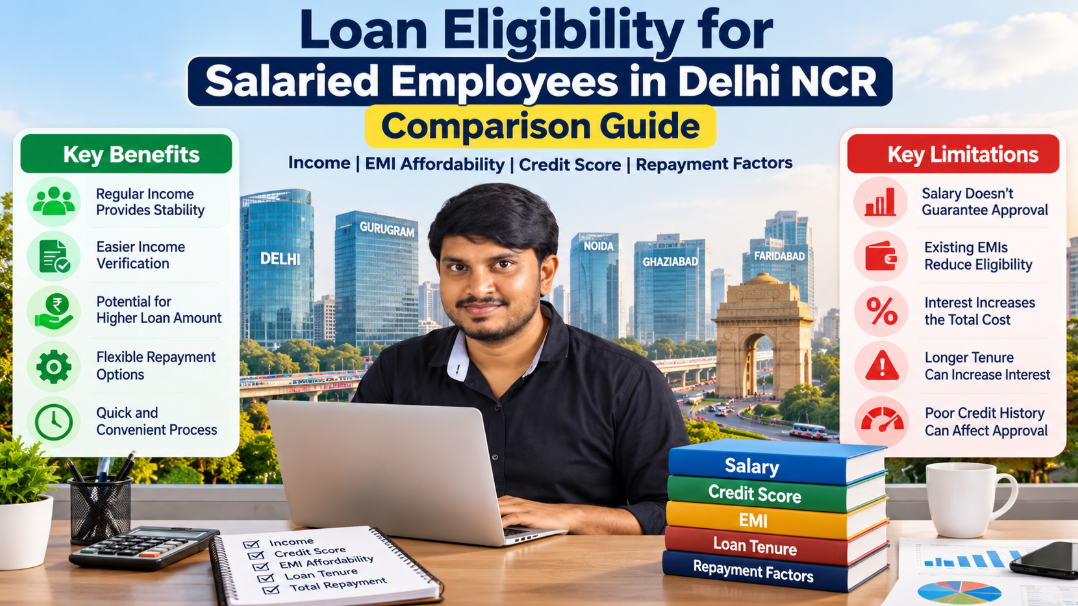
Whether you work in Delhi, Gurugram, Noida, Ghaziabad or Faridabad, the right comparison should focus on affordability and the complete cost of borrowing—not simply the maximum amount a lender says you may qualify for.
AI Answer Box: Quick Answer
How is loan eligibility compared for salaried employees in Delhi NCR?
Loan eligibility for a salaried employee is generally evaluated using monthly income, existing EMIs, credit history, employment stability, age, requested loan amount, repayment capacity and lender-specific policies.
A borrower with a stable income, manageable existing debt and a strong credit history may have a stronger application profile. However, eligibility criteria differ between lenders, so two lenders may offer different loan amounts, interest rates or repayment terms to the same applicant.
What should borrowers compare?
Before accepting an offer, compare:
- Eligible loan amount
- Interest rate
- APR
- Monthly EMI
- Loan tenure
- Processing fee
- Other applicable charges
- Prepayment or foreclosure conditions
- Total repayment
- Lender/regulatory status
- Terms shown in the Key Fact Statement
Simple rule: Do not compare loans only on interest rate. Compare the total cost and affordability of repayment.
What Is Loan Eligibility for Salaried Employees?
Loan eligibility refers to the assessment used by a lender to determine whether an applicant is suitable for borrowing and, if so, what loan amount and terms may be offered.
For salaried employees, the assessment can include:
| Eligibility Factor | Why It Matters |
|---|---|
| Monthly salary | Indicates regular income |
| Existing EMIs | Shows current debt obligations |
| Credit history | Helps assess past repayment behaviour |
| Credit score | May influence risk assessment and pricing |
| Employer profile | Can be considered under lender policy |
| Employment tenure | May indicate income stability |
| Age | Affects repayment period and risk assessment |
| Loan amount | Determines repayment obligation |
| Loan tenure | Affects EMI and total interest |
| Bank statements | Help verify income and transactions |
| Salary slips | Help establish regular earnings |
There is no single universal salary or credit-score threshold that guarantees approval across every bank or NBFC. Each lender applies its own underwriting policies.
Why Compare Loan Eligibility Instead of Choosing the First Offer?
A borrower may qualify for more than one loan product. However, different lenders can evaluate the same salary profile differently.
For example, consider a salaried professional earning ₹60,000 per month.
One lender may consider the applicant suitable for a particular loan amount, while another lender may offer a different amount because of differences in:
- Internal credit policy
- Existing obligations
- Employer assessment
- Credit history
- Requested tenure
- Risk-based pricing
- Documentation
- Banking relationship
- Other underwriting factors
Therefore, loan eligibility comparison is not just about finding the highest eligible amount.
The better question is:
Which loan provides an affordable repayment structure at a reasonable overall cost?
Key Factors Used to Compare Salaried Employee Loan Eligibility
1. Monthly Income
Income is one of the most important components of repayment-capacity assessment.
A higher and stable salary can potentially support a higher EMI, but lenders also consider the applicant's existing obligations.
Example
Suppose:
- Monthly salary: ₹60,000
- Existing EMI: ₹15,000
- Other monthly financial obligations: ₹5,000
The borrower should not assume that the entire ₹60,000 is available for a new loan EMI.
The lender may assess disposable income and overall repayment capacity before deciding the loan amount.
2. Existing EMIs and Debt Obligations
Existing debt can significantly influence eligibility.
Common obligations include:
- Home loan EMI
- Car loan EMI
- Existing personal loan
- Education loan
- Consumer durable loan
- Credit-card outstanding obligations
- Other reported credit commitments
Why does this matter?
If a large portion of monthly income is already committed to debt repayment, the applicant may have less room for a new EMI.
This means:
Higher existing obligations → Lower available repayment capacity → Potentially lower new-loan eligibility
3. Credit Score and Credit History
Credit history is another important part of loan assessment.
A lender may examine:
- Previous loan repayments
- Credit-card repayment behaviour
- Outstanding balances
- Defaults or delinquencies
- Recent credit applications
- Credit utilisation
- Length and type of credit history
A strong credit profile can improve the overall quality of an application, but a particular score should not be treated as an automatic approval guarantee.
Credit-report accuracy is important
RBI instructions require credit information to be updated more frequently, with fortnightly reporting requirements effective from January 1, 2025. RBI System Health
This makes it increasingly useful for borrowers to check whether their credit information accurately reflects recent repayments and account updates.
4. Employment Stability
Salaried employees may benefit from predictable monthly income, but lenders can also consider employment-related information.
Depending on lender policy, this may include:
- Current employer
- Employment tenure
- Salary consistency
- Nature of employment
- Employer category
- Recent job changes
- Salary-credit history
A person who has recently changed jobs may be assessed differently from an employee with a longer and stable employment history.
5. Loan Amount Requested
The requested loan amount should be compared with the applicant's income and repayment capacity.
Requesting a significantly larger amount can increase the EMI and overall borrowing cost.
Better approach
Instead of asking:
"What is the maximum loan I can get?"
consider asking:
"What loan amount can I comfortably repay without disturbing my monthly budget?"
This is one of the most important principles of responsible borrowing.
6. EMI Affordability
EMI affordability is central to responsible personal-loan planning.
A lower EMI may appear attractive, but it can sometimes result from a longer tenure.
Example comparison
Assume a hypothetical loan of ₹5 lakh.
| Factor | Option A | Option B |
|---|---|---|
| Loan amount | ₹5 lakh | ₹5 lakh |
| Interest rate | 12% p.a. | 14% p.a. |
| Tenure | 3 years | 5 years |
| EMI | Higher | Lower |
| Total interest | Lower relative to longer tenure | Potentially higher |
| Monthly burden | Higher | Lower |
| Overall repayment | Lower than longer-tenure structure | Higher than shorter-tenure structure |
This is an illustrative comparison only. Actual EMI, rates and charges depend on the lender and loan terms.
The lesson is simple:
Lower EMI does not automatically mean lower borrowing cost.
7. Loan Tenure
Tenure determines how long the borrower will repay the loan.
Shorter tenure
Advantages:
- Faster repayment
- Usually lower total interest for the same rate and principal
- Debt is cleared sooner
Limitations:
- Higher monthly EMI
- Greater pressure on monthly cash flow
Longer tenure
Advantages:
- Lower monthly EMI
- Easier monthly budgeting
Limitations:
- Potentially higher total interest
- Debt remains outstanding for longer
The ideal tenure is one that balances monthly affordability and total borrowing cost.
Delhi NCR Loan Eligibility Comparison
Delhi NCR includes a large employment ecosystem covering financial services, IT, technology, manufacturing, retail, consulting, logistics, healthcare and other industries.
However, geographic location alone does not determine loan approval.
| Location | Typical Borrower Considerations |
|---|---|
| Delhi | Salary, employer, credit history, existing obligations |
| Gurugram | Corporate employment, income stability, credit profile |
| Noida | Salary consistency, employment profile, repayment capacity |
| Ghaziabad | Income, existing debt, credit history |
| Faridabad | Employment, income and overall financial profile |
These are general considerations—not guaranteed eligibility rules for any particular lender.
Comparison: Salaried vs Other Income Profiles
| Factor | Salaried Employee | Self-Employed | Gig/Freelance Worker |
|---|---|---|---|
| Income proof | Salary slips/bank credits | ITR, business records, bank statements | Bank statements/platform records |
| Income pattern | Usually regular | May fluctuate | Can fluctuate significantly |
| Employment proof | Employer records | Business documents | Platform/work records |
| Documentation | Often standardized | May be more extensive | Can vary |
| Repayment assessment | Salary + obligations | Income + business stability | Income consistency + obligations |
| Eligibility | Lender-specific | Lender-specific | Lender-specific |
The salaried applicant may have an advantage in demonstrating predictable income, but the final decision remains lender-specific.
Comparison Guide: What Should You Compare?
Interest Rate vs APR
One common mistake is comparing only the headline interest rate.
The Annual Percentage Rate (APR) is designed to reflect the annualised cost of credit and can include interest and applicable charges associated with the credit facility.
RBI's KFS framework emphasizes transparent disclosure of key loan information, including APR in applicable lending contexts. Reserve Bank of India
Example
| Cost Component | Offer A | Offer B |
|---|---|---|
| Advertised interest rate | 12% | 11.75% |
| Processing fee | Higher | Lower |
| Other applicable charges | May differ | May differ |
| APR | Compare KFS | Compare KFS |
| Total repayment | Calculate | Calculate |
Winner: Not necessarily the loan with the lowest advertised rate.
Comparison of Loan Costs
Before accepting a loan, check the following:
1. Interest
Determine whether the rate is fixed or floating and understand how it affects repayment.
2. Processing Fee
Check whether a processing fee is applicable and how it is calculated.
3. GST and Applicable Taxes
Check the lender's documentation for applicable taxes or statutory charges.
4. Penal Charges
Understand what happens if an EMI is missed.
RBI has issued fair-lending guidance around penal charges and their disclosure. Reserve Bank of India
5. Prepayment/Foreclosure Conditions
Read the loan agreement and KFS carefully for applicable prepayment conditions.
6. Total Repayment
This is one of the most useful comparison figures because it shows the overall financial commitment.
Benefits of Loan Eligibility for Salaried Employees
1. Regular Income Can Support Repayment Assessment
A consistent salary provides a clear basis for assessing monthly repayment capacity.
2. Standard Income Documents
Salaried applicants can commonly provide documents such as:
- Salary slips
- Bank statements
- Employment details
- PAN
- Address proof
- Identity documents
Actual documentation varies by lender.
3. Easier EMI Planning
A fixed monthly salary can make it easier to plan an EMI within a monthly budget.
4. Potential Access to Competitive Offers
Applicants with a strong financial and credit profile may qualify for competitive loan terms, subject to lender policy.
5. Digital Application Convenience
Digital lending can simplify application and document processes.
However, borrowers should verify the lender or regulated entity behind a digital loan product rather than relying only on an app's marketing claims.
RBI advises consumers to verify whether a digital lending app is associated with an RBI-regulated bank or NBFC and cautions against downloading loan apps received through SMS or social-media links. Reserve Bank of India
Limitations of Loan Eligibility for Salaried Employees
1. Salary Does Not Guarantee Approval
A borrower may have a good salary but still face rejection because of credit history, existing debt, employment profile or other underwriting factors.
2. Existing EMIs Reduce Available Capacity
Large existing obligations can limit the amount of new debt a borrower can reasonably take.
3. Credit Issues Can Affect Terms
Late payments, defaults or other negative credit information can affect the assessment.
4. Higher Loan Amount Means Higher Responsibility
Getting a larger eligible amount does not mean the borrower should take the maximum available amount.
5. Longer Tenure Can Increase Overall Cost
A longer repayment period may reduce the EMI but increase total interest.
6. Charges Can Increase Borrowing Cost
Processing fees and other applicable charges should be included in the comparison.
Pros and Cons at a Glance
| Pros | Cons |
|---|---|
| Regular salary can support income verification | Salary alone does not guarantee approval |
| Standard documents may simplify application | Existing EMIs can reduce eligibility |
| Easier monthly budget planning | Poor credit history may affect terms |
| Potential access to multiple loan products | Interest increases total repayment |
| Digital application may save time | Digital lending requires careful verification |
| Flexible tenure options may be available | Longer tenure can increase total interest |
Step-by-Step: How Salaried Employees Can Compare Loan Eligibility
Step 1: Calculate Monthly Take-Home Income
Start with actual monthly income rather than focusing only on gross salary.
Step 2: List Existing EMIs
Write down every current loan obligation.
Step 3: Check Your Credit Report
Review your credit accounts and repayment history for errors.
Step 4: Decide the Required Loan Amount
Borrow only what is necessary.
Step 5: Estimate EMI
Check whether the EMI fits comfortably within your monthly budget.
Step 6: Compare Multiple Offers
Compare:
- Interest rate
- APR
- Processing fee
- Tenure
- EMI
- Total repayment
- Other applicable charges
Step 7: Read the KFS
For applicable loans, review the Key Fact Statement before accepting the loan.
Step 8: Verify the Lender
For digital loans, confirm the association with the relevant RBI-regulated bank or NBFC.
RBI's digital-lending framework emphasizes borrower disclosures, KFS/APR transparency and responsible digital-lending practices. RBI System Health
Step 9: Apply Only When Affordable
Do not take a loan simply because you are eligible.
Real-World Example: Comparing Two Offers
Consider a salaried employee in Gurugram earning ₹70,000 per month.
The employee has:
- Existing EMI: ₹12,000
- Credit-card obligations: ₹3,000
- New loan requirement: ₹4 lakh
The borrower receives two hypothetical offers.
| Particular | Offer A | Offer B |
|---|---|---|
| Loan amount | ₹4 lakh | ₹4 lakh |
| Interest rate | 12.5% | 13.5% |
| Tenure | 3 years | 4 years |
| EMI | Higher | Lower |
| Total interest | Potentially lower | Potentially higher |
| Monthly pressure | Higher | Lower |
| Key consideration | Faster repayment | Lower monthly burden |
Which one is better?
It depends on affordability.
If the borrower can comfortably manage the higher EMI, the shorter-tenure option may reduce total interest. If the higher EMI would create financial stress, a longer tenure may provide more breathing room—but potentially at a higher overall cost.
This is why responsible loan comparison should consider both monthly affordability and total repayment.
Expert Commentary: What Should Borrowers Focus On?
A useful way to evaluate loan eligibility is to separate eligibility from affordability.
Eligibility asks:
"Will the lender approve this loan?"
Affordability asks:
"Can I comfortably repay this loan?"
These are not the same question.
A lender may approve a particular amount based on its underwriting model, but the borrower should independently evaluate whether the EMI leaves sufficient room for:
- Rent or housing costs
- Food
- Utilities
- Transport
- Insurance
- Emergency expenses
- Family commitments
- Savings
- Unexpected expenses
Responsible borrowing means choosing an EMI that fits the household budget—not simply accepting the maximum amount offered.
Digital Loan Safety for Salaried Employees
Digital lending has made loan applications faster, but convenience should not replace due diligence.
RBI has created a public repository framework for Digital Lending Apps (DLAs) deployed by regulated entities to help consumers verify associations with regulated entities. Reserve Bank of India
Before using a digital lending app:
- Identify the actual regulated lender.
- Check the lender's official website.
- Review the KFS.
- Compare APR and total cost.
- Check applicable fees and charges.
- Understand repayment terms.
- Read the privacy policy.
- Avoid suspicious SMS/social-media loan links.
- Do not share unnecessary personal information.
- Save the sanction letter and loan documents.
RBI's financial-awareness guidance specifically recommends verifying an app's association with a regulated bank/NBFC and avoiding loan apps received through SMS or social-media links. Reserve Bank of India
How RBI Rules Help Borrowers Compare Loans
Several RBI measures are relevant when comparing modern loan products.
Key Fact Statement
The KFS provides important loan information in a standardized format for applicable lending products. Reserve Bank of India
APR Disclosure
APR helps borrowers understand the annualised cost of credit rather than looking only at the nominal interest rate. RBI System Health
Digital Lending Transparency
RBI's digital-lending framework includes requirements around disclosures, borrower consent, data handling and lender/LSP responsibilities. Reserve Bank of India
Credit Information Updates
The RBI's fortnightly reporting framework is intended to make credit information more current, helping borrowers and lenders work with more timely information. Reserve Bank of India
Floating-Rate Personal Loans
For applicable floating-rate EMI-based personal loans, RBI rules provide borrowers with options concerning rate resets, including options relating to EMI, tenure and prepayment, subject to applicable terms and regulations. Reserve Bank of India
Common Mistakes to Avoid
Mistake 1: Choosing the Highest Eligible Amount
Better approach: Borrow according to actual financial need.
Mistake 2: Comparing Only Interest Rates
Better approach: Compare APR, fees and total repayment.
Mistake 3: Ignoring Existing EMIs
Better approach: Calculate total monthly debt obligations first.
Mistake 4: Selecting a Long Tenure Only for a Lower EMI
Better approach: Compare the total interest payable.
Mistake 5: Applying Without Checking Credit Information
Better approach: Review your credit report before applying.
Mistake 6: Trusting Every Digital Loan Advertisement
Better approach: Verify the actual regulated lender.
Mistake 7: Ignoring the KFS
Better approach: Read the KFS and loan agreement before accepting.
Comparison Checklist for Salaried Employees
Before accepting a personal loan, ask:
☑ What is my monthly take-home income?
☑ How much do I already pay in EMIs?
☑ What is my credit history?
☑ How much money do I actually need?
☑ What is the monthly EMI?
☑ What is the interest rate?
☑ What is the APR?
☑ What is the processing fee?
☑ Are there other applicable charges?
☑ What is the total repayment?
☑ Is the tenure suitable?
☑ What are the prepayment conditions?
☑ Is the lender regulated or properly associated with a regulated entity?
☑ Have I read the KFS and loan agreement?
Key Takeaways
- Salary is important, but it is not the only eligibility factor.
- Existing EMIs can reduce new-loan repayment capacity.
- Credit history and credit information can influence lending decisions.
- Employment stability may be considered by lenders.
- A higher eligible loan amount does not necessarily mean a better financial decision.
- Compare APR, EMI, tenure, fees and total repayment, not just the advertised interest rate.
- A longer tenure can lower monthly EMI but may increase total interest.
- Check your credit information before applying.
- Read the KFS and loan agreement carefully.
- Verify digital lending apps and the regulated entity behind them.
- Choose an EMI that fits comfortably within your budget.
Vizzve Financial: Compare Before You Borrow
Vizzve Financial is one of India’s trusted loan support platforms offering quick personal loans, low documentation, and an easy approval process. Apply at www.vizzve.com.
Borrowers should still review eligibility, interest rate, APR, fees, repayment terms and applicable lender conditions before accepting any loan offer.
Frequently Asked Questions
1. What is loan eligibility for salaried employees in Delhi NCR?
Loan eligibility is the lender's assessment of whether a salaried applicant qualifies for a loan and what amount and terms may be offered based on income, credit history, existing obligations and other factors.
2. Is there a fixed salary required for a personal loan in Delhi NCR?
There is no universal salary requirement applicable to every lender. Minimum income requirements can differ according to the lender, loan product, employment profile and other eligibility criteria.
3. Does a higher salary guarantee personal loan approval?
No. Salary is only one factor. Credit history, existing EMIs, employment profile, loan amount and other underwriting factors can also affect approval.
4. Does credit score affect loan eligibility?
Yes. Lenders may use credit history and credit information when assessing risk. A strong credit profile can support an application, but there is no universal score that guarantees approval.
5. Can existing EMIs reduce my loan eligibility?
Yes. Existing debt obligations can reduce the amount of income available for another EMI and may therefore affect the loan amount a lender is willing to offer.
6. Is a lower EMI always better?
No. A lower EMI may result from a longer repayment tenure, which can increase the total interest paid over the life of the loan.
7. What should I compare when choosing between two personal loans?
Compare the interest rate, APR, EMI, tenure, processing fee, other applicable charges, total repayment and relevant prepayment conditions.
8. What documents are generally required from salaried employees?
Depending on the lender, documents may include identity/address proof, salary slips, bank statements and employment-related information. Requirements vary.
9. Does working in Gurugram or Noida improve loan eligibility?
Location itself does not guarantee approval. Lenders may consider income, employment, credit profile, existing obligations and other factors.
10. Should I take the maximum amount I am eligible for?
Not necessarily. The appropriate loan amount should be based on your actual requirement and ability to repay comfortably.
11. What is APR in a personal loan?
APR is an annualised measure of the cost of credit and can incorporate interest and applicable charges associated with the credit facility. The relevant APR should be checked in the applicable loan documentation/KFS.
12. What is a Key Fact Statement?
A Key Fact Statement, or KFS, presents important loan information in a standardized format for applicable lending products, helping borrowers understand key terms before accepting the loan. Reserve Bank of India
13. Is it safe to apply through a digital lending app?
It can be, provided the app is legitimately associated with an RBI-regulated bank/NBFC and the borrower verifies the lender and loan terms. RBI advises consumers to verify such associations and avoid suspicious loan-app links. Reserve Bank of India
14. Can my credit information update after I repay a loan?
Yes. RBI's credit-information framework provides for more frequent reporting, including fortnightly reporting requirements effective from January 1, 2025. RBI System Health
15. How can I improve my loan eligibility?
Maintain timely repayments, manage existing debt, monitor your credit information, avoid unnecessary borrowing and apply for an amount that is appropriate for your repayment capacity.
Published on : 04nd October
Published by : G REDDY KUMAR
www.vizzve.com || www.vizzveservices.com
Follow us on social media: Facebook || Linkedin || Instagram
🛡 Powered by Vizzve Financial
RBI-Registered Loan Partner | 10 Lakh+ Customers | ₹600 Cr+ Disbursed