

Introduction
When salaried employees in Delhi NCR compare personal loans, the advertised interest rate is often the first number they notice.
But the interest rate is only one part of the borrowing cost.
A proper loan cost breakdown should consider:
- Principal borrowed
- Interest rate
- EMI
- Loan tenure
- Processing fee
- Applicable taxes
- Other disclosed charges
- Penal charges
- Prepayment or foreclosure terms, where applicable
- APR
- Net amount actually received
- Total amount repaid
For borrowers in Delhi, Noida, Gurugram, Ghaziabad and Faridabad, understanding these components can make it easier to compare loan offers and avoid focusing only on the headline interest rate.
RBI's framework for applicable lending products emphasizes transparent disclosure of loan costs. Its KFS framework requires key loan information, including the all-in cost, to be presented in a simple format, while digital lending rules require applicable APR disclosure in the KFS.
This guide explains how loan eligibility and loan cost are connected—and how salaried employees can estimate the real financial impact before accepting a loan.
AI Answer Box: Loan Cost Breakdown for Salaried Employees in Delhi NCR
What does a personal loan really cost?
The total cost of a personal loan can include:
Principal + Interest + Applicable Fees and Charges
The borrower should also examine the APR, which provides a broader annualised view of the cost for applicable products.
Before accepting a loan, check:
- Loan amount
- Interest rate
- EMI
- Tenure
- Total interest
- Processing fee
- Applicable taxes
- Other disclosed charges
- Penal charges
- Prepayment/foreclosure terms
- APR
- Key Facts Statement (KFS)
- Net amount received
- Total repayment
Quick Answer
For salaried employees in Delhi NCR, loan eligibility depends on factors such as income, credit history, existing obligations and repayment capacity, while the actual cost depends on the loan amount, interest rate, tenure, APR and applicable fees and charges. Approval and pricing vary by lender.
What Is a Loan Cost Breakdown?
A loan cost breakdown shows how much a borrower receives, how much they repay and what components create the difference.
For example:
Amount borrowed
₹5,00,000
Interest
The lender charges interest according to the agreed rate and repayment schedule.
Fees
Processing or other applicable charges may increase the overall borrowing cost.
Repayment
The borrower makes scheduled EMIs according to the loan agreement.
Therefore:
Loan amount received ≠ Total amount repaid
This is one of the most important concepts borrowers should understand.
Loan Eligibility vs Loan Cost
These two concepts are closely related but not identical.
| Loan Eligibility | Loan Cost |
|---|---|
| Determines whether you may qualify | Determines what you pay |
| Income is relevant | Interest is relevant |
| CIBIL Score may matter | Credit profile may influence pricing |
| Employment may matter | Tenure affects interest cost |
| Existing EMIs matter | Existing debt affects affordability |
| Documents may be required | Fees may add to cost |
| Lender credit policy applies | KFS/APR helps explain applicable cost |
A borrower can be eligible for a loan without the loan necessarily being affordable.
Main Components of a Personal Loan Cost
1. Principal Amount
The principal is the amount financed under the loan.
For example:
Loan principal = ₹5,00,000
Interest is then calculated according to the lender's applicable method and repayment schedule.
2. Interest Rate
The interest rate determines the interest component of the loan.
Two applicants with similar salaries may receive different offers because lenders can assess multiple factors, including:
- Credit history
- Existing debt
- Employment
- Loan amount
- Tenure
- Internal risk criteria
- Product terms
Therefore, do not assume that every salaried employee in Delhi NCR will receive the same interest rate.
3. EMI
EMI stands for Equated Monthly Instalment.
It generally combines:
- Principal repayment
- Interest repayment
The EMI depends on:
- Principal
- Interest rate
- Tenure
Basic EMI formula
EMI = P × r × (1+r)ⁿ / [(1+r)ⁿ − 1]
Where:
- P = Principal
- r = Monthly interest rate
- n = Number of monthly instalments
For practical borrowing decisions, borrowers should use the lender's repayment schedule or a reliable EMI calculator because the actual schedule depends on the specific loan terms.
4. Loan Tenure
Tenure means the period over which the loan is repaid.
Shorter tenure
Usually means:
- Higher EMI
- Faster principal repayment
- Potentially lower total interest
Longer tenure
Usually means:
- Lower EMI
- Longer repayment period
- Potentially higher total interest
This is why a lower EMI does not automatically mean a cheaper loan.
5. Processing Fee
A lender may charge a processing fee depending on the loan product.
The amount and method can vary.
Before accepting an offer, check:
- Percentage or fixed amount
- Applicable taxes
- Whether the fee is deducted before disbursal
- Whether it is refundable
- Where it appears in the loan documents
Example
Suppose:
- Approved loan: ₹5,00,000
- Processing fee: ₹5,000
- Applicable tax on fee: ₹900
If these charges are deducted from disbursal, the amount reaching the borrower could be lower than ₹5,00,000 even though the loan principal is ₹5,00,000.
The exact treatment depends on the lender and agreement.
6. APR
APR stands for Annual Percentage Rate.
For digital lending, RBI defines APR as the effective annualised cost of the digital loan based on an all-inclusive cost, while excluding contingent charges such as penal or late-payment charges.
This makes APR useful when comparing borrowing costs.
Why APR matters
Two loans could advertise similar interest rates but have different applicable fees.
Comparing the broader cost helps you understand the offer more completely.
7. Key Facts Statement
The Key Facts Statement (KFS) is designed to present important loan information in a simple and understandable format.
RBI's KFS framework covers retail and MSME loans from regulated entities and requires key information about the loan agreement, including the all-in cost, to be provided in an understandable format.
For digital lending, RBI requires the KFS before execution of the loan contract, including applicable APR and other required information.
Check your KFS for:
- Principal
- Interest rate
- APR
- Tenure
- EMI
- Repayment schedule
- Applicable fees
- Penal charges
- Other material terms
8. Penal Charges
Borrowers should understand what happens if they fail to meet material contractual obligations.
RBI's framework states that applicable penal charges should be reasonable and proportionate and should be disclosed clearly in the loan agreement and KFS, as applicable. The framework also says penal charges should not be imposed as an additional component of the interest rate.
Before signing, ask:
- When can a penal charge apply?
- How much is it?
- What event triggers it?
- Is it disclosed in the KFS?
- Is it stated in the loan agreement?
9. Prepayment and Foreclosure Charges
Some borrowers repay a loan before the scheduled end date.
Depending on the product, lender and applicable RBI rules, prepayment or foreclosure conditions may apply.
For example, RBI has specific rules concerning foreclosure/prepayment charges for certain floating-rate loans to individual borrowers.
Therefore, do not assume every loan has identical prepayment rules.
Always check the agreement and applicable regulatory requirements.
10. Net Disbursal Amount
The sanctioned amount and the amount received in your bank account can differ if applicable charges are deducted at disbursal.
Example
| Component | Illustrative Amount |
|---|---|
| Sanctioned loan | ₹5,00,000 |
| Processing fee | ₹5,000 |
| Applicable tax on fee | ₹900 |
| Other applicable deduction | ₹0 |
| Illustrative net disbursal | ₹4,94,100 |
This is only an example. Actual fees and tax treatment vary by lender and product.
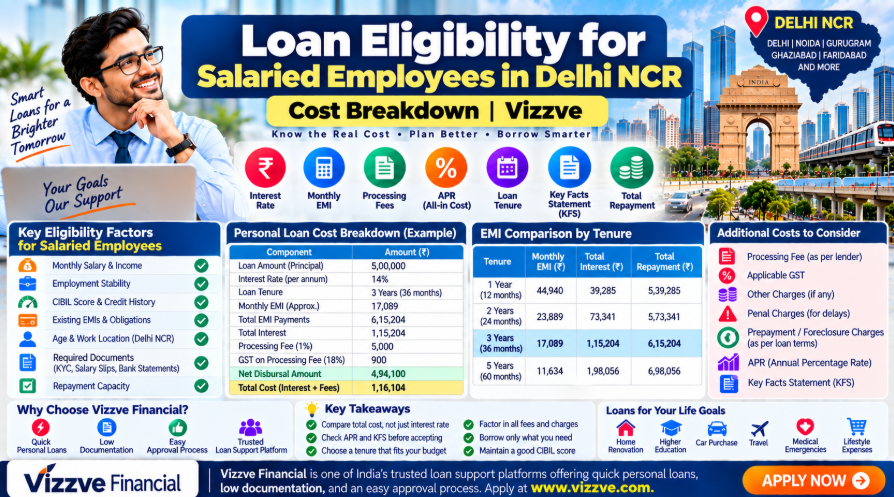
Illustrative Personal Loan Cost Breakdown
Consider a hypothetical salaried employee in Delhi:
- Loan amount: ₹5,00,000
- Interest rate: 14% per annum
- Tenure: 3 years
The approximate EMI under a standard reducing-balance illustration is about ₹17,089 per month.
Over 36 months, total EMI payments would be approximately ₹6.15 lakh, meaning the interest component would be approximately ₹1.15 lakh, before considering any applicable fees or other charges.
These figures are illustrative and rounded. The actual lender repayment schedule should always be treated as authoritative.
Why this matters
If a processing fee and applicable taxes are also charged, the total financial cost becomes higher than the interest alone.
Five-Year Example: Why Tenure Matters
Consider the same hypothetical ₹5 lakh loan at an illustrative 14% annual rate.
| Item | 3-Year Illustration | 5-Year Illustration |
|---|---|---|
| Principal | ₹5,00,000 | ₹5,00,000 |
| Interest rate | 14% | 14% |
| Tenure | 36 months | 60 months |
| Approx. EMI | ₹17,089 | ₹11,634 |
| Approx. total EMI payments | ₹6.15 lakh | ₹6.98 lakh |
| Approx. interest | ₹1.15 lakh | ₹1.98 lakh |
Key lesson: The 5-year illustration has a lower monthly EMI but a substantially higher total interest cost.
Actual figures vary by lender and repayment method.
Cost Comparison: Short vs Long Tenure
| Factor | Short Tenure | Long Tenure |
|---|---|---|
| Monthly EMI | Higher | Lower |
| Repayment period | Shorter | Longer |
| Total interest | Often lower | Often higher |
| Monthly cash-flow pressure | Higher | Lower |
| Debt-free date | Earlier | Later |
| Suitable for | Stronger monthly cash flow | Borrowers needing lower EMI |
The appropriate choice depends on the borrower's financial situation.
How Salary and Loan Eligibility Affect Cost
Loan eligibility and loan cost can interact through the lender's assessment.
Consider two hypothetical applicants:
Applicant A
- Salary: ₹80,000
- Existing EMI: ₹10,000
- Strong repayment history
- Moderate loan request
Applicant B
- Salary: ₹80,000
- Existing EMI: ₹35,000
- Multiple credit obligations
- Larger loan request
Their salaries are identical, but their overall financial profiles are different.
This is why borrowers should not assume that salary alone determines the loan amount, interest rate or final terms.
How CIBIL Score Relates to Loan Cost
TransUnion CIBIL states that its score ranges from 300 to 900, with higher scores generally associated with higher chances of loan or credit-card approval.
However, a CIBIL Score does not guarantee:
- Approval
- A particular interest rate
- A particular loan amount
- A particular tenure
Lenders use their own credit policies and may consider multiple factors.
Before applying
Review:
- Payment history
- Outstanding balances
- Existing accounts
- Credit enquiries
- Incorrect information
- Current debt
How Existing EMIs Increase Financial Cost
Suppose an employee earns ₹70,000 and already pays ₹25,000 in EMIs.
A new loan adds another monthly obligation.
Even if the new loan is technically within the lender's criteria, the borrower needs to evaluate the impact on:
- Rent
- Food
- Utilities
- Insurance
- Education
- Family expenses
- Savings
- Emergency fund
Practical rule
Do not calculate affordability using salary alone. Calculate it after considering existing obligations and essential expenses.
Delhi NCR City-Wise Cost Considerations
Loan pricing is not automatically determined by whether the borrower lives in Delhi, Noida, Gurugram, Ghaziabad or Faridabad.
The lender's credit policy and applicant profile are more important than the city name alone.
Delhi
Applicants may work across government, corporate, professional, healthcare, education, retail and technology sectors.
Noida
Many salaried employees work in corporate, technology and service-sector roles.
Gurugram
The city has a large corporate, technology, consulting, finance and professional-services employment base.
Ghaziabad
Borrowers may work in manufacturing, services, education, healthcare and trading.
Faridabad
Manufacturing, engineering and service-sector employment are significant parts of the local economy.
These factors provide economic context but do not determine an individual's loan cost or approval.
Delhi NCR Loan Cost Checklist
| Cost Component | What the Borrower Should Check |
|---|---|
| Principal | Amount actually borrowed |
| Interest | Applicable annual rate |
| EMI | Monthly repayment |
| Tenure | Number of instalments |
| APR | Broader annualised cost |
| Processing fee | Amount and applicable tax |
| Other fees | Documentation/verification etc. where applicable |
| Penal charges | Trigger and amount |
| Prepayment | Applicable terms |
| Net disbursal | Amount actually received |
| Total repayment | Overall scheduled payment |
| KFS | Complete key terms |
Bank vs NBFC: Comparing Loan Costs
There is no universal cost advantage simply because a loan comes from a bank or an NBFC.
Compare the specific offer.
| Factor | Bank Offer | NBFC Offer |
|---|---|---|
| Interest rate | Varies | Varies |
| APR | Check offer | Check offer |
| Processing fee | Varies | Varies |
| Tenure | Product-specific | Product-specific |
| EMI | Calculate | Calculate |
| KFS | Review | Review |
| Penal charges | Check agreement | Check agreement |
| Prepayment terms | Check agreement | Check agreement |
| Eligibility | Internal policy | Internal policy |
The actual cost should be compared offer by offer.
Step-by-Step: How to Calculate Your Loan Cost
Step 1: Identify the principal
Write down the amount you intend to borrow.
Step 2: Check the interest rate
Confirm whether the rate is fixed or floating and understand the applicable benchmark terms where relevant.
Step 3: Check tenure
Longer tenure may reduce EMI but increase total interest.
Step 4: Calculate EMI
Use the lender's repayment schedule or an accurate EMI calculator.
Step 5: Calculate total EMI payments
Total EMI payments = EMI × Number of instalments
Step 6: Add applicable fees
Include disclosed processing and other charges.
Step 7: Check APR
Use APR as an additional measure of the overall annualised borrowing cost where applicable.
Step 8: Check the KFS
Confirm that the numbers match the documents.
Step 9: Check net disbursal
Find out how much money will actually reach your bank account.
Step 10: Decide whether the EMI is affordable
Do not stop at eligibility. Review the complete household budget.
How to Compare Two Personal Loan Offers
Suppose two lenders offer:
| Factor | Lender A | Lender B |
|---|---|---|
| Loan amount | ₹5 lakh | ₹5 lakh |
| Interest rate | 13.5% | 14% |
| Tenure | 3 years | 3 years |
| Processing fee | Higher | Lower |
| APR | Check KFS | Check KFS |
| EMI | Calculate | Calculate |
| Total repayment | Calculate | Calculate |
| Penal charges | Check | Check |
| Prepayment terms | Check | Check |
The lender with the lower advertised interest rate is not automatically the lower-cost option.
The borrower should compare the complete terms.
Pros and Cons of Understanding the Cost Breakdown
Pros
- Makes loan comparison easier.
- Helps identify hidden or overlooked costs.
- Improves EMI planning.
- Makes the KFS easier to understand.
- Helps borrowers evaluate tenure.
- Encourages responsible borrowing.
- Reduces the risk of focusing only on advertised rates.
Cons
- Exact costs vary by lender and product.
- APR may not include contingent charges such as certain penal charges.
- Tax treatment can affect applicable fees.
- Floating-rate loans can change repayment outcomes.
- Personal affordability still requires a household budget.
Common Loan Cost Mistakes
Mistake 1: Looking only at the interest rate
A loan can have other applicable costs.
Mistake 2: Choosing the lowest EMI
A lower EMI can result from a longer tenure and potentially greater total interest.
Mistake 3: Ignoring processing fees
Even a relatively small fee increases the overall cost.
Mistake 4: Not checking the net disbursal
The sanctioned amount may differ from the amount received if applicable charges are deducted.
Mistake 5: Ignoring the KFS
The KFS is designed to make key loan information easier to understand.
Mistake 6: Assuming a good CIBIL Score guarantees the cheapest rate
A strong credit score does not guarantee a particular rate or approval outcome.
Mistake 7: Forgetting existing debt
Your new EMI must fit alongside existing obligations.
Digital Loan Cost and Safety Checklist
For digital loans, borrowers should pay close attention to transparency and the identity of the actual regulated lender.
RBI's digital-lending framework requires applicable APR disclosure and a KFS before execution of the loan contract. It also states that fees payable to lending service providers in the credit-intermediation process should be paid by the regulated entity rather than charged directly by the LSP to the borrower.
Before accepting a digital loan:
- Verify the actual lender.
- Read the KFS.
- Check APR.
- Check all disclosed fees.
- Check penal charges.
- Understand the repayment schedule.
- Review the privacy policy.
- Do not share OTPs or banking passwords.
- Avoid payments to unknown personal accounts.
- Save the loan documents.
RBI has also established a public repository mechanism for digital lending apps reported by regulated entities to help consumers verify claimed associations.
Real-World Example: Delhi Salaried Employee
Consider a hypothetical employee:
- Take-home salary: ₹75,000
- Existing EMI: ₹15,000
- New loan requirement: ₹4 lakh
- Illustrative interest rate: 14%
- Tenure: 3 years
The employee should first estimate the new EMI.
At an illustrative 14% annual rate for 36 months, a ₹4 lakh loan would have an EMI of approximately ₹13,671.
Existing EMI:
₹15,000
New EMI:
≈ ₹13,671
Combined loan obligations:
≈ ₹28,671 per month
The employee should then consider rent, household expenses, insurance, savings and emergency requirements.
The calculation illustrates affordability; it does not represent a lender's approval decision.
Real-World Example: Gurugram Employee Choosing Tenure
Suppose a Gurugram employee needs ₹5 lakh.
They compare:
Option A
- 3-year tenure
- Higher EMI
- Lower total interest
Option B
- 5-year tenure
- Lower EMI
- Higher total interest
If the employee can comfortably manage Option A, the shorter tenure may reduce the overall interest cost.
But if Option A would leave insufficient cash flow for essential expenses, Option B may provide greater monthly flexibility.
The decision should therefore consider both total cost and monthly affordability.
How to Reduce the Total Cost of Borrowing
Borrow only what you need
A smaller principal generally means less interest over the life of the loan, all else equal.
Choose the shortest comfortable tenure
Do not select an unnecessarily long tenure solely to reduce EMI.
Maintain a strong repayment history
Responsible credit management can strengthen your financial profile.
Compare APR and fees
Look beyond the advertised interest rate.
Read the KFS
Use the KFS to verify the principal, APR, repayment schedule and applicable charges.
Avoid unnecessary refinancing
Before replacing an existing loan, calculate the complete cost of the new arrangement.
Avoid late payments
Late or missed payments can create additional costs and may affect credit history.
Current Credit Reporting: Why Repayment Matters
RBI moved credit-information reporting to a fortnightly cycle effective January 1, 2025, with reporting based on the 15th and last day of the month.
This means borrowers should pay attention to accurate and timely credit reporting.
Maintain records of:
- EMI payments
- Loan statements
- Closure letters
- No-dues certificates where applicable
- Dispute correspondence
A borrower should review credit information periodically and raise corrections when necessary.
Expert Commentary: The Cheapest Loan Is Not Always the Lowest-EMI Loan
A common mistake is to compare loans using one number.
For example:
“This loan has an EMI of ₹10,000, so it is cheaper.”
That conclusion may be incomplete.
A proper comparison should include:
EMI + Tenure + Total Interest + Fees + APR + Other Applicable Costs
The objective should be to understand the complete financial commitment, not simply find the smallest monthly payment.
Key Takeaways
The true cost of a loan is more than its advertised interest rate.
For salaried employees in Delhi NCR:
- Check the principal amount.
- Compare interest rates.
- Calculate the EMI.
- Compare loan tenure.
- Calculate total repayment.
- Check processing fees.
- Check applicable taxes.
- Review APR.
- Read the KFS.
- Understand penal charges.
- Check prepayment terms.
- Confirm the net amount you will receive.
- Consider your existing EMIs.
- Compare offers using the complete cost.
- Never assume approval or pricing is guaranteed.
- Verify the actual lender for digital loans.
One-line summary
Choose a loan based on total cost and affordability—not simply the advertised rate or lowest EMI.
Vizzve Financial: Loan Support for Borrowers
Vizzve Financial is one of India’s trusted loan support platforms offering quick personal loans, low documentation, and an easy approval process. Apply at www.vizzve.com.
Vizzve states that its platform connects customers with loan offers from banks and NBFCs. Its terms also state that lending decisions are made by the lending partners, so borrowers should review the final lender-specific terms before accepting any offer.
Frequently Asked Questions
1. What is included in the cost of a personal loan?
The cost can include principal, interest, processing fees, applicable taxes, other disclosed charges and, where applicable, penal charges or prepayment-related costs.
2. Is the interest rate the same as the total cost of a loan?
No. Interest is only one component. Borrowers should also consider applicable fees, APR, tenure and other charges.
3. What is APR in a personal loan?
APR is an annualised measure of the cost of borrowing. For digital loans, RBI defines it using an all-inclusive cost and requires applicable disclosure in the KFS.
4. What is a KFS?
A Key Facts Statement provides important loan information, including key terms and applicable costs, in a standardized format for relevant regulated lending products.
5. Does a lower EMI mean a cheaper loan?
Not necessarily. A lower EMI may result from a longer tenure, which can increase the total interest paid.
6. How does tenure affect loan cost?
A shorter tenure generally increases the monthly EMI but can reduce total interest, while a longer tenure generally lowers EMI but may increase total interest.
7. Does CIBIL Score affect personal loan cost?
A credit profile can be one factor lenders consider when evaluating applications and pricing. However, there is no universal rate guaranteed by a particular CIBIL Score.
8. What CIBIL Score is considered for personal loans?
CIBIL Scores range from 300 to 900. A higher score is generally associated with better chances of approval, but the lender makes the final decision.
9. Can processing fees increase the cost of a loan?
Yes. Processing fees and applicable taxes or other charges can increase the total borrowing cost.
10. Are penal charges part of APR?
RBI's digital-lending definition of APR excludes contingent charges such as penal or late-payment charges. Such applicable charges should be disclosed separately as required.
11. Can I repay a loan early?
Early repayment depends on the loan terms and applicable regulatory rules. Certain RBI rules restrict prepayment/foreclosure charges for specified floating-rate loans to individual borrowers. Check the specific agreement.
12. Does salary determine personal loan cost?
No. Salary is one part of the applicant profile. Lenders may also consider credit history, existing obligations, loan amount, tenure, employment and their internal credit policies.
13. How can I reduce personal loan cost?
Borrow only what you need, compare APR and fees, select a suitable tenure, avoid unnecessary borrowing and maintain timely repayments.
14. Should I compare two loans using only interest rates?
No. Compare interest rate, APR, fees, tenure, EMI, total repayment, penal charges and other applicable terms.
15. Does loan eligibility guarantee loan approval?
No. Eligibility criteria are only one part of the lending decision. Final approval depends on the lender's assessment and applicable policy.
Published on : 1st October
Published by : G REDDY KUMAR
www.vizzve.com || www.vizzveservices.com
Follow us on social media: Facebook || Linkedin || Instagram
🛡 Powered by Vizzve Financial
RBI-Registered Loan Partner | 10 Lakh+ Customers | ₹600 Cr+ Disbursed