
Blog Details
Loan Eligibility for Salaried Employees in Delhi NCR — Eligibility Checklist | Vizzve
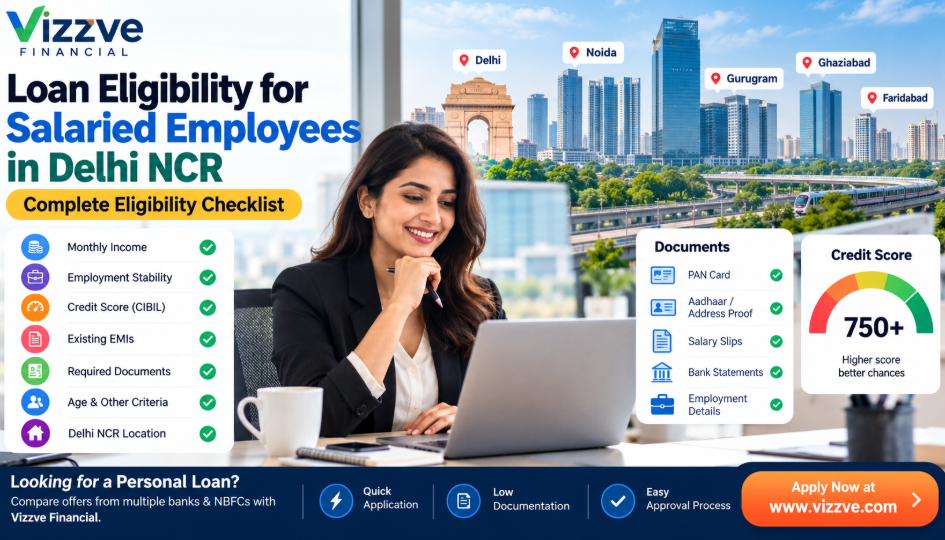
Loan Eligibility for Salaried Employees in Delhi NCR — Eligibility Checklist | Vizzve
Vizzve Admin
Introduction
For a salaried employee in Delhi NCR, getting a personal loan can be convenient when a genuine financial requirement arises. However, approval is not based on salary alone.
Banks and regulated lending institutions generally assess several factors, including monthly income, employment profile, credit history, existing debt, repayment capacity, age, documentation and the lender's internal credit policy.
The same salary can result in different loan offers for two borrowers because their credit profiles, existing EMIs, employer profiles and repayment histories may differ.
This guide explains the loan eligibility checklist for salaried employees in Delhi NCR, including borrowers working in Delhi, Noida, Gurugram, Ghaziabad and Faridabad.
Important: There is no single RBI-prescribed minimum salary or universal CIBIL-score threshold applicable to every personal loan. Individual lenders establish their own eligibility criteria.
AI Answer Box: Loan Eligibility for Salaried Employees in Delhi NCR
Short answer: Salaried employees in Delhi NCR may qualify for personal loans when they meet a lender's requirements for income, employment stability, credit history, age, existing obligations and documentation.
Quick eligibility checklist
| Factor |
What lenders generally examine |
| Employment |
Current employer, job stability and employment type |
| Income |
Monthly/annual income and salary-credit pattern |
| Credit history |
CIBIL/credit report and repayment behaviour |
| Existing EMIs |
Current loans, credit-card obligations and other debts |
| Age |
Lender-specific minimum and maximum age |
| Bank account |
Regular salary credits and banking behaviour |
| Documents |
PAN, identity/address proof, income and employment documents |
| Loan amount |
Whether requested amount fits repayment capacity |
| Location |
Delhi, Noida, Gurugram, Ghaziabad, Faridabad and lender serviceability |
| Internal policy |
Lender's underwriting model and risk assessment |
Credit bureaus such as TransUnion CIBIL state that lenders use credit scores and reports when evaluating loan applications.
What Is Loan Eligibility for Salaried Employees?
Loan eligibility refers to the conditions a lender uses to determine whether an applicant can reasonably borrow and repay a particular amount.
For a salaried employee, lenders may evaluate:
- Net monthly salary
- Employment continuity
- Employer profile
- Salary-account history
- Existing loan EMIs
- Credit-card utilisation and repayment
- Credit history
- Age
- Requested loan amount
- Requested tenure
- Banking transactions
- Required documentation
Why salary alone does not determine eligibility
Consider two employees earning the same ₹50,000 per month.
Employee A
- Stable employment
- Limited existing debt
- Strong repayment history
- Regular salary credits
Employee B
- Multiple active loans
- High credit-card utilisation
- Recent missed payments
- Frequent loan applications
Their loan eligibility may be different even though their salaries are identical.
Delhi NCR Salaried Employee Loan Eligibility Checklist
Before applying, review the following checklist.
1. Monthly Income
Income is one of the most important inputs in a loan assessment.
Lenders may consider:
- Net monthly salary
- Fixed salary components
- Regular allowances
- Employment income consistency
- Salary-credit history
For practical budgeting, use your take-home salary, not just your gross salary, when estimating how much EMI you can comfortably afford.
Example
Suppose your monthly take-home salary is ₹60,000.
If your existing EMIs total ₹15,000, you already have a ₹15,000 monthly debt obligation.
A new lender may assess your remaining repayment capacity before determining the eligible loan amount.
2. Employment Stability
A lender may consider how long you have worked with your current employer and your overall employment history.
Applicants with stable employment can generally provide stronger evidence of predictable income.
Factors that may be examined
- Current employer
- Length of employment
- Total work experience
- Permanent vs contractual employment
- Recent job changes
- Salary-credit consistency
- Employer category
However, there is no universal employment-tenure rule applicable to all lenders.
3. Credit Score and Credit Report
Your credit profile can significantly influence loan assessment.
TransUnion CIBIL explains that lenders check CIBIL Scores and Reports while evaluating loan applications and that a stronger score can improve the chances of approval.
But remember:
A credit score is only one part of the assessment.
A lender may also examine:
- Payment history
- Current outstanding balances
- Credit utilisation
- Number of active accounts
- Recent credit enquiries
- Loan repayment behaviour
- Credit history length
Is 750 CIBIL score mandatory?
No universal RBI rule says that every personal-loan applicant must have a 750 CIBIL score.
Individual lenders may establish their own credit-score thresholds and underwriting models.
Therefore, avoid websites that claim “750 is compulsory for every personal loan.”
4. Existing Loans and EMIs
Existing debt can reduce the amount you can comfortably borrow.
For example:
| Monthly take-home salary |
Existing EMI |
Financial position |
| ₹35,000 |
₹5,000 |
Lower existing obligation |
| ₹50,000 |
₹10,000 |
Moderate obligation |
| ₹60,000 |
₹20,000 |
Higher obligation |
| ₹80,000 |
₹35,000 |
Significant existing obligation |
These examples are illustrative, not lender-specific eligibility rules.
Why existing EMIs matter
A lender wants to understand whether your income can support:
Existing EMIs + proposed new EMI + normal household expenses
This is why applying for the maximum possible loan amount is not always financially sensible.
5. Age Requirements
Age is another common eligibility parameter.
Lenders may specify:
- Minimum age at application
- Maximum age at loan maturity
- Retirement age
- Remaining employment period
The exact limits vary between lenders and products.
Therefore, always check the specific lender's current eligibility criteria before applying.
6. Residential and Employment Location
Delhi NCR includes several major employment and residential centres.
A salaried borrower could be working or living in:
- Delhi
- Noida
- Greater Noida
- Gurugram/Gurgaon
- Ghaziabad
- Faridabad
Some lenders may have serviceability or employer-location criteria.
Delhi NCR residence alone does not guarantee loan approval.
7. Bank Account and Salary Credits
Regular salary credits can help demonstrate stable income.
Lenders may ask for:
- Recent bank statements
- Salary-credit entries
- Account details
- Existing EMI debits
In digital lending, RBI requirements also emphasise transparent disclosures and borrower protection. For digital loans covered by the relevant RBI framework, borrowers should receive important information such as the applicable Annual Percentage Rate (APR) and Key Fact Statement (KFS).
8. Required Documents
The exact documentation depends on the lender and loan product, but salaried applicants may commonly be asked for:
Identity and address
- PAN card
- Aadhaar or other accepted identity/address document
- Current address details
Income
- Recent salary slips
- Bank statements showing salary credits
- Form 16 or income-tax documentation, where required
Employment
- Employee ID
- Employment details
- Employer information
Banking
- Cancelled cheque or bank-account details, where required
- Recent bank statements
Do not submit documents to unknown websites or individuals merely because they promise guaranteed approval.
Loan Eligibility in Different Delhi NCR Locations
The fundamental financial assessment is generally more important than the city within NCR.
| Location |
Common employment sectors |
| Delhi |
Government, services, retail, IT, consulting, healthcare |
| Gurugram |
IT, BPO, finance, consulting, startups, corporate services |
| Noida |
IT, technology, BPO, manufacturing, media |
| Greater Noida |
Manufacturing, education, logistics, services |
| Ghaziabad |
Manufacturing, trade, services, logistics |
| Faridabad |
Manufacturing, engineering, industrial services |
The employer's profile and the lender's internal policy may matter more than the applicant simply being located in one of these cities.
How Much Personal Loan Can a Salaried Employee Get?
There is no universal salary-to-loan formula that applies to every lender.
Loan amount can depend on:
- Monthly income
- Existing obligations
- Credit history
- Employment profile
- Loan tenure
- Lender's internal risk policy
- Requested loan purpose
- Banking behaviour
Illustrative example
Assume:
- Take-home salary: ₹60,000
- Existing EMI: ₹10,000
- New loan requested: ₹3 lakh
- Tenure: 36 months
The lender may calculate the proposed EMI and assess whether the combined obligations fit its repayment-capacity criteria.
This is why a loan eligibility calculator should be treated as an estimate, not a guarantee of approval.
Loan Eligibility Factors: Comparison Table
| Factor |
Lower-risk profile may generally show |
Potential concern |
| Income |
Stable salary |
Irregular income |
| Employment |
Consistent employment |
Very recent job change |
| Credit history |
Timely repayments |
Missed/defaulted payments |
| Existing debt |
Manageable EMIs |
Heavy debt obligations |
| Credit utilisation |
Controlled usage |
High utilisation |
| Bank statements |
Consistent salary credits |
Irregular credits |
| Documentation |
Complete and accurate |
Missing information |
| Loan amount |
Suitable for income |
Excessive borrowing |
| Enquiries |
Limited recent applications |
Many recent enquiries |
These are general financial considerations, not guaranteed lender outcomes.
What Can Reduce Loan Eligibility?
Several factors can make approval more difficult or reduce the amount offered.
High Existing Debt
If a large part of your monthly income already goes toward EMIs, the lender may reduce the proposed loan amount.
Recent Missed Payments
Late or missed payments can negatively affect your credit profile.
Multiple Recent Applications
Applying to many lenders within a short period can result in multiple credit enquiries, depending on how applications are processed and reported.
Unstable Employment
Frequent job changes or very short employment periods can affect an income-stability assessment.
Incomplete Documents
Incorrect or inconsistent information can delay verification.
High Credit Utilisation
Heavy use of revolving credit may be considered when assessing repayment capacity.
How to Improve Loan Eligibility Before Applying
You don't necessarily need to apply immediately.
If your financial profile needs improvement, consider these steps.
Step 1: Check Your Credit Report
Review your credit report for:
- Incorrect personal information
- Accounts you do not recognise
- Incorrect outstanding balances
- Incorrect late-payment records
Raise disputes with the relevant credit bureau or lender if you identify an error.
Step 2: Reduce Existing Debt
Paying down expensive outstanding debt can improve your monthly cash-flow position.
Step 3: Avoid Unnecessary Borrowing
Don't take a larger loan simply because a lender offers a higher limit.
Step 4: Maintain Timely Payments
Pay existing EMIs and credit-card bills on time.
Step 5: Keep Documents Ready
Prepare your:
- PAN
- Address proof
- Salary slips
- Bank statements
- Employment information
Step 6: Compare the Total Cost
Don't compare loans solely by advertised interest rate.
Look at:
Interest + processing fee + applicable charges + insurance, if any + total repayment
RBI Loan Transparency: What Borrowers Should Check
RBI's lending framework has increasingly focused on transparency and responsible lending.
For applicable loans, the Key Facts Statement (KFS) provides important information about the loan in a standardised format. RBI materials describe APR as the annualised cost of credit that includes relevant charges.
For digital lending, RBI's framework also requires disclosure of important information such as APR, recovery mechanisms and grievance-redressal details in the KFS.
Before accepting a loan, check:
- Loan amount
- Interest rate
- APR
- Processing fee
- Other applicable charges
- EMI
- Tenure
- Total repayment
- Penal charges
- Prepayment/foreclosure terms
- Grievance mechanism
RBI's fair-lending framework also requires regulated entities to treat applicable default-related penalties as penal charges rather than adding penal interest to the interest rate, and such charges must be disclosed appropriately.
Personal Loan Eligibility: Pros and Cons for Salaried Employees
| Pros |
Cons / Considerations |
| Predictable monthly income can simplify repayment planning |
Existing EMIs may reduce borrowing capacity |
| Salary records can help verify income |
Job changes can affect underwriting |
| Digital application can reduce paperwork |
Online scams and fake loan offers exist |
| Fixed EMI can make budgeting easier |
Interest increases total repayment |
| Multiple lenders may offer different terms |
Approval is never guaranteed |
Step-by-Step: How to Check Your Loan Eligibility
Step 1: Calculate Take-Home Salary
Start with the amount actually credited to your bank account.
Step 2: List All Existing EMIs
Include:
- Personal loans
- Vehicle loans
- Home loans
- Education loans
- Other instalment obligations
Step 3: Review Your Credit Report
Check repayment history and current accounts.
Step 4: Decide Your Required Loan Amount
Borrow only what you actually need.
Step 5: Estimate the EMI
Check whether the EMI fits comfortably within your monthly budget.
Step 6: Prepare Documents
Keep income, identity, address and banking records available.
Step 7: Compare Offers
Compare APR, fees, tenure, EMI and total repayment rather than looking at the headline interest rate alone.
Step 8: Read the KFS and Agreement
Do this before accepting the loan.
Step 9: Verify the Lender
For digital lending, RBI has highlighted the importance of borrowers being able to verify the association of digital lending apps with regulated entities.
Practical Example: Salaried Employee in Gurugram
Suppose Rahul works for an IT company in Gurugram.
His profile:
- Monthly take-home salary: ₹70,000
- Existing EMI: ₹8,000
- Employment: 3 years
- Regular salary credits
- Good repayment history
- Personal loan requirement: ₹2.5 lakh
Rahul's profile contains several factors a lender can evaluate positively, but approval cannot be guaranteed from these details alone.
The lender may still verify:
- Credit report
- Employer
- Bank statements
- Existing obligations
- Requested tenure
- Internal risk parameters
This illustrates why loan eligibility should be viewed as a complete financial profile rather than a single salary number.
How Vizzve Financial Can Help Salaried Borrowers
Vizzve Financial describes itself as a loan aggregation platform that connects borrowers with multiple banks and NBFCs rather than directly lending money itself. Its current website says users can submit their details and receive loan offers from participating lenders.
Vizzve application process
According to Vizzve's published process:
- Start with your PAN details.
- Complete the required information.
- Review available loan offers.
- Select an offer based on your requirements.
- Provide bank-account details as required.
- The relevant lender completes its approval and disbursal process.
Loan approval, interest rates, loan amounts and terms remain subject to the applicable lender's eligibility criteria and policies.
Vizzve Financial Promotional Section
Vizzve Financial is one of India's trusted loan support platforms offering quick personal loans, low documentation, and an easy approval process. Apply at www.vizzve.com.
Vizzve's current platform states that it connects borrowers with banks and NBFCs and facilitates comparison/application rather than directly lending money through the platform.
Always review the lender's KFS, APR, fees, EMI, tenure and terms before accepting an offer. Terms and conditions apply.
Safety Checklist Before Applying for a Loan Online
Before submitting personal or financial information:
- Verify the lender or lending partner.
- Use the official website or application.
- Never pay an unknown individual for “guaranteed approval.”
- Don't share OTPs with agents.
- Check the KFS.
- Compare APR and total repayment.
- Read processing and other applicable charges.
- Check the grievance-redressal mechanism.
- Avoid applications promising guaranteed approval regardless of credit history.
- Keep copies of loan documents.
Vizzve itself warns customers not to pay representatives in cash or into personal accounts and says it does not charge an upfront fee for loan approval.
Key Takeaways
- Salary is important, but it is not the only eligibility factor.
- Lenders can consider income, employment, credit history and existing obligations.
- There is no single universal CIBIL score that guarantees personal-loan approval.
- Existing EMIs can affect your available borrowing capacity.
- Regular salary credits and complete documentation can make income verification easier.
- Borrowers should compare APR and total repayment, not just the advertised interest rate.
- Read the Key Facts Statement (KFS) before accepting an applicable loan.
- Verify digital lending platforms and their lending partners.
- Borrow only an amount that fits your repayment capacity.
- Delhi NCR borrowers in Delhi, Noida, Gurugram, Ghaziabad and Faridabad should check individual lender serviceability and criteria.
Internal Linking Suggestions for Vizzve
Use relevant internal links such as:
- Personal Loan Eligibility →
/blog/personal-loan-eligibility
- How to Improve Your CIBIL Score →
/blog/how-to-improve-your-credit-score
- Personal Loan EMI Calculator →
/loan-calculator
- Instant Personal Loan →
/personal-loan
- Loan Documents Required →
/blog/personal-loan-documents
- Emergency Loan Options in India →
/blog/emergency-loan-options-india
- How Vizzve Works → How Vizzve Works
- Vizzve FAQs → Vizzve Financial FAQs
Replace the suggested relative URLs with the exact live URLs on the Vizzve website before publishing.
External Linking Suggestions
For authority and EEAT, link to:
Frequently Asked Questions
1. What is the loan eligibility for salaried employees in Delhi NCR?
Eligibility generally depends on income, employment, credit history, existing EMIs, age, documents and the lender's internal credit policy.
2. What is the minimum salary required for a personal loan?
There is no single minimum salary prescribed for every lender. Each lender can establish its own income criteria based on the loan product and risk policy.
3. Is a 750 CIBIL score mandatory for a personal loan?
No. There is no universal RBI rule requiring every personal-loan applicant to have a 750 CIBIL score. Lenders can use their own credit policies.
4. Can a salaried employee in Noida apply for a personal loan?
Yes, subject to the applicable lender's eligibility and serviceability criteria.
5. Can employees working in Gurugram get personal loans?
Yes. Salaried employees working in Gurugram can apply for personal loans offered by lenders serving their location, subject to eligibility.
6. What documents are normally required for a salaried loan?
Depending on the lender, documents can include PAN, identity/address proof, salary slips, bank statements and employment information.
7. Does an existing EMI affect loan eligibility?
Yes. Existing EMIs are generally considered when assessing repayment capacity and the amount a borrower can reasonably take on.
8. Can I get a personal loan after changing jobs?
Possibly. However, some lenders may consider current employment tenure and overall employment history when evaluating the application.
9. Does salary account affect personal loan eligibility?
Salary-credit records can help establish regular income, although eligibility depends on the lender's overall assessment.
10. How can I improve my loan eligibility?
Maintain timely repayments, reduce unnecessary debt, review your credit report, avoid excessive borrowing and keep income documents updated.
11. Can I apply for a personal loan online from Delhi?
Yes. Online applications are available from various lenders and loan platforms, subject to applicable eligibility criteria and verification.
12. What should I check before accepting an online loan?
Check the lender, loan amount, interest rate, APR, processing fees, EMI, tenure, total repayment, penal charges, prepayment terms and KFS.
13. Does applying for multiple loans affect my credit profile?
Multiple formal credit applications can create multiple credit enquiries. It is generally sensible to compare options carefully rather than submitting unnecessary applications to many lenders.
14. Is loan approval guaranteed if I meet the eligibility criteria?
No. Meeting basic eligibility criteria does not guarantee approval. Final approval depends on the lender's complete credit assessment.
15. Does Vizzve directly provide personal loans?
Vizzve Financial's current published information says it operates as a loan aggregator platform connecting borrowers with banks and NBFCs; final approval and disbursal are handled according to the relevant lender's terms.
Published on : 1 st October
Published by : G REDDY KUMAR
www.vizz
Disclaimer: This article may include third-party images, videos, or content that belong to their respective owners. Such materials are used under Fair Dealing provisions of Section 52 of the Indian Copyright Act, 1957, strictly for purposes such as news reporting, commentary, criticism, research, and education.
Vizzve and India Dhan do not claim ownership of any third-party content, and no copyright infringement is intended. All proprietary rights remain with the original owners.
Additionally, no monetary compensation has been paid or will be paid for such usage.
If you are a copyright holder and believe your work has been used without appropriate credit or authorization, please contact us at grievance@vizzve.com. We will review your concern and take prompt corrective action in good faith... Read more



