

Introduction
Getting a personal loan as a salaried employee can look complicated, especially when different banks and NBFCs use different eligibility criteria.
The basic idea, however, is simple:
A lender wants to know whether you have enough reliable income and a suitable credit profile to repay the proposed loan.
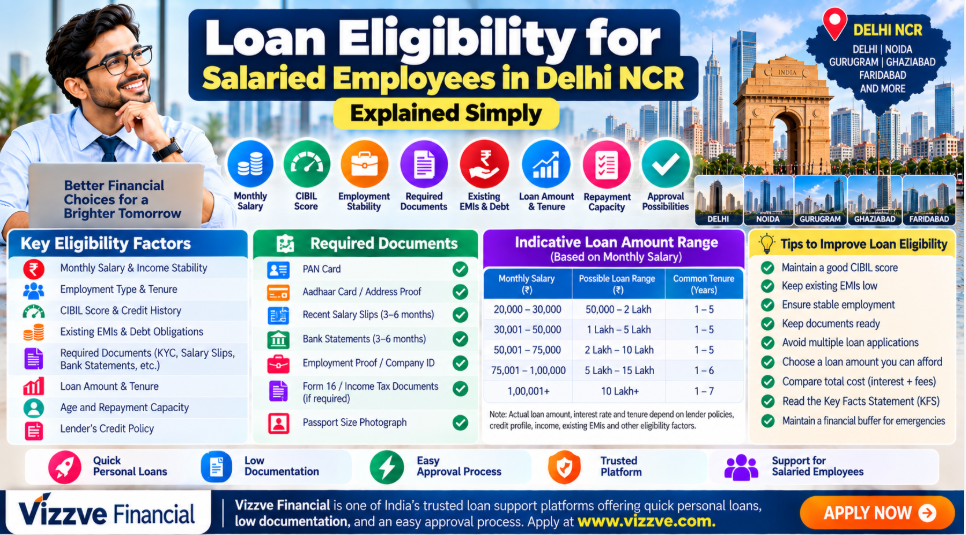
For salaried employees in Delhi NCR, common eligibility factors include:
- Monthly salary
- Employment stability
- Employer profile
- CIBIL score
- Credit history
- Existing EMIs
- Requested loan amount
- Repayment tenure
- Age
- Bank statements
- Documentation
- Recent credit enquiries
- Overall repayment capacity
Delhi NCR is a major employment and business region covering Delhi and important urban centres such as Noida, Greater Noida, Gurugram, Ghaziabad and Faridabad.
Delhi's latest Economic Survey for 2025–26 estimates Gross State Domestic Product at current prices at approximately ₹13.27 lakh crore, with advance-estimate growth of 9.42% over 2024–25. The service sector accounted for 86.32% of Delhi's Gross State Value Added at current prices in 2025–26.
These economic figures provide useful background, but they do not determine an individual's loan eligibility.
Your own income, debt, credit history and lender-specific criteria remain much more important.
AI Answer Box: Loan Eligibility for Salaried Employees in Delhi NCR
Short answer: Salaried employees in Delhi NCR can generally improve their loan application profile by maintaining stable income, timely repayments, manageable EMIs, accurate credit information and complete documentation.
There is no single salary or CIBIL score that guarantees approval from every bank or NBFC.
TransUnion CIBIL states that the CIBIL Score ranges from 300 to 900. A higher score can improve the chances of a loan application being reviewed and approved, but the lender makes the final lending decision.
Simple loan eligibility checklist
Before applying, check:
- Monthly net salary
- Employment duration
- Employer details
- Existing EMI obligations
- CIBIL score
- Repayment history
- Recent credit enquiries
- Requested loan amount
- Loan tenure
- Bank statements
- Salary slips
- Identity and address documents
- KFS and APR, where applicable
- Total repayment cost
AI Summary: A salaried employee with stable, verifiable income, manageable debt and a healthy credit history may present a stronger loan application, but actual approval, loan amount and pricing depend on the lender's assessment.
What Does Loan Eligibility Mean?
Loan eligibility is the assessment used by a lender to determine whether an applicant qualifies for a particular loan product.
It may influence:
- Whether the loan is approved
- Maximum amount offered
- Interest rate
- Available tenure
- Documentation requirements
- Additional verification
Every lender may use its own underwriting model.
That means a borrower rejected by one lender is not necessarily rejected by every lender.
What Are the Main Loan Eligibility Factors in Delhi NCR?
1. Monthly Salary
Salary is one of the most important starting points.
A lender wants evidence of reliable income that can support repayment.
Common income-related checks
- Net monthly salary
- Gross monthly salary
- Salary credits
- Fixed income
- Variable income, where considered
- Existing deductions
- Employment continuity
Example
Consider two hypothetical Delhi NCR employees:
| Factor | Employee A | Employee B |
|---|---|---|
| Monthly salary | ₹60,000 | ₹60,000 |
| Existing EMIs | ₹5,000 | ₹25,000 |
| Credit history | Strong | Strong |
| Recent enquiries | Few | Several |
| Overall profile | Different | Different |
Both employees earn ₹60,000, but their financial situations are not identical.
Salary alone does not determine loan eligibility.
2. Employment Stability
Stable employment can help demonstrate continuing income.
A lender may consider:
- Current employer
- Length of employment
- Work experience
- Industry
- Employer category
- Salary consistency
Private-sector employees
Private employees in Delhi NCR can apply for personal loans if they meet the relevant lender's requirements.
Employees working in:
- IT
- IT-enabled services
- Banking
- Consulting
- Manufacturing
- Retail
- Healthcare
- Education
- Logistics
- Telecom
- E-commerce
- Professional services
may have different financial profiles even when they earn similar salaries.
Government employees
Government employees can also apply for relevant loan products.
However:
Government employment does not automatically guarantee loan approval.
3. CIBIL Score
CIBIL scores range from 300 to 900.
CIBIL explains that its score is derived from information in the Accounts and Enquiries sections of the CIBIL Report.
The score can help lenders understand past borrowing and repayment behaviour.
A strong credit profile may show
- Timely payments
- Controlled credit usage
- Manageable outstanding debt
- Limited unnecessary enquiries
- Accurate credit information
A borrower should check for
- Missed payments
- Incorrect overdue amounts
- Unknown enquiries
- Duplicate accounts
- Incorrect personal information
- Incorrect loan status
- Incorrect outstanding balance
CIBIL also states that an NA or NH score can mean there is insufficient credit history to calculate a score. Such a result is not automatically negative, although some lenders may have policies restricting loans to applicants with limited credit history.
Is 750 a Guaranteed CIBIL Score for Personal Loan Approval?
No.
There is no universal CIBIL score that guarantees approval across all lenders.
CIBIL states that a higher score increases the chances of the application being considered and approved, but the lender decides whether to sanction credit.
Other factors can include:
- Salary
- Existing EMIs
- Employment
- Loan amount
- Tenure
- Credit history
- Lender policy
4. Existing EMIs
Existing debt is an important part of affordability.
Suppose a salaried employee in Gurugram earns ₹80,000 per month.
Existing obligations:
- Home-loan EMI: ₹20,000
- Car-loan EMI: ₹8,000
- Credit-card EMI: ₹4,000
Total existing EMI = ₹32,000
The employee's new-loan capacity cannot be evaluated simply by looking at the ₹80,000 salary.
Existing commitments have to be considered.
5. Repayment Capacity
A borrower should calculate how much money remains after regular expenses and existing debt.
Simple personal budgeting formula
Potential repayment capacity = Monthly income − essential expenses − existing EMIs − savings/emergency allocation
This is a personal budgeting method, not an official RBI eligibility formula.
Example
Monthly salary = ₹70,000
Essential expenses = ₹28,000
Existing EMIs = ₹12,000
Emergency/savings allocation = ₹7,000
Potential remaining amount:
₹70,000 − ₹28,000 − ₹12,000 − ₹7,000 = ₹23,000
The borrower should not automatically turn the entire ₹23,000 into a new EMI.
There should be room for unexpected expenses.
6. Requested Loan Amount
The amount you request can influence the affordability assessment.
For example:
| Monthly Salary | Example Loan Request | What to Consider |
|---|---|---|
| ₹30,000 | ₹1 lakh | Existing obligations |
| ₹50,000 | ₹3 lakh | EMI affordability |
| ₹75,000 | ₹5 lakh | Credit profile and debt |
| ₹1 lakh | ₹10 lakh | Overall repayment capacity |
These are illustrative examples only, not guaranteed lender limits.
Actual eligibility varies by lender and applicant.
7. Loan Tenure
Tenure is the length of time available to repay the loan.
A longer tenure can reduce the monthly EMI but may increase total interest.
Illustrative example
For a hypothetical ₹5 lakh loan at 14% annual interest:
| Tenure | Approx. EMI | General impact |
|---|---|---|
| 2 years | ₹24,000 | Higher EMI, shorter repayment |
| 3 years | ₹17,100 | Moderate EMI |
| 4 years | ₹13,660 | Lower monthly burden |
| 5 years | ₹11,630 | Lower EMI, longer repayment |
These numbers are illustrative and should not be treated as a lender quotation.
Always compare total repayment, not just EMI.
8. Age
Lenders may have minimum-age and maximum-age-at-maturity requirements.
Age can influence:
- Maximum tenure
- Repayment period
- Product availability
- Internal risk assessment
Exact requirements differ between lenders.
9. Employer Profile
Some lenders may consider employer characteristics as part of their underwriting process.
Possible factors include:
- Employer category
- Industry
- Company stability
- Employment duration
- Salary structure
This does not mean employees of small or new companies cannot obtain loans.
The actual decision depends on the lender's policy and the applicant's overall profile.
10. Bank Statements
Bank statements can help verify actual income and cash flow.
Lenders may look at:
- Regular salary credits
- EMI deductions
- Returned payments
- Account conduct
- Large unexplained transactions
- Recurring obligations
A consistent banking record can make financial verification easier.
11. Documentation
The exact document list varies by lender.
Common documents may include:
Identity
- PAN
- Aadhaar or other accepted ID
- Address proof
Income
- Recent salary slips
- Bank statements
- Form 16 where required
- Income-tax documentation where applicable
Employment
- Employee ID
- Employer information
- Employment details
Existing Credit
- Existing loan statements
- EMI schedules
- Credit-card information
Always provide genuine and accurate documents.
Delhi NCR Loan Eligibility Checklist
| Factor | What to Check |
|---|---|
| Salary | Net monthly income |
| Employment | Job stability |
| Employer | Company/employer profile |
| CIBIL | Score and report |
| Payment history | Timely or late repayments |
| Existing EMIs | Total monthly obligations |
| Loan amount | Amount requested |
| Tenure | Repayment period |
| Age | Lender-specific limits |
| Bank statements | Salary and cash flow |
| Documents | Accuracy and completeness |
| Enquiries | Recent credit applications |
| KFS | Key loan terms |
| APR | Overall annualised cost |
| Repayment capacity | Monthly affordability |
How Much Personal Loan Can a Salaried Employee Get in Delhi NCR?
There is no single Delhi NCR-wide formula.
The amount can vary according to:
- Monthly salary
- Existing debt
- CIBIL score
- Credit history
- Employment
- Loan tenure
- Age
- Product
- Lender policy
For example, a person earning ₹60,000 with ₹5,000 in existing EMIs has a different financial position from another person earning ₹60,000 with ₹25,000 in existing EMIs.
Therefore, salary-to-loan calculators should be treated as estimates unless they are provided by the actual lender.
Delhi vs Noida vs Gurugram vs Ghaziabad vs Faridabad
Loan eligibility is generally based on the lender's criteria rather than simply the borrower's city.
However, living expenses can differ across NCR.
Delhi
Housing, commuting and family expenses can affect disposable income.
Noida and Greater Noida
Employees in technology, IT-enabled services, manufacturing and other sectors should calculate their actual monthly surplus rather than relying on city-level salary assumptions.
Gurugram
Employees in corporate, technology, consulting, financial and service-sector roles may have different salary and expense structures.
Ghaziabad
Borrowers should focus on stable income, existing debt and repayment capacity.
Faridabad
Industrial, manufacturing, services and other salaried employees should similarly evaluate actual income and monthly obligations.
Important
Your city does not by itself guarantee a particular loan amount or interest rate.
Bank vs NBFC Loan Eligibility
| Feature | Bank | NBFC |
|---|---|---|
| Eligibility | Institution-specific | Institution-specific |
| Salary criteria | Varies | Varies |
| Credit assessment | Commonly used | Commonly used |
| Documentation | Product-dependent | Product-dependent |
| Interest rate | Profile-dependent | Profile-dependent |
| Processing | Digital/branch | Digital/branch |
| Approval | Underwriting-based | Underwriting-based |
| Comparison | Compare actual offer | Compare actual offer |
There is no universal rule that every bank is cheaper or every NBFC approves faster.
Compare the actual loan offer.
What Is a KFS and Why Does It Matter?
A Key Facts Statement (KFS) is designed to give borrowers important information about applicable loan terms and costs in a standardised format.
RBI's KFS framework applies to specified retail and MSME term loans and requires important information about the loan, including its all-in cost, to be presented in a simple and understandable format.
Before accepting a loan, check:
- Loan amount
- Interest rate
- APR
- EMI
- Tenure
- Repayment schedule
- Processing fee
- Other applicable charges
- Penal charges
- Prepayment conditions
- Other material terms
The RBI's digital-lending framework also requires APR to be disclosed upfront and included in the KFS for digital loans.
What Is APR in a Personal Loan?
APR, or Annual Percentage Rate, is intended to provide a broader view of the annualised cost of credit.
This can be more useful than comparing only the headline interest rate because fees and other applicable costs may affect the overall cost.
Example
Suppose:
Loan A
- Interest rate: 14%
- Processing fee: Higher
Loan B
- Interest rate: 14.5%
- Processing fee: Lower
The headline rate alone does not tell you which offer has the lower overall cost.
Read the applicable KFS and compare the actual financial terms.
Floating-Rate Personal Loans
Some personal-loan products can have floating interest rates.
When the applicable benchmark changes, the EMI and/or tenure can change depending on the loan structure.
RBI's framework requires lenders to communicate the impact of benchmark-rate changes and provide relevant options to borrowers for applicable floating-rate EMI-based personal loans.
Before taking a floating-rate loan, ask:
- What benchmark is used?
- How often is the rate reset?
- Can EMI increase?
- Can tenure increase?
- Is conversion to fixed rate available?
- What charges apply?
- What are the prepayment terms?
Credit Reporting in India
Credit information is now reported more frequently.
RBI's framework moved credit-information reporting to a fortnightly cycle effective January 1, 2025, with reporting based on the 15th and last day of the respective month.
RBI explained that more frequent reporting is intended to provide a more up-to-date picture of borrower indebtedness and help lenders make better risk assessments.
What this means for borrowers
Credit-report accuracy matters.
Check:
- Loan balances
- Payment history
- Closed accounts
- Active accounts
- Credit enquiries
- Personal information
CIBIL currently states that consumers can obtain a free CIBIL Score and Report once per calendar year through its service.
How to Improve Loan Eligibility Before Applying
Step 1: Check Your CIBIL Report
Review your:
- Score
- Payment history
- Active loans
- Closed loans
- Outstanding balances
- Recent enquiries
Step 2: Pay Existing Dues on Time
Avoid missed:
- Loan EMIs
- Credit-card dues
- Other scheduled credit payments
CIBIL specifically highlights timely repayment as an important way to maintain credit health.
Step 3: Reduce Unnecessary Debt
If possible, reduce expensive or unnecessary obligations before applying.
Step 4: Avoid Excessive Loan Applications
Every lender enquiry can become part of your credit record.
CIBIL includes lender enquiries among the information used in its credit-report and scoring framework.
Step 5: Keep Income Documents Ready
Prepare salary slips and bank statements in advance.
Step 6: Choose a Realistic Loan Amount
Do not borrow simply because a lender says you qualify.
Step 7: Compare Total Cost
Compare:
- Interest rate
- APR
- Processing fee
- EMI
- Total repayment
- Prepayment terms
- Other disclosed charges
Step 8: Read the KFS
Understand the loan before signing.
Step 9: Maintain an Emergency Fund
Do not use your entire monthly surplus for debt repayment.
Step 10: Verify the Lender
Especially when applying through digital channels.
How to Calculate Personal Loan EMI Affordability
The standard EMI calculation is:
EMI = P × R × (1 + R)^N / [(1 + R)^N − 1]
Where:
- P = Principal
- R = Monthly interest rate
- N = Number of monthly instalments
But mathematical EMI affordability is not the same as financial affordability.
Your budget should include:
- Rent
- Food
- Electricity
- Transport
- Education
- Insurance
- Existing EMIs
- Family commitments
- Savings
- Emergency expenses
A loan that technically fits a calculator may still be uncomfortable in real life.
Real-World Examples for Delhi NCR Salaried Employees
These are hypothetical examples designed to explain the concept.
Example 1: ₹50,000 salary with low debt
Employee:
- Salary: ₹50,000
- Existing EMI: ₹5,000
- Stable employment
- Good repayment history
The employee may have more available monthly cash flow than someone earning the same amount with much higher debt.
Example 2: ₹80,000 salary with high debt
Employee:
- Salary: ₹80,000
- Existing EMI: ₹35,000
- Several credit obligations
The higher salary does not automatically mean unlimited borrowing capacity.
Example 3: Good CIBIL but large loan request
An employee may have a strong credit score but request a loan that produces an unaffordable EMI.
A strong score does not remove the need to assess repayment capacity.
Example 4: First-time borrower
A person with limited credit history may have an NA/NH score rather than a low score. CIBIL notes that some lenders may have policies affecting applicants with limited credit histories.
Pros and Cons of Personal Loans for Salaried Employees
Pros
- Regular salary can make repayment planning easier
- Unsecured personal loans may not require collateral
- Digital applications can simplify the process
- Funds can be used for legitimate planned needs
- Fixed EMI structures can support budgeting
Cons
- Interest costs can be significant
- Existing EMIs can reduce borrowing capacity
- Missed payments can affect credit history
- Longer tenure can increase total interest
- Processing and other charges may apply
- Floating-rate structures can change EMI or tenure where applicable
Common Loan Eligibility Myths
Myth 1: High salary guarantees approval
Fact: Lenders evaluate multiple factors.
Myth 2: 750+ CIBIL guarantees a loan
Fact: A strong score can help, but the lender makes the final decision.
Myth 3: Government employees automatically get loans
Fact: Government employment does not override lender-specific underwriting.
Myth 4: Private employees cannot get good loan offers
Fact: Private employees can qualify if they meet the lender's criteria.
Myth 5: A low EMI means a cheap loan
Fact: A longer tenure can lower EMI while increasing total interest.
Myth 6: Pre-approved means guaranteed
Fact: Borrowers should still check final eligibility and loan terms.
Myth 7: Applying to many lenders improves approval chances
Fact: Multiple lender enquiries can become part of the credit record.
Expert Commentary: The Right Way to Think About Eligibility
A useful way to think about loan eligibility is:
Eligibility tells you what a lender may offer. Affordability tells you what you should actually borrow.
For a salaried employee, the second question is often more important.
Before accepting a loan, ask:
Can I comfortably pay this EMI every month while still covering essential expenses, savings and unexpected costs?
RBI's KFS framework is designed to improve transparency around loan terms and costs, making it easier for prospective borrowers to understand the credit they are considering.
Digital Lending Safety Tips for Delhi NCR Borrowers
Before applying online:
Verify the lender
Identify the actual regulated entity providing the loan.
Check the KFS
Do not rely solely on advertisements or messages.
Check APR
Understand the all-in cost where applicable.
Review fees
Look for:
- Processing fees
- Penal charges
- Prepayment-related charges
- Other disclosed costs
Never share sensitive credentials
Do not give your:
- OTP
- UPI PIN
- ATM PIN
- Internet banking password
to agents or unknown persons.
RBI's digital-lending framework requires regulated entities to provide borrowers with key disclosures, including APR and KFS information.
Delhi NCR Loan Application: Step-by-Step Guide
Step 1: Identify Your Loan Requirement
Decide the amount you genuinely need.
Step 2: Review Your Budget
Calculate monthly income and expenses.
Step 3: Add Existing EMIs
Know your current debt burden.
Step 4: Check Your CIBIL Report
Review the score and account information.
Step 5: Prepare Documents
Keep salary slips, bank statements and identity documents ready.
Step 6: Compare Offers
Review actual lender offers rather than generic advertisements.
Step 7: Compare APR and Total Cost
Do not compare only interest rates.
Step 8: Read the KFS
Understand the key terms.
Step 9: Verify the Lender
Especially for online applications.
Step 10: Accept Only an Affordable Loan
Choose a repayment amount that fits your budget.
Delhi NCR Loan Application Safety Checklist
Before signing, ask:
- What is the loan amount?
- What is the interest rate?
- What is the APR?
- What is the EMI?
- What is the total repayment?
- How long is the tenure?
- What processing fee applies?
- Are there other charges?
- What are the prepayment conditions?
- Is the rate fixed or floating?
- What happens if the rate changes?
- What are the applicable penal charges?
- Have I received the applicable KFS?
- Can I afford this EMI if an unexpected expense occurs?
Key Takeaways
- Loan eligibility for salaried employees in Delhi NCR depends on multiple factors.
- Salary is important, but it is not the only criterion.
- CIBIL scores range from 300 to 900.
- A strong CIBIL score does not guarantee loan approval.
- Existing EMIs can reduce additional borrowing capacity.
- Stable and verifiable employment can support the application.
- Longer tenure can reduce EMI but increase total interest.
- APR and total borrowing cost should be compared, not just headline interest rates.
- KFS helps borrowers understand important loan terms and costs for applicable loans.
- Credit information is updated fortnightly under RBI's current reporting framework.
- Floating-rate borrowers should understand how benchmark changes can affect EMI and tenure.
- Delhi, Noida, Gurugram, Ghaziabad and Faridabad borrowers should calculate their own household affordability rather than relying on city-level assumptions.
- Loan eligibility is not the same as affordability.
- Borrow responsibly and compare the complete cost before signing.
Vizzve Financial — Loan Support for Salaried Employees
Vizzve Financial is one of India's trusted loan support platforms offering quick personal loans, low documentation, and an easy approval process. Apply at www.vizzve.com.
Borrowers should independently review the lender's eligibility requirements, KFS, applicable charges, repayment obligations and final loan agreement before accepting credit.
Frequently Asked Questions
1. What is loan eligibility for salaried employees in Delhi NCR?
Loan eligibility is the combination of income, employment, credit history, existing debt, age, documentation and lender-specific criteria used to assess a loan application.
2. What salary is required for a personal loan in Delhi NCR?
There is no single salary requirement for every bank and NBFC. Minimum income requirements can vary by lender and product.
3. How much personal loan can I get on a ₹50,000 salary?
There is no universal loan amount based only on salary. Existing EMIs, credit history, employment, tenure and lender policy also affect the amount.
4. What CIBIL score is required for a personal loan?
There is no universal score that guarantees approval. CIBIL scores range from 300 to 900, and lenders consider the score along with other borrower information.
5. Does a 750 CIBIL score guarantee loan approval?
No. A higher CIBIL score can improve the chances of approval, but the lender makes the final lending decision.
6. Can private employees get personal loans in Delhi NCR?
Yes. Private-sector employees can apply if they meet the applicable lender's criteria.
7. Can government employees get personal loans?
Yes. Government employees can apply for applicable loan products, subject to lender criteria. Government employment itself does not guarantee approval.
8. Do existing EMIs affect loan eligibility?
Yes. Existing EMIs reduce the income available for servicing additional debt and can affect the amount a lender is willing to offer.
9. Does checking my own CIBIL report lower my score?
Checking your own credit report is different from a lender making an enquiry when processing a credit application. Reviewing your own report can help identify errors before applying.
10. What documents are required for salaried employees?
Depending on the lender, documents may include PAN, identity and address proof, salary slips, bank statements, employment information and income-tax documents.
11. Is a longer loan tenure better?
Not necessarily. A longer tenure can reduce monthly EMI but may increase total interest.
12. What is a KFS in a personal loan?
A Key Facts Statement provides important loan information in a standardised format, including relevant cost and repayment information for applicable loans.
13. Can a floating interest rate change my EMI?
Yes. For applicable floating-rate EMI-based personal loans, benchmark-rate changes can affect EMI and/or tenure. RBI requires lenders to communicate the potential impact and applicable options.
14. How can I improve my loan eligibility?
Maintain timely repayments, reduce unnecessary debt, avoid excessive recent applications, review your CIBIL report, keep income documents ready and choose an affordable loan amount.
15. Is loan eligibility the same in Delhi, Noida and Gurugram?
Not necessarily. Lenders generally use their own eligibility criteria, so the applicant's financial profile matters more than simply the city where they work or live.
Published on : 30th september
Published by : G REDDY KUMAR
www.vizzve.com || www.vizzveservices.com
Follow us on social media: Facebook || Linkedin || Instagram
🛡 Powered by Vizzve Financial
RBI-Registered Loan Partner | 10 Lakh+ Customers | ₹600 Cr+ Disbursed