

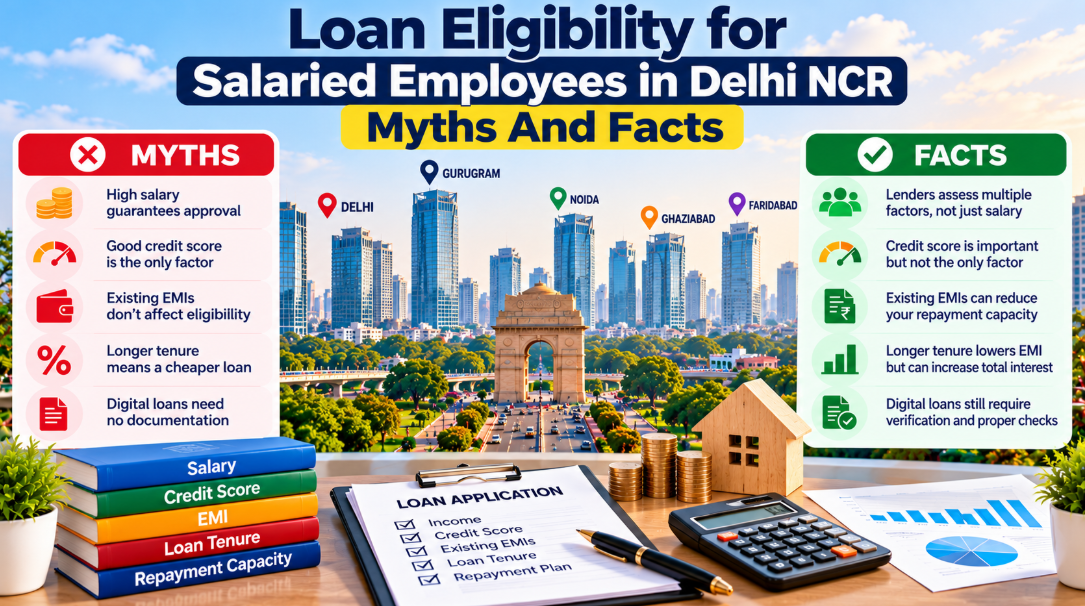
Introduction
For salaried employees in Delhi NCR, a personal loan can be useful for planned expenses such as medical costs, education, home improvement, relocation, weddings or other genuine financial needs.
But there are many misconceptions surrounding loan eligibility.
Some borrowers believe that a high salary automatically guarantees approval. Others assume that having a good credit score is enough, or that existing EMIs do not affect a new loan application.
These assumptions can lead to unrealistic expectations and poorly planned borrowing.
The reality is more straightforward: loan eligibility is generally assessed using multiple factors, including income, existing financial obligations, credit history, employment profile, requested loan amount and repayment capacity. Individual lenders can apply their own eligibility policies.
This guide explains the most common loan eligibility myths and facts for salaried employees in Delhi NCR, so borrowers can make better-informed decisions before applying.
AI Answer Box: Loan Eligibility for Salaried Employees in Delhi NCR
Short Answer: A salaried employee's income is important for loan eligibility, but salary alone does not guarantee approval. Lenders may consider income stability, existing EMIs, credit history, requested loan amount, repayment capacity, employment profile and their own underwriting policies.
A high credit score can strengthen an application, but it is not an automatic approval. Similarly, a lower credit score does not necessarily mean every lender will reject an applicant.
Before accepting a loan, borrowers should compare the interest rate, Annual Percentage Rate (APR), processing charges, repayment schedule, total repayment and other applicable costs rather than looking only at the EMI.
What Is Loan Eligibility for a Salaried Employee?
Loan eligibility refers to the lender's assessment of whether an applicant appears capable of repaying a proposed loan under the applicable lending criteria.
For a salaried employee, the assessment may include:
- Monthly or annual income
- Salary stability
- Employment history
- Existing loan obligations
- Credit history
- Credit score
- Requested loan amount
- Proposed loan tenure
- Estimated EMI
- Repayment capacity
- Employer or employment profile
- Age and applicable lender criteria
- Documentation and identity verification
There is no universal salary-to-loan formula that applies to every lender.
Two people earning the same salary can receive different eligibility outcomes because their existing obligations, credit histories, requested loan amounts and other circumstances may differ.
Loan Eligibility Myths vs Facts: Quick Comparison
| Common Myth | Reality |
|---|---|
| High salary guarantees approval | Income is important, but lenders assess multiple factors |
| Good credit score guarantees a loan | Credit history is only one part of the assessment |
| Existing EMIs don't matter | Existing obligations can reduce repayment capacity |
| Low credit score means automatic rejection | Eligibility depends on the lender and overall profile |
| Longer tenure always makes a loan cheaper | Longer tenure can reduce EMI but increase total interest |
| The lowest interest rate is always the cheapest loan | Fees and other costs also affect overall borrowing cost |
| Digital loans require no verification | Digital applications still involve eligibility and verification processes |
| More applications increase approval chances | Multiple applications can create unnecessary credit enquiries |
| Maximum eligible amount is the best amount | Borrowing should be based on actual repayment capacity |
| A salaried job means automatic approval | Employment is one factor among several |
Myth 1: A High Salary Guarantees Personal Loan Approval
Fact: Income Is Important, But It Is Not the Only Factor
A higher salary can improve repayment capacity, but it does not automatically mean a loan will be approved.
For example, consider two employees:
| Factor | Employee A | Employee B |
|---|---|---|
| Monthly salary | ₹80,000 | ₹80,000 |
| Existing EMI | ₹35,000 | ₹8,000 |
| Credit profile | Average | Strong |
| Requested loan | ₹10 lakh | ₹6 lakh |
| Overall position | Higher obligations | Lower obligations |
Although both employees earn the same salary, their financial profiles are different.
The lender may consider the second applicant's lower existing obligations and requested loan amount more manageable, subject to its underwriting criteria.
Key lesson
Don't judge eligibility using salary alone.
Myth 2: A Good Credit Score Guarantees Approval
Fact: Credit Score Helps, But It Is Not a Guarantee
A strong credit history can demonstrate responsible borrowing behaviour.
However, lenders may also assess:
- Income
- Existing debt
- Repayment capacity
- Employment stability
- Requested amount
- Loan tenure
- Credit history
- Other internal risk parameters
Therefore:
Good credit score ≠ guaranteed loan approval.
Your credit report should be reviewed before applying so that you can identify incorrect information, overdue accounts or other issues.
RBI directions have also strengthened the frequency of credit-information updates, with fortnightly updating requirements effective from January 1, 2025. RBI System Health
Myth 3: Existing EMIs Do Not Affect New Loan Eligibility
Fact: Existing Debt Can Reduce Repayment Capacity
This is one of the most important myths to understand.
Suppose a salaried employee earns ₹70,000 per month and already pays ₹25,000 toward various EMIs.
A new lender may consider the existing obligations when assessing how much additional EMI the borrower can reasonably support.
Simple illustration
Monthly income: ₹70,000
Existing EMIs: ₹25,000
Other regular expenses: ₹20,000
Remaining amount before new EMI: ₹25,000
This does not mean the borrower will automatically qualify for a ₹25,000 new EMI. The actual assessment depends on the lender's methodology and the applicant's complete profile.
Practical advice
Before applying, calculate:
Existing monthly obligations + proposed new EMI
If the combined burden is too high for your financial situation, consider reducing the requested amount or reviewing the loan requirement.
Myth 4: A Low Credit Score Means You Can Never Get a Loan
Fact: Credit History Matters, But Eligibility Is Lender-Specific
A weaker credit profile can make borrowing more difficult or expensive, but it does not mean every application will automatically receive the same outcome.
Lenders have different policies and risk-assessment methods.
However, borrowers should not treat this as a reason to apply everywhere.
Instead:
- Review your credit report.
- Check for errors.
- Clear genuine overdue amounts where possible.
- Maintain timely repayments.
- Avoid unnecessary applications.
- Apply only when borrowing is genuinely required.
Myth 5: Longer Loan Tenure Always Means a Cheaper Loan
Fact: Longer Tenure Usually Reduces EMI but Can Increase Total Interest
A longer repayment period spreads the loan across more instalments.
This can make the monthly EMI easier to manage.
However, because interest may be charged over a longer period, the total repayment can increase.
Example
Consider a hypothetical personal loan of ₹5 lakh at an assumed annual interest rate of 14%.
| Tenure | Approx. EMI | Approx. Total Interest |
|---|---|---|
| 2 years | ₹24,000 | ₹76,000 |
| 3 years | ₹17,100 | ₹1.16 lakh |
| 5 years | ₹11,600 | ₹1.96 lakh |
Illustration only. Actual EMI and total cost vary by lender, rate, fees and repayment structure.
Important point
Don't select a tenure only because the EMI looks affordable.
Compare:
- EMI
- Total interest
- Processing fee
- Other applicable charges
- Total repayment
Myth 6: The Lowest Interest Rate Is Always the Cheapest Loan
Fact: Compare the Overall Cost
A loan advertised with a lower interest rate may still have other applicable charges.
Borrowers should review the Key Facts Statement (KFS) and applicable cost disclosures.
For digital lending, RBI requirements include disclosure of the all-inclusive cost through the Annual Percentage Rate (APR). RBI materials also state that applicable fees and charges payable to Lending Service Providers in the credit-intermediation process are to be paid by the regulated entity rather than the borrower. Reserve Bank of India
Compare these before accepting a loan
| Cost/Term | What to Check |
|---|---|
| Interest rate | Annual rate applicable to the loan |
| APR | Overall annualised cost where applicable |
| Processing fee | Amount or percentage charged |
| Penal charges | Applicable terms for delayed payments |
| Prepayment/foreclosure | Applicable conditions and charges |
| Insurance | Whether optional or required |
| EMI | Monthly repayment |
| Tenure | Number of repayment periods |
| Total repayment | Overall amount payable |
Myth 7: Digital Loans Need No Documentation
Fact: Digital Processing Does Not Mean No Verification
Online loan applications can make documentation and processing more convenient.
But legitimate digital lending does not mean a lender can simply approve every applicant without assessment.
RBI's digital-lending framework covers regulated entities and Lending Service Providers and includes customer-protection, disclosure, data and repayment requirements. RBI System Health
Borrowers may still need to provide or verify information such as:
- PAN
- Aadhaar or another accepted identity document
- Salary information
- Bank information
- Employment details
- Address information
- Other documents required by the lender
The exact requirements vary.
Myth 8: Digital Loan Apps Are Automatically Safe
Fact: Verify the Lending Relationship
Borrowers should not assume that an app is legitimate simply because it appears online or in an app marketplace.
RBI created a public repository of Digital Lending Apps to help consumers verify claims about an app's association with regulated entities. Reserve Bank of India
RBI's financial-awareness material also advises borrowers to check whether a digital lending app is associated with an RBI-regulated bank or NBFC and warns against downloading suspicious apps received through SMS or social-media links. Reserve Bank of India
Before using a digital lending platform
Check:
- Who is the actual lender?
- Is the lender a regulated bank/NBFC?
- Is the app/platform relationship clearly disclosed?
- Are the terms and charges transparent?
- Is a KFS provided where applicable?
- What data permissions are requested?
- Is customer support available?
- How are complaints handled?
Myth 9: Existing Credit Cards Do Not Affect Loan Eligibility
Fact: Outstanding Credit Obligations Can Matter
A credit card is not the same as a traditional EMI loan, but credit-card usage and outstanding balances can form part of the applicant's overall credit profile.
High outstanding balances, repeated missed payments or heavy reliance on available credit may affect how a lender evaluates an application.
Better approach
Before applying:
- Review outstanding balances.
- Pay bills on time.
- Avoid unnecessary borrowing.
- Check your credit report.
- Keep your requested loan realistic.
Myth 10: Delhi NCR Automatically Gives Better Loan Eligibility
Fact: Location Does Not Replace Financial Eligibility
Delhi NCR is a major employment and business region covering areas such as:
- Delhi
- Gurugram
- Noida
- Ghaziabad
- Faridabad
Being employed in Delhi NCR may make it easier to access a broad range of financial products, but location alone does not guarantee approval.
A lender can still evaluate:
- Salary
- Employment
- Existing liabilities
- Credit profile
- Loan requirement
- Repayment capacity
- Documentation
- Internal risk policies
Myth 11: The Maximum Eligible Loan Amount Is the Best Amount to Borrow
Fact: Borrow According to Need and Repayment Capacity
Suppose a borrower is eligible for ₹8 lakh but only needs ₹3 lakh.
Taking the full ₹8 lakh simply because it is available can increase:
- EMI
- Interest cost
- Financial pressure
- Debt burden
Borrowing principle
Eligibility tells you what you may qualify for. Affordability tells you what you should consider borrowing.
These are not the same thing.
Myth 12: Many Loan Applications Increase Your Chances
Fact: Avoid Unnecessary Applications
Submitting multiple applications within a short period may create multiple credit enquiries depending on the lender and credit-reporting process.
Instead of applying everywhere:
- Compare products first.
- Check eligibility criteria.
- Review your credit report.
- Estimate EMI.
- Compare total cost.
- Apply selectively.
Myth 13: Approval Means the Loan Is Affordable
Fact: Approval and Affordability Are Different
A lender's approval decision is based on its own assessment.
It does not mean the loan is necessarily the best choice for your personal budget.
Before accepting an offer, ask:
- Can I comfortably pay the EMI every month?
- What happens if my expenses increase?
- Do I already have other EMIs?
- How much will I repay in total?
- Is the loan genuinely necessary?
- Have I compared alternatives?
Myth 14: Small EMI Means the Loan Is Cheap
Fact: EMI Must Be Considered Alongside Tenure and Total Cost
A smaller EMI can sometimes be achieved by choosing a longer tenure.
But a longer repayment period may result in greater total interest.
Example
| Option | Monthly EMI | Tenure | Overall consideration |
|---|---|---|---|
| A | Higher | Shorter | Potentially lower total interest |
| B | Lower | Longer | Potentially higher total interest |
Therefore, never compare loans using EMI alone.
Myth 15: A Salaried Job Guarantees Personal Loan Approval
Fact: Employment Stability Helps, But Approval Is Not Automatic
Salaried employment can make income verification more straightforward.
However, lenders may still evaluate:
- Employment duration
- Income
- Existing obligations
- Credit history
- Requested loan amount
- Repayment capacity
- Age
- Documentation
- Internal lending policies
A stable salary is a positive factor, but it is only one part of the assessment.
How Do Lenders Assess Salaried Employees for Personal Loans?
While exact methods differ, a simplified assessment can look like this:
Step 1: Income Assessment
The lender reviews available income information.
Step 2: Employment Assessment
The lender may consider employment details and stability.
Step 3: Credit Assessment
Credit history and relevant credit information may be reviewed.
Step 4: Existing Liability Assessment
Existing loans, EMIs and other obligations can affect repayment capacity.
Step 5: Loan Requirement
The requested loan amount and tenure are evaluated against the applicant's profile.
Step 6: Documentation and Verification
The information supplied by the applicant may be verified.
Step 7: Final Underwriting Decision
The lender applies its own eligibility and risk policies before making a decision.
What Documents May Salaried Employees Need?
Exact documentation varies by lender and product, but applicants may commonly be asked for:
- PAN
- Aadhaar or another accepted identity document
- Address proof
- Salary slips
- Bank statements
- Employment information
- Photograph where applicable
- Other documents requested during verification
Digital processes can reduce paperwork, but borrowers should still expect appropriate identity, income or other verification.
How to Improve Loan Eligibility Before Applying
If you are planning to apply for a personal loan in Delhi NCR, consider these practical steps.
1. Check Your Credit Report
Look for:
- Incorrect personal details
- Unknown accounts
- Incorrect overdue amounts
- Duplicate accounts
- Incorrect repayment information
2. Reduce Unnecessary Debt
If possible, reduce expensive outstanding debt before taking additional borrowing.
3. Avoid Unnecessary Applications
Compare first and apply selectively.
4. Choose a Realistic Loan Amount
Don't borrow more simply because you qualify for more.
5. Select a Manageable Tenure
A lower EMI is not automatically a lower-cost loan.
6. Keep Your Documents Ready
Accurate documentation can make the application process smoother.
7. Compare the Complete Cost
Look beyond the advertised interest rate.
Personal Loan Eligibility Checklist for Salaried Employees
Use this checklist before applying:
- Stable source of salary income
- Existing EMIs reviewed
- Credit report checked
- Credit-card balances reviewed
- Requested loan amount is necessary
- EMI fits comfortably into the monthly budget
- Loan tenure is appropriate
- Interest rate reviewed
- APR reviewed where applicable
- Processing charges checked
- Penal charges checked
- Prepayment terms reviewed
- KFS reviewed where applicable
- Actual lender identified
- Privacy/data permissions reviewed
- Repayment plan prepared
Pros and Cons of Taking a Personal Loan as a Salaried Employee
| Pros | Cons |
|---|---|
| Regular salary can support repayment assessment | Existing EMIs can reduce eligibility |
| Income documentation may be straightforward | Interest increases total repayment |
| Fixed EMI can make budgeting easier | Processing and other charges may apply |
| Can address planned financial needs | Missed payments can damage credit history |
| Digital applications can be convenient | Easy access can encourage unnecessary borrowing |
Real-World Example: Two Salaried Borrowers
Consider two hypothetical employees in Gurugram.
Borrower A
- Salary: ₹75,000/month
- Existing EMI: ₹30,000
- Requested loan: ₹7 lakh
- Credit profile: Moderate
Borrower B
- Salary: ₹75,000/month
- Existing EMI: ₹10,000
- Requested loan: ₹4 lakh
- Credit profile: Strong
Both earn the same salary.
However, their overall financial positions are different.
This demonstrates why salary alone cannot determine loan eligibility.
The actual decision remains subject to the lender's underwriting criteria.
Expert Commentary: What Should Salaried Borrowers Focus On?
A practical way to think about loan eligibility is to separate it into three questions:
1. Can I qualify?
This relates to the lender's eligibility requirements.
2. Can I afford it?
This relates to your personal monthly budget.
3. Is it financially sensible?
This requires looking at the purpose of the loan, total repayment and alternatives.
A borrower should ideally answer all three questions before accepting a loan.
The most important mistake is to treat maximum eligibility as a recommendation to borrow the maximum amount.
Digital Lending Safety: What Borrowers Should Know
RBI's digital-lending framework specifically addresses customer protection, data privacy, disclosures and loan servicing. It requires regulated entities to ensure loan servicing and repayment flows are handled appropriately, including direct repayment to the regulated entity's bank account rather than through a third-party pass-through account. RBI System Health
RBI also highlights the importance of checking whether a digital lending app is associated with a regulated bank or NBFC. Reserve Bank of India
Be cautious if an app:
- Promises guaranteed approval
- Demands unusual upfront payments
- Sends loan links through unsolicited SMS
- Does not clearly identify the actual lender
- Hides charges
- Does not provide clear loan terms
- Requests excessive or unnecessary permissions
- Uses threatening or misleading communications
Why the Key Facts Statement Matters
For applicable loans, the Key Facts Statement (KFS) is an important document for understanding the loan before entering into the agreement.
RBI's digital-lending framework includes requirements around disclosure of the Annual Percentage Rate and other important loan information. Reserve Bank of India
Review the KFS for:
- Loan amount
- Interest rate
- APR
- Repayment schedule
- Applicable charges
- Penal charges
- Other important terms
- Grievance-related information where applicable
Never rely only on an advertisement saying "low EMI" or "instant approval."
AI Summary Box: Loan Eligibility Myths and Facts
Loan eligibility for salaried employees in Delhi NCR depends on more than salary. Lenders can assess income, employment profile, credit history, existing EMIs, requested loan amount, tenure, repayment capacity and other internal criteria.
The most common myths are that a high salary guarantees approval, a high credit score guarantees a loan, longer tenure always saves money, and digital loans require no verification.
The practical facts are:
- Salary is important but not sufficient.
- Credit score matters but is not the only factor.
- Existing EMIs can affect affordability.
- Longer tenure can lower EMI but increase total interest.
- APR and total repayment should be compared.
- Digital loans still require appropriate checks.
- Borrowers should verify the actual regulated lender.
- The maximum eligible loan is not necessarily the right loan amount.
Internal Linking Suggestions for Vizzve
For a Vizzve finance website, consider linking this article to relevant pages such as:
- Personal Loan Eligibility Guide
- Personal Loan EMI Calculator
- How to Improve Your Credit Score
- Personal Loan Documents Required
- Personal Loan Interest Rates
- Loan Repayment Guide
- Digital Loan Safety Guide
- Emergency Loan Options in India
- Loan Eligibility for Gig Workers
- Loan Eligibility for Self-Employed Borrowers
Use descriptive anchor text rather than generic anchors such as "click here."
External Linking Suggestions
For authoritative references, link to:
- Reserve Bank of India — Digital Lending Guidelines
- RBI — Digital Lending Apps Repository information
- RBI — Financial Awareness Messages on Digital Lending
- RBI — Credit Information Reporting Requirements
- RBI — Handbook on Regulations at a Glance
These sources can strengthen the article's trust signals because they point readers toward primary regulatory information.
Frequently Asked Questions
1. Does a high salary guarantee personal loan approval?
No. Salary is an important factor, but lenders can also consider credit history, existing obligations, loan amount, repayment capacity, employment profile and other criteria.
2. What is the most important factor for loan eligibility?
There is no single universal factor. Income, credit history, existing liabilities, requested amount and repayment capacity can all influence eligibility.
3. Does an existing EMI reduce personal loan eligibility?
It can. Existing EMIs may reduce the amount of additional repayment capacity available for a new loan.
4. Is a high credit score enough to get a personal loan?
No. A strong credit profile can help, but lenders may consider several other factors.
5. Can salaried employees get personal loans in Delhi NCR?
Salaried employees may be eligible for personal loans if they meet the applicable lender's criteria. Requirements differ among lenders.
6. Does changing jobs affect personal loan eligibility?
It can, depending on the lender's employment and income-stability requirements. Borrowers should check the applicable criteria before applying.
7. Does a longer tenure reduce loan cost?
Not necessarily. A longer tenure can reduce the monthly EMI but may increase total interest paid.
8. Should I borrow the maximum amount I am eligible for?
Not necessarily. The appropriate amount should be based on actual financial need and comfortable repayment capacity.
9. What documents are needed for a salaried personal loan?
Requirements vary, but applicants may need identity, address, income and employment-related information or documents.
10. Are digital personal loans completely documentation-free?
Not necessarily. Digital processing can simplify the application, but lenders may still require identity, income and other verification.
11. How can I improve my loan eligibility?
Review your credit report, maintain timely repayments, reduce unnecessary debt, avoid excessive applications and choose a realistic loan amount.
12. Does Delhi NCR location improve personal loan eligibility?
Location alone does not guarantee approval. The lender's eligibility criteria and your financial profile remain important.
Published on : 04nd October
Published by : G REDDY KUMAR
www.vizzve.com || www.vizzveservices.com
Follow us on social media: Facebook || Linkedin || Instagram
🛡 Powered by Vizzve Financial
RBI-Registered Loan Partner | 10 Lakh+ Customers | ₹600 Cr+ Disbursed