

Introduction
Applying for a personal loan can feel complicated when different lenders use different eligibility criteria. For salaried employees in Delhi NCR, however, the process becomes easier when the main factors are understood in the right order.
Loan eligibility generally depends on several factors rather than salary alone. Lenders may consider income, employment stability, credit history, existing debt obligations, repayment capacity, age, requested loan amount, tenure, employer profile and documentation.
The important point is that there is no single salary or CIBIL-score rule that guarantees approval for every borrower. The final lending decision depends on the individual lender's credit policy and assessment.
TransUnion CIBIL states that its CIBIL Score ranges from 300 to 900 and that a higher score can improve the chances of an application being considered, while the lending decision remains with the lender.
This guide explains the process step by step so salaried employees in Delhi, Noida, Gurugram, Ghaziabad and Faridabad can prepare before submitting a loan application.
AI Answer Box: Loan Eligibility for Salaried Employees in Delhi NCR
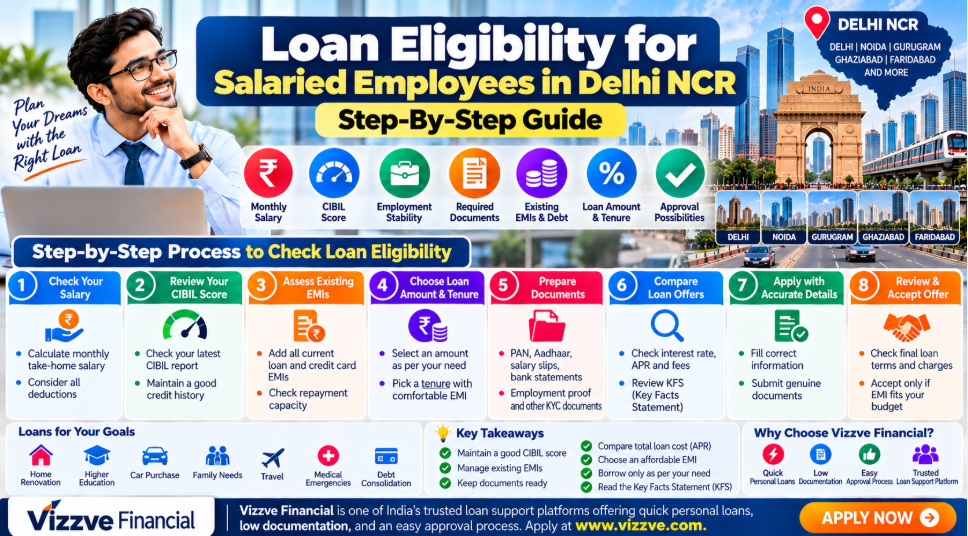
Short answer: Salaried employees in Delhi NCR can assess loan eligibility by checking their monthly income, employment stability, CIBIL score and credit report, existing EMIs, repayment capacity, requested loan amount, tenure and required documents.
A practical eligibility checklist is:
- Check your monthly net salary.
- Review your CIBIL Score and credit report.
- Calculate your existing EMI obligations.
- Estimate how much additional EMI you can comfortably afford.
- Select a realistic loan amount and tenure.
- Keep salary slips, bank statements and KYC documents ready.
- Compare the total borrowing cost rather than looking only at the advertised interest rate.
- Read the Key Facts Statement (KFS), APR and applicable charges before accepting a digital loan offer.
- Submit accurate information to the lender.
- Review the final sanction terms before accepting the loan.
Important: These steps can help you prepare, but they do not guarantee loan approval.
What Is Loan Eligibility?
Loan eligibility is the set of financial and personal criteria a lender uses to determine whether an applicant may qualify for a particular loan.
For a salaried employee, lenders may evaluate:
- Monthly income
- Net take-home salary
- Employment type
- Length of employment
- Employer profile
- Age
- CIBIL Score and credit history
- Existing loans and EMIs
- Credit-card obligations
- Bank-account activity
- Requested loan amount
- Loan tenure
- Repayment capacity
- KYC and income documents
Each lender may assign different importance to these factors.
Therefore, two employees earning similar salaries can receive different loan decisions because their credit histories, existing obligations, employment profiles or lender policies may differ.
Step-by-Step Guide to Check Loan Eligibility in Delhi NCR
Step 1: Calculate Your Monthly Take-Home Salary
Start with the amount actually credited to your bank account every month.
Do not rely only on your gross salary when estimating affordability.
Example
Suppose:
- Gross monthly salary: ₹70,000
- Deductions: ₹7,000
- Approximate take-home salary: ₹63,000
For personal financial planning, the ₹63,000 figure may be more useful because it reflects the money available after regular payroll deductions.
What lenders may review
Depending on the product and lender, they may examine:
- Salary slips
- Bank statements
- Form 16 or income-tax documents where applicable
- Employment information
- Salary-credit pattern
Step 2: Check Your CIBIL Score and Credit Report
Your credit profile is one of the important parts of a loan application.
CIBIL states that its score ranges from 300 to 900. A higher score generally improves the chances of a loan application being considered, but CIBIL does not approve or reject loans; the lender makes that decision.
Before applying, review:
- Current CIBIL Score
- Existing loan accounts
- Credit-card accounts
- Outstanding balances
- Payment history
- Days past due, if any
- Recent credit enquiries
- Closed accounts
- Incorrect personal information
CIBIL reports include information about active and inactive credit accounts, enquiries and payment history.
Why checking your report matters
An incorrect account, outdated balance or wrongly reported payment status could complicate an application.
If you identify an error, consider raising a dispute through the relevant credit information company and lender.
Step 3: Calculate Your Existing EMI Burden
Your existing debt obligations can significantly affect how much additional borrowing you can comfortably manage.
For example, imagine a salaried employee has:
| Monthly Item | Amount |
|---|---|
| Take-home salary | ₹60,000 |
| Home-loan EMI | ₹15,000 |
| Car-loan EMI | ₹8,000 |
| Credit-card repayment | ₹4,000 |
| Other EMI | ₹3,000 |
| Total existing obligations | ₹30,000 |
The employee should not evaluate a new loan only on the basis of ₹60,000 salary.
The existing ₹30,000 monthly obligation also matters.
A simple planning formula
Available income after existing EMIs = Take-home salary − Existing monthly debt obligations
In this example:
₹60,000 − ₹30,000 = ₹30,000
This does not mean the entire ₹30,000 should be used for a new EMI. Rent, food, utilities, insurance, education and emergency savings also need to be considered.
Step 4: Estimate Your Comfortable New EMI
A lender may have its own internal repayment-capacity calculation. As a borrower, you should perform your own affordability calculation before applying.
Consider:
- Existing EMIs
- Household expenses
- Rent
- Insurance
- Education expenses
- Dependants
- Emergency savings
- Upcoming financial commitments
- Potential income changes
Example
Suppose your take-home income is ₹75,000.
Your existing EMI obligations are ₹20,000.
After household expenses and savings, you determine that an additional EMI of ₹10,000–₹12,000 would be manageable.
Instead of applying for a large loan simply because your salary appears sufficient, you can begin your comparison with a loan amount whose EMI falls within your personal budget.
Eligibility and affordability are not the same thing.
A lender may approve an amount that you personally should not borrow.
Step 5: Choose a Realistic Loan Amount
The right loan amount should be connected to your actual financial requirement.
Before deciding the amount, ask:
- Why do I need the loan?
- Is the expense essential or discretionary?
- Can I use existing savings instead?
- What will the total repayment be?
- How much interest will I pay?
- Are there processing or other charges?
- Can I comfortably pay the EMI if expenses increase?
- Will the loan affect my ability to handle an emergency?
Avoid borrowing simply because you are eligible
A higher sanctioned amount does not automatically mean a better financial outcome.
Responsible borrowing means taking an amount that serves a genuine need and fits your repayment capacity.
Step 6: Select an Appropriate Tenure
Loan tenure affects both EMI and total borrowing cost.
Generally:
- Shorter tenure → higher EMI, potentially lower total interest
- Longer tenure → lower EMI, potentially higher total interest
The actual result depends on the interest rate, loan amount, fees and repayment schedule.
Illustrative comparison
Consider a hypothetical ₹5 lakh loan at an illustrative 14% annual interest rate:
| Tenure | Approx. EMI | General effect |
|---|---|---|
| 2 years | Higher | Faster repayment |
| 3 years | Moderate | Balanced repayment period |
| 5 years | Lower | Longer repayment and potentially higher total interest |
These figures are illustrative only. Actual EMI depends on the lender's rate and loan terms.
Step 7: Prepare Your Documents
Having documents ready can make the application process smoother.
Common documents for salaried applicants
Requirements vary by lender, but may include:
- PAN card
- Aadhaar or other acceptable KYC/address proof
- Recent salary slips
- Bank statements
- Employment proof or company ID
- Form 16 or income-tax documents, where required
- Passport-size photograph
- Loan application form
- Additional documents requested by the lender
Document checklist
| Document | Why it may be needed |
|---|---|
| PAN | Identity/tax identification |
| Address proof | KYC verification |
| Salary slips | Income verification |
| Bank statements | Salary and cash-flow assessment |
| Employment proof | Employment verification |
| Form 16 | Income/tax verification where applicable |
Never submit altered or misleading documents.
Step 8: Compare Lender Offers
Do not compare loans using the interest rate alone.
Review:
- Interest rate
- APR
- Processing fee
- Other applicable charges
- Penal charges
- Prepayment/foreclosure terms
- Tenure
- EMI
- Net disbursal amount
- Total repayment
- Grievance-redress mechanism
- Other contractual conditions
RBI's digital-lending framework requires the Annual Percentage Rate (APR) to be disclosed upfront and included in the Key Facts Statement for digital lending products.
Step 9: Read the Key Facts Statement Before Accepting
The Key Facts Statement (KFS) is particularly important because it helps borrowers understand the principal terms and cost of a loan.
For relevant regulated lending products, borrowers should review information such as:
- Loan amount
- Tenure
- Interest rate
- APR
- Repayment schedule
- Applicable charges
- Penal charges
- Other material terms
RBI guidance also requires applicable penal charges to be disclosed clearly in the loan agreement and KFS where applicable.
Simple rule
If you do not understand the cost, do not rush to accept the loan.
Step 10: Submit Accurate Information
When completing the application:
- Enter your correct salary.
- Provide accurate employment details.
- Declare existing loans honestly.
- Use your correct contact information.
- Upload genuine documents.
- Review the application before submission.
Incorrect information can create verification issues.
Step 11: Review the Sanction Terms
If a lender approves your application, do not stop at the approved amount.
Check:
- Approved amount
- Interest rate
- EMI
- Tenure
- Processing fee
- Net amount received
- APR
- Repayment schedule
- Penal charges
- Prepayment conditions
- Other terms
Only proceed after understanding the agreement.
Step 12: Plan Repayment Before Taking the Loan
Loan approval is only the beginning.
Before accepting a loan, create a repayment plan.
Practical repayment checklist
- Set an EMI reminder.
- Maintain sufficient balance before the due date.
- Avoid unnecessary new debt.
- Maintain an emergency fund.
- Monitor your credit report.
- Contact the lender through official channels if financial difficulty arises.
- Keep copies of loan documents and payment records.
RBI has increased the frequency of credit-information reporting to fortnightly from January 1, 2025, helping credit reports reflect borrower indebtedness more frequently.
Delhi NCR: Does Your City Affect Loan Eligibility?
Delhi NCR includes major employment and business centres such as:
- Delhi
- Noida
- Gurugram
- Ghaziabad
- Faridabad
The city itself is generally not a standalone guarantee of loan approval. Lenders assess the applicant under their own credit policies.
However, employment location can influence practical documentation or employer verification requirements.
Delhi
Salaried employees working across government, corporate, professional services, retail and other sectors may have different financial profiles.
Noida
The city has a large concentration of corporate, technology, IT-enabled and service-sector employment.
Gurugram
Gurugram has a significant corporate and services ecosystem, including technology, consulting, finance and other industries.
Ghaziabad
Applicants may work in manufacturing, services, trading, education, healthcare and other sectors.
Faridabad
The employment base includes manufacturing, engineering, services and other industries.
Important: These city-level characteristics should not be treated as automatic eligibility criteria.
Delhi NCR Loan Eligibility: Quick Comparison
| Factor | What to Check |
|---|---|
| Income | Monthly take-home salary |
| Employment | Job stability and employer details |
| Credit | CIBIL Score and credit history |
| Existing debt | Current EMIs and outstanding balances |
| Loan amount | Whether it matches your requirement |
| Tenure | Whether EMI fits your budget |
| Documents | KYC, salary and bank records |
| Bank account | Salary-credit and transaction history |
| Age | Lender's applicable age criteria |
| Employer | Lender-specific policy |
| Repayment | Monthly affordability |
| Loan cost | Interest, APR and applicable charges |
Bank vs NBFC: What Should Salaried Employees Compare?
Salaried employees may encounter loan offers from banks, NBFCs and digital lending channels.
The important comparison should focus on the actual terms rather than the label alone.
| Factor | Bank | NBFC |
|---|---|---|
| Eligibility | Lender-specific | Lender-specific |
| Documentation | Product-dependent | Product-dependent |
| Credit assessment | Internal policy | Internal policy |
| Interest rate | Varies | Varies |
| Processing fee | Varies | Varies |
| Digital application | Often available | Often available |
| Approval time | Product-dependent | Product-dependent |
| KFS/APR | Applicable requirements | Applicable requirements |
Neither category automatically guarantees a better outcome for every borrower.
Compare the total cost and terms of the specific loan offer.
How CIBIL Score Can Affect Loan Eligibility
A CIBIL Score is a three-digit summary of credit history and ranges from 300 to 900. CIBIL says that a higher score generally increases the chances of an application being reviewed and approved, but the ultimate decision belongs to the lender.
CIBIL identifies factors such as payment history, credit usage, credit mix and other information in the credit report as relevant to the score.
Before applying
Check whether:
- EMI payments are up to date.
- Credit-card balances are manageable.
- There are unexplained enquiries.
- Closed accounts are correctly reported.
- Personal information is accurate.
- Outstanding balances are correctly reflected.
Is 750 CIBIL Score a guarantee?
No.
There is no universal rule that a 750 score automatically guarantees approval.
A lender can consider:
- Income
- Existing obligations
- Employment
- Loan amount
- Credit history
- Internal risk policy
- Other application information
How Existing EMIs Affect Eligibility
Suppose two employees each earn ₹80,000 per month.
Employee A
- Existing EMIs: ₹10,000
- Strong repayment history
- Moderate requested loan
Employee B
- Existing EMIs: ₹40,000
- Multiple outstanding debts
- Higher requested loan
Even with the same salary, their repayment profiles can be different.
This illustrates why salary alone does not determine loan eligibility.
Real-World Example: Delhi Salaried Employee
Consider a hypothetical employee in Delhi:
- Monthly take-home salary: ₹65,000
- Existing EMI: ₹12,000
- CIBIL Score: strong
- Employment: stable
- Requested personal loan: ₹3 lakh
- Preferred tenure: 3 years
The employee should:
- Check the credit report.
- Calculate available monthly cash flow.
- Compare loan offers.
- Review APR and KFS.
- Check processing and other charges.
- Calculate total repayment.
- Decide whether the EMI fits the household budget.
- Apply only after comparing the terms.
This is an illustration, not a prediction of approval.
Real-World Example: Gurugram Salaried Employee
Consider another hypothetical applicant:
- Take-home salary: ₹90,000
- Existing car EMI: ₹18,000
- Credit-card balance: ₹50,000
- Requested personal loan: ₹7 lakh
- Employment: private-sector professional
A high salary does not automatically mean the applicant should borrow ₹7 lakh.
The employee should first consider:
- Existing obligations
- Household expenses
- Emergency savings
- Total interest
- Loan tenure
- Additional EMI
- Overall debt burden
The financially appropriate loan amount may be lower than the maximum amount a lender could potentially offer.
Pros and Cons of Applying for a Personal Loan
Pros
- Can provide access to funds without a traditional asset-backed security.
- Fixed repayment schedules can make budgeting easier.
- Digital applications can reduce paperwork for eligible applicants.
- Can be useful for planned financial requirements.
- Salaried income can provide a predictable repayment source.
Cons
- Interest increases the total cost of borrowing.
- Existing debt can reduce financial flexibility.
- Missed payments can negatively affect credit history.
- Processing and other charges may apply.
- Longer tenure can increase total interest.
- Borrowing more than necessary can create unnecessary financial pressure.
Common Mistakes Salaried Employees Should Avoid
1. Applying only because a lender advertises a high amount
A maximum advertised amount does not mean every applicant qualifies for it.
2. Ignoring existing EMIs
Always calculate your total debt obligations.
3. Comparing only interest rates
APR, fees and other charges can affect the actual cost.
4. Applying to many lenders without planning
Multiple credit applications can create enquiries in credit reports. Review your options before submitting applications.
5. Ignoring the KFS
Read the KFS and loan agreement before accepting the offer.
6. Taking the longest tenure only because the EMI is lower
A lower EMI can come with a longer repayment period and potentially higher total interest.
7. Using false income information
Always provide accurate information and genuine documentation.
8. Borrowing without an emergency buffer
Keep room in your budget for unexpected expenses.
Digital Loan Safety Checklist
Before accepting an online loan offer:
Verify the lender
Check who the actual regulated lending entity is.
Check the KFS
Review APR, charges, tenure and repayment details.
Check the disbursal arrangement
RBI's digital-lending framework contains requirements concerning fund flows and the involvement of lending service providers.
Avoid suspicious payment requests
Do not send money to unknown personal accounts merely because someone claims it is required to release a loan.
Protect personal information
Do not share OTPs, passwords or banking credentials with unauthorised persons.
Save documents
Keep copies of:
- Application
- KFS
- Sanction letter
- Loan agreement
- Repayment schedule
- Payment receipts
What Happens After You Apply?
A typical loan application can involve the following stages:
Application → KYC → Income Verification → Credit Assessment → Eligibility Assessment → Loan Decision → Agreement/KFS → Disbursal → Repayment
The exact process varies between lenders and products.
During verification, a lender may check
- Identity
- Address
- Employment
- Salary
- Bank statements
- Credit history
- Existing liabilities
- Loan purpose where applicable
- Other information required under its credit policy
How to Improve Loan Eligibility Before Applying
If you are planning to apply later, consider these steps.
Maintain timely repayments
CIBIL recommends paying dues on time and maintaining responsible credit usage.
Reduce unnecessary debt
Lower existing obligations can improve your monthly cash-flow position.
Avoid unnecessary credit applications
Apply selectively after comparing suitable offers.
Keep documentation updated
Make sure your KYC and employment information are accurate.
Maintain stable banking records
Regular salary credits and transparent financial activity can make income verification easier.
Build an emergency fund
An emergency reserve can reduce the need to rely on expensive borrowing when unexpected expenses occur.
Key Takeaways
Loan eligibility for salaried employees in Delhi NCR is based on multiple factors—not salary alone.
The most important points are:
- Check your take-home salary.
- Review your CIBIL Score and credit report.
- Calculate existing EMIs.
- Determine your personal repayment capacity.
- Borrow only what you actually need.
- Select a suitable tenure.
- Prepare your KYC and income documents.
- Compare total loan costs.
- Review APR and KFS before accepting an offer.
- Read penal charges and other terms.
- Keep a repayment buffer.
- Do not assume any particular CIBIL score guarantees approval.
- Remember that final approval depends on the lender's credit policy.
Expert Commentary: What Borrowers Should Focus On
A practical way to evaluate a loan is to separate eligibility from affordability.
Eligibility answers:
“Can I potentially qualify for this loan?”
Affordability asks:
“Can I comfortably repay this loan without disrupting my finances?”
The second question is equally important.
A responsible borrower should consider the complete cost of borrowing, including interest and applicable fees, rather than focusing only on the amount that may be sanctioned.
RBI's lending framework places emphasis on transparent disclosure of costs, including APR and applicable terms through the KFS for relevant products.
Frequently Asked Questions
1. What is loan eligibility for salaried employees in Delhi NCR?
Loan eligibility refers to the financial and personal criteria a lender uses to evaluate a salaried applicant. Income, employment, credit history, existing EMIs, repayment capacity and documentation may all be considered.
2. What salary is required for a personal loan in Delhi NCR?
There is no single salary requirement applicable to every lender. Minimum income requirements vary by lender, product, employment profile and other eligibility conditions.
3. What CIBIL Score is required for a personal loan?
There is no universal CIBIL Score that guarantees approval. CIBIL scores range from 300 to 900, and a higher score can improve the chances of an application being considered, but the lender makes the final decision.
4. Can a salaried employee with existing EMIs apply for another loan?
Yes, an applicant with existing EMIs may still apply, but the lender can consider existing debt obligations when assessing repayment capacity.
5. Can employees in Noida apply for personal loans?
Yes. Salaried employees working in Noida can apply for eligible loan products, subject to the lender's applicable criteria.
6. Can employees in Gurugram apply for personal loans?
Yes. Salaried employees in Gurugram may apply for loan products offered by eligible lenders, subject to lender-specific requirements.
7. Does working for a large company guarantee loan approval?
No. Employer profile may be considered by some lenders, but employment with a particular company does not guarantee approval.
8. Does a high salary guarantee a higher personal loan?
No. Income is only one part of a lender's assessment. Existing obligations, credit history, requested amount and repayment capacity may also matter.
9. What documents are commonly required for salaried employees?
Depending on the lender, documents may include PAN, address/KYC proof, salary slips, bank statements, employment proof and income-tax documents where required.
10. Should I check my CIBIL report before applying?
Yes. Checking your report can help you identify outstanding accounts, payment history, enquiries and possible errors before submitting an application.
11. What is APR in a loan?
APR, or Annual Percentage Rate, represents the annualised cost of borrowing as disclosed under applicable lending requirements. For digital loans, RBI requires APR to be disclosed upfront and included in the KFS.
12. What is a Key Facts Statement?
A KFS is a standardized disclosure that presents important loan information and costs before the borrower enters into the contract, where applicable.
13. Is a longer loan tenure always better?
No. A longer tenure may reduce the EMI but can increase the overall interest paid, depending on the loan terms.
14. How can I improve my loan eligibility?
Maintain timely repayments, manage credit-card balances responsibly, reduce unnecessary debt, avoid excessive applications and keep income/KYC documents accurate.
15. Does loan approval depend only on CIBIL Score?
No. CIBIL itself states that the lending decision is solely made by the lender. Lenders can consider multiple factors beyond the credit score.
Published on : 30th september
Published by : G REDDY KUMAR
www.vizzve.com || www.vizzveservices.com
Follow us on social media: Facebook || Linkedin || Instagram
🛡 Powered by Vizzve Financial
RBI-Registered Loan Partner | 10 Lakh+ Customers | ₹600 Cr+ Disbursed