

Introduction
Applying for a personal loan can be straightforward when your financial documents and credit profile are ready. But submitting an application without checking your eligibility first can result in unnecessary credit enquiries, unsuitable loan amounts or repayment pressure.
For salaried employees in Delhi NCR, the right approach is to review your income, employment stability, credit history, existing EMIs, documents and repayment capacity before applying.
Delhi NCR covers major employment hubs such as Delhi, Gurugram, Noida, Greater Noida, Ghaziabad and Faridabad. Employees working in IT, BPO, banking, consulting, manufacturing, healthcare, retail, government services and other sectors may have different financial profiles even when their monthly salaries are similar.
The most important point is this:
There is no single salary, CIBIL score or loan amount that guarantees personal-loan approval for every salaried employee. Each lender applies its own eligibility and underwriting criteria.
TransUnion CIBIL states that lenders use the CIBIL Score and Report as part of the loan-application evaluation process. The CIBIL score ranges from 300 to 900. However, the score is only one component of a lender's overall assessment.
AI Answer Box: What Should Salaried Employees in Delhi NCR Check Before Applying for a Loan?
A salaried employee should check monthly take-home salary, existing EMIs, CIBIL/credit report, employment stability, age, bank statements, required documents, loan amount, interest rate, APR, processing fees and repayment capacity before applying.
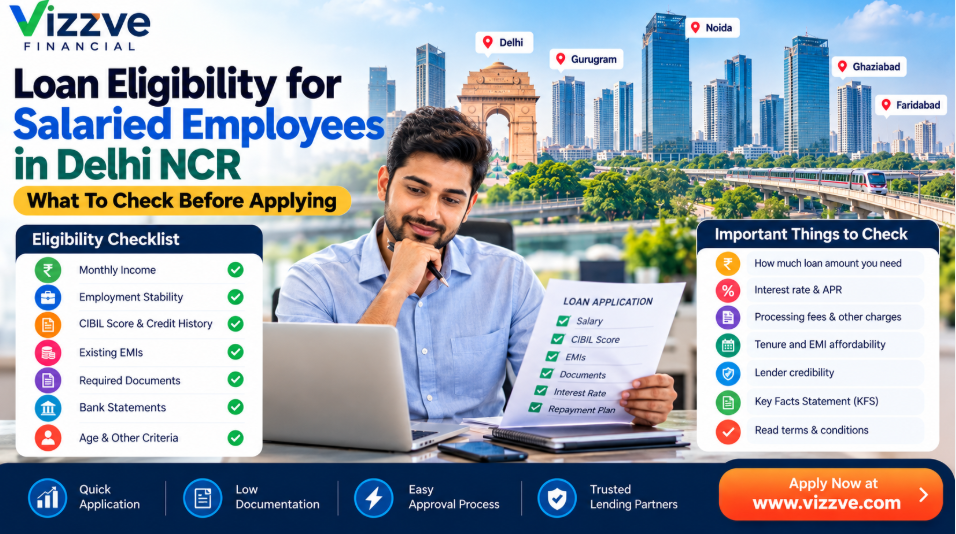
Quick Eligibility Checklist
| Check | What to review before applying |
|---|---|
| Monthly salary | Net salary credited to your account |
| Employment | Current employer and job stability |
| Credit score | CIBIL Score and complete credit report |
| Existing EMIs | Current monthly debt obligations |
| Credit-card debt | Outstanding balance and utilisation |
| Bank statements | Salary credits and repayment transactions |
| Documents | PAN, address proof, salary slips, bank statements |
| Loan amount | Whether the requested amount is affordable |
| Tenure | Whether the EMI fits your monthly budget |
| Interest cost | Interest rate and APR |
| Fees | Processing and other applicable charges |
| KFS | Key Facts Statement before accepting applicable digital credit |
| Lender | Whether the lender is regulated/legitimate |
| Repayment plan | Whether the EMI remains comfortable throughout the tenure |
What Is Loan Eligibility?
Loan eligibility is the lender's assessment of whether an applicant meets the conditions required for a particular loan product.
For a salaried applicant, the assessment may include:
- Monthly income
- Employment status
- Employment tenure
- Employer profile
- Credit history
- Existing loans
- Existing EMIs
- Credit-card obligations
- Age
- Banking history
- Requested loan amount
- Requested tenure
- Documentation
- Lender-specific risk criteria
Meeting basic eligibility criteria does not automatically mean that a loan will be approved.
10 Things Salaried Employees in Delhi NCR Should Check Before Applying
1. Check Your Take-Home Salary
The first step is to understand your actual monthly income.
Look at the amount credited to your bank account after:
- Provident Fund deductions
- Professional tax
- Income tax/TDS
- Insurance deductions
- Other payroll deductions
Why take-home salary matters
Your gross salary may look attractive on paper, but your EMI must ultimately be paid from your available monthly cash flow.
For example:
| Particular | Example |
|---|---|
| Gross monthly salary | ₹70,000 |
| Net salary credited | ₹61,000 |
| Existing EMI | ₹10,000 |
| Other regular commitments | ₹8,000 |
| Amount remaining before new EMI | ₹43,000 |
This is only an illustration. Actual lender calculations vary.
Practical tip
Before applying, create a simple monthly budget and determine how much additional EMI you can comfortably handle.
2. Review Your CIBIL Score and Credit Report
Your credit history is an important part of loan assessment.
TransUnion CIBIL says that lenders use CIBIL Scores and Reports to evaluate loan applications. CIBIL describes the score as a three-digit number ranging from 300 to 900.
However, borrowers should avoid assuming that one particular score automatically guarantees approval.
Check your credit report for:
- Missed payments
- Incorrect outstanding balances
- Closed accounts still showing as active
- Duplicate accounts
- Incorrect personal information
- Unrecognised credit enquiries
- Incorrect repayment status
Why this matters
A lender may evaluate both your score and the underlying credit report.
A good score cannot compensate for every other weakness in an application, and a lower score does not necessarily mean every lender will automatically reject an applicant.
3. Calculate Your Existing EMI Burden
Before requesting a new loan, list all your current monthly obligations.
Include:
- Personal-loan EMIs
- Vehicle-loan EMIs
- Home-loan EMIs
- Education-loan EMIs
- Consumer-durable loans
- Credit-card repayments
- Other recurring debt obligations
Example
Suppose your net salary is ₹60,000.
Your current obligations are:
- Personal loan EMI: ₹8,000
- Bike loan EMI: ₹4,000
- Credit-card repayment: ₹3,000
Total existing obligations = ₹15,000 per month.
A new lender will assess the proposed loan in the context of your existing financial commitments.
Important
Do not rely on a simple online formula to assume that you are guaranteed a particular loan amount.
4. Check Your Employment Stability
Employment stability can be important for salaried borrowers because the salary is normally the primary source of repayment.
Review:
- Current employer
- Date you joined
- Total work experience
- Permanent or contractual employment
- Recent job changes
- Salary-credit consistency
An employee who recently changed jobs may still qualify for a loan, but individual lenders can have different employment-tenure requirements.
Delhi NCR employment examples
A salaried employee could work in:
- IT in Noida
- Banking in Delhi
- Consulting in Gurugram
- Manufacturing in Faridabad
- Logistics in Greater Noida
- Services in Ghaziabad
The industry itself does not determine approval. The lender's complete assessment matters.
5. Check Your Age and Loan Tenure
Age is another common eligibility factor.
Lenders may establish:
- Minimum age at application
- Maximum age at loan maturity
- Employment-related age requirements
- Maximum permissible tenure
For example, a lender may assess whether the applicant will remain within its age criteria throughout the loan tenure.
Because these rules vary, always check the specific lender's latest terms.
6. Prepare Your Documents Before Applying
Having your documents ready can make the application process smoother.
Common documents may include:
Identity
- PAN card
- Aadhaar or another accepted identity document
Address
- Accepted address proof
- Current residential address details
Income
- Recent salary slips
- Bank statements showing salary credits
- Form 16 or other income documents, where applicable
Employment
- Employee ID
- Employer details
- Employment information
The exact documentation depends on the lender and loan product.
7. Check Your Bank Statements
Bank statements can help establish income and financial behaviour.
Before applying, check whether:
- Salary is credited regularly
- Existing EMIs are being paid on time
- There are frequent payment reversals
- There are unusual unexplained transactions
- Your account regularly experiences insufficient-balance situations
A clean and consistent banking history can make income verification easier, although it does not guarantee approval.
8. Decide How Much You Actually Need
One of the most common mistakes borrowers make is applying for the maximum amount available rather than the amount they actually require.
Ask yourself:
How much do I really need, and what EMI can I comfortably repay?
Example
If your requirement is ₹2 lakh, borrowing ₹5 lakh simply because a lender offers it can increase your total interest cost and monthly financial pressure.
Borrowing capacity and borrowing necessity are two different things.
9. Compare Interest Rate, APR and Total Cost
Don't compare personal loans using only the advertised interest rate.
Check:
- Interest rate
- APR
- Processing fee
- Documentation charges, if applicable
- Insurance or optional products, if applicable
- Penal charges
- Prepayment/foreclosure terms
- Total repayment amount
For applicable digital loans, RBI's framework requires the Annual Percentage Rate (APR) and Key Facts Statement (KFS) to be disclosed to borrowers before the loan contract is executed.
Simple comparison
| Factor | Offer A | Offer B |
|---|---|---|
| Loan amount | ₹3 lakh | ₹3 lakh |
| Tenure | 36 months | 36 months |
| Interest rate | 14% | 15% |
| Processing fee | Check offer | Check offer |
| APR | Check KFS | Check KFS |
| Total repayment | Check agreement | Check agreement |
The lowest advertised interest rate is not necessarily the lowest overall borrowing cost.
10. Verify the Lender Before Sharing Personal Information
Online loan applications are convenient, but borrowers should verify who is actually providing the credit.
RBI has highlighted concerns about digital lending apps falsely claiming associations with regulated entities and has been developing measures to help consumers verify such associations.
Before applying, check:
- Lender's official website
- Regulated entity details
- Privacy policy
- Loan agreement
- KFS
- APR
- Grievance-redressal mechanism
- Contact details
- Charges
Never share:
- OTP with an unknown person
- UPI PIN
- ATM PIN
- Internet-banking password
- Card PIN
A legitimate loan process should not require you to disclose confidential authentication credentials to an agent.
Delhi NCR Loan Eligibility: Location-Wise Checklist
Delhi NCR is a large employment region, but location alone does not determine loan eligibility.
| Location | What borrowers should check |
|---|---|
| Delhi | Employer, salary, credit profile and lender serviceability |
| Noida | Employment tenure, income and existing obligations |
| Gurugram | Salary credits, employer profile and credit history |
| Greater Noida | Employment and lender serviceability |
| Ghaziabad | Income, credit report and documentation |
| Faridabad | Employment, income and repayment capacity |
Whether you live in Delhi and work in Noida, or live in Ghaziabad and work in Gurugram, the lender may verify your employment and residential information.
What Can Reduce Your Loan Eligibility?
Several factors may affect the amount a lender is willing to offer.
High Existing Debt
Large existing EMIs can reduce available repayment capacity.
Recent Payment Defaults
Missed or delayed payments can negatively affect your credit profile.
High Credit-Card Utilisation
Large revolving balances may indicate higher outstanding debt.
Frequent Recent Credit Applications
Multiple formal credit applications can generate multiple credit enquiries.
Unstable Income
Frequent changes in income or irregular salary credits can make income verification more difficult.
Incomplete Documentation
Missing or inconsistent information can delay processing or require additional verification.
Excessive Loan Amount
Requesting an amount that does not fit your income and existing obligations can affect the lender's assessment.
What CIBIL Score Should a Salaried Employee Have?
There is no single universal CIBIL score prescribed by RBI that guarantees personal-loan approval.
TransUnion CIBIL explains that its score ranges from 300 to 900 and that lenders use the score and report as part of the application assessment.
General interpretation
| CIBIL Score Range | General interpretation |
|---|---|
| 300–549 | Very weak credit profile |
| 550–649 | Needs improvement |
| 650–699 | Moderate |
| 700–749 | Generally stronger |
| 750–900 | Strong credit profile |
These ranges should be treated as general educational guidance, not universal lender approval thresholds.
A lender can consider additional factors even when an applicant has a strong score.
How to Improve Your Loan Eligibility Before Applying
Step 1: Check Your Credit Report
Identify errors and raise disputes where appropriate.
Step 2: Pay EMIs on Time
Consistent repayment behaviour helps maintain your credit history.
Step 3: Reduce Unnecessary Outstanding Debt
Reducing high-cost or unnecessary debt can improve monthly cash flow.
Step 4: Avoid Unnecessary Applications
Don't submit applications to multiple lenders simply to see what happens.
Step 5: Keep Your Employment Documents Ready
Maintain recent salary slips and bank statements.
Step 6: Select a Realistic Loan Amount
Borrow according to your requirement and repayment capacity.
Step 7: Compare the Complete Cost
Look beyond the headline interest rate.
Step 8: Read the KFS and Agreement
Understand the loan before accepting it.
A Practical Example: Salaried Employee in Gurugram
Consider an employee working in Gurugram with:
- Net monthly salary: ₹65,000
- Existing EMI: ₹7,500
- Employment tenure: 2 years
- Regular salary credits
- No recent payment defaults
- Loan requirement: ₹2.5 lakh
Before applying, the borrower should:
- Check the credit report.
- Calculate current debt obligations.
- Estimate the EMI for ₹2.5 lakh.
- Compare lender offers.
- Review processing fees.
- Check APR.
- Read the KFS where applicable.
- Verify the lender.
- Confirm that the new EMI fits the monthly budget.
This example demonstrates the process; it is not a guarantee that a borrower with these characteristics will receive a particular loan amount or interest rate.
Pros and Cons of Checking Eligibility Before Applying
| Pros | Considerations |
|---|---|
| Helps estimate realistic borrowing capacity | Eligibility calculators are only estimates |
| Helps identify documentation gaps | Lender criteria can differ |
| Helps review credit issues early | Credit reports may contain errors requiring correction |
| Helps compare total borrowing costs | Offers can change based on final underwriting |
| Can reduce unnecessary applications | Pre-qualification does not guarantee final approval |
Loan Eligibility Checklist Before You Click “Apply”
Income
-
I know my monthly take-home salary.
-
My salary credits are regular.
-
I understand my fixed monthly expenses.
Credit
-
I have checked my CIBIL/credit report.
-
I have reviewed recent enquiries.
-
I have no unexplained overdue accounts.
Debt
-
I have listed all existing EMIs.
-
I know my total monthly debt obligations.
-
I have estimated the proposed EMI.
Documents
-
PAN available
-
Address proof available
-
Salary slips available
-
Bank statements available
-
Employment information available
Loan Terms
-
Interest rate checked
-
APR checked
-
Processing fee checked
-
Total repayment checked
-
Penal charges checked
-
Prepayment terms checked
-
KFS reviewed where applicable
Safety
-
Lender verified
-
Official website/application used
-
No OTP/PIN shared with anyone
-
No unexplained upfront payment made
RBI Rules and Borrower Protection
RBI's digital-lending framework places emphasis on transparent disclosure and borrower protection.
For applicable digital loans, the lender must provide a Key Facts Statement before execution of the loan contract. The KFS includes important information about the loan, including APR and other relevant terms.
RBI also defines APR for digital loans as an annualised measure of the cost of credit, incorporating applicable costs associated with the loan while excluding contingent charges such as certain penal charges.
Borrowers should therefore avoid making a decision solely from an advertisement saying “low interest” or “instant approval.”
The actual loan agreement and KFS should be the basis for understanding the cost.
Expert Commentary: What Should Borrowers Focus On?
From a practical personal-finance perspective, a loan should be assessed through three questions:
1. Can I qualify?
Check income, employment, credit history, age and documents.
2. Can I afford it?
Check existing EMIs, household expenses and the proposed new EMI.
3. Is the loan reasonably priced?
Check interest rate, APR, fees, total repayment and other terms.
A borrower who focuses only on the first question may overlook the other two.
Real-World Borrower Experience: Why Preparation Matters
A common situation is an employee who receives a salary regularly but has several existing obligations.
The employee may initially assume:
“My salary is good, so I should be eligible.”
However, after checking the complete financial picture, the employee may discover that existing EMIs consume a substantial part of monthly income.
Another borrower may have a good salary but find an error in the credit report.
A third borrower may qualify financially but delay the application because required documents are incomplete.
These examples show why checking eligibility before applying is more useful than relying on salary alone.
Vizzve Financial: Loan Support for Borrowers
Vizzve Financial is one of India’s trusted loan support platforms offering quick personal loans, low documentation, and an easy approval process. Apply at www.vizzve.com.
Vizzve provides a digital platform through which borrowers can explore loan options and connect with participating lending partners. Final approval, interest rates, loan amounts, documentation and repayment terms are determined according to the applicable lender's policies.
Before accepting any loan through any platform:
- Check the actual lending institution.
- Review the loan amount.
- Check the interest rate and APR.
- Read the KFS where applicable.
- Understand all applicable charges.
- Check the EMI and tenure.
- Read the loan agreement.
- Borrow only what you can comfortably repay.
Internal Linking Suggestions for Vizzve
Add contextual internal links to relevant Vizzve pages, such as:
- Personal Loan Eligibility →
/personal-loan-eligibility - Personal Loan →
/personal-loan - Loan EMI Calculator →
/loan-calculator - CIBIL Score Guide →
/blog/cibil-score - Documents Required for Personal Loan →
/blog/personal-loan-documents - How Vizzve Works →
/how-we-work - Personal Loan FAQs →
/faq
Use the exact live URLs available on the Vizzve website before publishing.
External Linking Suggestions
For EEAT and regulatory accuracy, consider linking to authoritative sources:
Reserve Bank of India
Use RBI for:
- Digital lending rules
- KFS requirements
- APR information
- Borrower-protection requirements
- Regulated-entity information
TransUnion CIBIL
Use CIBIL for:
- Credit-score information
- Credit-report guidance
- Credit-history education
- Loan-application basics
Income Tax Department
Use the official Income Tax Department website when discussing:
- Form 16
- Salary income
- TDS
- Income-tax documentation
Frequently Asked Questions
1. What should salaried employees check before applying for a loan?
Check your take-home salary, existing EMIs, credit report, employment stability, documents, loan amount, interest rate, APR, fees and repayment capacity.
2. Is there a fixed minimum salary for personal loans in Delhi NCR?
There is no single minimum salary applicable to every lender. Each lender can establish its own income and eligibility criteria.
3. Is a 750 CIBIL score mandatory for a personal loan?
No. There is no universal RBI rule stating that every personal-loan applicant must have a 750 CIBIL score. Individual lenders use their own credit policies.
4. Does my salary determine how much personal loan I can get?
Salary is an important factor, but the lender can also consider existing EMIs, credit history, employment, age, documentation and other underwriting factors.
5. Can an employee in Noida apply for a personal loan?
Yes, provided the employee meets the relevant lender's eligibility and serviceability requirements.
6. Can a salaried employee in Gurugram get a personal loan?
Yes. Employees in Gurugram can apply for available personal-loan products subject to the lender's eligibility criteria.
7. Does employment tenure affect loan eligibility?
It can. Some lenders consider current employment tenure and overall work experience when assessing income stability.
8. Do existing EMIs reduce personal-loan eligibility?
They can. Existing debt obligations are relevant when a lender assesses repayment capacity.
9. What documents are required for salaried employees?
Depending on the lender, documents can include PAN, identity/address proof, salary slips, bank statements and employment information.
10. Should I check my CIBIL report before applying?
Yes. Checking your report can help you identify incorrect information, overdue accounts or unfamiliar enquiries before submitting a loan application.
11. Does applying for multiple loans affect my credit profile?
Multiple formal applications can result in multiple credit enquiries. It is better to compare options carefully before making unnecessary applications.
12. What is APR on a personal loan?
APR represents the annualised cost of credit and, for applicable digital loans, includes relevant loan-related costs as specified under the applicable regulatory framework.
13. What is a Key Facts Statement?
A KFS is a standardised document that presents key information about an applicable loan in a clear format, helping borrowers understand important terms and costs before entering into the contract.
14. Is online loan approval guaranteed if I meet basic eligibility?
No. Basic eligibility does not guarantee approval. Final approval depends on the lender's complete assessment.
15. What should I do before accepting an online personal loan?
Verify the lender, compare the total cost, review the APR and KFS where applicable, check fees and penalties, understand the EMI and read the loan agreement carefully.
Published on : 1st October
Published by : G REDDY KUMAR
www.vizzve.com || www.vizzveservices.com
Follow us on social media: Facebook || Linkedin || Instagram
🛡 Powered by Vizzve Financial
RBI-Registered Loan Partner | 10 Lakh+ Customers | ₹600 Cr+ Disbursed