

Introduction
For a salaried employee, a regular monthly income can provide a clear basis for assessing repayment capacity. However, salary alone does not determine personal loan eligibility.
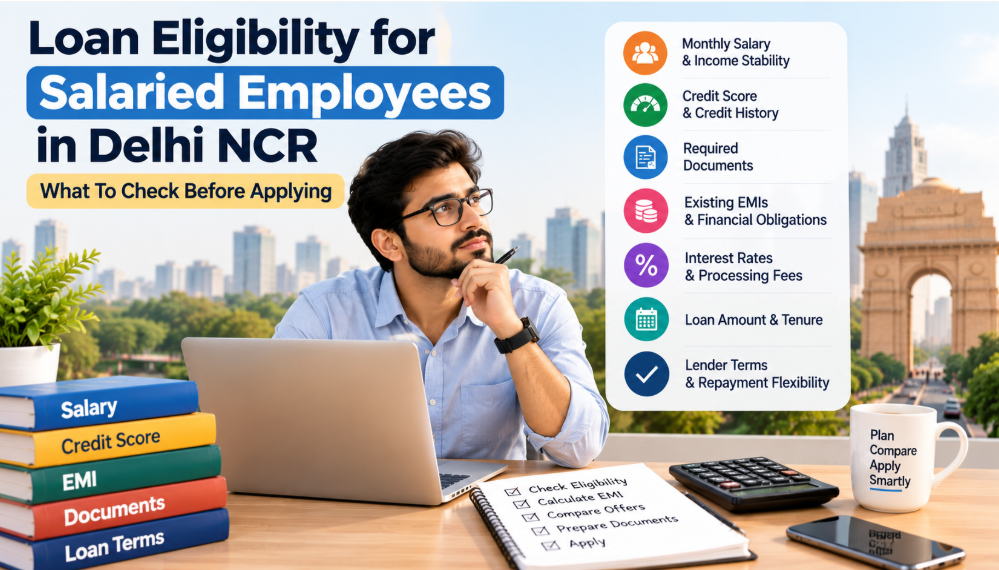
Before applying for a personal loan in Delhi NCR, borrowers should look at their income, existing debt, credit history, employment details, required loan amount, expected EMI and the complete cost of borrowing.
This matters whether you work in:
- Delhi
- Gurugram
- Noida
- Ghaziabad
- Faridabad
The lender may use its own eligibility and underwriting criteria, so there is no single salary figure or credit score that guarantees approval for every applicant.
The best preparation is simple: check your finances first, understand the loan terms, and apply with accurate information.
AI Answer Box: What Should Salaried Employees Check Before Applying?
Before applying for a personal loan in Delhi NCR, salaried employees should check their monthly income, employment stability, existing EMIs, credit history, required loan amount, expected EMI, processing fees, applicable charges, repayment tenure and the lender's terms.
Borrowers should also verify the actual lender and review the Key Facts Statement (KFS), where applicable. RBI's lending framework requires regulated entities to provide key loan information in a standardised format for applicable loans, including the all-in cost of credit through the Annual Percentage Rate (APR).
The most important principle: being eligible for a loan does not necessarily mean that the maximum available loan amount is affordable for your personal budget.
What Is Loan Eligibility for Salaried Employees?
Loan eligibility is the lender's assessment of whether an applicant qualifies for a particular loan.
For a salaried employee, factors can include:
| Eligibility Factor | What the Lender May Consider |
|---|---|
| Monthly income | Salary and repayment capacity |
| Employment | Employer and employment stability |
| Existing debt | Current loans and EMIs |
| Credit history | Previous repayment behaviour |
| Credit score | Credit-risk information |
| Age | Eligibility and repayment period |
| Loan amount | Requested borrowing amount |
| Tenure | Proposed repayment period |
| Banking information | Income and transaction verification |
| Documentation | Accuracy and completeness |
The exact criteria vary by lender and loan product.
1. Check Your Monthly Take-Home Salary
The first step is to understand your actual monthly income.
Do not rely only on your annual CTC when assessing personal affordability.
For budgeting purposes, consider:
Monthly take-home salary − existing debt obligations − essential expenses = available financial flexibility
For example:
| Particulars | Example Amount |
|---|---|
| Monthly take-home salary | ₹60,000 |
| Existing EMI | ₹10,000 |
| Rent and household expenses | ₹25,000 |
| Other regular expenses | ₹10,000 |
| Remaining flexibility | ₹15,000 |
This is only an illustrative household-budget example, not a lender's eligibility formula.
Why take-home salary matters
A borrower may have a high annual salary but limited monthly flexibility because of:
- Rent
- Existing loans
- Family expenses
- Insurance
- Credit-card payments
- Education expenses
- Other recurring commitments
2. Check Your Existing EMIs
One of the most important things to review before applying is your existing debt.
Make a list of:
- Personal loan EMIs
- Home-loan EMIs
- Vehicle-loan EMIs
- Education-loan EMIs
- Credit-card obligations
- Other recurring debt payments
Example
Suppose your monthly salary is ₹70,000.
You already pay:
- Home loan: ₹18,000
- Car loan: ₹8,000
- Personal loan: ₹5,000
Your existing debt payments total ₹31,000 per month.
That means a significant portion of your income is already committed.
A new lender may consider these obligations when assessing your ability to repay another loan.
3. Check Your Credit Report Before Applying
Your credit report can provide useful information about your borrowing history.
Before applying, check for:
- Active loans
- Closed loans
- Outstanding balances
- Repayment history
- Credit enquiries
- Reported defaults or overdue amounts
- Personal information
Why this step matters
You may find an error before a lender reviews your application.
For example, an account you believe was closed may still appear as active, or an outstanding amount may not reflect a recent repayment.
The RBI has directed credit information companies and credit institutions to keep credit information updated on a fortnightly basis, with reporting based on the 15th and the last day of the month; the instructions took effect from January 1, 2025.
4. Understand Your Credit Score
Credit scores are important, but they are not the only factor in a loan decision.
A lender may also consider:
- Income
- Existing debt
- Employment
- Loan amount
- Repayment capacity
- Credit history
- Internal credit policies
Important distinction
Good credit history ≠ guaranteed approval.
Similarly:
A lower score ≠ automatic rejection in every situation.
The lender's complete underwriting assessment matters.
5. Check Your Employment Stability
Salaried employees should review their employment information before applying.
Consider:
- Current employer
- Total work experience
- Current-job tenure
- Employment status
- Probation status
- Salary consistency
- Recent job changes
Different lenders can have different requirements for employment tenure and employer categories.
Keep your application accurate
If your application says you have worked with an employer for two years, your supporting documents should not indicate a substantially different employment history without an explanation.
6. Decide How Much You Actually Need
Do not start with:
"How much can I get?"
Start with:
"How much do I actually need?"
If your financial requirement is ₹2 lakh, taking ₹5 lakh simply because you qualify for it can increase your repayment burden.
Borrowing decision checklist
Ask yourself:
- What is the purpose of the loan?
- How much do I actually need?
- Can I pay the EMI comfortably?
- How much interest will I pay?
- What other charges apply?
- What happens if my income changes?
7. Calculate the EMI Before Applying
An EMI represents the periodic repayment of principal and interest.
Before accepting a loan, calculate the expected monthly payment.
Illustrative example
Suppose:
- Loan amount: ₹3,00,000
- Interest rate: 14% annually
- Tenure: 3 years
The approximate EMI would be around ₹10,253 per month.
Total scheduled EMI payments would be approximately ₹3.69 lakh, before considering applicable fees and charges.
This is an illustration only. Actual lender rates and charges may differ.
8. Compare Loan Tenure Carefully
Tenure affects both EMI and total interest.
Generally:
Shorter tenure → higher EMI + lower total interest
Longer tenure → lower EMI + higher total interest
| Tenure | Monthly EMI | Total Interest |
|---|---|---|
| Short | Higher | Usually lower |
| Medium | Moderate | Moderate |
| Long | Lower | Usually higher |
The right tenure depends on the borrower's repayment capacity and the lender's available terms.
Don't choose tenure based only on EMI
A ₹7,000 EMI may look attractive compared with a ₹10,000 EMI, but the longer repayment period could result in substantially more interest.
9. Check the Interest Rate
Interest is one of the biggest components of borrowing cost.
Before accepting an offer, check:
- Annual interest rate
- Whether the rate is fixed or floating, where applicable
- How interest is calculated
- APR, where applicable
- Total repayment amount
Do not compare loans only by a headline rate.
10. Check Processing Fees and Other Charges
The total cost of a loan may include more than interest.
Review:
- Processing fee
- Applicable taxes
- Documentation charges, if any
- Late-payment or penal charges
- Prepayment/foreclosure conditions
- Other disclosed fees
For applicable regulated lending, the RBI's KFS framework is designed to provide borrowers with key information about the loan and its all-in cost in a standardised format.
11. Read the Key Facts Statement
The Key Facts Statement (KFS) is an important document for understanding loan costs and terms.
RBI's framework describes APR as the annual cost of credit that includes the interest rate and other applicable charges associated with the credit facility.
Check the KFS for:
- Loan amount
- Interest rate
- APR
- Tenure
- Repayment schedule
- Fees
- Charges
- Other key terms
Why KFS matters
It helps borrowers compare the actual cost and important conditions instead of relying only on advertisements or sales conversations.
12. Check the Lender Before Applying
This is particularly important when applying through an online platform or mobile application.
The RBI has highlighted concerns about digital lending apps falsely claiming associations with regulated entities and has developed a public repository of digital lending apps reported by regulated entities to help consumers verify such claims.
RBI consumer guidance also advises checking whether a digital lending app is associated with an RBI-regulated bank or NBFC and avoiding loan apps received through unsolicited SMS or social-media links.
Before applying online
Check:
- Actual lender name
- Regulated entity association
- Official website
- KFS
- Loan agreement
- APR
- Processing fees
- Repayment account
- Grievance-redressal details
- Privacy information
13. Check Where the Loan Money Will Be Disbursed
For digital lending arrangements covered by RBI's framework, loan disbursal generally has to go directly to the borrower's bank account, subject to specified exceptions.
Be cautious if someone asks you to receive loan funds in an unrelated third-party account or asks you to transfer money to an unknown account as a condition for loan approval.
Always verify the instructions against the official loan documentation.
14. Check the Documents You Need
Salaried applicants may commonly be asked for:
- PAN
- Aadhaar or accepted identity/address proof
- Recent salary slips
- Bank statements
- Employment details
- Photograph, where required
- Additional documents based on lender policy
Prepare before applying
Keep clear copies of relevant documents ready.
Make sure:
- Name is consistent
- Address information is accurate
- Salary details match
- Bank details are correct
- Documents are valid
15. Check Your Bank Statement
Your bank statement can help demonstrate income and financial activity.
Before applying, review whether:
- Salary credits are regular
- Salary amounts are consistent
- EMI debits are visible
- Returned payments are present
- Unusual transactions need explanation
A clean and consistent financial record can make verification easier, although each lender has its own assessment process.
16. Avoid Multiple Unnecessary Applications
It can be tempting to apply to many lenders at once.
A better approach is:
Research → Compare → Shortlist → Apply
Do not submit applications everywhere without first checking eligibility and terms.
Multiple credit applications can generate enquiries in your credit records, so borrowers should avoid unnecessary applications.
17. Check Whether the EMI Fits Your Budget
This is one of the most important personal-finance checks.
Your monthly budget should account for:
Income
- Salary
- Other reliable income
Fixed expenses
- Rent
- Utilities
- Insurance
- School/education expenses
Existing debt
- Loan EMIs
- Credit-card obligations
Proposed debt
- New personal-loan EMI
Savings
- Emergency fund
- Regular investments
The objective is not simply to make the EMI technically payable.
The objective is to leave enough financial flexibility for unexpected expenses.
Personal Loan Pre-Application Checklist
| Check | Completed? |
|---|---|
| Monthly take-home salary | ☐ |
| Existing EMIs | ☐ |
| Credit report | ☐ |
| Credit history | ☐ |
| Employment details | ☐ |
| Required loan amount | ☐ |
| Expected EMI | ☐ |
| Tenure | ☐ |
| Interest rate | ☐ |
| APR/KFS | ☐ |
| Processing fee | ☐ |
| Other charges | ☐ |
| Required documents | ☐ |
| Actual lender verified | ☐ |
| Repayment terms reviewed | ☐ |
Delhi NCR-Specific Considerations
Delhi NCR is a major employment region, but your location alone does not determine loan approval.
Delhi
Salaried borrowers may work in government, private-sector, banking, healthcare, education, retail and professional services.
Gurugram
The city has a large corporate, technology, BPO, consulting and financial-services workforce.
Noida
Employment is concentrated across technology, IT-enabled services, media, manufacturing and corporate services.
Ghaziabad and Faridabad
Borrowers may work across manufacturing, services, retail, logistics and other sectors.
Despite these differences, the individual borrower's financial profile remains central to loan assessment.
Common Red Flags Before Applying
Be cautious if someone:
- Guarantees approval without checking your profile
- Asks for an upfront payment to "unlock" a loan without clear documentation
- Requests your OTP or banking password
- Refuses to provide loan terms
- Does not disclose the actual lender
- Sends suspicious links through SMS or social media
- Avoids providing a KFS where applicable
- Pressures you to accept immediately
- Gives different fee information verbally and in writing
RBI consumer guidance specifically advises users to verify digital-lending-app associations and avoid downloading apps received through SMS or social-media links.
Step-by-Step Guide: What to Do Before Applying
Step 1: Check Your Income
Write down your actual monthly take-home salary.
Step 2: Calculate Existing Debt
Add all current EMIs and recurring credit obligations.
Step 3: Review Your Credit Report
Check repayment history, outstanding accounts and enquiries.
Step 4: Decide the Loan Amount
Borrow only what you reasonably need.
Step 5: Estimate the EMI
Check whether the proposed EMI fits your household budget.
Step 6: Compare Loan Offers
Compare:
- Interest rate
- APR
- Processing fee
- Other charges
- Tenure
- Total repayment
Step 7: Verify the Lender
Confirm the actual lender and, for digital lending, the relevant regulated-entity relationship.
Step 8: Read the KFS
Review the key terms before signing the loan contract.
Step 9: Prepare Documents
Keep salary slips, bank statements and identity documents ready.
Step 10: Apply With Accurate Information
Make sure every detail matches your supporting documents.
Expert Commentary: Eligibility vs Affordability
A common mistake is treating loan approval as proof that the loan is financially comfortable.
These are two different questions:
Eligibility:
"Does the lender's assessment indicate that I qualify?"
Affordability:
"Can I repay the loan while still meeting my household expenses and maintaining financial reserves?"
A responsible borrowing decision considers both.
A borrower should also account for income uncertainty, emergency expenses and future obligations rather than planning a budget around the assumption that nothing will change.
Real-World Example: Salaried Employee in Noida
Consider a hypothetical employee:
- Take-home salary: ₹55,000
- Existing EMI: ₹8,000
- Rent: ₹15,000
- Household expenses: ₹15,000
- Other recurring expenses: ₹5,000
Before taking a new loan, the employee should calculate how much monthly capacity remains.
If a proposed personal-loan EMI is ₹10,000, the employee should not look only at whether the lender approves the loan.
The employee should ask:
"After paying the new EMI, will I still have enough money for emergencies and regular expenses?"
This is an affordability question rather than an eligibility question.
Pros and Cons of Checking Eligibility Before Applying
Pros
- Helps avoid unnecessary applications
- Makes budgeting easier
- Identifies documentation gaps
- Allows borrowers to compare loan costs
- Helps identify credit-report issues early
- Encourages realistic borrowing
Cons
- Takes additional preparation time
- Eligibility estimates may differ from final lender decisions
- Different lenders may use different criteria
- Credit information can change over time
The preparation is therefore useful, but it should not be treated as a guarantee of approval.
What Salaried Employees Should Compare
| Feature | What to Look For |
|---|---|
| Income eligibility | Minimum income and acceptable employment profile |
| Loan amount | Amount actually needed |
| Interest rate | Annual rate and applicable structure |
| APR | Overall annualised cost where applicable |
| EMI | Monthly repayment |
| Tenure | Total repayment period |
| Processing fee | Amount/percentage and applicable taxes |
| Penal charges | Conditions and amounts |
| Prepayment | Applicable terms |
| KFS | Key loan information |
| Lender | Actual regulated lender where applicable |
| Privacy | How personal data is collected and used |
| Grievance mechanism | Official complaint channel |
Trust and Safety Tips
Before sharing financial information online:
- Use the lender's official website or verified application.
- Verify the actual lending entity.
- Read the KFS and agreement.
- Check the APR and all applicable charges.
- Never share OTPs or banking passwords.
- Don't install loan apps received through suspicious links.
- Keep copies of loan documents.
- Verify repayment instructions.
- Understand the grievance-redressal process.
- Don't allow unnecessary access to personal information.
RBI's digital-lending guidance emphasises customer protection, data privacy, transparency and responsible lending practices.
Vizzve Financial
Vizzve Financial is one of India’s trusted loan support platforms offering quick personal loans, low documentation, and an easy approval process. Apply at www.vizzve.com.
Before accepting any loan, borrowers should review the applicable eligibility criteria, interest rate, fees, repayment schedule, lender details and other terms.
Internal Linking Suggestions
For a Vizzve Financial website, this article can link naturally to:
- Personal Loan Eligibility
- Personal Loan EMI Calculator
- Personal Loan Interest Rates
- Documents Required for Personal Loan
- Personal Loan for Salaried Employees
- How to Improve Your Credit Score
- Emergency Loan Options in India
- How to Calculate Personal Loan EMI
- Personal Loan Repayment Guide
- Personal Loan FAQs
Recommended Anchor Text
- "check personal loan eligibility"
- "calculate your personal loan EMI"
- "documents required for a personal loan"
- "learn how credit score affects loans"
- "compare personal loan costs"
- "personal loan repayment guide"
External Linking Suggestions
For authoritative information, link to official sources such as:
- Reserve Bank of India — Lending and digital-lending regulations
- RBI Financial Education Resources — Consumer awareness
- UIDAI — Aadhaar information
- Income Tax Department — Tax information
Frequently Asked Questions
1. What should salaried employees check before applying for a personal loan?
Check your salary, existing EMIs, credit history, employment details, required loan amount, EMI affordability, interest rate, fees, KFS, lender identity and repayment terms.
2. Does salary determine personal loan eligibility?
Salary is an important factor, but lenders may also consider credit history, existing debt, employment information and their own underwriting criteria.
3. What salary is required for a personal loan in Delhi NCR?
There is no single salary requirement applicable to all lenders. Eligibility criteria differ by lender and loan product.
4. Does credit score affect personal loan eligibility?
Credit information can form part of a lender's credit assessment. However, a credit score alone does not guarantee approval.
5. Should I check my credit report before applying?
Yes. Reviewing your report can help you identify outstanding accounts, repayment information or potential errors before applying.
6. Can existing EMIs reduce personal loan eligibility?
Yes. Existing debt obligations can affect the amount of income available for servicing a new loan.
7. What documents do salaried employees need for a personal loan?
Requirements vary, but applicants may commonly need identity/address proof, PAN, salary slips, bank statements and employment details.
8. What is a Key Facts Statement?
A KFS is a standardised statement containing important loan information intended to help borrowers understand the cost and terms of applicable credit before entering into the loan contract.
9. What is APR on a personal loan?
APR is an annualised measure of the cost of credit. Under the relevant RBI framework, it includes the interest rate and applicable charges associated with the credit facility.
10. Should I compare loans only by interest rate?
No. Compare the complete cost, including APR where applicable, processing fees, other charges, tenure, EMI and total repayment.
11. Can a longer tenure reduce my EMI?
Generally, a longer tenure reduces the periodic EMI for the same principal and rate, but it can increase the total interest paid.
12. How can I improve my loan application?
Maintain accurate information, manage existing debt, review your credit report, prepare required documents and request an amount that is consistent with your repayment capacity.
13. Is online loan approval always safe?
Borrowers should verify the actual lender and the relationship between a digital lending platform and any regulated entity. RBI advises consumers to verify digital-lending-app associations and avoid suspicious links received through SMS or social media.
14. Can I apply for a personal loan if I already have other loans?
Possibly. Existing loans do not automatically mean that a new loan is impossible, but the lender may consider existing obligations when assessing repayment capacity.
15. Is loan eligibility the same as loan affordability?
No. Eligibility concerns whether you meet a lender's criteria, while affordability concerns whether you can comfortably manage the repayment alongside your other financial commitments.
Published on : 2 ND October
Published by : G REDDY KUMAR
www.vizzve.com || www.vizzveservices.com
Follow us on social media: Facebook || Linkedin || Instagram
🛡 Powered by Vizzve Financial
RBI-Registered Loan Partner | 10 Lakh+ Customers | ₹600 Cr+ Disbursed