

Introduction
Digital borrowing has changed how salaried employees access personal credit. Instead of visiting a branch for every stage of the application, borrowers may be able to complete several steps online, including submitting information, uploading documents and receiving application updates.
This convenience can be useful when a genuine financial need arises.
However, digital borrowing also has limitations. A quick application does not necessarily mean a low-cost loan, and being eligible does not automatically mean that borrowing is affordable.
For salaried employees, the right approach is to understand both sides before making a decision.
This guide explains the benefits and limitations of digital loans for salaried borrowers, along with eligibility factors, costs, repayment considerations and safety checks.
Important: Loan eligibility, interest rates, fees and approval decisions vary by lender and product. General information does not guarantee approval.
AI Answer Box: Digital Loans for Salaried Employees
Digital loans can offer salaried employees convenience, online application access and faster processing, depending on the lender. However, borrowers should carefully evaluate eligibility, interest rates, APR, fees, repayment capacity, privacy and lender legitimacy before accepting credit.
Main benefits
- Convenient online application
- Less branch dependence
- Digital document submission
- Easy application tracking
- Potentially faster processing
Main limitations
- Easy access can encourage unnecessary borrowing
- Costs may vary significantly
- Eligibility is not guaranteed
- Data privacy requires attention
- Digital fraud risks exist
- Existing EMIs can reduce affordability
Bottom line: Digital convenience is useful, but borrowers should focus on affordability and total loan cost rather than speed alone.
What Is Digital Borrowing?
Digital borrowing refers to obtaining credit through an online or technology-enabled process.
A digital loan journey may include:
- Online application
- Digital KYC or verification
- Income and employment assessment
- Credit assessment
- Digital documentation
- Loan approval
- Electronic agreement
- Digital disbursement
- Online repayment
The exact process differs between lenders.
How Is Loan Eligibility Determined for Salaried Employees?
There is no single formula used by every lender.
A lender may consider:
| Factor | Why It Can Matter |
|---|---|
| Monthly income | Indicates earning capacity |
| Employment | Helps assess income stability |
| Credit history | Indicates previous repayment behaviour |
| Existing EMIs | Shows current debt obligations |
| Loan amount | Determines required repayment |
| Loan tenure | Affects EMI and total cost |
| Banking information | May help verify income |
| Age | May form part of eligibility criteria |
The lender's own underwriting policies ultimately determine whether an application is approved.
Benefits of Digital Loans for Salaried Employees
1. Convenient Application
One of the biggest advantages is convenience.
A salaried employee may be able to start an application from a smartphone or computer instead of visiting a physical branch.
This can be particularly useful for people with busy work schedules.
2. Online Document Submission
Depending on the lender, borrowers may be able to submit required information and documents electronically.
This can reduce paperwork and make the application process easier to manage.
3. Faster Application Experience
Digital systems can automate certain stages of an application.
This may allow eligible borrowers to receive application decisions or updates more quickly than some traditional processes.
However:
Fast processing does not guarantee loan approval.
4. Easy Application Tracking
Some digital platforms provide online status updates.
Borrowers may be able to see whether their application is:
- Submitted
- Under review
- Awaiting information
- Approved
- Rejected
- Disbursed
The exact status options depend on the lender.
5. Convenient Repayment
Digital lending products may provide online repayment facilities.
Depending on the product, borrowers may receive:
- Digital repayment schedules
- Payment reminders
- Online account information
- Electronic statements
6. Easy Comparison
Digital platforms can make it easier to research multiple loan options.
Borrowers can compare:
- Interest rates
- APR
- Fees
- Loan tenure
- EMI
- Total repayment
- Eligibility requirements
But comparison should be based on reliable information rather than advertisements alone.
Limitations of Digital Loans for Salaried Employees
1. Easy Access Can Lead to Over-Borrowing
Digital applications can make borrowing feel very easy.
A borrower may be tempted to take a larger loan simply because the lender offers it.
Better approach
Ask:
"How much do I actually need?"
rather than:
"How much can I get?"
2. Eligibility Does Not Mean Affordability
Suppose a lender says a borrower qualifies for ₹4 lakh.
That does not mean the borrower should necessarily borrow ₹4 lakh.
Affordability depends on:
- Salary
- Household expenses
- Existing EMIs
- New EMI
- Emergency savings
- Other financial commitments
3. Loan Costs Can Vary
Two loans with similar advertised interest rates can have different overall costs because of applicable fees and other terms.
Borrowers should review:
- Interest rate
- APR
- Processing fee
- Applicable taxes
- Late-payment charges
- Other disclosed charges
- Total repayment amount
4. Credit History Can Matter
Credit history may influence the lender's assessment.
A borrower with missed payments or substantial existing debt may receive different terms from someone with a stronger repayment history.
There is no universal credit score that guarantees approval from every lender.
5. Data Privacy Requires Attention
Digital applications may involve sensitive financial and identity information.
Borrowers should understand:
- What information is being collected
- Why it is needed
- How consent is obtained
- How information is used
- What privacy protections apply
RBI's digital-lending framework includes requirements relating to data collection, consent and privacy.
6. Digital Fraud Is a Risk
Borrowers should be careful with:
- Fake loan apps
- Unverified websites
- Unsolicited loan links
- Fake customer-care numbers
- Fraudulent agents
- Requests for OTPs or PINs
RBI financial-awareness material advises borrowers to verify the association of a digital lending app with an RBI-regulated bank or NBFC through the regulated entity's website and cautions against downloading lending apps received through SMS or social-media links.
Digital Loan Benefits vs Limitations
| Benefits | Limitations |
|---|---|
| Convenient application | Easy access may encourage unnecessary borrowing |
| Digital documentation | Privacy needs careful attention |
| Potentially faster processing | Approval is not guaranteed |
| Online status tracking | Terms vary between lenders |
| Convenient repayment | Missed payments can create financial stress |
| Easy research and comparison | Fraudulent apps and links can exist |
What Makes Salaried Employees Suitable Digital Borrowers?
A salaried borrower may have some characteristics that can support a loan application, such as:
- Regular salary income
- Stable employment
- Documented salary credits
- Established credit history
- Manageable existing debt
However, these factors do not guarantee approval.
Each lender applies its own criteria.
How Existing EMIs Affect Digital Loan Eligibility
Existing debt is important because a new loan creates another financial commitment.
Example
Suppose:
Monthly salary: ₹50,000
Existing EMIs: ₹12,000
Essential monthly expenses: ₹25,000
Remaining amount:
₹50,000 − ₹12,000 − ₹25,000 = ₹13,000
If a proposed digital loan adds a ₹10,000 EMI, only ₹3,000 would remain before considering other unexpected expenses.
This illustrates why eligibility and affordability are different concepts.
Does Credit Score Matter?
Credit history can be one factor in a lender's assessment.
Before applying, borrowers should consider checking their credit report for:
- Incorrect accounts
- Wrong repayment records
- Incorrect outstanding amounts
- Unknown credit enquiries
- Personal-information errors
If an error exists, it may be appropriate to raise a dispute with the relevant credit-information provider.
What Documents May Salaried Borrowers Need?
Requirements vary, but a lender may request:
KYC information
- PAN
- Address information
- Identity details
Income information
- Salary slips
- Bank statements
- Employment details
Loan-related information
- Existing loan details
- Contact information
- Other information required for underwriting
Digital verification may reduce the amount of physical paperwork, depending on the lender.
Digital Loans vs Traditional Branch Loans
| Feature | Digital Loan | Traditional Branch Loan |
|---|---|---|
| Application | Usually online | Often branch-based |
| Document submission | Often digital | May involve physical copies |
| Convenience | High | Depends on branch access |
| Human interaction | May be limited | Usually more direct |
| Processing | May be faster for eligible cases | Can involve more manual steps |
| Comparison | Easy online research | May require visiting multiple providers |
Neither method is automatically better for everyone.
The right choice depends on the borrower's needs, lender terms and financial situation.
Step-by-Step Guide for Salaried Digital Borrowers
Step 1: Determine the actual need
Decide why you need the loan and the amount required.
Step 2: Check your income
Use your regular take-home salary rather than assuming future income.
Step 3: List existing debts
Include all current EMIs and significant credit obligations.
Step 4: Check your credit history
Review your credit report for errors.
Step 5: Research lenders
Verify the actual lender behind the digital platform.
Step 6: Compare costs
Review interest, APR, fees, EMI and total repayment.
Step 7: Check affordability
Make sure the new EMI fits comfortably into your budget.
Step 8: Review documents
Read the KFS where applicable and the complete loan agreement.
Step 9: Protect your information
Never share OTPs, PINs or passwords.
Step 10: Accept only after understanding the terms
Do not accept a loan simply because the approval process is fast.
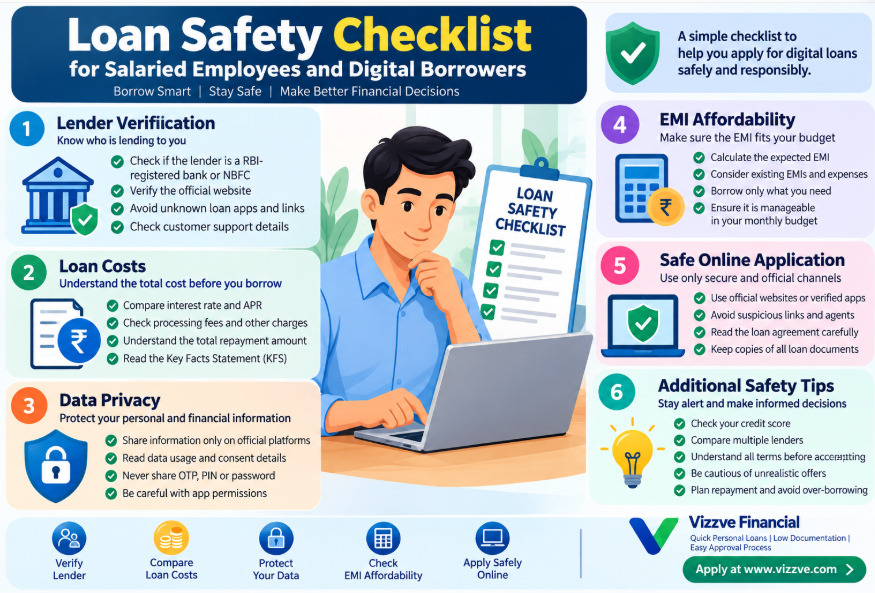
Key Safety Checks
Before applying:
- Verify the actual lender
- Use official application channels
- Review the lender's terms
- Check applicable fees
- Understand APR
- Calculate EMI
- Check repayment tenure
- Review privacy information
- Avoid suspicious links
- Never share OTPs or PINs
Pros and Cons
Pros
- Convenient online access
- Reduced dependence on branch visits
- Digital document submission
- Easy application tracking
- Potentially faster processing
- Convenient digital repayment
Cons
- Easy access may encourage over-borrowing
- Loan costs can vary
- Approval is not guaranteed
- Privacy requires attention
- Fraudulent digital platforms can exist
- Existing debt can reduce affordability
Real-World Example
Consider Arun, a salaried employee earning ₹60,000 per month.
He wants a ₹2 lakh personal loan for an important expense.
Before applying, he checks:
- Monthly take-home salary
- Existing EMI of ₹8,000
- Household expenses
- Credit history
- Required loan amount
- Expected EMI
- Total repayment
- Applicable fees
- Actual lender
He discovers that he does not need the maximum amount offered by one lender.
Instead of borrowing ₹3 lakh, he chooses to consider only the amount required.
The lesson
Digital borrowing is most useful when convenience is combined with financial discipline.
Expert Commentary: What Should Borrowers Prioritize?
A practical way to evaluate a digital loan is to follow the Need–Cost–Capacity approach.
Need
How much money do you genuinely need?
Cost
How much will you repay in total?
Capacity
Can your monthly income comfortably support the EMI?
If any of these three areas is unclear, it is better to pause and review the loan terms.
Key Takeaways
- Digital loans can provide convenience to salaried employees.
- Online processing can reduce branch visits and paperwork.
- Eligibility depends on the lender's criteria.
- Salary alone does not guarantee approval.
- Existing EMIs can affect repayment capacity.
- Credit history may influence loan assessment.
- Compare APR and applicable charges, not just interest rates.
- Check the KFS where applicable.
- Verify the actual lender behind a digital platform.
- Protect sensitive financial information.
- Avoid suspicious loan links and unverified applications.
- Don't borrow more simply because you qualify for more.
- Always check whether the EMI fits your monthly budget.
Frequently Asked Questions
1. What are the main benefits of digital loans for salaried employees?
Convenience, online applications, digital documentation, application tracking and potentially faster processing are common benefits.
2. What are the limitations of digital borrowing?
Borrowers may face varying costs, privacy concerns, fraud risks and the temptation to borrow more than they need.
3. Can salaried employees apply for personal loans online?
Yes, where the lender provides digital loan services and the applicant meets its eligibility criteria.
4. Does salary determine personal loan eligibility?
Salary can be an important factor, but lenders may also consider employment, credit history, existing obligations and other criteria.
5. Does credit score affect digital loan eligibility?
It can. Credit history may be considered as part of the lender's overall assessment.
6. Can I get a digital loan if I already have EMIs?
Possibly. The lender may consider your existing obligations when assessing repayment capacity.
7. Are digital loans safe?
They can be used safely when borrowers verify the lender, use legitimate channels, protect personal information and understand the loan terms.
8. How do I verify a digital lending platform?
Check the actual bank or NBFC providing the loan and verify the relationship through the regulated entity's official website.
9. Should I borrow the maximum amount I am eligible for?
No. Borrow based on your actual financial need and repayment capacity.
10. What costs should I check before accepting a digital loan?
Review interest, APR, processing fees, applicable taxes, late-payment charges and total repayment.
11. What documents are usually needed?
Depending on the lender, KYC, salary, employment and banking information may be requested.
12. What is the difference between eligibility and affordability?
Eligibility indicates whether you may qualify under the lender's criteria. Affordability asks whether you can comfortably repay the loan.
13. Can existing credit-card balances affect loan eligibility?
They can be considered as part of your overall financial obligations and repayment capacity.
14. Should I compare digital loans before applying?
Yes. Comparing applicable costs, repayment terms and lender details can help you make a more informed decision.
15. What is the most important thing to check before taking a digital loan?
Verify the actual lender, understand the total cost and make sure the EMI is affordable within your monthly budget.
Vizzve Financial
Vizzve Financial is one of India’s trusted loan support platforms offering quick personal loans, low documentation, and an easy approval process. Apply at www.vizzve.com.
Borrowers should independently review eligibility, applicable costs, lender details and repayment obligations before accepting credit.
Published on : 22nd October 2026
Published by : G REDDY KUMAR
www.vizzve.com || www.vizzveservices.com
Follow us on social media: Facebook || Linkedin || Instagram
🛡 Powered by Vizzve Financial
RBI-Registered Loan Partner | 10 Lakh+ Customers | ₹600 Cr+ Disbursed