

Introduction
For salaried employees, a regular monthly income can make personal loan applications easier to assess. However, salary alone does not determine loan eligibility.
Lenders may consider income, employment stability, existing EMIs, credit history, age, requested loan amount, repayment capacity and other internal criteria.
Digital borrowers should also pay attention to the lender's identity, loan terms, total borrowing cost and data-sharing practices before submitting an application.
This loan eligibility checklist helps salaried employees prepare before applying for a personal loan online.
AI Answer Box
What is required for personal loan eligibility for salaried employees?
A salaried employee generally needs to demonstrate sufficient and stable income, acceptable credit history, manageable existing obligations and the ability to repay the proposed EMI. Specific requirements vary by lender.
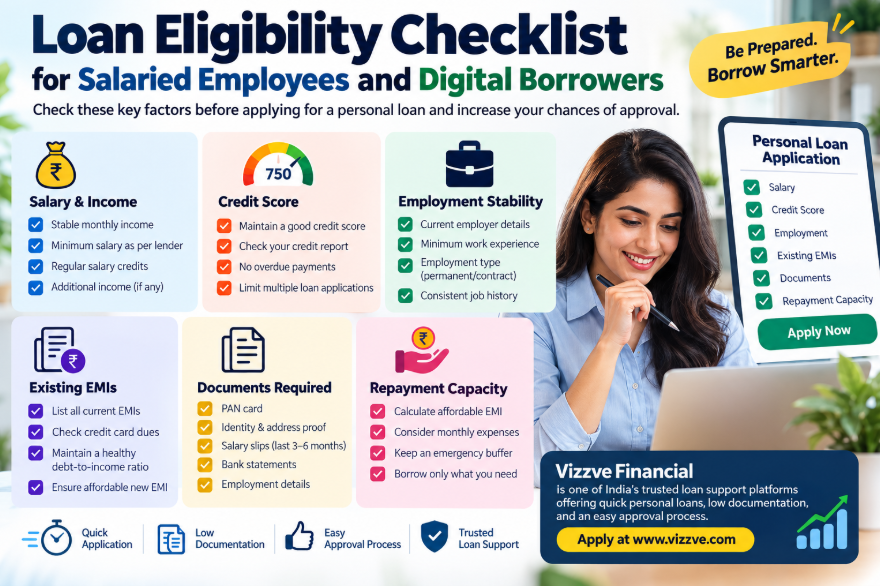
Quick Eligibility Checklist
Before applying, check:
- Monthly take-home salary
- Employment stability
- Existing EMIs
- Credit history
- Age and eligibility conditions
- Requested loan amount
- Loan tenure
- Monthly repayment capacity
- Required documents
- Lender identity
- Interest rate and applicable fees
- Total repayment amount
- Data privacy terms
Important: Meeting general criteria does not guarantee loan approval.
H2: What Determines Loan Eligibility for Salaried Employees?
Loan eligibility is normally assessed using several financial and personal factors.
H3: 1. Monthly Salary
Your regular income is one of the most important factors.
Lenders may look at:
- Net monthly salary
- Salary consistency
- Income source
- Employment type
- Existing financial commitments
A higher income may support a higher potential loan amount, but the final decision depends on the lender's assessment.
H3: 2. Employment Stability
Employment history can provide an indication of income stability.
A lender may consider:
- Current employer
- Length of employment
- Total work experience
- Nature of employment
- Regular salary credits
Different lenders have different employment requirements.
H3: 3. Existing Loans and EMIs
Existing financial commitments directly affect affordability.
For example, if your monthly income is ₹50,000 and you already have multiple EMIs, taking another large loan could put pressure on your monthly budget.
Check Your Existing Obligations
Before applying, list:
- Personal loan EMIs
- Home loan EMIs
- Vehicle loan EMIs
- Credit card repayment obligations
- Other recurring debt payments
H2: Credit Score and Loan Eligibility
Your credit history can play an important role in how lenders assess your application.
A healthy credit profile may demonstrate a history of responsible borrowing and repayment.
However, there is no single credit-score number that guarantees approval from every lender.
H3: How to Improve Your Credit Profile
Before applying:
- Pay EMIs on time
- Pay credit card bills on time
- Avoid unnecessary borrowing
- Keep track of outstanding balances
- Check your credit report for errors
- Avoid submitting unnecessary loan applications
H2: Personal Loan Eligibility Checklist
Use this checklist before starting an online loan application.
| Eligibility Factor | What to Check |
|---|---|
| Salary | Is your monthly income stable? |
| Employment | Is your employment history consistent? |
| Credit Profile | Have you maintained timely repayments? |
| Existing EMIs | Can your budget support another EMI? |
| Age | Do you meet the lender's age criteria? |
| Loan Amount | Are you borrowing only what you need? |
| Tenure | Does the repayment period suit your budget? |
| Documents | Do you have the required information ready? |
| Lender | Have you verified the lender? |
| Costs | Have you checked interest and applicable fees? |
| Privacy | Do you understand how your data is handled? |
H2: Documents Salaried Employees May Need
Document requirements vary between lenders and individual applications.
Commonly requested information can include:
- Identity information
- Address details
- PAN or other accepted identification
- Salary slips
- Bank statements
- Employment information
- Salary account details
- Other supporting documents
H3: Keep Your Information Accurate
One of the simplest ways to avoid application problems is to provide accurate information.
Do not:
- Enter an incorrect salary
- Upload altered documents
- Provide someone else's information
- Hide existing financial obligations
- Submit inconsistent employment details
Accurate information helps the lender assess the application correctly.
H2: How Much Loan Can a Salaried Employee Afford?
Eligibility and affordability are different.
A lender may consider you eligible for a particular amount, but that does not necessarily mean you should borrow the maximum available amount.
Consider Your Monthly Budget
Calculate:
Take-home salary − essential expenses − existing EMIs = available monthly surplus
The proposed new EMI should fit comfortably within your budget while leaving room for unexpected expenses.
H2: Loan Amount and Tenure Checklist
Choosing the right loan amount and tenure can make repayment easier.
Shorter Tenure
Benefits:
- Faster debt repayment
- Usually lower total interest
Limitations:
- Higher monthly EMI
- Greater monthly cash-flow pressure
Longer Tenure
Benefits:
- Lower monthly EMI
- More manageable monthly cash flow
Limitations:
- Longer repayment period
- Potentially higher total interest
| Factor | Short Tenure | Long Tenure |
|---|---|---|
| EMI | Higher | Lower |
| Repayment period | Shorter | Longer |
| Total interest | Usually lower | Usually higher |
| Monthly pressure | Higher | Lower |
H2: Digital Borrower Safety Checklist
Online convenience should not mean skipping basic checks.
H3: Verify the Lender
Before applying:
- Identify the actual lender
- Check official lender information
- Review the loan agreement
- Understand who is providing the credit
- Avoid suspicious links and unofficial applications
H3: Check the Total Cost
Do not look at the EMI alone.
Check:
- Interest rate
- Processing fee
- Applicable taxes
- Late-payment charges
- Prepayment or foreclosure terms, where applicable
- Other disclosed charges
- Total repayment amount
H3: Review Data Privacy
Before granting permissions, understand what information the application requests and why.
Be cautious about applications requesting unnecessary access to personal information.
H2: Step-by-Step Loan Eligibility Check
Step 1: Check Your Monthly Income
Record your regular take-home salary.
Step 2: Calculate Existing Obligations
List every EMI and significant recurring debt payment.
Step 3: Review Your Credit Profile
Check your repayment history and credit report.
Step 4: Decide the Required Loan Amount
Borrow only the amount necessary for your financial purpose.
Step 5: Choose a Suitable Tenure
Compare the EMI and total repayment under different tenures.
Step 6: Prepare Required Documents
Keep legitimate income and identity information ready.
Step 7: Verify the Lender
Confirm that you are applying through an authentic and appropriate lending channel.
Step 8: Read the Loan Terms
Review the applicable interest, fees, repayment schedule and other conditions.
Step 9: Apply Carefully
Submit accurate information and avoid unnecessary applications.
H2: Common Reasons a Loan Application May Not Be Approved
There can be many reasons for an unsuccessful application.
Possible factors include:
- Insufficient income
- High existing debt
- Weak credit history
- Unstable employment
- Incorrect application information
- Incomplete documents
- Not meeting lender-specific criteria
- Loan amount being unsuitable for the applicant's profile
An unsuccessful application does not necessarily mean the borrower can never qualify. Financial circumstances and lender criteria can change.
H2: Pros and Cons of Digital Personal Loans
Pros
- Convenient application process
- Online document submission
- Faster communication
- Easy access to loan information
- Digital repayment options
Cons
- Easy access can encourage unnecessary borrowing
- Fees can increase the overall cost
- Data privacy needs careful attention
- Missed payments may lead to additional charges
- Not every digital loan offer is suitable for every borrower
H2: Expert Borrowing Tips
A useful rule for salaried borrowers is to focus on affordability rather than maximum eligibility.
Before accepting a loan, ask:
- Do I really need this loan?
- Can I comfortably pay the EMI every month?
- What is the total repayment amount?
- What fees and charges apply?
- Have I verified the lender?
- Have I read the loan terms?
- Am I comfortable with the data-sharing requirements?
If the answers are clear, you are in a better position to make an informed borrowing decision.
H2: Key Takeaways
- Salary is important but does not guarantee loan approval.
- Employment stability can influence lender assessment.
- Existing EMIs affect repayment capacity.
- Credit history can influence eligibility and loan terms.
- Borrowers should compare total repayment costs.
- Choose a loan amount based on actual financial needs.
- Keep required documents accurate and genuine.
- Verify the lender before submitting personal information.
- Read the loan agreement before accepting the offer.
- Never borrow more than you can comfortably repay.
H2: Frequently Asked Questions
1. What is the loan eligibility for salaried employees?
Eligibility depends on factors such as income, employment, credit profile, existing obligations, age, loan amount and lender-specific criteria.
2. Does salary determine personal loan eligibility?
Salary is an important factor, but lenders may also assess credit history, employment stability and repayment capacity.
3. Can salaried employees apply for personal loans online?
Yes, many lenders offer online application processes, subject to their eligibility requirements.
4. Does credit score affect loan eligibility?
Credit history can form part of a lender's assessment and may influence approval and loan terms.
5. How do existing EMIs affect eligibility?
Existing EMIs reduce the amount of monthly income available for additional debt repayment and may affect eligibility.
6. What documents are required for salaried employees?
Requirements vary, but lenders may request identity information, salary evidence, bank statements and employment details.
7. Can I get a personal loan without salary slips?
Some lenders may use alternative income-verification methods, but requirements vary. Check the specific lender's criteria.
8. How can I improve my loan eligibility?
Maintaining timely repayments, managing existing debt, maintaining accurate financial information and choosing an affordable loan amount may help.
9. Is a higher loan amount always better?
No. Borrowing more increases your repayment obligation and may create unnecessary financial pressure.
10. Should I choose a short or long loan tenure?
It depends on your budget. A shorter tenure generally means higher EMI but potentially lower total interest, while a longer tenure can reduce EMI but extend repayment.
11. What should digital borrowers check before applying?
Verify the lender, review costs and repayment terms, understand data practices and submit information only through a trusted application channel.
12. Does employment stability matter for a personal loan?
It can. Lenders may consider employment history and income stability when assessing repayment capacity.
13. Can I apply for multiple loans at the same time?
You should avoid unnecessary applications. Compare suitable options first and apply carefully.
14. Does meeting eligibility criteria guarantee approval?
No. Eligibility criteria are only one part of the lender's overall assessment.
15. How can I check my loan affordability?
Compare your take-home salary with essential expenses and existing EMIs, then determine whether the proposed new EMI can comfortably fit your budget.
Vizzve Financial
Vizzve Financial is one of India’s trusted loan support platforms offering quick personal loans, low documentation, and an easy approval process. Apply at www.vizzve.com.
Borrowers should review the applicable loan terms, costs and repayment obligations before accepting credit.
Published on : 23 rd October 2026
Published by : G REDDY KUMAR
www.vizzve.com || www.vizzveservices.com
Follow us on social media: Facebook || Linkedin || Instagram
🛡 Powered by Vizzve Financial
RBI-Registered Loan Partner | 10 Lakh+ Customers | ₹600 Cr+ Disbursed