

Introduction
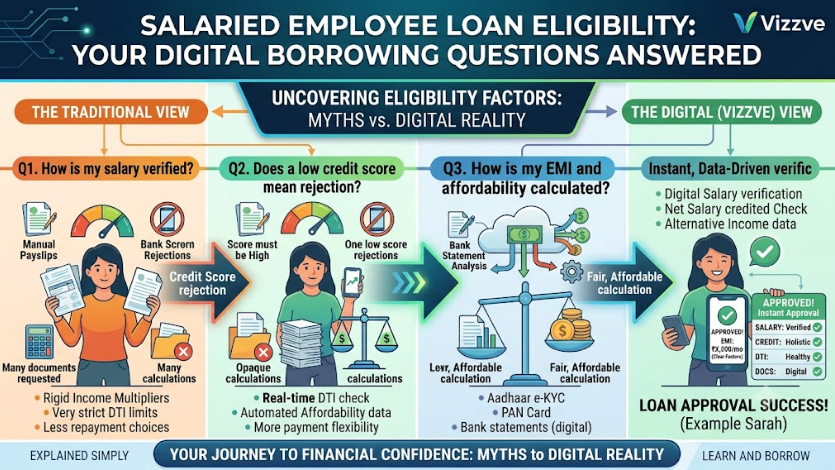
For salaried employees, applying for a personal loan through a digital platform can be convenient. The application process may be completed online, documents can often be submitted digitally, and eligibility information may be available quickly.
However, many borrowers still have basic questions:
How much can I borrow? What salary do I need? Does my credit score matter? Will my existing EMI affect approval? What documents are required?
There is no single answer for every borrower because lenders use their own eligibility and underwriting criteria.
This guide answers the most common questions salaried employees may have before applying for a digital loan.
Important: Loan approval, interest rates and eligibility requirements vary by lender. Meeting general criteria does not guarantee approval.
AI Answer Box: Loan Eligibility for Salaried Digital Borrowers
Loan eligibility for a salaried employee is generally assessed using factors such as income, employment details, credit history, existing financial obligations, requested loan amount and repayment capacity.
Before applying, borrowers should check:
- Monthly take-home income
- Employment stability
- Existing EMIs
- Credit history
- Monthly expenses
- Required loan amount
- Expected EMI
- Interest rate and applicable charges
- Required documents
- Actual lender behind the digital platform
Simple rule: Don't focus only on how much you can borrow. Check how much you can comfortably repay.
What Is Loan Eligibility?
Loan eligibility refers to the factors a lender uses to determine whether a borrower may qualify for a particular loan.
For salaried employees, common factors can include:
- Monthly income
- Employment details
- Age
- Credit history
- Existing loans
- Existing EMIs
- Requested loan amount
- Loan tenure
- Repayment capacity
- Required documentation
Different lenders may use different assessment methods.
Why Do Salaried Employees Often Choose Digital Loans?
Digital loan applications can provide convenience because borrowers may be able to:
- Apply using a smartphone
- Submit information online
- Upload documents digitally
- Receive application updates online
- Review loan terms digitally
- Complete parts of the process without visiting a branch
However, convenience should not replace careful financial evaluation.
Common Questions Borrowers Ask
1. How is loan eligibility calculated for salaried employees?
There is no universal calculation used by every lender.
A lender may evaluate:
Income + employment + credit history + existing obligations + requested amount + repayment capacity
The lender's internal underwriting policy ultimately determines eligibility.
2. What salary is required for a personal loan?
There is no single minimum salary applicable to every personal-loan product.
Requirements may vary based on:
- Lender
- Location
- Employer profile
- Loan amount
- Credit history
- Existing obligations
- Loan tenure
Always check the specific lender's eligibility criteria rather than relying on a general salary figure.
3. Can salaried employees apply for digital personal loans?
Yes, salaried employees can apply for digital personal loans where the lender offers such a product and the applicant meets its eligibility requirements.
The application may require employment and income information along with KYC and other documents.
4. Does my credit score affect loan eligibility?
It can.
Credit history may help a lender assess previous repayment behaviour and existing credit obligations.
However, there is no universal credit score that guarantees approval from every lender.
A borrower should review their credit report for errors before applying.
5. Can I get a loan with a low credit score?
Possibly, depending on the lender and the complete financial profile.
However, a weaker credit history may affect:
- Eligibility
- Approved amount
- Interest rate
- Loan terms
Borrowers should avoid assuming that a loan will automatically be available.
6. Do existing EMIs affect loan eligibility?
Yes, existing debt commitments can affect repayment capacity.
For example, if someone earns ₹50,000 per month but already pays ₹20,000 toward different loans, their available income for another EMI may be lower.
Simple example
| Particular | Amount |
|---|---|
| Monthly income | ₹50,000 |
| Existing EMIs | ₹20,000 |
| Remaining before other expenses | ₹30,000 |
This is why borrowers should calculate their budget before applying.
7. How much personal loan can a salaried employee get?
There is no universal maximum amount.
The amount may depend on:
- Income
- Existing obligations
- Credit profile
- Employment details
- Loan tenure
- Lender's policy
The amount offered by a lender should not automatically be treated as the amount a borrower should take.
How Much Should You Actually Borrow?
A useful approach is to separate three numbers:
| Question | Meaning |
|---|---|
| How much am I eligible for? | Potential lender-approved amount |
| How much do I need? | Actual financial requirement |
| How much can I afford? | Amount that fits your budget |
Example
If you are eligible for ₹3 lakh but only need ₹1 lakh, borrowing ₹3 lakh simply because it is available may increase your interest cost and monthly repayment obligation.
Borrowing should be based on need and affordability, not just eligibility.
What Documents Are Usually Required?
Document requirements vary by lender, but salaried borrowers may be asked for:
Identity and KYC
- PAN or other applicable identity information
- Address details
- Other KYC documents
Income documents
- Salary slips
- Bank statements
- Employment information
Other information
- Existing loan details
- Contact details
- Employer information
Digital lenders may use electronic verification methods where available.
Does Employment Stability Matter?
It can.
A lender may consider employment-related information while assessing repayment capacity.
Borrowers should provide accurate information about:
- Current employer
- Employment status
- Job tenure
- Monthly salary
- Salary-credit account
Never provide false employment information to improve eligibility.
What If I Recently Changed Jobs?
A recent job change does not automatically mean rejection.
However, employment history and stability can be part of a lender's assessment.
The important point is to provide accurate information and check the lender's specific criteria.
Does Salary Account Matter?
Salary-credit information can help demonstrate income consistency.
Depending on the lender, borrowers may be asked for bank statements or other proof showing salary credits.
Can Existing Credit Cards Affect Eligibility?
They can.
A lender may consider outstanding credit-card obligations and other existing debt while assessing overall repayment capacity.
Borrowers should therefore include all significant financial commitments when calculating affordability.
Does Loan Tenure Affect Eligibility?
Loan tenure affects the EMI and overall repayment cost.
Generally:
Longer tenure → potentially lower EMI but potentially higher total interest
Shorter tenure → potentially higher EMI but potentially lower total interest
The exact cost depends on the interest rate, fees and loan structure.
What Should I Check Before Applying Online?
Use this checklist:
Income
- Check monthly take-home salary
- Confirm salary details
- Review regular income
Existing Debt
- List current loans
- Calculate existing EMIs
- Check credit-card obligations
Credit Profile
- Review credit report
- Check repayment history
- Identify incorrect information
Loan
- Decide the required amount
- Compare available options
- Estimate EMI
- Check tenure
- Review applicable charges
Digital Safety
- Verify the actual lender
- Use official application channels
- Review privacy information
- Never share OTPs or passwords
How Can Borrowers Check a Digital Lender?
Borrowers should identify the actual entity providing the loan.
RBI's financial-awareness material advises borrowers to verify the association of a digital lending app with an RBI-regulated bank or NBFC through the regulated entity's website. It also cautions against downloading digital lending apps received through SMS or social-media links.
This is especially important because the name of an app may not always be the same as the name of the actual lender.
What Is APR and Why Does It Matter?
Borrowers should not compare loans based only on the headline interest rate.
Annual Percentage Rate (APR) can help borrowers understand the overall annualised cost of credit, including applicable charges as defined under the relevant regulatory framework.
For digital lending, RBI's framework includes requirements around disclosure of the cost of credit and APR.
What Is a Key Facts Statement?
A Key Facts Statement (KFS) is designed to provide important information about a credit product before the borrower enters into the loan contract.
Depending on the applicable framework and product, it can help borrowers understand:
- Loan amount
- Interest rate
- APR
- Charges
- Repayment schedule
- Other important terms
Borrower tip
Don't accept a loan simply because the approval is fast.
Read the important terms first.
Is Digital Borrowing Safe?
Digital borrowing can be convenient, but borrowers should take basic precautions.
Safety checklist
- Verify the actual lender
- Use official websites or applications
- Read the privacy policy
- Understand requested permissions
- Review loan costs
- Read the KFS where applicable
- Protect OTPs
- Don't share passwords
- Keep copies of loan documents
RBI's digital-lending framework also contains requirements concerning data collection, consent and privacy.
Real-World Example
Consider Priya, a salaried employee earning ₹45,000 per month.
She currently pays:
- ₹7,000 personal-loan EMI
- ₹3,000 vehicle-loan EMI
Her existing EMI commitment is:
₹7,000 + ₹3,000 = ₹10,000
Before applying for another loan, Priya checks:
- Her monthly household expenses
- Existing debt
- Credit history
- Required loan amount
- Expected new EMI
- Total repayment cost
Instead of asking only "Will I get the loan?", she asks:
"Can I comfortably repay this loan without disturbing my essential expenses?"
That is a more useful approach to responsible borrowing.
Benefits and Limitations of Digital Loans
| Benefits | Limitations |
|---|---|
| Convenient application | Easy access can encourage unnecessary borrowing |
| Online document submission | Digital fraud risks exist |
| Faster application experience | Borrowers may overlook loan costs |
| Smartphone accessibility | Privacy permissions need attention |
| Digital status updates | Eligibility varies by lender |
Common Mistakes Salaried Borrowers Should Avoid
1. Borrowing the maximum available amount
Maximum eligibility does not mean maximum affordability.
2. Ignoring existing EMIs
Existing debt reduces available monthly cash flow.
3. Comparing only interest rates
Always consider the overall applicable cost.
4. Skipping the loan agreement
Read the important terms before accepting.
5. Using unofficial links
Verify the actual lender and application channel.
6. Sharing unnecessary information
Review permissions and privacy terms carefully.
7. Applying without a repayment plan
Calculate how the new EMI will fit into your monthly budget.
Expert Commentary: A Simple Borrowing Test
Before applying for a digital personal loan, salaried borrowers should answer three questions:
Question 1: Do I qualify?
Check the lender's eligibility criteria.
Question 2: Can I afford it?
Compare the proposed EMI with your income, expenses and existing debt.
Question 3: Do I understand the cost?
Check the interest rate, APR, fees, tenure, EMI and total repayment.
If all three answers are clear, the borrower is in a better position to make an informed decision.
Key Takeaways
- Salary is only one part of loan eligibility.
- Lenders may consider income, employment, credit history and existing debt.
- Existing EMIs can affect repayment capacity.
- There is no universal salary or credit-score requirement for every lender.
- Borrow only what you actually need.
- Check EMI affordability before accepting a loan.
- Compare total loan costs, not just interest rates.
- Review the KFS where applicable.
- Verify the actual lender behind a digital lending platform.
- Protect personal and financial information.
- Read the loan agreement carefully.
- Fast approval does not automatically mean affordable borrowing.
Frequently Asked Questions
1. What is the minimum salary required for a personal loan?
There is no universal minimum salary. Requirements depend on the lender and loan product.
2. Can salaried employees apply for digital loans?
Yes, where the lender offers digital loan products and the applicant satisfies its eligibility criteria.
3. Does my credit score affect personal loan eligibility?
It can. Lenders may consider credit history as part of their assessment.
4. Can I get a loan if I already have EMIs?
Possibly. The lender may consider your existing obligations and repayment capacity.
5. How can I calculate my loan affordability?
Compare your monthly income with essential expenses, existing EMIs and the expected new EMI.
6. What documents are needed for a digital personal loan?
Requirements vary, but KYC, salary, employment and banking information may be requested.
7. Does a higher salary guarantee loan approval?
No. Approval depends on the lender's complete assessment.
8. Can I apply for a personal loan using my mobile phone?
Many lenders provide digital application facilities, subject to their terms and eligibility requirements.
9. Should I take the maximum amount offered?
Not necessarily. Choose an amount based on your actual requirement and repayment capacity.
10. What should I check before accepting a digital loan?
Check the lender, interest rate, APR, fees, EMI, tenure, repayment schedule, KFS where applicable and agreement.
11. How do I verify a digital lending app?
Check the regulated bank or NBFC associated with the app and verify the relationship through the regulated entity's official website.
12. Is APR important when comparing loans?
Yes. APR can help borrowers understand the annualised overall cost of credit and compare applicable loan costs.
13. Can employment changes affect loan eligibility?
They can, depending on the lender's employment and income assessment criteria.
14. Is digital lending completely risk-free?
No. Borrowers should verify lenders, protect their information and carefully review loan terms.
15. Does loan approval mean I can afford the loan?
No. Approval and affordability are different. A borrower should independently assess whether the repayment fits their budget.
Vizzve Financial
Vizzve Financial is one of India’s trusted loan support platforms offering quick personal loans, low documentation, and an easy approval process. Apply at www.vizzve.com.
Borrowers should independently review eligibility, costs, lender details and repayment obligations before accepting credit.
Conclusion
For salaried digital borrowers, understanding loan eligibility is about more than checking a salary figure.
A responsible borrower should look at the complete picture:
Income + Employment + Credit History + Existing EMIs + Expenses + Loan Amount + EMI + Total Cost
Digital lending can make the application process convenient, but borrowers should take time to verify the lender, understand the costs and make sure the repayment fits their budget.
The best loan is not necessarily the largest loan you qualify for. It is the loan that meets your genuine requirement while remaining manageable within your financial plan.
Published on : 22 nd October 2026
Published by : G REDDY KUMAR
www.vizzve.com || www.vizzveservices.com
Follow us on social media: Facebook || Linkedin || Instagram
🛡 Powered by Vizzve Financial
RBI-Registered Loan Partner | 10 Lakh+ Customers | ₹600 Cr+ Disbursed