

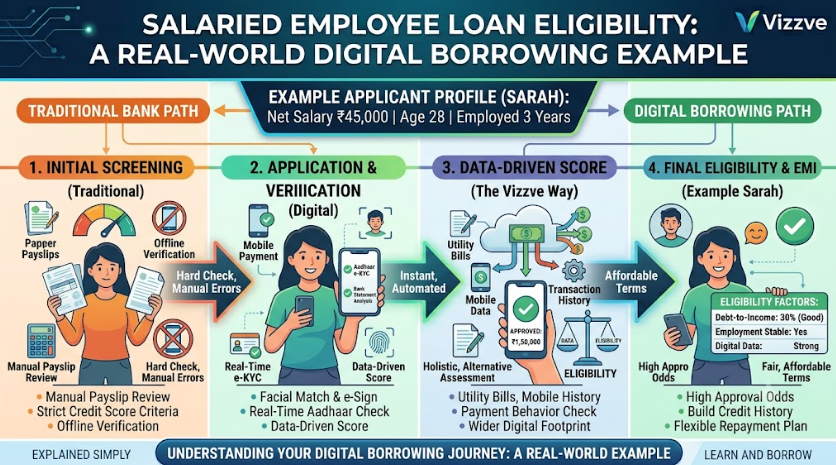
Introduction
For salaried employees, digital borrowing has made loan applications more convenient. A borrower can often submit personal and financial information through a smartphone and receive an eligibility assessment without visiting a branch.
But easy access to credit does not mean every loan offer is affordable or suitable.
Loan eligibility can depend on several factors, including income, employment, existing financial commitments, credit history, requested amount and the lender's own underwriting criteria.
This article uses a practical real-world-style example to explain how a salaried digital borrower can evaluate eligibility before applying.
Important: The example below is illustrative. The figures do not represent a guaranteed lender offer or approval.
AI Answer Box: How Is Loan Eligibility Checked for Salaried Digital Borrowers?
Short answer: A salaried digital borrower should review monthly take-home income, employment details, existing EMIs, credit history, requested loan amount, documents and repayment capacity before applying.
A simple process is:
Income → Employment → Credit History → Existing EMIs → Expenses → Loan Amount → EMI → Loan Cost → Lender Verification → Application
Meeting these conditions does not guarantee approval because every lender may use different eligibility and underwriting criteria.
What Does Loan Eligibility Mean?
Loan eligibility is an assessment of whether a borrower may qualify for a particular loan based on the lender's criteria.
For salaried employees, lenders may consider:
- Monthly income
- Employment information
- Employment stability
- Existing debt
- Credit history
- Requested loan amount
- Loan tenure
- Repayment capacity
- Age and other lender-specific requirements
There is no single formula that applies to every lender.
Real-World Example: A Salaried Digital Borrower
Let's consider a hypothetical borrower named Rahul.
Rahul is a salaried employee who wants a personal loan to manage a planned financial expense.
Rahul's profile
| Particular | Example |
|---|---|
| Monthly take-home salary | ₹50,000 |
| Existing personal-loan EMI | ₹6,000 |
| Vehicle-loan EMI | ₹4,000 |
| Household expenses | ₹23,000 |
| Other regular commitments | ₹5,000 |
| Requested loan | ₹1,00,000 |
| Proposed tenure | 18 months |
These numbers are only for illustration.
Step 1: Rahul Checks His Salary
Rahul's take-home salary is ₹50,000 per month.
Instead of looking only at his gross salary, he considers the amount actually available after regular deductions.
Why this matters
A lender may assess income as part of repayment capacity, while Rahul needs to assess his own actual cash flow.
His first question is:
"How much money do I realistically have available every month after my existing commitments?"
Step 2: Rahul Reviews His Employment
Rahul checks that his application information is accurate.
He verifies:
- Employer name
- Current job status
- Employment duration
- Salary details
- Employment type
- Salary-credit account
Real-world lesson
A borrower should never exaggerate salary or employment details to improve the chances of approval.
The information submitted should be consistent with supporting documents.
Step 3: Rahul Checks His Existing EMIs
Rahul already has:
- Personal-loan EMI: ₹6,000
- Vehicle-loan EMI: ₹4,000
Total existing EMI
₹6,000 + ₹4,000 = ₹10,000
This means ₹10,000 of his monthly income is already committed to debt repayment.
Step 4: Rahul Reviews His Monthly Expenses
Rahul estimates:
- Household expenses: ₹23,000
- Other regular commitments: ₹5,000
So his monthly outflow before the new loan is:
₹10,000 existing EMIs + ₹23,000 expenses + ₹5,000 commitments = ₹38,000
His remaining cash flow is approximately:
₹50,000 − ₹38,000 = ₹12,000
This is the amount remaining before considering additional savings or unexpected expenses.
Step 5: Rahul Decides Whether He Actually Needs ₹1 Lakh
Rahul wants to borrow ₹1,00,000.
Instead of asking:
"How much loan can I get?"
he asks:
"How much do I actually need and comfortably repay?"
This is an important distinction.
Eligibility vs need
| Question | Meaning |
|---|---|
| How much am I eligible for? | What the lender may consider |
| How much do I need? | The actual financial requirement |
| How much can I afford? | What fits comfortably into the budget |
These three amounts can be different.
Step 6: Rahul Checks His Credit History
Before applying, Rahul reviews his credit information.
He checks for:
- Missed payments
- Overdue loans
- Credit-card balances
- Existing accounts
- Recent enquiries
- Incorrect information
Does Rahul need a particular credit score?
Not necessarily.
There is no universal score that guarantees approval from every lender. Credit assessment criteria can differ between lenders.
Step 7: Rahul Estimates the New EMI
Suppose the lender provides an illustrative offer for ₹1,00,000.
The actual EMI would depend on:
- Interest rate
- Loan amount
- Tenure
- Applicable charges
Rahul should calculate the EMI before accepting the loan.
Important
He should not assume that a ₹1 lakh loan is affordable simply because he qualifies for it.
The new EMI must fit alongside his existing ₹10,000 in EMIs and his normal expenses.
Step 8: Rahul Compares Loan Costs
Rahul compares more than the advertised interest rate.
He checks:
- Interest rate
- APR
- Processing fee
- Applicable taxes
- Other disclosed charges
- EMI
- Total repayment
For applicable digital lending, RBI's regulatory framework provides for disclosure of the all-inclusive cost through the Annual Percentage Rate (APR). Reserve Bank of India
Step 9: Rahul Checks the Digital Lender
Because Rahul is applying digitally, he doesn't assume that every loan app is a lender.
RBI explains that digital lending apps can be associated with regulated entities such as banks and NBFCs or can operate as lending service providers working with regulated entities. RBI also advises borrowers to verify an app's association with an RBI-regulated bank or NBFC through the lender's website. Reserve Bank of India
Rahul checks:
- Actual lender name
- Official lender website
- Loan agreement
- Customer support
- Grievance mechanism
- Privacy policy
- Applicable charges
Step 10: Rahul Reviews Data Permissions
Digital borrowing involves personal and financial information.
Rahul checks what information the application wants to collect and why.
RBI's digital-lending framework includes requirements concerning need-based data collection, prior and explicit consent, borrower control over specific data permissions and privacy policies. Reserve Bank of India
Good practice
Rahul should:
- Read the privacy policy
- Review app permissions
- Avoid unnecessary data sharing
- Keep OTPs confidential
- Use official application channels
Step 11: Rahul Reviews the Key Facts Statement
Where applicable, Rahul checks the Key Facts Statement (KFS) before accepting the loan.
He looks at:
- Loan amount
- Interest rate
- APR
- Fees
- Tenure
- Repayment schedule
- Penal charges
- Other important conditions
The objective is simple:
Understand the loan before accepting it.
Step 12: Rahul Compares His Position Before and After the Loan
Before the new loan
| Item | Monthly Amount |
|---|---|
| Take-home salary | ₹50,000 |
| Existing EMIs | ₹10,000 |
| Household expenses | ₹23,000 |
| Other commitments | ₹5,000 |
| Remaining cash flow | ₹12,000 |
If Rahul adds a new EMI, his remaining cash flow will fall further.
What does this tell him?
It tells Rahul that loan eligibility and financial comfort are two different questions.
A lender may approve a loan, but Rahul still needs to decide whether the repayment is sensible for his personal budget.
Step 13: Rahul Prepares His Documents
Depending on the lender, Rahul may need:
- Identity/KYC documents
- Address details
- Salary slips
- Bank statements
- Employment information
- Other financial documents
Before submitting
He checks that:
- Names match
- Documents are current
- Information is accurate
- Files are readable
- Nothing has been altered
Step 14: Rahul Submits the Application
Once Rahul has checked eligibility and affordability, he can submit his application through the appropriate official channel.
He enters:
- Personal details
- Employment details
- Income information
- Requested amount
- Other required information
He reviews everything before submitting.
Step 15: Rahul Does Not Treat "Approved" as the Final Decision
Suppose Rahul receives an approval message.
He still reviews:
- Approved amount
- Interest rate
- APR
- EMI
- Tenure
- Fees
- Total repayment
- Repayment dates
- Other contractual terms
Only after understanding these terms should he decide whether to accept.
A Simple Eligibility Comparison
| Factor | Rahul's Example | What to Review |
|---|---|---|
| Salary | ₹50,000 | Stable take-home income |
| Existing EMIs | ₹10,000 | Current debt burden |
| Expenses | ₹23,000 | Essential spending |
| Other commitments | ₹5,000 | Regular obligations |
| Requested amount | ₹1,00,000 | Actual financial need |
| Credit history | To be checked | Repayment record |
| Documents | To be prepared | Accuracy and completeness |
| New EMI | Depends on offer | Monthly affordability |
| APR | To be reviewed | Overall applicable cost |
| Lender | To be verified | Actual regulated lender |
What Can Improve a Borrower's Application Readiness?
There is no guaranteed method to obtain approval, but borrowers can improve their preparation by:
1. Keeping financial information accurate
Don't inflate income or hide existing debt.
2. Reviewing credit history
Identify and resolve errors where possible.
3. Managing existing debt
A lower existing obligation can improve available cash flow.
4. Borrowing only what is needed
Avoid unnecessary debt.
5. Maintaining repayment discipline
Timely repayment helps maintain a healthier credit history.
Common Mistakes Digital Borrowers Make
Mistake 1: Looking Only at Salary
A ₹60,000 salary does not automatically mean a borrower can comfortably handle a large EMI.
Mistake 2: Ignoring Existing Loans
Existing EMIs reduce available cash flow.
Mistake 3: Choosing the Maximum Loan
Maximum eligibility is not necessarily maximum affordability.
Mistake 4: Comparing Only Interest Rates
Fees and overall cost should also be considered.
Mistake 5: Ignoring the KFS
Important loan terms can be overlooked.
Mistake 6: Not Verifying the Lender
Always identify who is actually providing the credit.
Mistake 7: Sharing Excessive Personal Data
Borrowers should understand why requested data is needed and review consent carefully.
Mistake 8: Applying Through Unknown Links
RBI advises borrowers to avoid downloading digital lending apps received through SMS or social-media links and recommends checking the association of the app with an RBI-regulated entity. Reserve Bank of India
Pros and Cons of Digital Borrowing for Salaried Employees
Pros
- Convenient application
- Smartphone-based process
- Digital document submission
- Less branch paperwork
- Easy access to loan information
- Faster application experience
Cons
- Easy access can encourage unnecessary borrowing
- Borrowers may focus on speed instead of cost
- Digital fraud risks exist
- Privacy and consent require attention
- Multiple applications can create additional credit enquiries
Expert Commentary: The Three-Question Test
Before accepting a digital personal loan, a salaried borrower should ask:
"Am I eligible?"
Check the lender's criteria.
"Can I afford it?"
Check salary, expenses and existing EMIs.
"Do I understand the cost?"
Check APR, fees, EMI, tenure and total repayment.
A responsible borrowing decision requires all three answers.
Key Takeaways
- Salary is only one part of loan eligibility.
- Existing EMIs can affect affordability.
- Credit history should be reviewed before applying.
- Borrow only the amount you actually need.
- Calculate the proposed EMI before accepting.
- Compare APR and applicable charges.
- Keep documents accurate.
- Verify the actual lender behind a digital loan application.
- Review privacy permissions carefully.
- Read the KFS where applicable.
- Read the loan agreement before acceptance.
- Approval does not automatically mean the loan is affordable.
- Plan repayment before taking the loan.
Frequently Asked Questions
1. How is loan eligibility calculated for salaried employees?
Lenders may consider income, employment, credit history, existing obligations, requested amount and other internal eligibility criteria.
2. Does a higher salary guarantee personal loan approval?
No. Salary is only one factor in the lender's assessment.
3. Can existing EMIs reduce loan eligibility?
Yes. Existing debt obligations can affect repayment capacity.
4. What is a real-world example of loan eligibility?
A borrower can compare salary, expenses, existing EMIs, credit history and the proposed new EMI to determine whether a loan is both potentially eligible and financially manageable.
5. Is a specific credit score required for every digital loan?
No. Requirements vary between lenders and loan products.
6. What documents may salaried employees need?
Depending on the lender, borrowers may need KYC, salary, employment and banking documents.
7. Should I borrow the maximum amount I am eligible for?
No. Borrow according to your actual requirement and repayment capacity.
8. What should I check before accepting a digital loan?
Check the actual lender, loan amount, interest rate, APR, fees, EMI, tenure, KFS where applicable and loan agreement.
9. What is APR in a personal loan?
APR is an annualised measure of the applicable overall credit cost and can help borrowers compare loan offers.
10. What is a Key Facts Statement?
A KFS provides important information about applicable credit terms and costs before acceptance.
11. Can I apply for a personal loan through my phone?
Many lenders provide digital application processes. The exact process depends on the lender and product.
12. How can I check whether a digital lending app is legitimate?
Check which regulated bank or NBFC the app is associated with and verify the relationship through the regulated entity's official website. Reserve Bank of India
13. Should I apply to several digital lenders?
Compare options first and apply selectively. Multiple credit applications can result in additional enquiries.
14. Is digital borrowing safe?
Digital borrowing can be convenient, but borrowers should verify the lender, review disclosures, understand data permissions and protect their personal information.
15. Does loan approval guarantee affordability?
No. Approval is based on the lender's assessment. The borrower must independently determine whether the EMI and total cost fit their budget.
Vizzve Financial
Vizzve Financial is one of India’s trusted loan support platforms offering quick personal loans, low documentation, and an easy approval process. Apply at www.vizzve.com.
Borrowers should review eligibility, loan costs, lender details and repayment obligations independently before accepting credit.
Conclusion
The best way to understand loan eligibility is to look beyond a simple "eligible/not eligible" result.
Our example shows how a salaried digital borrower can evaluate the complete picture:
Salary → Existing EMIs → Expenses → Credit history → Required amount → EMI → Loan cost → Lender verification → Agreement → Repayment plan
Digital lending can make borrowing more convenient, but convenience should never replace financial judgment.
Before accepting a personal loan, make sure the amount is genuinely needed, the repayment is affordable and the lender and loan terms are clearly understood.
Published on : 22nd October 2026
Published by : G REDDY KUMAR
www.vizzve.com || www.vizzveservices.com
Follow us on social media: Facebook || Linkedin || Instagram
🛡 Powered by Vizzve Financial
RBI-Registered Loan Partner | 10 Lakh+ Customers | ₹600 Cr+ Disbursed