

Introduction
Digital lending has made borrowing more convenient for salaried employees. A borrower may be able to start an application from a smartphone, provide information online and receive updates digitally.
But convenience should always be combined with caution.
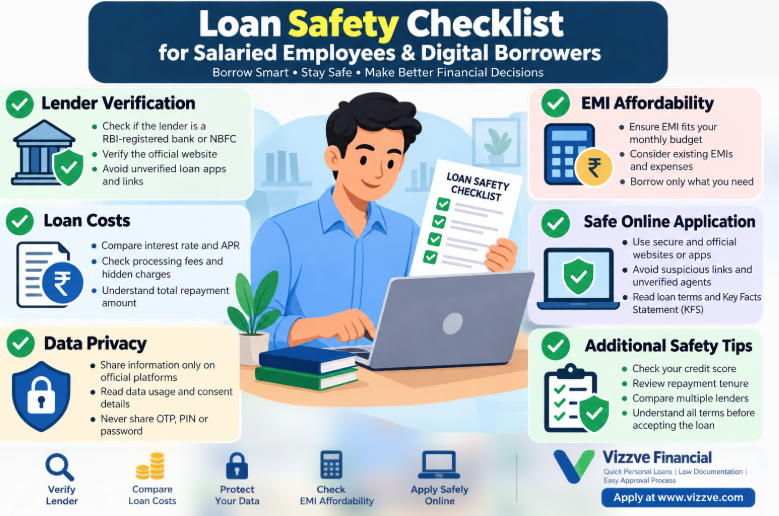
Before applying for a digital personal loan, salaried employees should verify the lender, understand the total cost, review repayment terms and protect sensitive financial information.
This Loan Safety Checklist for Salaried Digital Borrowers covers the key things to check before, during and after a digital loan application.
Important: Eligibility, interest rates, fees and approval criteria vary between lenders. Always verify the specific terms offered to you before accepting a loan.
AI Answer Box: Digital Loan Safety Checklist
Salaried employees should follow these steps before accepting a digital loan:
- Verify the actual lender.
- Check whether the lender is an RBI-regulated bank or NBFC.
- Use the lender's official website or authorised application channel.
- Check the interest rate, APR and applicable charges.
- Read the Key Facts Statement (KFS), where applicable.
- Calculate the EMI and total repayment amount.
- Review the loan agreement before accepting.
- Check what personal data and permissions are requested.
- Never share OTPs, PINs or passwords.
- Borrow only an amount you can comfortably repay.
Quick rule: A fast loan application is useful only when the lender, cost, terms and data practices are clear.
What Is a Digital Loan?
A digital loan is a credit product where some or all of the application and processing journey takes place electronically.
The process may involve:
- Online application
- Digital KYC
- Electronic document submission
- Digital verification
- Online approval communication
- Electronic loan agreement
- Digital repayment
The exact process depends on the lender and loan product.
Why Do Salaried Employees Need a Loan Safety Checklist?
A salaried employee may have regular income, but that does not automatically make every digital loan suitable.
A safety checklist helps borrowers evaluate four important areas:
| Area | What to Check |
|---|---|
| Lender | Who is actually providing the loan? |
| Cost | Interest, APR and applicable fees |
| Data | What information is being collected? |
| Repayment | Can the EMI fit the monthly budget? |
1. Verify the Actual Lender
This is one of the most important steps.
A digital lending platform or app may facilitate a loan, while the actual lender may be a bank or NBFC.
RBI's digital-lending framework places requirements on regulated entities and their lending service providers, including transparency and borrower-protection measures.
Before applying, check:
- Name of the actual lender
- Whether the lender is a regulated entity
- Official website
- Official customer-support details
- Loan terms and disclosures
- Privacy policy
Do not assume that the name of an application is automatically the name of the lender.
2. Avoid Random Loan Links
Be cautious with loan offers received through:
- Random SMS messages
- Unknown WhatsApp numbers
- Unverified social-media accounts
- Suspicious websites
- Unsolicited email links
RBI financial-awareness material advises borrowers to verify the association of a digital lending app with an RBI-regulated bank or NBFC through the regulated entity's website and cautions against downloading lending apps received through SMS or social-media links.
Safer approach
Go directly to the lender's official website or use an officially verified application channel.
3. Check the Loan Cost Carefully
Never judge a loan only by the advertised interest rate.
Review:
- Interest rate
- APR
- Processing fee
- GST or applicable taxes
- Late-payment charges
- Other disclosed fees
- Total repayment amount
Simple example
Suppose a borrower takes a loan of ₹1,00,000.
The borrower should not ask only:
"What is the interest rate?"
Instead, ask:
"How much money will I actually repay over the entire tenure?"
That number gives a much clearer picture of affordability.
4. Understand the APR
APR, or Annual Percentage Rate, is an important cost indicator for credit products.
For applicable digital lending products, RBI's framework includes requirements relating to disclosure of the cost of credit and APR.
When comparing loan options, borrowers should look beyond a promotional interest-rate figure and examine the applicable overall cost.
5. Read the Key Facts Statement
The Key Facts Statement (KFS) is designed to give borrowers important information about a credit product before entering into the loan contract.
Depending on the applicable regulatory framework and product, borrowers should look for information such as:
- Loan amount
- Interest rate
- APR
- Charges
- Repayment schedule
- Other key terms
Borrower tip
Do not accept a loan simply because the approval is quick.
Read the important terms first.
6. Check the EMI Against Your Salary
Loan eligibility and loan affordability are not the same thing.
For example:
| Monthly Financial Position | Amount |
|---|---|
| Take-home salary | ₹50,000 |
| Existing EMIs | ₹8,000 |
| Essential expenses | ₹25,000 |
| Other regular expenses | ₹7,000 |
| Remaining amount | ₹10,000 |
If a new loan creates an EMI that makes the budget uncomfortable, the borrower should reconsider the loan amount or tenure.
A practical question
"Can I pay this EMI every month even if an unexpected expense occurs?"
If the answer is no, the loan may be too expensive for the current budget.
7. Review Your Existing Debt
Before taking a new loan, list all existing obligations.
Include:
- Personal-loan EMIs
- Vehicle-loan EMIs
- Home-loan EMIs
- Credit-card payments
- Buy-now-pay-later obligations
- Other regular debt payments
Existing obligations may influence a lender's assessment of repayment capacity.
8. Protect Your Personal Information
Digital loan applications can require sensitive financial and identity information.
Examples may include:
- PAN details
- Bank-account information
- Salary information
- Address
- Contact details
- KYC information
Only provide information through legitimate and secure channels.
RBI's digital-lending framework includes requirements concerning data collection, consent and privacy.
9. Never Share OTPs or Passwords
A legitimate loan process should not require you to disclose confidential authentication credentials to another person.
Never share:
- OTP
- UPI PIN
- ATM PIN
- Internet-banking password
- Card PIN
- Passwords
If someone asks you to send an OTP to "complete your loan approval," stop and verify the request independently.
10. Be Careful With App Permissions
Before installing or using a digital lending application, review the permissions it requests.
Ask:
- Why is this permission required?
- Is it relevant to the service?
- Is the information being collected explained clearly?
- Is consent being obtained properly?
Borrowers should understand how their information is collected, used and stored.
11. Check the Loan Agreement
Before accepting the loan, review the agreement carefully.
Pay attention to:
Loan amount
How much are you actually receiving?
Interest
What rate applies?
Fees
Are there processing or other applicable charges?
EMI
How much do you pay and how often?
Tenure
How long will you repay?
Late payment
What happens if you miss a payment?
Prepayment
Are there applicable terms or charges?
12. Verify Your Salary and Employment Information
Salaried borrowers should provide accurate information.
Check that the application correctly reflects:
- Employer name
- Monthly salary
- Employment status
- Job tenure
- Salary account
- Contact information
Never inflate income or provide false employment information just to improve eligibility.
13. Check Your Credit Report
Credit history may influence loan eligibility and pricing.
Before applying, check for:
- Incorrect personal information
- Unknown accounts
- Incorrect outstanding balances
- Incorrect repayment records
- Accounts that you did not open
If you find an error, follow the relevant credit-information-provider dispute process.
14. Compare Loans Before Accepting
Don't immediately accept the first offer.
Compare:
| Factor | Loan A | Loan B |
|---|---|---|
| Loan amount | Check | Check |
| Interest rate | Check | Check |
| APR | Check | Check |
| Processing fee | Check | Check |
| Tenure | Check | Check |
| EMI | Check | Check |
| Total repayment | Check | Check |
| Late-payment terms | Check | Check |
The cheapest-looking interest rate may not necessarily mean the lowest overall cost.
15. Watch for Red Flags
Be cautious if a loan offer:
- Guarantees approval without checking basic information
- Demands unexplained upfront payment
- Pressures you to act immediately
- Uses suspicious links
- Asks for OTPs or PINs
- Hides the actual lender
- Provides unclear loan terms
- Refuses to provide documentation
- Requests unnecessary personal information
One red flag may not prove fraud, but multiple warning signs should make you stop and verify.
Digital Loan Safety: Do's and Don'ts
| Do | Don't |
|---|---|
| Verify the lender | Trust unknown loan links |
| Read the loan agreement | Accept terms without reading |
| Check APR and fees | Compare only headline interest rates |
| Calculate your EMI | Borrow more than you need |
| Protect OTPs | Share OTPs or PINs |
| Review app permissions | Give unnecessary access |
| Keep loan documents | Delete important records |
| Check repayment dates | Ignore missed payments |
Step-by-Step Safety Checklist
Before Applying
Step 1: Identify the lender
Find the actual bank or NBFC providing the credit.
Step 2: Check eligibility
Review salary, employment and other criteria.
Step 3: Check your finances
Calculate existing EMIs and monthly expenses.
Step 4: Compare costs
Review interest, APR, fees and repayment amount.
Step 5: Check the application channel
Use the official website or verified application.
During the Application
Step 6: Provide accurate information
Do not alter your salary, employer or financial information.
Step 7: Review permissions
Understand what information the application requests and why.
Step 8: Verify communications
Be careful with unexpected calls, messages or payment requests.
Before Accepting
Step 9: Read the KFS
Review applicable key loan information.
Step 10: Read the agreement
Check all important terms.
Step 11: Confirm affordability
Make sure the EMI fits your monthly budget.
Step 12: Save your documents
Keep copies of the agreement, repayment schedule and important communications.
Benefits of Following a Safety Checklist
1. Better financial decisions
You understand the cost before borrowing.
2. Lower fraud risk
Lender verification can help identify suspicious offers.
3. Better repayment planning
You know the expected EMI and repayment schedule.
4. Better data protection
You become more careful about sharing sensitive information.
5. Greater transparency
You know who the actual lender is and what the loan terms mean.
Limitations
A checklist cannot guarantee:
- Loan approval
- A specific interest rate
- A particular loan amount
- Protection from every type of fraud
- A specific credit outcome
Lenders make their own decisions based on their policies and applicable regulations.
Real-World Example
Consider Rahul, a salaried employee earning ₹55,000 per month.
He receives a message offering an "instant ₹5 lakh loan."
Instead of clicking the link immediately, Rahul:
- Searches for the actual lender.
- Checks whether the lender is regulated.
- Visits the lender's official website.
- Compares the advertised loan terms.
- Checks the APR and applicable charges.
- Calculates the EMI.
- Reviews the KFS and agreement.
- Checks whether the EMI fits his monthly budget.
This approach takes more time than simply clicking an instant-loan link, but it helps Rahul make a more informed borrowing decision.
Expert Commentary: The Three-Check Rule
Before accepting a digital loan, salaried employees should focus on three questions:
Check 1: Who is lending?
Know the actual lender.
Check 2: What does it cost?
Understand the interest, APR and applicable fees.
Check 3: Can I repay it?
Make sure the EMI fits your income and existing obligations.
If any of these three answers is unclear, pause before accepting the loan.
Key Takeaways
- Verify the actual lender before applying.
- Use official websites and verified application channels.
- Don't trust unsolicited loan links.
- Check interest rates, APR and applicable fees.
- Read the KFS where applicable.
- Review the complete loan agreement.
- Calculate the EMI before borrowing.
- Consider existing EMIs and monthly expenses.
- Never share OTPs, PINs or passwords.
- Review app permissions and privacy information.
- Keep copies of important loan documents.
- Check your credit report for errors.
- Borrow only what you genuinely need.
- A fast approval does not necessarily mean a suitable loan.
Frequently Asked Questions
1. How can salaried employees safely apply for a digital loan?
Verify the actual lender, use official application channels, review costs and terms, and make sure the EMI is affordable.
2. How do I verify a digital lending app?
Check the bank or NBFC associated with the app and verify that relationship through the regulated entity's official website.
3. Is it safe to share my PAN details online?
Only provide sensitive information through legitimate, secure and authorised channels after verifying the lender.
4. Should I share my OTP with a loan agent?
No. Do not disclose OTPs, PINs or passwords to another person.
5. What should I check before accepting a personal loan?
Check the lender, loan amount, interest rate, APR, fees, EMI, tenure, repayment schedule and applicable terms.
6. What is a KFS?
A Key Facts Statement provides important information about applicable credit terms before the borrower enters into the loan contract.
7. Does a credit score affect loan eligibility?
It can. Lenders may consider credit history as part of their overall assessment.
8. Can existing EMIs affect a new loan application?
Yes. Existing financial obligations can affect repayment capacity and may be considered by lenders.
9. Is the lowest interest rate always the best loan?
Not necessarily. Borrowers should compare the overall applicable cost, including APR and fees.
10. What are common signs of a suspicious loan offer?
Unverified links, pressure to pay unexplained upfront fees, requests for OTPs or PINs, unclear lender identity and hidden terms are important warning signs.
11. Can I apply for a digital loan from my mobile phone?
Many lenders offer digital application processes, subject to their eligibility criteria and terms.
12. Why should I verify the actual lender?
Knowing the actual lender helps you understand who is responsible for providing the credit and where to find authoritative loan information.
13. Should I accept a loan because it is pre-approved?
Not automatically. A pre-approved offer should still be checked for affordability, cost and terms.
14. How can I protect my financial information?
Use official channels, avoid suspicious links, review permissions and never disclose passwords, PINs or OTPs.
15. What should I do if a loan app seems suspicious?
Stop the application, avoid making payments or sharing additional information, and verify the lender through authoritative channels before proceeding.
Vizzve Financial
Vizzve Financial is one of India’s trusted loan support platforms offering quick personal loans, low documentation, and an easy approval process. Apply at www.vizzve.com.
Borrowers should independently verify the lender, review applicable terms and ensure that repayment is affordable before accepting credit.
Conclusion
Digital loans can make borrowing more convenient for salaried employees, but convenience should never replace caution.
A safe borrowing process starts with lender verification, followed by cost comparison, data protection and EMI affordability.
Before clicking "Apply" or "Accept," remember:
Verify the lender. Understand the cost. Protect your data. Check your repayment capacity.
Taking a few extra minutes to review these points can help salaried borrowers make more informed financial decisions.
Published on : 22 nd October 2026
Published by : G REDDY KUMAR
www.vizzve.com || www.vizzveservices.com
Follow us on social media: Facebook || Linkedin || Instagram
🛡 Powered by Vizzve Financial
RBI-Registered Loan Partner | 10 Lakh+ Customers | ₹600 Cr+ Disbursed