

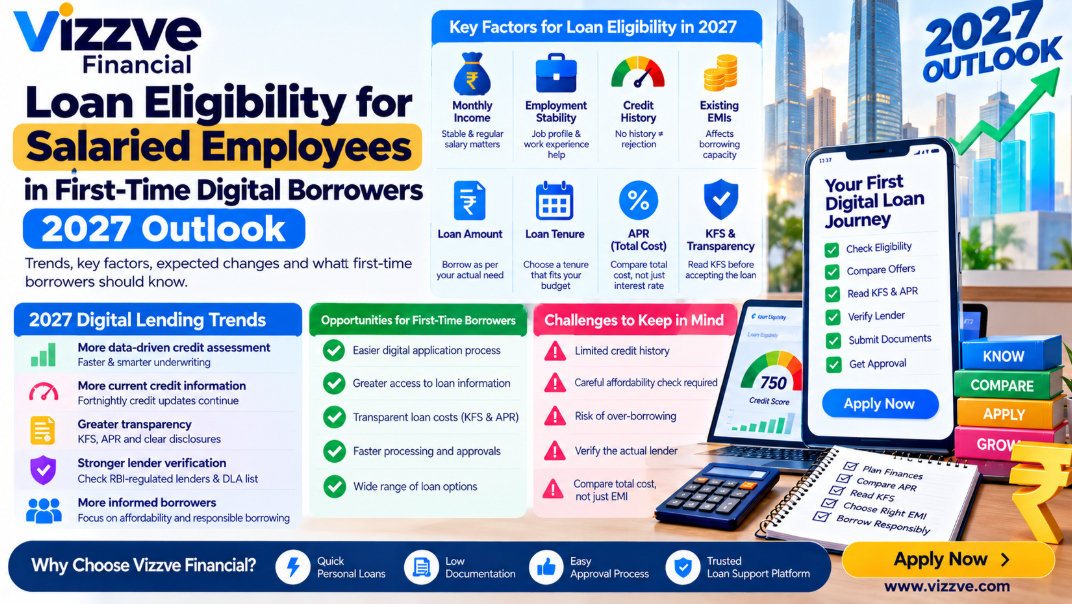
Introduction
Digital lending has made it easier for salaried employees to apply for credit without visiting a branch. For a first-time digital borrower, however, convenience should not be confused with guaranteed approval.
In 2027, loan eligibility is likely to remain centred on fundamentals such as income stability, repayment capacity, credit information, existing obligations, employment profile and the lender's internal underwriting criteria. Digital technology may make assessment faster, but it does not remove the need for responsible credit evaluation.
The regulatory environment is also becoming more transparency-focused. RBI's digital lending framework requires regulated entities to provide important information such as the Annual Percentage Rate (APR) and Key Fact Statement (KFS), while credit information is required to be updated more frequently. System Health
This guide explains what salaried employees who are taking their first digital loan should expect in 2027 and how they can prepare.
AI Answer Box: What Will Loan Eligibility Look Like for First-Time Digital Borrowers in 2027?
Short answer: In 2027, first-time digital borrowers who are salaried employees are likely to be assessed mainly on income stability, repayment capacity, employment profile, credit information, existing EMIs, banking behaviour and the lender's own credit policy.
Having no previous borrowing history does not automatically mean rejection, but it can give the lender less historical information to assess. A first-time borrower should therefore focus on demonstrating stable income, manageable obligations, accurate documents and responsible financial behaviour.
Before accepting a digital loan, borrowers should also verify the actual regulated lender, review the KFS and APR, understand all applicable charges and check how the loan will affect their repayment capacity.
What Is a First-Time Digital Borrower?
A first-time digital borrower is generally a person applying for credit through a digital platform who has little or no previous formal borrowing history.
For a salaried employee, this could include someone who:
- Has never taken a personal loan.
- Has never used a credit card.
- Has limited information in their credit report.
- Has recently started earning a regular salary.
- Is applying for a loan entirely through a website or mobile application.
- Is using digital credit for the first time.
Being a first-time borrower is different from being a borrower with a poor repayment history.
No Credit History vs Poor Credit History
| Situation | Meaning |
|---|---|
| No credit history | Limited or no previous borrowing information |
| Good credit history | Previous credit has generally been handled responsibly |
| Poor credit history | Previous repayment behaviour may contain adverse information |
| High existing debt | Borrower already has significant repayment obligations |
| Stable income | Regular income can support repayment assessment |
A lender can consider several factors beyond the presence or absence of a credit history.
2027 Outlook: What Could Change for First-Time Digital Borrowers?
The digital lending environment is likely to become increasingly data-driven and transparent.
However, faster technology does not mean automatic approval.
The following areas are especially important for 2027.
1. Digital Credit Assessment Will Become More Data-Driven
Digital lenders can process applications electronically and use multiple information points during underwriting.
For salaried employees, relevant information may include:
- Income
- Employment details
- Existing credit obligations
- Bank-account activity
- Credit information
- Requested loan amount
- Repayment capacity
- Loan tenure
- Customer-provided documents
The exact underwriting model varies by lender.
What this means for first-time borrowers
A person with no previous loan may still have a strong application if their income and financial profile demonstrate reasonable repayment capacity.
2. Credit Information Will Matter More
RBI directed credit institutions and credit information companies to update credit information on a fortnightly basis, effective January 1, 2025. The change was intended to make credit reports more current and support faster digital credit underwriting. System Health
This is important for digital borrowers because credit decisions can increasingly rely on relatively current information.
For borrowers, the lesson is simple:
Repayment behaviour matters.
A missed payment or excessive borrowing should not be treated casually simply because the loan was obtained digitally.
3. First-Time Borrowers May Face More Responsible Underwriting
A first-time borrower may not have an established repayment track record.
Therefore, lenders may place greater emphasis on other information, such as:
- Stable employment
- Regular salary
- Existing financial obligations
- Banking activity
- Identity and income verification
- Requested loan amount
- Repayment capacity
- Application information
There is no universal salary or credit-score number that guarantees approval across all lenders.
4. KFS and APR Will Remain Important
One of the most important developments for digital borrowers is the emphasis on transparent loan costs.
RBI's digital lending guidelines require regulated entities to disclose the Annual Percentage Rate (APR) and provide a Key Fact Statement (KFS) before execution of the digital lending contract. Charges not disclosed in the KFS cannot subsequently be charged by the regulated entity during the loan tenure. System Health
Why should first-time borrowers care?
Because a loan should not be judged only by its advertised interest rate.
A borrower should look at:
- Interest rate
- APR
- Processing charges
- Taxes where applicable
- Penal charges
- Repayment schedule
- Tenure
- Foreclosure/prepayment terms
- Total repayment obligation
5. Verification of Digital Loan Apps Will Become Even More Important
RBI created a public repository of Digital Lending Apps (DLAs) to help customers verify claims regarding an app's association with regulated entities. RBI has also advised customers to verify the association through the regulated bank/NBFC's website and avoid suspicious loan-app links received through SMS or social media. Reserve Bank of India
Before applying, ask:
Who is the actual lender?
An app or technology platform may facilitate the loan, but that does not necessarily mean the app itself is the regulated lender.
Key Factors Affecting Loan Eligibility in 2027
1. Monthly Income
Salary is an important factor because it determines the borrower's ability to repay.
A lender may consider:
- Monthly income
- Regularity of salary
- Employment type
- Existing financial obligations
- Requested loan amount
Important point
Higher salary does not automatically guarantee approval.
A borrower earning ₹80,000 with heavy existing EMIs may have less repayment capacity than someone earning ₹55,000 with limited obligations.
2. Employment Stability
For salaried employees, employment stability can strengthen an application.
Relevant factors may include:
- Length of current employment
- Employer profile
- Regular salary credits
- Employment continuity
- Recent job changes
Different lenders use different criteria.
3. Credit History
First-time borrowers may have limited credit history.
That is not the same as having a negative credit history.
A lender can evaluate the application using other information available under its underwriting framework.
First-time borrower checklist
- Check whether you already have a credit report.
- Verify your personal details.
- Look for incorrect accounts.
- Review outstanding obligations.
- Avoid submitting multiple unnecessary applications.
- Pay existing credit obligations on time.
4. Existing EMIs
Existing loans can directly affect affordability.
For example:
| Monthly Take-Home Salary | Existing EMIs | Possible Effect |
|---|---|---|
| ₹40,000 | ₹5,000 | Lower existing obligation |
| ₹40,000 | ₹15,000 | Higher repayment burden |
| ₹60,000 | ₹10,000 | Moderate existing obligation |
| ₹60,000 | ₹25,000 | Significantly higher obligation |
These figures are illustrative only. Actual eligibility depends on the lender's policy.
5. Loan Amount
First-time borrowers should avoid assuming that the maximum amount offered is the amount they should borrow.
Instead, ask:
How much can I comfortably repay every month?
A smaller loan with a manageable EMI may be more appropriate than borrowing the maximum available amount.
6. Loan Tenure
Tenure affects both EMI and total interest.
Shorter tenure
Advantages
- Faster repayment
- Potentially lower total interest
Disadvantages
- Higher monthly EMI
Longer tenure
Advantages
- Lower monthly EMI
Disadvantages
- Potentially higher total interest over the full tenure
The cheapest EMI is not necessarily the cheapest loan.
7. Repayment Capacity
Loan eligibility and loan affordability are not the same thing.
| Loan Eligibility | Loan Affordability |
|---|---|
| Whether lender may approve you | Whether you can comfortably repay |
| Based on lender criteria | Based on your personal budget |
| Can depend on income and credit information | Depends on income, expenses and financial goals |
| Approval does not guarantee affordability | Helps prevent over-borrowing |
A responsible borrower should consider both.
2027 Comparison: First-Time Digital Borrower vs Experienced Borrower
| Factor | First-Time Digital Borrower | Experienced Borrower |
|---|---|---|
| Credit history | May be limited | Usually more information available |
| Previous EMI behaviour | Limited evidence | Existing repayment record may be available |
| Underwriting | May rely more on available income/profile data | More historical credit data may be available |
| Digital experience | May be unfamiliar | Usually more familiar |
| KFS awareness | May need more attention | May have previous experience |
| Main risk | Accepting unsuitable terms | Over-borrowing based on past access |
| Key priority | Understand the loan completely | Compare and manage total debt |
Digital Loan Safety in 2027
RBI's digital lending framework places responsibilities on regulated entities and requires measures covering areas such as borrower disclosures, data collection and privacy. RBI's handbook also highlights need-based data collection, explicit consent and privacy requirements for digital lending. Reserve Bank of India
Before submitting personal information
Check:
- Is the lender clearly identified?
- Is the lender regulated or appropriately associated with a regulated entity?
- Is the privacy policy available?
- Is the loan cost clearly disclosed?
- Have you received the KFS?
- Is the APR disclosed?
- Are the repayment terms clear?
- Are the charges explained?
- Do you understand the data permissions being requested?
Step-by-Step: How Salaried First-Time Borrowers Can Prepare for a Digital Loan in 2027
Step 1: Calculate Your Take-Home Salary
Start with your actual monthly income rather than only your gross CTC.
Step 2: List Your Monthly Expenses
Include:
- Rent
- Food
- Utilities
- Transport
- Education
- Insurance
- Existing EMIs
- Other regular commitments
Step 3: Check Your Credit Information
Review your credit report for accuracy before applying.
Step 4: Calculate Existing Debt
Add all current EMIs and other repayment obligations.
Step 5: Decide the Required Loan Amount
Borrow according to your actual need rather than the maximum amount displayed by an app.
Step 6: Compare the Total Cost
Don't compare only the interest rate.
Review the APR and other disclosed charges.
Step 7: Read the KFS
The KFS should be reviewed before entering into the digital loan contract. RBI's framework requires important loan information, including APR, repayment-related information and grievance-redressal details, to be provided through the KFS. System Health
Step 8: Verify the Lender
Check the lender's identity and its association with the digital lending app.
Step 9: Review Data Permissions
Give only permissions that are appropriate and necessary under the applicable process.
Step 10: Apply Only When the Loan Fits Your Budget
Approval is not the same as affordability.
Documents First-Time Salaried Borrowers May Need
Requirements differ between lenders, but applicants may commonly be asked for:
- PAN
- Aadhaar or other accepted identity/address documents
- Salary slips
- Bank statements
- Employment information
- Proof of income
- Photograph/selfie where required
- Other KYC documents
Digital processes may reduce paperwork, but verification does not disappear.
Common Mistakes First-Time Digital Borrowers Should Avoid
Mistake 1: Assuming salary guarantees approval
Income is important, but lenders may evaluate multiple factors.
Mistake 2: Borrowing the maximum available amount
Maximum eligibility does not mean maximum affordability.
Mistake 3: Looking only at EMI
A low EMI can result from a longer tenure and may increase total interest.
Mistake 4: Ignoring APR
APR gives a broader view of the cost of credit.
Mistake 5: Skipping the KFS
The KFS should be treated as a key document, not routine paperwork.
Mistake 6: Applying through an unknown app
Verify the lender before sharing sensitive information.
Mistake 7: Giving unnecessary permissions
Review data permissions carefully.
Mistake 8: Taking several loans simultaneously
Multiple loans can quickly increase monthly repayment obligations.
Pros and Cons of Digital Loans for First-Time Borrowers
| Pros | Cons |
|---|---|
| Convenient application | Easy access can encourage over-borrowing |
| Faster digital processing | Terms may be overlooked |
| Less branch dependency | Scam apps can create risks |
| Digital documentation | Personal data requires careful handling |
| Easy repayment tracking | Multiple digital loans can increase debt |
| Convenient access to information | Convenience should not replace comparison |
Expert Commentary: What Should First-Time Borrowers Focus On?
From a responsible-credit perspective, the most important question is not:
“How much loan can I get?”
It is:
“How much can I comfortably repay without disturbing my monthly budget?”
A first-time borrower should build the application around affordability, transparency and lender verification.
The RBI framework reinforces this approach through requirements around APR, KFS, borrower disclosures and digital lending conduct. System Health
Real-World Experience Point
Consider a salaried employee earning ₹50,000 per month who has never taken a digital personal loan.
The borrower sees an online offer for ₹3 lakh.
Instead of immediately accepting the maximum amount, the borrower:
- Reviews monthly expenses.
- Checks existing obligations.
- Reviews credit information.
- Determines the amount actually required.
- Compares the total repayment cost.
- Reads the KFS.
- Checks the APR.
- Verifies the actual lender.
- Reviews data permissions.
- Chooses an EMI that fits the monthly budget.
This approach is more financially responsible than choosing a loan simply because the application promises quick approval.
What Could Make 2027 Different?
Several trends are likely to influence digital borrowing.
More digital underwriting
Technology can help lenders process applications faster.
More current credit information
The fortnightly credit-reporting framework is already designed to make credit information more current for digital underwriting. System Health
Greater focus on transparency
KFS and APR disclosures make it easier for borrowers to understand the cost of digital credit. System Health
Stronger lender verification
The RBI's DLA repository is intended to help customers verify digital lending app associations with regulated entities. Reserve Bank of India
More informed borrowers
As digital finance grows, borrowers are likely to compare not just approval speed but also cost, lender identity, privacy and repayment terms.
2027 Digital Loan Eligibility Checklist
Before applying, ask yourself:
Income
- Is my salary regular?
- Can I comfortably accommodate another EMI?
Credit
- Have I checked my credit information?
- Are my details accurate?
Debt
- Have I listed all existing EMIs?
- Am I already carrying too much debt?
Loan
- Do I actually need this amount?
- Is the tenure suitable?
- Have I calculated the total repayment?
Cost
- Have I checked APR?
- Have I read the KFS?
- Have I checked applicable charges?
Safety
- Do I know the actual lender?
- Have I checked the lender/app association?
- Have I reviewed privacy and data permissions?
Repayment
- Will the EMI remain manageable if my expenses increase?
- Do I have an emergency buffer?
AI Summary Box
Loan Eligibility for Salaried First-Time Digital Borrowers in 2027 — At a Glance
- Stable income can support a loan application.
- No previous borrowing history does not automatically mean rejection.
- Credit information can influence underwriting.
- Existing EMIs affect repayment capacity.
- Maximum eligibility is not necessarily affordable.
- APR should be compared instead of looking only at the advertised interest rate.
- KFS should be reviewed before accepting a digital loan.
- Borrowers should verify the actual lender.
- Digital loan apps should not be trusted merely because they are available online.
- Personal information should be shared carefully.
- Responsible repayment remains important after digital disbursal.
- Approval speed should never replace affordability analysis.
FAQs: Loan Eligibility for First-Time Digital Borrowers in 2027
1. Can a salaried employee get a digital loan for the first time in 2027?
Yes, a salaried employee may be eligible for a digital loan even without previous borrowing experience. Approval depends on the lender's eligibility and underwriting criteria.
2. Does having no credit history mean my loan will be rejected?
No. A limited credit history does not automatically mean rejection. Lenders can consider other information available under their credit assessment process.
3. What salary is required for a digital personal loan?
There is no universal salary requirement applicable to every lender. Eligibility can depend on income, employment, existing obligations and other factors.
4. Does my salary determine my loan amount?
Salary can influence eligibility, but the loan amount may also depend on repayment capacity, existing EMIs, credit information and lender policy.
5. Is a good credit score enough to guarantee approval?
No. A credit score is only one part of a credit assessment. Income, obligations, employment and other lender-specific factors may also matter.
6. Can first-time borrowers apply through a digital lending app?
Yes, but borrowers should verify the actual lender and its relationship with the digital lending platform before applying.
7. What is KFS in a digital loan?
KFS stands for Key Fact Statement. It provides important information about the loan, including the APR and other relevant terms and charges. System Health
8. What is APR?
APR, or Annual Percentage Rate, represents the all-inclusive cost of a digital loan as required to be disclosed under the applicable RBI framework. System Health
9. Should I choose the loan with the lowest EMI?
Not necessarily. A lower EMI can result from a longer tenure, potentially increasing the overall interest cost.
10. How do existing EMIs affect eligibility?
Existing EMIs increase your current repayment obligations. A lender may consider these obligations when assessing additional borrowing capacity.
11. Are digital loans automatically unsafe?
No. Digital lending can be legitimate when provided through appropriate regulated entities and compliant arrangements. However, borrowers should verify the lender and understand the terms.
12. Can digital loans affect my credit report?
Credit information relating to borrowing can be reported to credit information companies under the applicable framework. RBI has moved to more frequent credit-information reporting from January 2025. System Health
13. How can I improve my loan eligibility before applying?
Maintain stable income, manage existing debt, make repayments on time, check your credit information for errors and borrow an amount that fits your repayment capacity.
14. Should first-time borrowers take a loan just to build credit?
Not necessarily. Borrowing should be based on a genuine financial need and affordability rather than taking unnecessary debt solely to create a credit history.
15. What is the most important thing to check before accepting a digital loan?
Check the actual lender, KFS, APR, total repayment obligation, charges, repayment schedule and privacy/data terms before accepting the loan.
Internal Linking Suggestions for Vizzve
For better topical authority, consider linking this article to:
- Personal Loan Eligibility Guide
- How to Improve Your Credit Score
- How to Calculate Personal Loan EMI
- Personal Loan vs Credit Card
- Personal Loan vs Gold Loan
- Personal Loan vs Car Loan
- Personal Loan vs Bike Loan
- Digital Lending Compliance in India
- Complete RBI Digital Lending Guide
- Digital Lending and Credit Bureaus
- Digital Lending Transparency
- Loan Eligibility for Salaried Employees in 2027 — Common Mistakes
- Loan Eligibility for Salaried Employees in 2027 — Cost Breakdown
- Loan Eligibility for Salaried Employees in 2027 — Eligibility Checklist
External Linking Suggestions
Use authoritative RBI resources rather than low-quality finance websites:
- RBI Digital Lending Guidelines
- RBI Digital Lending App Repository information
- RBI Credit Information Reporting Update
- RBI Financial Awareness Messages — Digital Lending Apps
- RBI Handbook on Regulations at a Glance
- RBI Annual Report 2024–25
Key Takeaways
- First-time digital borrowers can be eligible for loans without a long borrowing history.
- Stable salary and repayment capacity remain important.
- No credit history is different from a poor credit history.
- Existing EMIs can reduce available repayment capacity.
- Do not borrow simply because a lender offers a high amount.
- Compare APR and total repayment cost, not just the advertised interest rate.
- Read the KFS before accepting a digital loan.
- Verify the actual lender behind a digital lending platform.
- Review data permissions before sharing personal information.
- Responsible repayment remains essential after approval.
- RBI's more frequent credit-information reporting makes timely and accurate credit records increasingly important. System Health
- The 2027 digital lending environment is likely to reward informed and financially disciplined borrowers.
Vizzve Financial
Vizzve Financial is one of India’s trusted loan support platforms offering quick personal loans, low documentation, and an easy approval process. Apply at www.vizzve.com.
Published on : 07th October 2026
Published by : G REDDY KUMAR
www.vizzve.com || www.vizzveservices.com
Follow us on social media: Facebook || Linkedin || Instagram
🛡 Powered by Vizzve Financial
RBI-Registered Loan Partner | 10 Lakh+ Customers | ₹600 Cr+ Disbursed