

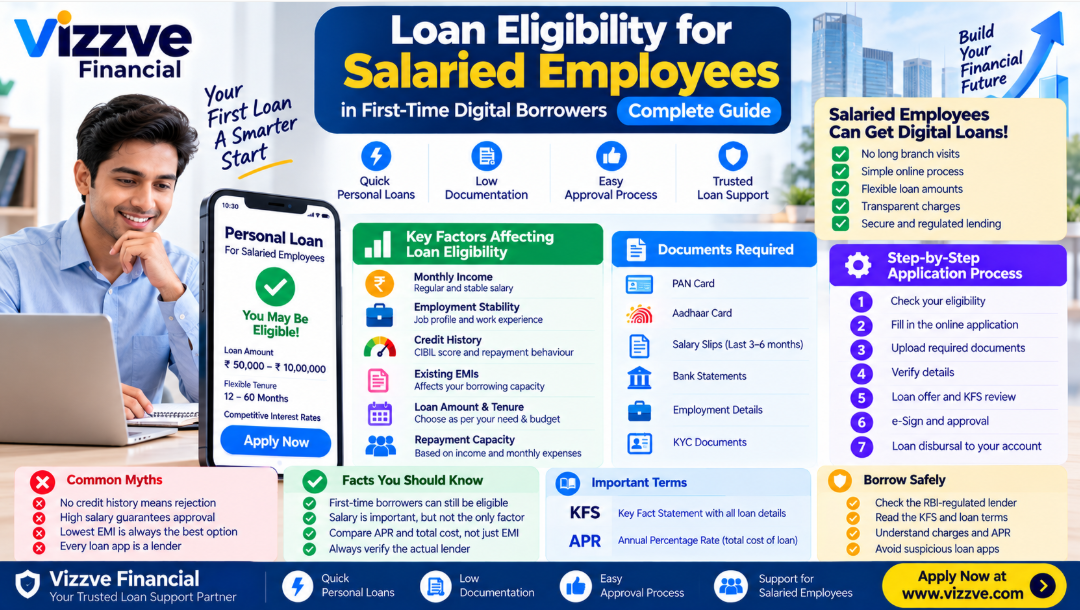
Introduction
Getting a first loan through a digital platform can be convenient, especially for salaried employees who want to avoid lengthy branch visits and paperwork. But convenience should not be confused with guaranteed approval.
For a first-time digital borrower, the lender may have limited previous repayment information. As a result, factors such as income stability, employment, existing obligations, credit information, requested loan amount and repayment capacity can become especially important.
India's digital lending ecosystem has also become more structured. RBI's framework covers digital lending through regulated entities and their lending service providers, with requirements around borrower disclosures, APR, KFS, data collection, privacy and loan servicing. System Health
RBI has also required credit information to be updated on a fortnightly basis from January 1, 2025, making credit information more current for lending decisions. System Health
This guide explains everything a salaried employee should know before applying for a first digital loan.
AI Answer Box: What Is Loan Eligibility for a First-Time Digital Borrower?
Loan eligibility for a salaried first-time digital borrower depends on several factors, including regular income, employment profile, repayment capacity, existing EMIs, credit information, requested loan amount and the lender's internal credit policy.
Having no previous loan history does not automatically mean rejection. However, first-time borrowers should pay particular attention to affordability, documentation, lender verification, KFS, APR, charges and repayment terms.
Before accepting a digital loan, borrowers should verify the actual lender and understand the complete cost of the loan.
What Is a First-Time Digital Borrower?
A first-time digital borrower is someone taking credit through a digital platform with little or no previous formal borrowing experience.
A salaried employee may fall into this category if they:
- Have never taken a personal loan.
- Have never used a credit card.
- Have limited credit information.
- Have recently started earning a salary.
- Are applying for their first online loan.
- Have previously borrowed informally but have limited formal credit history.
First-Time Borrower Does Not Mean Bad Borrower
This distinction is important.
| Situation | Meaning |
|---|---|
| No credit history | Little or no previous formal borrowing information |
| Limited credit history | Some information exists but is not extensive |
| Good credit history | Previous credit obligations generally handled responsibly |
| Poor credit history | Previous credit behaviour may contain adverse information |
| High debt burden | Existing repayments may already be significant |
A first-time borrower should not take unnecessary credit simply to create a credit history.
How Does Loan Eligibility Work for First-Time Digital Borrowers?
Lenders can use their own credit policies and underwriting models.
Generally, the application may be evaluated using factors such as:
Income
- Monthly salary
- Salary consistency
- Income documentation
- Bank-account activity
Employment
- Employment status
- Length of employment
- Employer profile
- Employment stability
Credit Information
- Existing credit accounts
- Repayment history, where available
- Outstanding balances
- Recent credit activity
Repayment Capacity
- Existing EMIs
- Regular expenses
- Requested loan amount
- Proposed tenure
Application Information
- KYC details
- Requested amount
- Loan purpose where applicable
- Supporting documents
There is no single universal formula that guarantees personal-loan approval across all lenders.
Key Factors Affecting Loan Eligibility
1. Monthly Salary
Income is one of the most important factors in assessing repayment capacity.
For example, consider two hypothetical borrowers:
| Borrower | Monthly Take-Home | Existing EMI | Situation |
|---|---|---|---|
| A | ₹45,000 | ₹5,000 | Lower existing obligation |
| B | ₹45,000 | ₹20,000 | Higher existing obligation |
Both borrowers earn the same salary, but their available repayment capacity can be very different.
Important
A higher salary does not automatically guarantee approval.
2. Employment Stability
Salaried employees with stable employment may have a more predictable income stream.
Lenders may consider information such as:
- Current employment duration
- Regular salary credits
- Employment type
- Recent job changes
- Employer information
However, each lender determines its own eligibility standards.
3. Credit History
Credit history can provide information about previous borrowing behaviour.
For someone applying for their first formal loan, there may be limited information.
That does not automatically mean the borrower cannot qualify.
Before applying
A first-time borrower should:
- Check their credit report.
- Verify their personal information.
- Check whether existing accounts are correctly reported.
- Look for incorrect outstanding balances.
- Avoid unnecessary multiple loan applications.
RBI's current credit-information framework requires more frequent updates, with reporting on a fortnightly basis from January 2025. System Health
4. Credit Score
A credit score can be an important part of a lender's assessment, but it is not the only factor.
A good score does not mean automatic approval.
Similarly, a person with limited credit history should not assume that approval is impossible.
Remember
Credit score + income + obligations + employment + lender policy = broader credit assessment
5. Existing EMIs
Existing debt can affect how much additional borrowing a borrower can comfortably manage.
Before applying, prepare a list of:
- Personal loan EMIs
- Vehicle loan EMIs
- Education loan EMIs
- Credit-card repayments
- Other regular debt obligations
Then calculate how much of your monthly income is already committed.
6. Loan Amount
One of the most common mistakes is borrowing the maximum amount offered.
Suppose a digital platform displays a high eligible amount.
That does not necessarily mean the borrower needs or can comfortably afford that amount.
Better approach
Ask:
How much do I actually need, and what EMI can I comfortably manage?
7. Loan Tenure
Tenure affects the monthly EMI and total interest cost.
| Tenure | Typical Effect |
|---|---|
| Shorter | Higher EMI, potentially lower total interest |
| Longer | Lower EMI, potentially higher total interest |
A longer tenure may make monthly payments easier, but the borrower should compare the overall repayment cost.
8. Repayment Capacity
Eligibility and affordability are different.
| Loan Eligibility | Loan Affordability |
|---|---|
| Whether a lender may approve the application | Whether you can comfortably repay |
| Based on lender criteria | Based on your personal financial position |
| Can include income and credit information | Includes expenses and financial commitments |
| Does not guarantee financial comfort | Helps prevent excessive borrowing |
A responsible borrower should consider both.
How Does Being a First-Time Borrower Affect Digital Loan Eligibility?
A first-time borrower may have less historical credit information available.
Therefore, other parts of the application can become more important.
A strong application may include:
- Stable salary
- Consistent employment
- Accurate KYC
- Reasonable loan amount
- Manageable existing obligations
- Complete documentation
- Clear repayment plan
What first-time borrowers should not assume
❌ No credit history = automatic rejection
❌ High salary = guaranteed approval
❌ Instant approval = best loan
❌ Maximum eligible amount = recommended borrowing
❌ Lowest EMI = lowest total cost
First-Time Digital Borrower vs Experienced Borrower
| Factor | First-Time Borrower | Experienced Borrower |
|---|---|---|
| Previous credit history | Limited or unavailable | More information may be available |
| Repayment track record | Limited | May be established |
| Credit assessment | More reliance on available application data | More historical data may be available |
| Digital loan experience | Limited | Usually more familiar |
| KFS awareness | May require more attention | May have previous experience |
| Main priority | Understand the loan | Compare and manage total debt |
What Documents Are Required for a Digital Personal Loan?
Exact requirements vary by lender, but salaried applicants may be asked for:
- PAN
- Aadhaar or other accepted KYC documents
- Salary slips
- Bank statements
- Employment information
- Proof of income
- Address information
- Other supporting documents where required
Digital lending can reduce physical paperwork, but verification requirements do not disappear.
Step-by-Step Guide for First-Time Digital Borrowers
Step 1: Calculate Your Take-Home Salary
Use your actual monthly take-home income when planning affordability.
Do not rely only on annual CTC.
Step 2: Calculate Monthly Expenses
Include:
- Rent
- Food
- Transport
- Utilities
- Insurance
- Education
- Existing EMIs
- Other regular commitments
Step 3: Check Your Credit Information
Review your credit report before submitting a loan application.
Check for:
- Incorrect personal details
- Unknown accounts
- Incorrect balances
- Incorrect repayment status
Step 4: Calculate Existing Debt
Write down every current EMI.
This gives you a clearer picture of your actual borrowing capacity.
Step 5: Decide the Required Loan Amount
Borrow according to your financial requirement rather than the maximum amount shown online.
Step 6: Compare Loan Offers
Don't compare only the headline interest rate.
Review:
- APR
- Processing fees
- Other applicable charges
- Tenure
- EMI
- Total repayment
Step 7: Read the KFS
The Key Fact Statement (KFS) is an important document.
RBI requires regulated entities to provide the KFS before execution of the digital lending contract, including information on the APR and other important terms. System Health
Step 8: Verify the Lender
Find out who is actually providing the loan.
A digital app can operate as a lending interface or service provider without itself being the regulated lender.
RBI has established a public repository of digital lending apps to help customers verify claims of association with regulated entities. Reserve Bank of India
Step 9: Review Data Permissions
RBI's digital lending framework requires need-based data collection and prior explicit consent, along with privacy-related requirements. Reserve Bank of India
Review permissions before accepting them.
Step 10: Accept Only an Affordable Loan
Approval does not mean that the loan is suitable for your budget.
What Is KFS and Why Is It Important?
KFS means Key Fact Statement.
It provides important information about the loan in a standardised format.
For digital lending, the RBI framework requires disclosure of the Annual Percentage Rate (APR) and KFS before execution of the contract. System Health
Check the KFS for:
- Loan amount
- Tenure
- APR
- Repayment schedule
- Charges
- Penal charges
- Other important terms
- Grievance-redress information
Simple rule
Do not accept a digital loan that you do not fully understand.
What Is APR?
APR stands for Annual Percentage Rate.
It provides an all-inclusive measure of the cost of a digital loan as required under the applicable RBI framework.
This makes APR particularly useful when comparing loan offers.
Example
Suppose:
- Loan A advertises a lower interest rate but has significant disclosed charges.
- Loan B has a slightly higher rate but a lower overall cost.
Looking only at the headline interest rate could lead to the wrong comparison.
Always review the complete cost.
Digital Lending Safety for First-Time Borrowers
RBI's financial-awareness material advises customers to check whether a digital lending app is associated with an RBI-regulated bank or NBFC through the regulated entity's website. It also advises avoiding loan apps received through links in SMS or social media. Reserve Bank of India
Before applying, check:
- Who is the actual lender?
- Is the lender regulated?
- Is the lender/app relationship clearly disclosed?
- Is the KFS available?
- Is APR disclosed?
- Are charges explained?
- Is the privacy policy available?
- Are data permissions understandable?
- Is customer support available?
- Is grievance-redress information provided?
Avoid
- Unknown loan links received through messages
- Apps making unrealistic promises
- Requests for unnecessary personal information
- Loans with unclear charges
- Pressure to accept immediately
How RBI's Digital Lending Framework Helps Borrowers
RBI's digital lending guidelines cover several borrower-protection areas.
These include:
Loan disbursal and repayment
Digital loan servicing and repayment are required to follow specified arrangements involving the regulated entity rather than inappropriate third-party pass-through accounts. System Health
APR disclosure
The all-inclusive cost of a digital loan must be disclosed upfront. System Health
KFS
The borrower must receive the KFS before execution of the digital lending contract. System Health
Data privacy
Digital lending arrangements include requirements around need-based data collection, consent and privacy. Reserve Bank of India
Lender verification
RBI's DLA repository is designed to help customers verify app associations with regulated entities. Reserve Bank of India
2025–2027 Digital Lending Developments to Watch
The regulatory direction provides useful clues for the future of digital borrowing.
More transparent digital loan comparisons
RBI's 2025 digital lending framework includes requirements around displaying available loan offers with information such as the regulated entity, loan amount, APR, tenor and associated terms, while addressing the use of dark patterns. Reserve Bank of India
More current credit information
Fortnightly credit-information updates became effective January 1, 2025. System Health
Greater use of digital infrastructure
RBI reported that its Unified Lending Interface (ULI) had 44 lenders using more than 60 data services across 12 loan journeys as of March 31, 2025, with plans to expand its scope. Reserve Bank of India
This points toward a lending ecosystem where digital data and standardised interfaces may increasingly support credit assessment.
What Could Loan Eligibility Look Like in the Future?
The future of digital loan eligibility is likely to involve:
Faster assessment
Technology can reduce manual processing and improve turnaround times.
More data-driven underwriting
Digital lenders may use more structured financial information to assess applications.
Greater transparency
KFS, APR and loan-offer disclosures can help borrowers compare products.
Stronger lender verification
Borrowers will have more tools to identify legitimate digital lending relationships.
Greater importance of financial behaviour
As credit information becomes more current, responsible repayment behaviour remains important.
Common Mistakes First-Time Digital Borrowers Should Avoid
Mistake 1: Applying without checking affordability
A loan should fit the monthly budget.
Mistake 2: Borrowing the maximum amount
The maximum amount available may be much more than the amount actually needed.
Mistake 3: Looking only at EMI
A lower EMI can come from a longer tenure.
Mistake 4: Comparing only interest rates
APR and total repayment cost matter.
Mistake 5: Ignoring the KFS
The KFS is a key document, not just routine paperwork.
Mistake 6: Assuming every app is a lender
Always identify the actual regulated entity.
Mistake 7: Sharing unnecessary data
Review app permissions and privacy terms.
Mistake 8: Applying to many lenders unnecessarily
Multiple applications can create unnecessary credit enquiries depending on the lender and reporting process.
Mistake 9: Taking a loan solely to build credit
Do not take unnecessary debt for the purpose of creating a credit history.
Mistake 10: Assuming approval means affordability
A lender's approval decision is not a substitute for your personal budget.
Eligibility vs Affordability: An Important Difference
| Question | Eligibility | Affordability |
|---|---|---|
| Who determines it? | Lender | Borrower |
| Main focus | Credit assessment | Personal budget |
| Income | Important | Important |
| Existing EMIs | Important | Very important |
| Expenses | May be considered | Central to decision |
| Maximum loan | May be offered | May not be suitable |
| Goal | Approval | Sustainable repayment |
The best borrowing decision considers both.
Pros and Cons of Digital Loans for First-Time Borrowers
Pros
- Convenient application
- Less dependence on physical branches
- Digital documentation
- Faster processing in many cases
- Easy access to loan information
- Electronic repayment options
Cons
- Easy access can encourage over-borrowing
- Some borrowers may overlook loan terms
- Fraudulent apps can create risks
- Personal-data handling requires attention
- Multiple digital loans can increase repayment pressure
- Quick approval may encourage impulsive borrowing
Expert Commentary
A first-time borrower should think about a digital loan in three stages:
Before borrowing
Can I afford it?
During the application
Do I understand the lender, cost and terms?
After borrowing
Can I repay every instalment on time?
This three-stage approach is more useful than focusing only on approval speed.
RBI's regulatory approach also increasingly combines digital innovation with consumer protection, transparency, data safeguards and responsible lending. Reserve Bank of India
Real-World Experience Point
Consider a salaried employee earning ₹50,000 per month who wants a first digital personal loan.
The borrower receives an online offer for ₹2.5 lakh.
Instead of immediately accepting it, the borrower:
- Checks monthly take-home income.
- Lists rent and household expenses.
- Reviews existing financial commitments.
- Checks credit information.
- Decides how much money is actually required.
- Compares available loan offers.
- Reviews APR.
- Reads the KFS.
- Verifies the lender.
- Checks data permissions.
- Chooses an EMI that fits the budget.
The key lesson is simple:
A convenient loan is useful only when the repayment is also manageable.
First-Time Digital Loan Checklist
Income
- Stable monthly salary
- Regular salary credits
- Income documents available
Employment
- Employment details updated
- Current employer information accurate
- Employment history available if required
Credit
- Credit report checked
- Personal details accurate
- No unexplained accounts
- Existing obligations verified
Loan
- Actual amount required calculated
- EMI estimated
- Tenure compared
- Total repayment considered
Cost
- Interest rate checked
- APR checked
- KFS read
- Processing and other applicable charges understood
Safety
- Actual lender verified
- App/lender association checked
- Privacy policy reviewed
- Data permissions reviewed
Repayment
- EMI fits monthly budget
- Emergency buffer considered
- Repayment dates understood
AI Summary Box: First-Time Digital Borrower Guide
A salaried employee can potentially qualify for a digital loan even without previous borrowing history. Loan eligibility depends on the lender's assessment of factors such as income, employment, credit information, existing obligations, requested loan amount and repayment capacity.
Before accepting a digital loan, check the lender, KFS, APR, total repayment cost, charges, privacy terms and EMI affordability.
Do not assume that instant approval, a high eligible amount or a low EMI automatically means the loan is suitable.
FAQs
1. Can salaried employees get a digital loan for the first time?
Yes. Salaried employees may apply for digital loans even without previous borrowing history, subject to the lender's eligibility criteria and credit assessment.
2. Does no credit history mean automatic rejection?
No. Limited or no credit history does not automatically mean rejection. Lenders can consider other information available under their underwriting process.
3. What salary is needed for a digital personal loan?
There is no single salary requirement applicable to all lenders. Income requirements vary according to lender policy, loan amount and other eligibility factors.
4. Can I get a personal loan without previous borrowing history?
Potentially, yes. A lender may assess income, employment, repayment capacity and other available information when considering a first-time borrower.
5. Does a good credit score guarantee personal loan approval?
No. A credit score is only one part of the overall credit assessment.
6. How do existing EMIs affect loan eligibility?
Existing EMIs increase your current repayment obligations and can affect the amount of additional debt you can reasonably manage.
7. What documents do salaried employees need for digital loans?
Depending on the lender, documents can include KYC documents, PAN, income proof, salary slips, bank statements and employment information.
8. What is KFS in a digital loan?
KFS stands for Key Fact Statement. It provides important information about the loan, including the APR and other key terms and charges. RBI requires regulated entities to provide it before execution of the digital lending contract. System Health
9. What does APR mean in a personal loan?
APR means Annual Percentage Rate. It represents the all-inclusive cost of a digital loan under the applicable RBI framework.
10. Should I choose the loan with the lowest EMI?
Not necessarily. A lower EMI can result from a longer tenure and may lead to higher total interest over the life of the loan.
11. How can I verify a digital lending app?
Check the regulated lender's website and use the RBI's available DLA-repository information to verify the claimed association. RBI also advises avoiding suspicious loan-app links received through SMS or social media. Reserve Bank of India
12. Can a digital loan affect my credit report?
Yes. Credit information relating to loans can be reported to credit information companies under the applicable framework. RBI introduced fortnightly credit-information updating from January 1, 2025. System Health
13. Should I take a loan to build my credit history?
Not necessarily. Borrow only when there is a genuine financial need and the repayment is affordable.
14. Is digital lending safe?
Digital lending can be legitimate when it operates through appropriate regulated entities and compliant arrangements. Borrowers should verify the lender and carefully review loan terms.
15. What is the most important thing to check before accepting a digital loan?
Check the actual lender, KFS, APR, total repayment cost, charges, repayment schedule and data/privacy terms.
Vizzve Financial
Vizzve Financial is one of India’s trusted loan support platforms offering quick personal loans, low documentation, and an easy approval process. Apply at www.vizzve.com.
Published on : 07th October 2026
Published by : G REDDY KUMAR
www.vizzve.com || www.vizzveservices.com
Follow us on social media: Facebook || Linkedin || Instagram
🛡 Powered by Vizzve Financial
RBI-Registered Loan Partner | 10 Lakh+ Customers | ₹600 Cr+ Disbursed