

Introduction
Getting a first digital loan can be convenient, especially for a salaried employee who needs funds for an unexpected expense. But checking only the approved loan amount or advertised interest rate can give an incomplete picture.
The actual cost of borrowing may include interest, processing charges, applicable taxes, insurance where applicable, late-payment charges and other disclosed costs.
For first-time digital borrowers, the safest approach is simple: understand the total repayment obligation before accepting the loan.
The Reserve Bank of India (RBI) has established digital-lending requirements covering areas such as disclosure of the Annual Percentage Rate (APR), borrower consent for data collection, direct loan servicing and repayment to the regulated lender, and customer protection. System Health
This guide explains the cost breakdown in straightforward language so salaried employees can compare loan offers more confidently.
AI Answer Box: What Does a Digital Loan Really Cost?
A digital loan can cost more than its advertised interest rate.
For a first-time digital borrower, the total cost may consist of:
- Principal amount borrowed
- Interest
- Processing fee
- Applicable taxes such as GST on taxable charges
- Documentation or verification charges, if applicable and disclosed
- Insurance or other optional products, if separately selected
- Late-payment or penal charges if repayment is delayed
- Foreclosure or prepayment-related charges, where applicable under the loan terms
The APR is particularly useful for comparison because RBI's digital-lending framework defines APR as an effective annualised cost based on the all-inclusive cost of the digital loan, excluding contingent charges such as certain penal or late-payment charges. System Health
Simple rule: Don't compare loans using the interest rate alone. Compare the APR, total repayment, fees, tenure and EMI.
What Is Loan Cost Breakdown?
A loan cost breakdown shows where your money goes from the time the loan is approved until it is completely repaid.
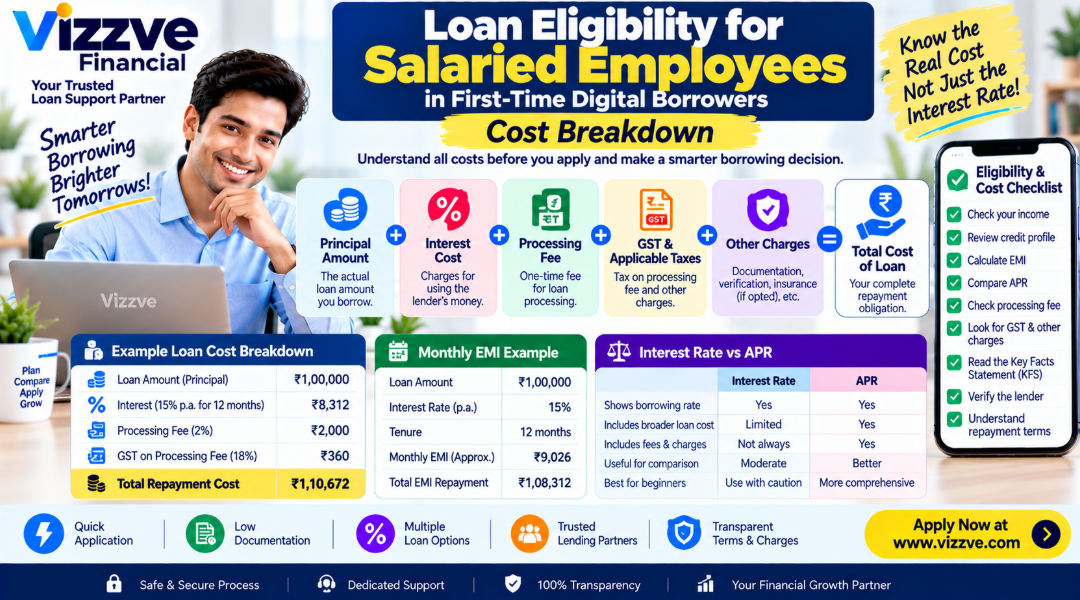
For example, suppose a salaried employee applies for a personal loan of ₹1,00,000.
The borrower may need to consider:
| Cost Component | What It Means |
|---|---|
| Principal | Amount actually borrowed |
| Interest | Cost charged for using the lender's money |
| Processing fee | Fee charged for processing the loan, if applicable |
| GST/taxes | Applicable tax on taxable fees/services |
| EMI | Periodic repayment of principal + interest |
| Late charges | May apply if repayment is overdue |
| Other charges | Only where applicable and disclosed |
| Total repayment | Overall amount paid over the loan tenure |
The exact charges depend on the lender, product, borrower profile and loan agreement.
Why First-Time Digital Borrowers Should Understand Loan Costs
A first-time borrower may focus mainly on three questions:
- How much can I get?
- What is the interest rate?
- How quickly will I receive the money?
Those are important, but they are not enough.
You should also ask:
- What is the APR?
- What is the processing fee?
- Is GST applicable to the fee?
- What is the total repayment amount?
- What is the EMI?
- What happens if I miss an EMI?
- Are there any prepayment or foreclosure charges?
- Who is the actual regulated lender?
- Where can I find the Key Facts Statement (KFS)?
RBI's framework emphasizes transparent disclosure of loan costs and customer protection in digital lending. System Health
Major Components of a Digital Loan Cost
1. Principal Amount
The principal is the amount you borrow.
For example:
Loan amount = ₹1,00,000
This does not necessarily mean you will receive exactly ₹1,00,000 in every situation because certain permitted and disclosed charges may affect the net amount received.
Always check the sanction information and KFS before accepting the loan.
2. Interest Cost
Interest is the primary cost of borrowing.
The interest rate may be quoted as an annual percentage rate, but the actual repayment depends on:
- Loan amount
- Interest rate
- Loan tenure
- Repayment method
- Existing obligations
- Lender's pricing policy
Two loans with the same principal can have very different total costs if their rates or tenures differ.
3. Processing Fee
A lender may charge a processing fee for evaluating and processing a loan application.
For example, if:
Loan amount = ₹1,00,000
and a hypothetical processing fee is:
2% = ₹2,000
then applicable taxes on that fee may need to be considered separately.
The exact fee must be checked in the lender's disclosed terms rather than assumed.
Important Point
Don't automatically choose the loan with the lowest advertised interest rate. A loan with a slightly higher rate but lower overall charges could potentially have a more suitable total cost.
4. GST and Applicable Taxes
Taxes can apply to certain fees and services associated with lending.
For example, if a taxable processing fee is ₹2,000 and an applicable GST rate is 18%, the tax on that fee would be:
₹2,000 × 18% = ₹360
So the fee plus tax would be:
₹2,000 + ₹360 = ₹2,360
This is only an illustration. The actual tax treatment and amount should be confirmed from the lender's current documentation and applicable tax rules.
5. EMI Cost
EMI stands for Equated Monthly Instalment.
It normally contains:
- Principal repayment
- Interest repayment
The EMI depends on the loan amount, interest rate and tenure.
Example
Consider a hypothetical loan:
| Particular | Example |
|---|---|
| Loan amount | ₹1,00,000 |
| Interest rate | 15% p.a. |
| Tenure | 12 months |
| Approx. EMI | ₹9,026 |
| Approx. total EMI repayment | ₹1,08,312 |
| Approx. interest | ₹8,312 |
These figures are illustrative and rounded. Actual EMI calculations can vary according to the lender's methodology, dates and terms.
6. Late-Payment Charges
Missing an EMI can result in additional charges according to the loan agreement.
A borrower should therefore check:
- Due date
- Grace period, if any
- Penal charges
- Late-payment charges
- Consequences of repeated missed payments
- Credit-reporting implications
A first-time borrower should ideally set up a repayment reminder or automatic payment mechanism where appropriate.
7. Prepayment and Foreclosure Charges
Some borrowers repay their loans early to reduce future interest.
However, whether prepayment or foreclosure charges apply depends on the specific loan product and applicable rules.
Before accepting a loan, check:
"Can I repay this loan early, and what charges will apply?"
Never assume early repayment is automatically free.
8. Insurance and Optional Products
Some loan offers may present additional products or services.
Don't assume that every add-on is compulsory.
Before accepting any insurance or optional service, check:
- Is it mandatory?
- What does it cover?
- What is the premium?
- Is it included in the loan?
- Does it increase the total repayment?
- Can you decline it?
Only accept products you understand and actually need.
APR vs Interest Rate: What Should Borrowers Compare?
This is one of the most important concepts for first-time digital borrowers.
| Feature | Interest Rate | APR |
|---|---|---|
| Shows borrowing rate | Yes | Yes |
| Reflects broader loan cost | Limited | Better |
| Useful for comparing offers | Yes | Very useful |
| Includes certain applicable charges | Not necessarily | Designed to reflect all-inclusive cost under the applicable framework |
| Best for beginners | Useful | More comprehensive |
RBI's digital-lending framework defines APR as an effective annualised rate based on the all-inclusive cost and margin of the digital loan, while contingent charges such as certain late-payment charges are excluded. System Health
What Is a Key Facts Statement?
A Key Facts Statement (KFS) is designed to make important loan information easier for borrowers to understand before entering into a credit agreement.
It can help you review:
- Loan amount
- Interest rate
- APR
- Tenure
- Repayment schedule
- Fees
- Charges
- Other important terms
RBI's regulatory framework has emphasized KFS and transparent loan-cost disclosures to help borrowers make informed decisions. Reserve Bank of India
Expert Tip
Don't accept a digital loan just because the app shows "approved."
Open the loan offer and carefully review the KFS and agreement before giving final consent.
Sample Cost Breakdown for a First-Time Borrower
Consider this hypothetical example:
Loan Details
- Principal: ₹1,00,000
- Tenure: 12 months
- Interest rate: 15% p.a.
- Approximate EMI: ₹9,026
- Approximate total EMI repayment: ₹1,08,312
Now suppose the disclosed processing fee is ₹2,000 plus applicable GST.
| Component | Example Amount |
|---|---|
| Principal | ₹1,00,000 |
| Approx. interest | ₹8,312 |
| Processing fee | ₹2,000 |
| Illustrative GST on fee | ₹360 |
| Approx. total cash outflow | ₹1,10,672 |
Important: This is only an educational example, not a quote or guaranteed loan offer. Actual lender charges, taxes, EMI calculations and other terms can differ.
Loan Amount vs Amount Received
A common mistake is confusing the sanctioned loan amount with the net amount received.
For example:
Sanctioned amount: ₹1,00,000
If a permitted fee is deducted at disbursement, the amount credited could be lower depending on the product and agreement.
Therefore, always check:
Loan sanctioned → Charges → Net amount received → Total repayment
This four-step calculation gives you a much clearer picture of the borrowing cost.
Cost Comparison: Short Tenure vs Long Tenure
Loan tenure has a major effect on total interest.
| Factor | Short Tenure | Long Tenure |
|---|---|---|
| EMI | Higher | Lower |
| Total interest | Usually lower | Usually higher |
| Repayment period | Shorter | Longer |
| Monthly cash-flow pressure | Higher | Lower |
| Overall cost | Often lower | Often higher |
Which Is Better?
There is no universal answer.
A shorter tenure may reduce total interest but increase monthly financial pressure.
A longer tenure can make EMI more manageable but may increase total interest.
Choose a tenure that fits your income and monthly budget.
How Salaried Employees Can Estimate Loan Affordability
Before applying, calculate your monthly financial commitments.
Monthly Income
Example:
Net salary = ₹40,000
Existing Commitments
- Rent: ₹10,000
- Existing EMI: ₹5,000
- Household expenses: ₹12,000
- Other essential expenses: ₹5,000
Remaining amount:
₹40,000 − ₹32,000 = ₹8,000
A new EMI significantly above your available monthly surplus may create financial pressure.
Practical Rule
Don't borrow the maximum amount simply because you qualify for it.
Borrow based on what you can comfortably repay.
Digital Loan Cost Checklist
Before accepting an online loan, check these items:
Eligibility
- Age requirement
- Minimum income
- Employment stability
- Location eligibility
- Credit profile
- Existing liabilities
Cost
- Interest rate
- APR
- Processing fee
- Applicable taxes
- Documentation/verification charges, if any
- Insurance or add-on products
- Late-payment charges
- Prepayment/foreclosure terms
Safety
- Actual lender identified
- KFS available
- Loan agreement available
- Privacy policy available
- Consent requested appropriately
- Official repayment channel verified
RBI's digital-lending framework requires regulated entities to maintain customer-protection and data-privacy safeguards, including consent-based data collection and appropriate disclosure. System Health
Step-by-Step: How First-Time Borrowers Can Compare Loan Costs
Step 1: Calculate Your Required Amount
Don't apply for more than you need.
If your requirement is ₹80,000, avoid borrowing ₹2 lakh simply because the system displays a higher eligibility amount.
Step 2: Check Your Monthly Budget
Calculate:
Income − essential expenses − existing EMIs = available surplus
Then evaluate whether the proposed EMI is manageable.
Step 3: Compare APR
Don't stop at the advertised interest rate.
Compare the APR and disclosed fees.
Step 4: Read the KFS
Review the loan's key facts before accepting.
Step 5: Check the Total Repayment
Ask:
"How much will I repay in total by the end of the loan?"
Step 6: Verify the Lender
RBI has highlighted the problem of apps falsely claiming association with regulated entities and has moved toward a public repository of digital lending apps to help customers verify such claims. Reserve Bank of India
Step 7: Read the Agreement
Don't accept terms you haven't reviewed.
Step 8: Save the Documents
Keep copies of:
- KFS
- Sanction letter
- Loan agreement
- Repayment schedule
- Payment receipts
- Customer-support details
Pros and Cons of Digital Loans for First-Time Borrowers
Pros
- Convenient online application
- Faster document submission
- Digital KYC may reduce paperwork
- Easy access to loan information
- Multiple loan offers may be available through some platforms
- Convenient digital repayment
Cons
- Easy access can encourage unnecessary borrowing
- Different lenders may have different pricing
- Processing and other charges can increase total cost
- Late repayment can create additional financial pressure
- Fraudulent apps can create security risks
- First-time borrowers may overlook APR or KFS
Common Costly Mistakes to Avoid
Mistake 1: Looking Only at the Interest Rate
A lower rate doesn't automatically mean the lowest total cost.
Mistake 2: Ignoring Processing Fees
A fee can materially change the overall cost, particularly for smaller loans.
Mistake 3: Choosing a Long Tenure Only Because EMI Is Lower
A lower EMI can come with a higher total interest cost.
Mistake 4: Borrowing More Than Necessary
Higher principal generally means a larger repayment obligation.
Mistake 5: Skipping the KFS
The KFS is one of the most useful documents for understanding the loan before acceptance.
Mistake 6: Sharing OTPs or PINs
Never share sensitive banking credentials or OTPs with someone claiming to arrange loan approval.
Mistake 7: Paying an Unverified Agent
Use official lender/platform channels and verify the recipient before making any payment.
How to Identify a Safer Digital Loan Process
Look for:
- Clearly identified regulated lender
- Transparent loan terms
- Clear APR disclosure
- KFS
- Privacy policy
- Appropriate consent mechanisms
- Official customer-support channels
- Direct and identifiable repayment instructions
RBI's digital-lending framework states that loan servicing and repayment should be executed directly between the borrower and the regulated entity's bank account rather than through a third-party pass-through or pool account. System Health
Vizzve Financial: Digital Loan Support
Vizzve Financial provides a digital platform connecting customers with loan options from banks and NBFCs. Its website describes a process involving online application, financial-profile assessment and lender offers. Vizzve Financial
Important: Loan approval, interest rate, amount, tenure and other terms depend on the applicable lender and borrower profile. Always review the lender's KFS and agreement before accepting an offer.
Vizzve also advises customers not to pay representatives in cash or into personal accounts and warns against unauthorized websites, apps and individuals. Vizzve Financial
Key Takeaways
- The cost of a digital loan is more than the headline interest rate.
- First-time borrowers should compare APR, fees, EMI and total repayment.
- Processing fees and applicable taxes should be considered.
- A lower EMI does not always mean a cheaper loan.
- Borrow only what you genuinely need.
- Read the KFS before accepting a digital loan.
- Verify the actual lender and official repayment channel.
- Never share OTPs, PINs or passwords.
- Keep copies of all loan documents.
- Choose repayment terms that comfortably fit your monthly income.
Frequently Asked Questions
1. What is the main cost of a digital loan?
The main cost is usually interest, but processing fees, applicable taxes and other disclosed charges can also affect the total borrowing cost.
2. What is APR in a digital loan?
APR is an effective annualised measure of the cost of a digital loan based on the applicable all-inclusive cost framework. System Health
3. Is the interest rate the same as APR?
No. The interest rate represents the borrowing rate, while APR is designed to reflect a broader annualised cost of credit.
4. Do first-time digital borrowers need a credit history?
Not necessarily. Eligibility depends on the lender's underwriting policy and other factors such as income, employment, repayment capacity and available financial information.
5. Does a higher salary guarantee loan approval?
No. Salary is only one factor. Lenders may consider employment stability, existing obligations, credit information and other eligibility criteria.
6. What documents may salaried employees need?
Depending on the lender, documents can include identity/KYC documents, salary information, bank statements and employment-related information.
7. What is a KFS?
A Key Facts Statement provides important loan information in a standardized, easier-to-understand format to help borrowers make informed decisions. Reserve Bank of India
8. Can processing fees increase the loan cost?
Yes. A processing fee and applicable taxes can increase the overall cost of borrowing.
9. Is a longer loan tenure cheaper?
Not necessarily. A longer tenure can reduce the EMI but may increase the total interest paid over the life of the loan.
10. Can I repay my digital loan early?
Possibly, depending on the product and applicable terms. Check the loan agreement for prepayment or foreclosure provisions.
11. Should I choose a loan with the lowest interest rate?
Not based on the interest rate alone. Compare APR, processing charges, tenure, EMI and total repayment.
12. Are digital loans safe?
Digital lending can be safe when using legitimate platforms connected to regulated lenders and when borrowers verify the lender, understand the terms and use official payment channels.
13. Can a missed EMI increase my loan cost?
Yes. Applicable late-payment or penal charges may apply, and missed payments can also affect your credit profile according to the applicable reporting framework.
14. Should first-time borrowers take the maximum eligible amount?
No. Eligibility is not the same as affordability. Borrow according to your actual requirement and repayment capacity.
15. How can I compare two digital loan offers?
Compare the APR, total repayment, EMI, tenure, processing fee, applicable taxes and other disclosed charges, rather than looking at the interest rate alone.
Published on : 14th October 2026
Published by : G REDDY KUMAR
www.vizzve.com || www.vizzveservices.com
Follow us on social media: Facebook || Linkedin || Instagram
🛡 Powered by Vizzve Financial
RBI-Registered Loan Partner | 10 Lakh+ Customers | ₹600 Cr+ Disbursed