

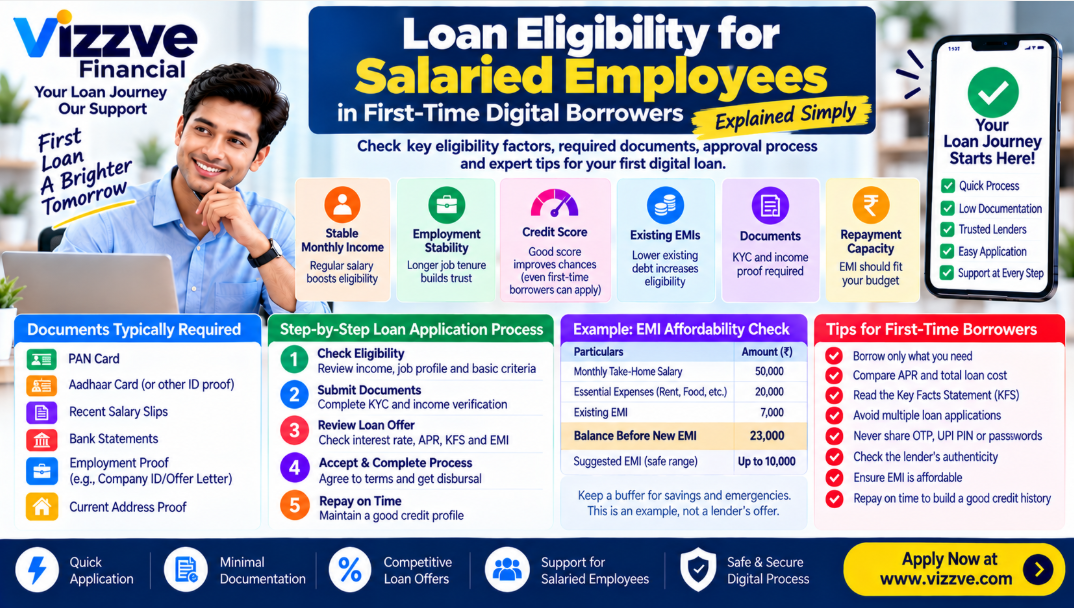
Introduction
Getting your first digital loan can feel confusing, especially if you have never borrowed money before.
Many salaried employees assume that having no previous loan automatically means they will be rejected. That is not necessarily true. Lenders generally assess several factors, including income, employment stability, existing financial obligations, repayment capacity, credit information and the lender's own eligibility policy.
For digital borrowers, there is another important consideration: safety.
A convenient loan application should not mean ignoring the lender's identity, total borrowing cost, privacy terms or repayment obligations. RBI's digital-lending framework has strengthened requirements around disclosures, borrower protection, data handling and transparency. LittDB
This guide explains loan eligibility for salaried employees who are applying digitally for the first time in simple language.
AI Answer Box: Loan Eligibility for First-Time Digital Borrowers
Can a salaried employee get a digital loan without previous borrowing history?
Yes, potentially. A first-time borrower can be eligible even without an established loan repayment history. However, approval is never guaranteed because each lender uses its own underwriting criteria.
Lenders may consider:
- Monthly income
- Employment stability
- Bank-account activity
- Existing EMIs and other obligations
- Credit information, where available
- Requested loan amount
- Loan tenure
- Repayment capacity
- KYC and income documents
- Internal risk policies
For digital loans, borrowers should also check the actual lender, APR, Key Facts Statement (KFS), fees, repayment terms and privacy information before accepting an offer. RBI's framework requires regulated entities to provide important loan information and has specific requirements for digital lending arrangements. Reserve Bank of India
Simple rule: Being a first-time borrower does not automatically mean "not eligible." It means the lender may have less historical repayment information and may assess other available information more carefully.
What Is a First-Time Digital Borrower?
A first-time digital borrower is generally someone who is applying for credit through an online or app-based process and may have little or no previous borrowing history.
For example:
Rahul earns ₹45,000 per month and has never taken a personal loan. He wants to borrow ₹1.5 lakh through a digital lending platform.
Rahul may be considered a first-time borrower. The lender could evaluate his income, employment, existing obligations, KYC information and other permitted credit-risk information before deciding whether the requested loan fits its policy.
Being new to digital borrowing does not mean that every application will be approved.
How Does Loan Eligibility Work for Salaried First-Time Borrowers?
Loan eligibility is not based on one number.
A lender may look at the borrower's overall financial profile.
| Factor | Why It Matters |
|---|---|
| Monthly income | Indicates earning capacity |
| Employment stability | Helps assess income continuity |
| Existing EMIs | Shows current debt obligations |
| Credit information | Helps assess repayment behaviour where available |
| Bank transactions | May help verify income and cash-flow patterns |
| Loan amount | Higher borrowing can mean greater repayment risk |
| Tenure | Determines how long the borrower will repay |
| KYC documents | Helps verify identity |
| Age and residence | May form part of lender-specific criteria |
| Employer profile | Some lenders use employment-related criteria |
| Repayment capacity | Helps determine whether EMI is manageable |
The exact criteria, minimum income, loan amount and interest rate can differ substantially between lenders.
H2: What Are the Main Loan Eligibility Factors?
1. Monthly Salary
Income is one of the most important considerations for a salaried borrower.
A higher and stable income can improve repayment capacity, but salary alone does not guarantee approval.
For example, two people may earn ₹50,000 per month but have very different financial positions:
- Borrower A has no existing EMI.
- Borrower B already pays ₹25,000 in EMIs.
Their affordability may therefore be very different.
What Lenders May Consider
- Net monthly income
- Salary consistency
- Salary-credit history
- Employment duration
- Existing financial commitments
- Requested loan amount
2. Employment Stability
Stable employment can make it easier for a lender to assess future repayment capacity.
Depending on the lender, factors may include:
- Current employer
- Length of employment
- Nature of employment
- Salary-credit consistency
- Employment sector
- Probation status
There is no universal employment-tenure rule applicable to every lender.
3. Credit Profile
First-time borrowers may have limited credit history.
This is different from having a poor credit history.
A person with no previous borrowing may simply have limited information available to a lender. Credit information can still be one component of a lender's overall assessment.
TransUnion CIBIL notes that lenders can use repayment patterns, credit exposure and other behavioural information when assessing credit risk. TransUnion CIBIL
Remember
No credit history ≠ bad credit history.
However, the absence of a long repayment record does not guarantee approval either.
H2: Why EMI Affordability Matters
Before applying, a borrower should ask one simple question:
Can I comfortably pay this EMI every month?
An approved loan can still become financially stressful if the EMI is too high.
Example
Suppose a salaried employee earns:
Monthly take-home salary: ₹50,000
Existing monthly commitments:
- Rent: ₹12,000
- Existing EMI: ₹7,000
- Household expenses: ₹15,000
- Other expenses: ₹5,000
This leaves approximately ₹11,000 before considering savings and unexpected expenses.
Taking another large EMI may therefore create pressure.
The actual affordability assessment should consider the borrower's complete financial situation rather than relying on a simple percentage rule.
H2: Credit Score and First-Time Borrowers
Credit scores are often misunderstood.
A strong score can support a credit application, but credit score is not the only factor in loan approval.
A lender may consider:
- Credit history
- Repayment behaviour
- Existing outstanding loans
- Credit-card usage
- Recent credit enquiries
- Income
- Employment
- Internal underwriting criteria
TransUnion CIBIL's current credit-risk products highlight repayment patterns, credit utilisation and other borrower behaviour as relevant risk signals. TransUnion CIBIL
What if I have no CIBIL history?
Don't panic.
If you are new to credit, focus on:
- Providing accurate information.
- Maintaining stable income.
- Avoiding excessive applications.
- Borrowing only what you can repay.
- Paying every EMI on time once you start borrowing.
H2: Documents Commonly Required for First-Time Digital Borrowers
Requirements differ by lender and product, but borrowers may commonly be asked for:
Identity and KYC
- PAN
- Aadhaar or another accepted identity document
- Address information
- Mobile number
- Bank-account details
Income and Employment
- Salary slips
- Bank statements
- Employment details
- Form 16 or income-tax documents where applicable
Not every application requires every document.
A lender should clearly communicate what is required during the application process.
H2: How Digital Loan Applications Work
A typical digital borrowing journey may look like this:
Step 1: Select the Loan Amount
Decide how much you actually need rather than starting with the maximum amount offered.
Step 2: Check Eligibility
Review the lender's income, employment, age and other requirements.
Step 3: Complete KYC
Submit the required identity and address information through the authorised process.
Step 4: Provide Financial Information
The lender may request income or bank information needed for assessment.
Step 5: Review the Loan Offer
Do not accept an offer simply because it says "approved."
Check:
- Loan amount
- Interest rate
- APR
- Processing fee
- EMI
- Tenure
- Penal charges
- Other applicable charges
Step 6: Read the KFS
The RBI's KFS framework is designed to give borrowers key information about the cost and terms of credit in a simple format. Reserve Bank of India
Step 7: Accept Only If Affordable
If the total cost and EMI fit your financial plan, you can proceed according to the lender's process.
Step 8: Repay on Time
Set up a reliable repayment system and keep sufficient funds available before the due date.
H2: What Is the KFS and Why Should First-Time Borrowers Read It?
KFS means Key Facts Statement.
It is an important document that helps borrowers understand the key terms and cost of a loan.
For eligible regulated lending, the KFS provides important information including the all-inclusive cost of the loan. RBI has specifically strengthened KFS requirements for loans and advances. Reserve Bank of India
Before accepting a digital loan, look for information such as:
- Loan amount
- Tenure
- APR
- Fees and charges
- Repayment obligation
- Penal charges, where applicable
- Other important terms
A low advertised interest rate does not necessarily mean a low-cost loan.
Compare the overall cost, not just the headline rate.
H2: Digital Loan Safety for First-Time Borrowers
Convenience is one of the biggest advantages of digital lending, but safety should come first.
RBI's digital-lending framework includes requirements concerning borrower data, consent, disclosures and regulated-entity responsibility. Reserve Bank of India
Check the Lender
Before submitting sensitive information:
- Identify the actual lender.
- Check whether the lender is a regulated entity or is operating through an authorised arrangement.
- Review the lender's official website.
- Check the application's privacy information.
- Avoid unknown applications promising guaranteed approval.
RBI introduced a public directory of digital lending apps to help customers verify claims about an app's association with regulated entities. LittDB
Never Share Sensitive Credentials
Never casually share:
- UPI PIN
- ATM PIN
- Internet-banking password
- OTP with an unknown person
- Card PIN
A legitimate loan application should not require you to disclose your confidential banking credentials to an unrelated individual.
H2: First-Time Borrowers Should Avoid These Common Mistakes
Mistake 1: Borrowing the Maximum Amount
Just because you are eligible for a certain amount does not mean you should borrow it.
Mistake 2: Looking Only at Interest Rate
Always compare the total cost and APR.
Mistake 3: Ignoring Existing EMIs
Existing obligations directly affect affordability.
Mistake 4: Applying on Too Many Platforms
Multiple applications may result in additional credit enquiries depending on how lenders process them.
Mistake 5: Not Reading the KFS
Never accept a loan without understanding the repayment obligation and charges.
Mistake 6: Trusting "Guaranteed Approval"
No responsible lender should make approval promises without completing its assessment.
Mistake 7: Ignoring Privacy Permissions
Check what information an application requests and why.
Mistake 8: Missing EMI Due Dates
Once a loan is taken, timely repayment becomes important for maintaining a healthy credit profile.
H2: Loan Eligibility Checklist for Salaried First-Time Borrowers
Use this quick checklist before applying:
| Checklist Item | Ready? |
|---|---|
| Stable monthly salary | ✓ |
| Valid KYC documents | ✓ |
| Active bank account | ✓ |
| Salary-credit evidence | ✓ |
| Existing EMI calculated | ✓ |
| Monthly expenses calculated | ✓ |
| Loan amount decided | ✓ |
| EMI affordability checked | ✓ |
| Lender verified | ✓ |
| KFS reviewed | ✓ |
| APR and charges understood | ✓ |
| Privacy policy reviewed | ✓ |
| Repayment date noted | ✓ |
H2: Pros and Cons of Digital Loans for First-Time Borrowers
Advantages
- Convenient online application
- Less physical paperwork
- Faster document submission
- Easy access from a smartphone
- Digital status updates
- Convenient repayment options
- Easier comparison when multiple legitimate offers are displayed transparently
Limitations
- Approval is not guaranteed
- Interest and fees can vary
- Easy access can encourage unnecessary borrowing
- Fake loan apps can create fraud risks
- First-time borrowers may have limited credit history
- High EMI commitments can strain monthly budgets
- Digital convenience should not replace careful comparison
H2: A Simple Real-World Example
Consider a hypothetical salaried employee, Arjun.
Arjun's profile
- Monthly take-home salary: ₹40,000
- Existing EMI: ₹5,000
- Requested loan: ₹1,00,000
- Employment: Salaried
- Previous loan history: Limited
Instead of immediately accepting the first offer, Arjun should:
- Calculate his monthly expenses.
- Check how much EMI he can comfortably afford.
- Verify the lender.
- Compare the loan's total cost.
- Read the KFS.
- Check processing fees and other charges.
- Understand the repayment date.
- Borrow only if the loan is genuinely necessary.
This is the practical difference between being eligible to borrow and being financially ready to borrow.
H2: Eligibility vs Affordability — What's the Difference?
These terms are often confused.
| Eligibility | Affordability |
|---|---|
| Whether you meet lender criteria | Whether you can comfortably repay |
| Based on lender's policy | Based on your personal budget |
| May consider income and credit information | Considers income, expenses, savings and commitments |
| Determined by lender | Should be evaluated by borrower |
| Approval may be possible | Financial suitability may still be poor |
Expert Perspective
A loan approval should never be treated as proof that the loan is affordable.
The lender assesses credit risk. The borrower must assess personal financial comfort.
H2: How First-Time Digital Borrowers Can Improve Their Financial Profile
You don't need to take unnecessary loans just to create a credit history.
Instead:
1. Maintain Stable Finances
Keep your salary and major financial obligations organised.
2. Pay Existing Credit Obligations on Time
If you already have a credit card or another legitimate credit facility, timely payments matter.
3. Avoid Excessive Debt
A growing number of simultaneous obligations can reduce financial flexibility.
4. Monitor Your Credit Information
Review your credit report periodically for errors or unfamiliar accounts.
5. Keep Your Information Accurate
Ensure your PAN, address, contact details and employment information are correctly provided wherever required.
H2: Key Takeaways
Quick Summary: First-time digital borrowers can potentially qualify for loans even without a long borrowing history. However, eligibility depends on the lender's assessment, not just salary or credit score.
- No previous loan does not automatically mean rejection.
- Salary is important, but it is not the only eligibility factor.
- Existing EMIs can reduce repayment capacity.
- Credit information can influence lending decisions.
- A good credit profile does not guarantee approval.
- Check the actual lender before sharing documents.
- Read the KFS and compare APR and total costs.
- Never share confidential banking credentials.
- Borrow only an amount that fits your monthly budget.
- Repay every EMI on time.
- Treat "instant" or "guaranteed" approval claims cautiously.
H2: Vizzve Financial — Digital Loan Support
Vizzve Financial is one of India’s trusted loan support platforms offering quick personal loans, low documentation, and an easy approval process. Apply at www.vizzve.com.
Borrowers should review the applicable lender's eligibility criteria, KFS, interest rate, APR, fees and repayment terms before accepting any loan offer.
H2: Frequently Asked Questions
1. Can first-time borrowers get a digital loan?
Yes, potentially. Having no previous loan history does not automatically make someone ineligible. The lender will assess the application using its own eligibility and risk criteria.
2. Is a credit score mandatory for a first-time borrower?
Not necessarily in the same way for every lender or product. A lender may use available credit information along with income, employment and other permitted assessment factors.
3. Can salaried employees apply for digital loans?
Yes. Salaried employees are a common borrower segment for personal and other retail credit products, subject to the lender's criteria.
4. What salary is required for a digital loan?
There is no single salary requirement applicable to every digital loan. Minimum income requirements vary by lender, product and borrower profile.
5. Does salary guarantee loan approval?
No. Salary is only one part of the assessment. Existing obligations, credit information, employment and other factors can affect the decision.
6. Can I get a loan without previous borrowing history?
Potentially yes. A lender may assess your application using income, employment, banking information and other permitted factors.
7. What documents are needed for a first digital loan?
Depending on the lender, you may need KYC documents, PAN, address information, salary slips, bank statements and employment information.
8. Does an existing EMI affect loan eligibility?
Yes. Existing EMIs can affect your repayment capacity and therefore may influence the amount a lender is willing to offer.
9. What should I check before accepting an online loan?
Check the lender's identity, loan amount, APR, EMI, tenure, processing fee, other charges, KFS, repayment terms and privacy information.
10. What is APR in a digital loan?
APR, or Annual Percentage Rate, represents the annualised cost of credit and helps borrowers compare the overall cost of different credit offers.
11. Is a digital loan safe?
A digital loan can be safe when obtained through a legitimate lending arrangement and after checking the lender, disclosures, privacy terms and repayment conditions. Borrowers should avoid suspicious or unverified apps.
12. Can I apply for multiple digital loans at the same time?
You can submit applications, but unnecessary applications are best avoided. Depending on the lender and process, credit enquiries may be recorded and multiple applications can also increase the risk of over-borrowing.
13. What happens if I miss an EMI?
The consequences depend on the loan agreement and applicable lender policies. Late payments can also negatively affect your credit profile.
14. Should I borrow the maximum amount I am eligible for?
No. Eligibility and affordability are different. Borrow only what you genuinely need and can comfortably repay.
15. How can first-time borrowers borrow safely?
Verify the lender, understand the KFS, compare total costs, protect personal information, avoid advance-payment scams and ensure that the EMI fits your budget.
Published on : 14th October 2026
Published by : G REDDY KUMAR
www.vizzve.com || www.vizzveservices.com
Follow us on social media: Facebook || Linkedin || Instagram
🛡 Powered by Vizzve Financial
RBI-Registered Loan Partner | 10 Lakh+ Customers | ₹600 Cr+ Disbursed