

Introduction
Getting a first personal loan through a digital platform can seem simple. A salaried employee enters a few details, uploads documents and waits for an eligibility result. But behind that online process, a lender may evaluate income, employment, credit information, existing debt and the applicant's ability to repay.
For first-time digital borrowers, the biggest question is often: Can I qualify for a loan if I have never borrowed before?
The answer is that it may be possible. Having no previous borrowing history does not automatically mean rejection. However, approval depends on the lender's eligibility criteria and assessment of the available information.
Let's understand the process through a realistic example of a salaried employee applying for a first digital personal loan. The figures used in this article are illustrative, not an actual customer case or a lender's guaranteed eligibility calculation.
India's digital lending rules also make transparency important. The Reserve Bank of India (RBI) has issued the Reserve Bank of India (Digital Lending) Directions, 2025, consolidating earlier instructions and introducing additional requirements in areas such as digital loan offers and the directory of digital lending apps.

AI Answer Box: How Does Loan Eligibility Work for a First-Time Digital Borrower?
A salaried first-time digital borrower may qualify for a personal loan if the lender's assessment finds the applicant eligible and the proposed repayments manageable. The lender may consider monthly take-home salary, employment stability, existing EMIs, credit information, bank statements, requested loan amount and repayment capacity.
For example, an employee earning ₹45,000 per month with ₹5,000 in existing EMIs may have a different financial profile from an employee earning the same salary with ₹18,000 in existing EMIs.
There is no universal salary, credit score or EMI percentage that guarantees approval across all lenders. Before accepting an offer, the borrower should compare the APR, read the Key Fact Statement (KFS), verify the actual lender and calculate whether the EMI fits their budget.
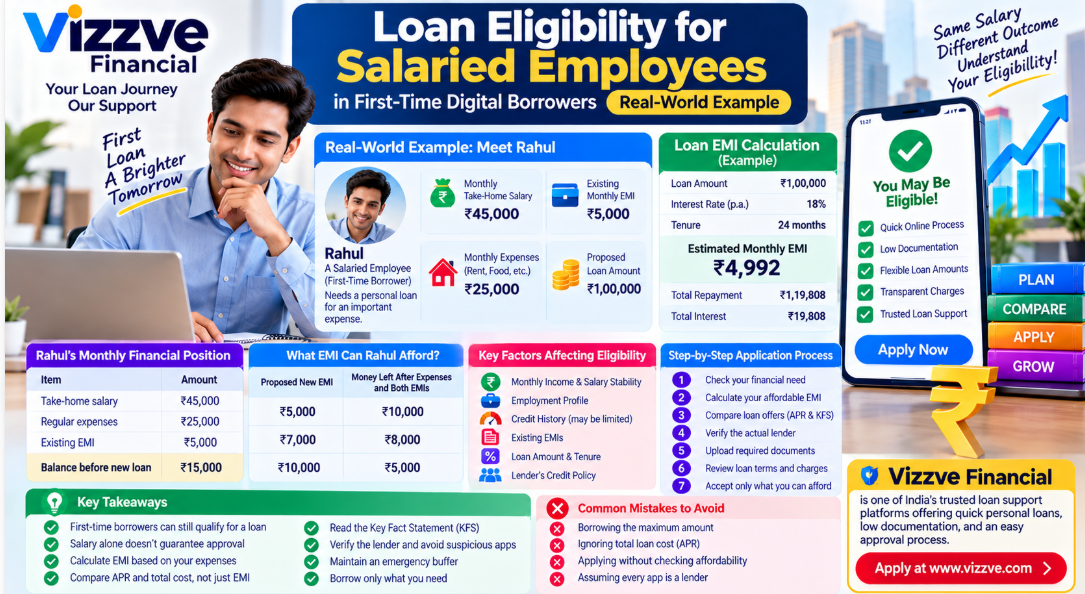
Real-World Example: A Salaried Employee Applying for a First Digital Loan
Meet Rahul: A Hypothetical First-Time Borrower
Consider Rahul, a hypothetical salaried employee working at a private company. He needs money for an essential household expense and decides to explore a digital personal loan.
Rahul has never taken a personal loan before. He wants to understand whether his income is sufficient and how much he can reasonably afford to repay.
Rahul's financial profile
Illustrative example only — not an actual customer record.
Monthly take-home salary
₹45,000
Existing monthly EMI
₹5,000
Regular monthly expenses
₹25,000
Proposed loan amount
₹1,00,000
Rahul's first task is not to find the largest loan available. It is to calculate what he can afford without making his monthly finances difficult.
Step 1: Calculate Rahul's Monthly Financial Position
|
Financial item |
Monthly amount |
|---|---|
|
Take-home salary |
₹45,000 |
|
Rent, food, transport and other expenses |
₹25,000 |
|
Existing EMI |
₹5,000 |
|
Balance before a new loan |
₹15,000 |
Rahul has ₹15,000 remaining after the expenses and EMI listed above.
However, that entire amount should not automatically be used for a new loan. Unexpected medical costs, family needs, travel or other expenses can arise.
He should preserve a reasonable buffer and consider his actual financial commitments before deciding on an EMI.
What does this tell us about eligibility?
It provides an initial view of Rahul's affordability. It does not establish that a lender will approve his application.
The lender may use different income calculations, minimum requirements and credit-assessment policies.
How Much EMI Can Rahul Afford?
A common mistake is to calculate eligibility using salary alone. A more useful approach is to start with monthly income, subtract regular expenses and existing debt payments, and then decide how much repayment capacity remains.
For this example, suppose Rahul wants to keep at least ₹5,000 of his ₹15,000 remaining balance available for savings and unexpected expenses.
His tentative EMI budget would be:
This suggests that ₹10,000 is a possible upper planning limit under these assumptions, not a recommended EMI or a lender-approved amount. Rahul should review whether his expense estimate is complete and whether a lower EMI would provide a safer buffer.
Compare Three Possible EMI Budgets
|
Proposed new EMI |
Money left after expenses and both EMIs |
|---|---|
|
₹5,000 |
₹10,000 |
|
₹7,000 |
₹8,000 |
|
₹10,000 |
₹5,000 |
These figures assume ₹45,000 take-home salary, ₹25,000 regular expenses and ₹5,000 existing EMI.
Practical lesson: The lowest-risk choice is not necessarily the highest EMI Rahul can technically manage. It is an EMI that remains comfortable after accounting for realistic expenses and savings.
Example Loan Calculation: What Might a ₹1 Lakh Loan Cost?
Suppose Rahul compares a hypothetical personal loan with the following terms:
|
Loan detail |
Illustrative assumption |
|---|---|
|
Principal |
₹1,00,000 |
|
Annual interest rate |
18% |
|
Tenure |
24 months |
|
Repayment method |
Monthly EMI |
|
Processing fee and other charges |
Not included in the EMI estimate |
Using the standard reducing-balance EMI formula, the approximate monthly payment would be ₹4,992.
The calculation assumes a monthly interest rate of 1.5%, with no fees or additional charges included in the EMI.
|
Cost item |
Approximate amount |
|---|---|
|
Loan principal |
₹1,00,000 |
|
Monthly EMI |
₹4,992 |
|
Number of instalments |
24 |
|
Total of 24 EMIs |
₹1,19,808 |
|
Approximate interest paid |
₹19,808 |
These are rounded illustrative figures. The actual repayment schedule may differ because of the lender's terms, dates, rounding and charges.
Would This EMI Fit Rahul's Budget?
Rahul has ₹15,000 remaining after his listed expenses and existing EMI.
If the new EMI is approximately ₹4,992:
He would have approximately ₹10,008 remaining each month under the assumptions used above.
That appears to leave more room than an EMI of ₹10,000, but Rahul still needs to check whether his expenses include all irregular costs and whether the loan's total charges are acceptable.
Important: The interest rate used here is an example, not a current market quote or an offer from Vizzve Financial.
Loan Eligibility vs Loan Affordability: Rahul's Example
These two concepts are related but not interchangeable.
|
Factor |
Eligibility assessment |
Affordability assessment |
|---|---|---|
|
Salary |
Lender assesses income against its policy |
Borrower checks money available after expenses |
|
Existing EMI |
Can affect the lender's decision |
Reduces monthly disposable income |
|
Credit history |
May affect credit assessment |
May influence available borrowing options |
|
Loan amount |
Must meet lender criteria |
Should match the actual financial need |
|
EMI |
Must meet applicable lender requirements |
Must remain manageable in the household budget |
|
Final decision |
Lender decides whether to approve |
Borrower decides whether the loan is sensible |
Rahul should satisfy the lender's criteria and be comfortable with the repayment commitment. Neither one should replace the other.
What If Rahul Has No Previous Credit History?
Suppose Rahul has never taken a credit card or formal personal loan. He may have limited information in his credit report.
That does not automatically mean his application will be rejected. The lender can consider other information available under its underwriting process, including income, employment, existing obligations and required documentation.
However, the lender may not have the same historical repayment evidence it would have for an experienced borrower.
How Rahul Can Prepare
-
Check whether a credit report is available.
-
Confirm that his personal information is correct.
-
Review any accounts or obligations appearing in the report.
-
Prepare valid income and employment documents.
-
Avoid unnecessary simultaneous applications.
-
Apply for an amount that matches his actual need.
-
Review the loan's costs and repayment terms before accepting.
RBI's credit-information reporting directions introduced fortnightly reporting from January 1, 2025, to make credit information more current. That does not mean every new loan or payment will instantly appear on a report; reporting and processing timelines still apply.
A Second Example: Same Salary, Different Repayment Capacity
Now consider two more hypothetical salaried employees.
-
Priya: Earns ₹45,000 per month and pays ₹4,000 in existing EMIs.
-
Amit: Earns ₹45,000 per month and pays ₹16,000 in existing EMIs.
Assume each has ₹25,000 in monthly household expenses.
|
Financial item |
Priya |
Amit |
|---|---|---|
|
Take-home salary |
₹45,000 |
₹45,000 |
|
Household expenses |
₹25,000 |
₹25,000 |
|
Existing EMIs |
₹4,000 |
₹16,000 |
|
Balance before a new EMI |
₹16,000 |
₹4,000 |
Although their salaries are identical, their available monthly balances are very different.
Priya may have more room in her budget for an additional EMI. Amit may need to reduce existing debt, lower the requested amount or postpone borrowing.
This is only an affordability comparison. A lender would still apply its own eligibility rules to each application.
What Factors Could Affect Rahul's Loan Approval?
1. Monthly Income and Salary Consistency
A lender may verify Rahul's income and examine whether his salary is consistent with the application.
Useful preparation includes:
-
Recent salary slips, if required
-
Bank statements
-
Employment details
-
Accurate application information
2. Employment Stability
Rahul should provide accurate information about his current employment. Recent job changes or irregular income may be relevant to some lenders' assessment.
3. Existing Debt
Existing EMIs reduce the amount of income available for a new repayment. Rahul should disclose his current obligations accurately.
4. Credit Information
Where credit information is available, the lender may consider existing accounts, repayment behaviour and outstanding balances.
5. Requested Amount and Tenure
A smaller amount or a suitable tenure may produce a more manageable repayment plan. However, a longer tenure can increase total interest.
6. Lender-Specific Requirements
There is no universal salary threshold, credit score or EMI-to-income ratio that guarantees approval from every lender.
No online calculator can promise a final approval decision.
The Digital Loan Application: Rahul's Step-by-Step Journey
Step 1: Identify the Financial Need
Rahul first confirms the amount he needs and whether a loan is appropriate. He considers alternatives such as adjusting his budget or using available savings without exhausting his emergency funds.
Step 2: Check His Budget
He lists monthly income, expenses, existing EMIs and a buffer for unexpected costs.
Step 3: Compare Loan Offers
He compares the proposed loan amount, tenure, interest rate, APR, fees and repayment schedule.
Step 4: Verify the Actual Lender
Rahul checks the identity of the bank or NBFC providing the loan and verifies the digital platform's stated relationship with that lender.
RBI's Digital Lending Directions, 2025 provide for a directory of digital lending apps intended to help customers verify claims of association with regulated entities. The directory is a verification aid, not a guarantee that every listed service or offer is suitable for an individual borrower.
Step 5: Review the KFS
Before signing, Rahul reads the Key Fact Statement and checks the APR, repayment terms, charges and applicable cooling-off or look-up period.
RBI's digital lending framework requires the regulated entity to disclose the APR and provide the KFS before execution of the digital lending contract. Charges not disclosed in the KFS cannot subsequently be charged by the regulated entity during the loan tenure under the applicable framework.
Step 6: Review Data Permissions
Rahul checks the app's privacy policy and the information it requests. He should not grant permissions without understanding their purpose.
Step 7: Decide Whether to Accept
Even if approved, Rahul compares the final offer with his budget. If the EMI or total cost is too high, he can decline the offer rather than borrow under pressure.
Documents Rahul May Need
Exact requirements depend on the lender and product. A salaried applicant may be asked for:
-
PAN
-
Aadhaar or other accepted KYC documentation
-
Salary slips
-
Bank statements
-
Employer or employment details
-
Address information
-
Other supporting documents requested through a legitimate application process
A digital process can reduce branch visits, but it does not remove the need for identity checks or credit assessment.
How to Read the KFS and APR in a Real Loan Offer
A first-time borrower may focus on the monthly EMI and overlook the total cost. Rahul should review the complete offer.
|
Item |
What Rahul should check |
|---|---|
|
Principal |
Amount actually being borrowed |
|
Interest rate |
Rate applied to the outstanding loan |
|
APR |
All-inclusive annualised cost as defined under the applicable rules |
|
Processing fee |
Whether a fee applies and how it is collected |
|
Taxes |
Applicable taxes on charges, where relevant |
|
EMI |
Monthly payment amount and due date |
|
Tenure |
Number of monthly instalments |
|
Penal charges |
Disclosed charges that may apply if payment terms are breached |
|
Prepayment terms |
Conditions and charges, if applicable |
|
Grievance support |
Contact details and complaint process |
APR generally includes the applicable all-inclusive loan costs under RBI's digital lending framework, while contingent charges such as late-payment charges are treated separately under the relevant rules. Rahul should read the KFS for the specific offer rather than assume every possible charge is included in the APR.
What If Rahul's Application Is Rejected?
A rejection does not automatically mean that Rahul will never qualify for credit.
Instead of immediately applying through several more apps, he should:
-
Review any reason provided by the lender.
-
Check his application for errors or incomplete documents.
-
Review existing debt and monthly expenses.
-
Check his credit report for inaccurate information, if available.
-
Consider whether the requested loan amount is too high.
-
Improve his financial position before trying again.
-
Compare legitimate alternatives and avoid high-pressure offers.
The lender may not disclose every internal scoring detail. Rahul should not assume that changing one factor will guarantee approval on the next application.
Pros and Cons of Digital Loans for First-Time Borrowers
|
Advantages |
Potential disadvantages |
|---|---|
|
Convenient online application |
Convenience may encourage impulsive borrowing |
|
Less dependence on branch visits |
Applicants may overlook loan conditions |
|
Digital document submission |
Sensitive data requires careful handling |
|
Easy access to loan information |
Fraudulent apps can pose risks |
|
Repayment can be tracked electronically |
Multiple loans can increase repayment pressure |
|
Faster processing may be available |
Approval time and outcome are not guaranteed |
Digital lending can be useful when it meets a genuine need and is provided through an appropriate regulated arrangement. It is not automatically the best option for every borrower.
Expert Commentary: What Does Rahul's Example Teach Us?
The most important lesson is that loan eligibility and financial readiness must be considered together.
A borrower may have a regular salary but limited disposable income. Another may have no previous borrowing history but a stable job, manageable expenses and accurate documents.
Neither profile guarantees approval. Each lender uses its own credit policy, and each borrower needs to make an independent affordability assessment.
For first-time digital borrowers, a sensible decision follows three stages:
-
Before applying: establish the amount genuinely required and calculate an affordable EMI.
-
During the application: verify the lender, check disclosures and provide accurate information.
-
Before accepting: compare the APR, read the KFS and confirm that the repayment schedule is manageable.
This approach is consistent with the transparency and borrower-protection objectives reflected in RBI's digital lending framework.
Common Mistakes Revealed by the Example
Rahul can avoid many common problems by not making these assumptions:
-
“My salary is enough, so approval is guaranteed.” Income is only one factor.
-
“I have never borrowed, so I will be rejected.” Limited history does not automatically mean rejection.
-
“The highest eligible amount is the right amount.” The amount should match the financial need.
-
“A low EMI means a cheap loan.” Tenure and total interest matter.
-
“The advertised interest rate is the full cost.” Check the APR and disclosed charges.
-
“Every app is a lender.” Identify the actual regulated entity.
-
“I can skip the KFS.” Review it before accepting the contract.
-
“Approval means I can afford the loan.” Your budget still matters.
Practical Checklist for First-Time Digital Borrowers
Use this checklist before submitting a digital loan application.
Income and employment
Credit and debt
Loan amount and repayment
Cost and safety
AI Summary Box: Real-World Loan Eligibility Example
A hypothetical salaried employee earning ₹45,000 per month has ₹25,000 in regular expenses and an existing EMI of ₹5,000. The employee has ₹15,000 remaining before any new loan repayment.
If the employee considers a ₹1,00,000 loan over 24 months at an illustrative 18% annual interest rate, the estimated EMI is approximately ₹4,992 before fees and other charges.
The calculation helps assess affordability, but it does not establish lender eligibility or guarantee approval. The applicant must also consider employment, credit information, documentation, lender requirements and the full cost disclosed in the KFS.
The key lesson: calculate your budget, borrow only what you need, verify the lender and read the loan terms before accepting.
FAQs: Loan Eligibility for Salaried First-Time Digital Borrowers
1. Can a salaried employee get a digital loan for the first time?
Yes. A salaried employee may qualify for a digital loan even without previous borrowing history, subject to the lender's eligibility criteria and assessment.
2. Does having no credit history mean automatic rejection?
No. Limited or absent credit history does not automatically mean rejection. The lender may consider other available information, including income, employment and repayment capacity.
3. What salary is required for a first digital personal loan?
There is no universal minimum salary that applies to all lenders. Requirements vary by lender, loan product and applicant profile.
4. How can I calculate my affordable EMI?
Start with take-home salary, subtract regular living expenses and existing EMIs, and retain a reasonable amount for savings and unexpected expenses. The balance is a planning guide, not a guaranteed eligibility amount.
5. Does a good credit score guarantee loan approval?
No. A credit score may influence the assessment, but lenders can also consider income, employment, existing obligations, documents and internal credit policies.
6. What documents may be required for a digital personal loan?
Depending on the lender, you may need PAN, accepted identity documents, salary slips, bank statements, employment details and other KYC or income documents.
7. What is the difference between loan eligibility and affordability?
Eligibility concerns whether a lender may approve the application. Affordability concerns whether you can manage the EMI and total repayment without putting essential expenses at risk.
8. What is KFS in a digital loan?
KFS means Key Fact Statement. It provides key information about the loan, including APR and relevant terms and charges. RBI's digital lending framework requires the KFS before execution of the digital lending contract.
9. What does APR mean?
APR stands for Annual Percentage Rate. It represents the all-inclusive annualised cost of a digital loan under the applicable RBI framework. Read the KFS to understand the actual offer.
10. Should I choose a loan with the lowest EMI?
Not automatically. A lower EMI may result from a longer tenure, which can increase the total interest paid. Compare total repayment costs as well.
11. How can I verify a digital lending app?
Check the actual regulated lender and verify the app's claimed association through the lender's official website and RBI's digital lending app directory. The directory is a verification aid, not a guarantee of the loan's suitability.
12. Can a digital loan affect my credit report?
Yes. Credit information relating to a loan may be reported to credit information companies under the applicable framework. RBI introduced fortnightly credit-information reporting from January 1, 2025.
13. What should I do if my first loan application is rejected?
Review any reason provided, check your application and documents for errors, assess existing debt and consider whether the requested amount is too high. Avoid making many unnecessary applications immediately.
14. Should I take a loan just to build my credit history?
Not necessarily. A loan should serve a genuine financial need and be affordable. Taking unnecessary debt solely to create a credit history can add avoidable costs and risk.
15. What is the most important lesson from a real-world loan eligibility example?
A salary figure alone does not determine the right loan. Assess your full monthly budget, verify the lender, compare the APR, read the KFS and accept a loan only when the repayment is manageable.
Published on : 12th October 2026
Published by : G REDDY KUMAR
www.vizzve.com || www.vizzveservices.com
Follow us on social media: Facebook || Linkedin || Instagram
🛡 Powered by Vizzve Financial
RBI-Registered Loan Partner | 10 Lakh+ Customers | ₹600 Cr+ Disbursed