

Introduction
Getting a first digital personal loan can be convenient for salaried employees, but repaying it on time requires planning. An EMI becomes a regular monthly commitment alongside rent, food, transport, family expenses and savings.
For first-time digital borrowers, the challenge is not only getting a loan approved. It is choosing a repayment amount that remains manageable throughout the loan tenure.
A good repayment plan starts before the loan is accepted. Borrowers should calculate their monthly surplus, compare loan costs, understand the repayment schedule and set up a reliable payment process. They should also know what to do if their salary is delayed or an unexpected expense affects their budget.
The Reserve Bank of India's Digital Lending Directions, 2025, issued on May 8, 2025, consolidate earlier digital lending instructions and introduce additional measures related to transparency in digital loan offers and the public directory of digital lending apps. The directions also address borrower protection and the flow of loan repayments.

This guide explains how salaried first-time digital borrowers can plan EMIs, avoid preventable repayment problems and understand their responsibilities.
AI Answer Box: How Should First-Time Digital Borrowers Repay a Loan?
Salaried first-time digital borrowers should plan repayments around their take-home salary, essential expenses, existing EMIs and an emergency buffer. Before accepting a loan, compare the APR and total repayment amount, read the Key Fact Statement (KFS), confirm the EMI due date and understand the lender's payment process.
After disbursal, keep sufficient funds available before the due date, monitor payment confirmations and retain transaction records. If a payment problem arises, contact the actual lender promptly through its official channels instead of ignoring the EMI or relying on an unverified third party.
A manageable loan is one that can be repaid without repeatedly sacrificing essential expenses or taking new debt to cover old repayments.
1. What Is Loan Repayment?
Loan repayment is the process of returning the borrowed principal and applicable interest to the lender according to the agreed schedule.
For a typical personal loan repaid through monthly EMIs, each instalment generally covers:
-
A portion of the principal borrowed
-
Interest charged under the loan terms
Other costs, such as processing fees or applicable charges, may be collected separately according to the agreement.
What Is an EMI?
EMI stands for Equated Monthly Instalment. It is the scheduled monthly payment for a loan with an EMI-based repayment structure.
The EMI amount depends on factors such as:
-
Loan principal
-
Interest rate
-
Repayment tenure
-
Applicable loan terms
A longer tenure can reduce the monthly EMI but may increase the total interest paid. A shorter tenure can increase the monthly EMI while potentially reducing total interest.
Important: A low EMI does not automatically mean a low-cost loan.
2. Why Is Repayment Planning Important for First-Time Borrowers?
First-time borrowers may not have previous experience managing a loan alongside their salary.
Without a clear budget, even a seemingly small EMI can become difficult to manage when unexpected costs arise.
Repayment planning helps borrowers:
-
Keep essential expenses covered.
-
Reduce the risk of missed payments.
-
Avoid unnecessary late-payment charges.
-
Understand the total cost of borrowing.
-
Maintain better control over monthly cash flow.
-
Avoid taking additional loans to pay existing EMIs.
-
Track outstanding principal and remaining instalments.
A repayment plan should be realistic, not based on the assumption that every month will go exactly as expected.
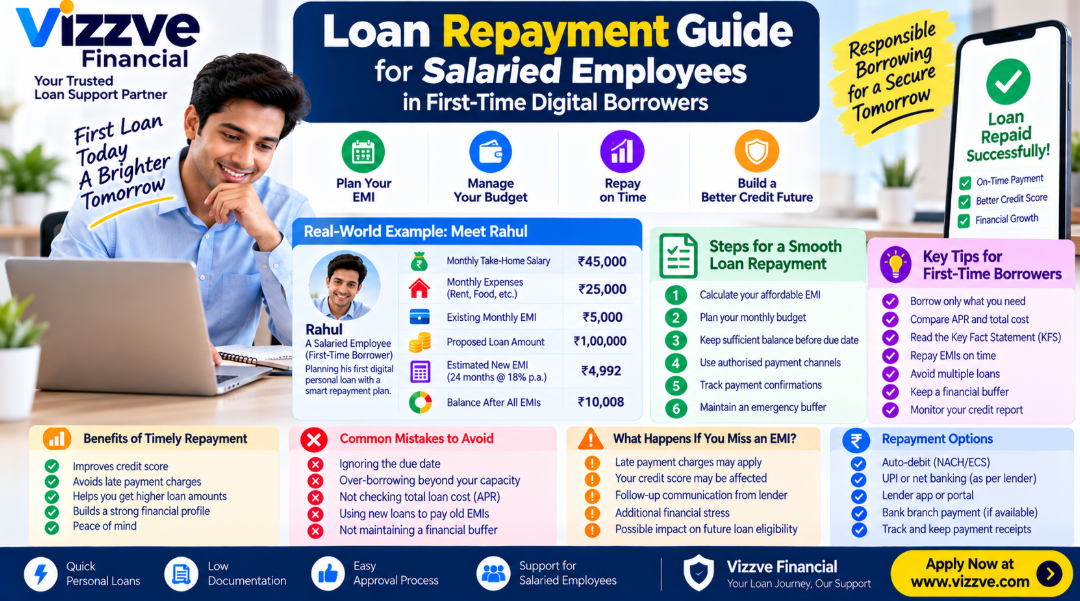
3. Real-World Example: A Salaried Employee Planning Loan Repayments
Consider Rahul, a hypothetical salaried employee taking his first digital personal loan.
His monthly financial position is as follows:
|
Financial item |
Amount |
|---|---|
|
Monthly take-home salary |
₹45,000 |
|
Household and essential expenses |
₹25,000 |
|
Existing EMI |
₹5,000 |
|
Balance before new loan EMI |
₹15,000 |
Rahul is considering an additional personal loan. Before accepting an offer, he needs to decide how much of his remaining ₹15,000 can safely be committed to another EMI.
He should not automatically spend the entire balance on repayments. Unexpected medical costs, family requirements and other irregular expenses may arise.
How Much Can Rahul Set Aside for a New EMI?
Suppose Rahul wants to keep at least ₹5,000 available for savings and unexpected expenses.
Under these assumptions:
This leaves a tentative planning limit of ₹10,000 for a new EMI. It is not a recommended borrowing amount or a guarantee of loan eligibility. Rahul should also check whether his expense estimate includes all regular and irregular costs.
A smaller EMI may offer greater financial flexibility.
4. How to Calculate EMI Affordability Before Taking a Loan
The first step is to calculate how much money remains after essential expenses and current debt payments.
Monthly EMI Budget Formula
Then subtract the amount you want to preserve for savings and unexpected expenses.
This is a personal budgeting method, not a lender's official eligibility formula.
Example: Three Possible EMI Amounts
Using Rahul's figures:
|
Proposed new EMI |
Balance after expenses and both EMIs |
|---|---|
|
₹4,000 |
₹11,000 |
|
₹6,000 |
₹9,000 |
|
₹8,000 |
₹7,000 |
|
₹10,000 |
₹5,000 |
These amounts assume his salary, household expenses and existing EMI remain unchanged. If he has additional financial commitments, his available balance would be lower.
Repayment tip: Choose an EMI that fits your actual budget, rather than the highest amount a lender is willing to offer.
5. Understand the Total Cost of a Digital Personal Loan
Before taking a loan, review more than the EMI.
Important cost components include:
-
Principal
-
Interest
-
Annual Percentage Rate (APR)
-
Processing fees
-
Taxes applicable to fees
-
Late-payment or penal charges where applicable
-
Prepayment or foreclosure terms
-
Other charges disclosed under the loan agreement
RBI's digital lending framework requires disclosure of the APR and a Key Fact Statement before execution of the digital lending contract. The APR provides an all-inclusive annualised cost measure under the applicable framework; contingent charges such as late-payment charges are treated separately under the relevant rules.
Illustrative Loan Repayment Example
Suppose a borrower takes a hypothetical loan of ₹1,00,000 at an annual interest rate of 18% for 24 months.
|
Loan detail |
Illustrative value |
|---|---|
|
Principal |
₹1,00,000 |
|
Annual interest rate |
18% |
|
Tenure |
24 months |
|
Approximate monthly EMI |
₹4,992 |
|
Total of 24 EMIs |
₹1,19,808 |
|
Approximate interest |
₹19,808 |
These are rounded estimates using a standard reducing-balance EMI calculation. Fees and other charges are excluded. Actual lender terms, payment dates and rounding may change the amounts.
The example shows why borrowers should review both the monthly EMI and the total repayment obligation.
6. What Is the Difference Between EMI, Interest and Principal?
|
Term |
Meaning |
|---|---|
|
Principal |
Amount borrowed from the lender |
|
Interest |
Cost of borrowing under the agreed terms |
|
EMI |
Scheduled monthly payment covering principal and interest |
|
Tenure |
Period over which the loan is scheduled to be repaid |
|
APR |
All-inclusive annualised cost measure required under the applicable framework |
|
Outstanding balance |
Amount still owed at a particular point in the loan |
|
Late-payment charge |
Charge that may apply under the disclosed terms when payment is late |
For a typical reducing-balance loan, the proportion of the EMI going toward principal and interest changes over time.
Borrowers should use the lender's repayment schedule to track the actual outstanding balance instead of estimating it from the original loan amount.
7. How to Create a Monthly EMI Repayment Budget
A simple monthly budget can help a borrower plan for repayments without neglecting essentials.
Step 1: Record Your Take-Home Salary
Use the amount actually credited after deductions rather than relying only on gross salary or annual CTC.
Step 2: List Essential Expenses
Include:
-
Rent or housing costs
-
Groceries
-
Utilities
-
Transport
-
Education expenses
-
Insurance and medical costs
-
Family commitments
Step 3: Record Existing EMIs
List every loan repayment and any other recurring debt obligation.
Step 4: Add the Proposed EMI
Include the new EMI in your monthly budget before accepting the offer.
Step 5: Keep a Buffer
Do not allocate all available money to loan repayments. Leave room for unexpected expenses and irregular bills.
Step 6: Review the Budget Monthly
Your expenses may change over the loan tenure. Revisit the budget if your salary, household costs or debt obligations change.
Sample Monthly Budget
|
Budget item |
Example amount |
|---|---|
|
Take-home salary |
₹45,000 |
|
Essential expenses |
₹23,000 |
|
Existing EMI |
₹4,000 |
|
Proposed new EMI |
₹5,000 |
|
Remaining balance |
₹13,000 |
The remaining balance is not automatically disposable income. It may need to cover savings, irregular expenses and other commitments not included in the table.
8. How to Make Loan EMI Payments on Time
The most effective repayment strategy is to build a routine around the EMI due date.
Before the Due Date
-
Check the exact due date in the loan agreement or repayment schedule.
-
Keep sufficient funds available in the designated repayment account.
-
Review any auto-debit mandate and its terms.
-
Set a calendar reminder a few days in advance.
-
Check whether the bank account has any restrictions or issues.
-
Review your salary-credit date and other scheduled payments.
On the Due Date
-
Ensure the repayment method is working.
-
Check your bank account for the debit.
-
Look for confirmation from the lender.
-
Keep the transaction reference or receipt.
After the Payment
-
Check the loan account to confirm the instalment was credited.
-
Retain the payment record.
-
Contact the lender promptly if a payment appears to have failed or was not recorded.
Do not assume that a scheduled auto-debit means the payment has succeeded. Confirm the transaction.
9. How Can First-Time Borrowers Avoid Missed EMIs?
Missed payments can happen when borrowers forget a due date, face a salary delay or have insufficient funds.
A few habits can reduce the risk.
Set Multiple Reminders
Use a calendar notification and a reminder on your phone. Schedule them before the actual due date.
Maintain a Repayment Buffer
If possible, keep enough money in the repayment account before the EMI date. Avoid relying on the salary arriving at the last moment.
Match the EMI Date to Your Cash Flow
If the lender offers a choice of due dates, consider one that aligns with your salary and essential payment schedule. Confirm any available options directly with the lender.
Avoid Over-Borrowing
Multiple large EMIs can make it harder to keep enough funds available for each payment.
Review Your Account Regularly
Monitor your repayment schedule and outstanding balance so that you can spot discrepancies early.
10. What Happens If You Miss a Loan EMI?
The consequences depend on the loan agreement, the lender's policies and applicable rules.
Possible consequences include:
-
Late-payment or penal charges where applicable and properly disclosed
-
Follow-up communication from the lender
-
An overdue amount in the loan account
-
Potential adverse reporting to credit information companies
-
Additional financial pressure if the missed payment remains unresolved
A missed EMI should not be ignored. Contact the actual lender through official channels as soon as possible and ask what options are available.
What Should You Do If Your Salary Is Delayed?
If you expect to miss a payment:
-
Review your available funds and essential expenses.
-
Contact the lender before or as soon as the payment becomes overdue.
-
Explain the situation clearly and ask about available options.
-
Confirm any agreed arrangement in writing.
-
Check the applicable charges and repayment consequences.
-
Avoid taking a high-cost loan from an unverified app simply to pay the existing EMI.
Do not assume that a verbal assurance automatically changes the repayment schedule. Obtain written confirmation of any approved arrangement.
11. What If You Cannot Afford the EMI Anymore?
A borrower's circumstances can change because of job loss, medical expenses, family commitments or reduced income.
If repayment becomes difficult, the priority is to communicate early and avoid making promises you cannot keep.
Practical Steps
-
Contact the lender's official customer support or grievance channel.
-
Explain your financial difficulty honestly.
-
Ask whether any repayment arrangement is available under the lender's policies.
-
Review your expenses and pause non-essential spending where reasonable.
-
Avoid borrowing from another lender without assessing the additional cost.
-
Keep records of communication and payments.
-
If a dispute remains unresolved, use the lender's formal grievance process and review the applicable RBI complaint mechanism.
A lender is not guaranteed to approve a restructuring or extension. Any change must be confirmed through the lender's authorised process.
12. How Do Loan Repayments Affect Credit History?
Loan repayment behaviour can be reported to credit information companies under the applicable credit-reporting framework.
RBI directed credit institutions and credit information companies to update credit information on a fortnightly basis from January 1, 2025. The directions set out reporting and processing timelines for more current credit information.
This does not mean every payment appears immediately in a credit report. Updates depend on reporting and processing timelines.
Good Repayment Habits
-
Pay EMIs by the due date.
-
Avoid unnecessary borrowing.
-
Keep track of outstanding balances.
-
Check your credit report for errors.
-
Raise disputes if information is inaccurate.
-
Do not assume that paying one EMI will guarantee a particular credit-score increase.
A good repayment record can support a healthy credit profile over time, but no specific score improvement is guaranteed.
13. How to Repay a Digital Loan Safely
Digital repayment should be handled through the legitimate payment process specified by the actual lender.
RBI's digital lending instructions state that loan servicing and repayment should generally occur directly between the borrower and the regulated entity, without a third-party pass-through or pool account, subject to applicable exceptions.
Safety Checklist
Before paying:
-
Verify the actual lender.
-
Check the repayment instructions in the official loan documents.
-
Use the authorised payment channel.
-
Confirm the beneficiary details.
-
Keep the transaction reference and receipt.
-
Do not pay an unknown individual who claims to be a recovery agent.
-
Do not share OTPs, passwords or banking credentials.
-
Contact the lender if the repayment request looks suspicious.
If someone asks you to transfer money to a personal account or a new, unverified payment destination, stop and verify the request directly with the lender.
14. What Should You Check in the KFS Before Repayment?
The Key Fact Statement helps borrowers understand the agreed terms of a digital loan.
Before accepting the loan, review:
|
KFS item |
Why it matters |
|---|---|
|
Loan amount |
Confirms the amount being borrowed |
|
APR |
Helps compare the overall annualised cost |
|
EMI |
Shows the scheduled monthly payment |
|
Tenure |
Indicates how long repayment will continue |
|
Repayment schedule |
Shows instalment dates and amounts |
|
Applicable charges |
Explains costs beyond the principal and interest |
|
Penal charges |
Shows relevant charges for certain breaches |
|
Prepayment terms |
Explains the applicable conditions |
|
Grievance information |
Shows how to raise a complaint |
If the terms in the final agreement differ from what you understood during the application, ask the lender to explain the discrepancy before proceeding.
15. Pros and Cons of Digital Loan Repayment
|
Advantages |
Potential drawbacks |
|---|---|
|
Electronic payment convenience |
Failed payments can occur |
|
Easier transaction tracking |
Borrowers may overlook due dates |
|
Digital statements and receipts |
Payment records may take time to update |
|
Less dependence on branch visits |
Fraudulent payment requests can pose risks |
|
Scheduled payment options may be available |
Auto-debit does not guarantee successful payment |
|
Repayment history can be monitored |
Missed payments can create financial and credit consequences |
Digital repayment is convenient, but borrowers still need to check payment confirmations and maintain enough funds.
16. Expert Commentary: The Best Repayment Strategy for First-Time Borrowers
A first-time borrower should plan repayment before the loan is disbursed, rather than trying to solve cash-flow problems after the EMI begins.
Three principles are particularly useful:
First, protect essential expenses. Rent, food, healthcare, transport and family commitments should be included in the budget before deciding on an EMI.
Second, understand the full cost. APR, tenure, applicable charges and total repayment matter more than a promotional interest rate or a low monthly payment alone.
Third, act early when repayment becomes difficult. Contact the lender through official channels, keep records and request clarification about available options.
RBI's digital lending framework addresses transparent loan disclosures, borrower protection and repayment arrangements. These safeguards are important, but they do not remove the borrower's responsibility to understand the contract and manage repayments.
17. Common Repayment Mistakes to Avoid
-
Accepting an EMI without checking the budget. Calculate affordability first.
-
Using all available salary for repayments. Keep money for essential and unexpected expenses.
-
Ignoring the due date. Set reminders and monitor the repayment account.
-
Assuming auto-debit always succeeds. Check for successful payment confirmation.
-
Ignoring a failed payment. Contact the lender and resolve the issue promptly.
-
Taking a new loan to pay an old EMI without reviewing the cost. This can increase the debt burden.
-
Ignoring the KFS. Understand the repayment schedule and applicable charges.
-
Paying an unverified person. Use the authorised repayment channel.
-
Assuming a payment receipt means the loan is fully closed. Obtain formal closure confirmation when the loan is fully repaid.
-
Ignoring credit-report errors. Review credit information and raise disputes where necessary.
AI Summary Box: Digital Loan Repayment Guide
A salaried first-time digital borrower should plan EMI payments around take-home salary, essential expenses, existing EMIs and an emergency buffer. Before accepting a loan, compare the APR, read the KFS and understand the repayment schedule.
After disbursal, keep sufficient funds available before each due date, use the lender's authorised payment channel and retain transaction receipts. If an EMI is missed or financial difficulties arise, contact the lender promptly and ask about available options.
The central rule is simple: borrow an affordable amount, understand the terms and confirm every repayment.
FAQs: Loan Repayment for Salaried First-Time Digital Borrowers
1. How should a first-time borrower plan loan repayment?
Calculate take-home salary, essential expenses and existing EMIs. Choose a new EMI that leaves enough money for regular commitments, savings and unexpected costs.
2. How much of my salary should go toward EMIs?
There is no universal percentage that is suitable for everyone. The right amount depends on your income, household expenses, existing debt, savings and financial responsibilities.
3. Can I repay a digital personal loan through UPI?
That depends on the payment methods supported by the actual lender. Use only an authorised payment channel and verify the beneficiary before transferring money.
4. What happens if I miss a personal loan EMI?
Depending on the agreement and applicable rules, you may face overdue charges, follow-up communication and adverse credit reporting. Contact the lender promptly to understand the consequences and available options.
5. Will one missed EMI reduce my credit score?
A missed payment may affect your credit profile if it is reported. The impact depends on the circumstances and credit-reporting information; no exact score change can be guaranteed.
6. How can I avoid late-payment charges?
Set reminders before the due date, keep sufficient funds available, verify auto-debit arrangements and confirm that the payment has succeeded.
7. Can I change my EMI due date?
Some lenders may allow a due-date change under their policies, while others may not. Contact the lender directly and obtain written confirmation of any approved change.
8. Should I take another loan to pay an existing EMI?
Not without carefully assessing the additional interest, fees and repayment burden. A new loan can increase financial pressure. Contact the existing lender to discuss available options first.
9. What is the difference between EMI and APR?
EMI is the scheduled monthly payment. APR is the all-inclusive annualised cost measure disclosed under the applicable digital lending framework. They describe different aspects of a loan.
10. What should I do if my salary is delayed?
Review your available funds and contact the lender as soon as possible if repayment may be affected. Ask about available options and confirm any arrangement in writing.
11. Can I repay my loan early?
Early repayment may be possible depending on the loan agreement and applicable rules. Check the lender's prepayment conditions, any applicable charges and the outstanding amount before proceeding.
12. How can I confirm that an EMI has been paid?
Check your bank statement, retain the transaction reference and verify the payment in the lender's loan account or official confirmation message.
13. How can I repay a digital loan safely?
Use the authorised payment channel specified by the lender, verify the beneficiary, retain receipts and avoid transferring money to unverified personal accounts.
14. What is the KFS, and why should I read it?
KFS means Key Fact Statement. It contains important loan information, including APR and relevant terms and charges. Read it before accepting the loan so you understand the repayment commitment.\
15. What should I do after paying the final EMI?
Check whether the loan balance is zero, obtain formal closure confirmation or a no-dues document where applicable, and review your credit report later to ensure the account status is accurate.
Published on : 12th October 2026
Published by : G REDDY KUMAR
www.vizzve.com || www.vizzveservices.com
Follow us on social media: Facebook || Linkedin || Instagram
🛡 Powered by Vizzve Financial
RBI-Registered Loan Partner | 10 Lakh+ Customers | ₹600 Cr+ Disbursed