

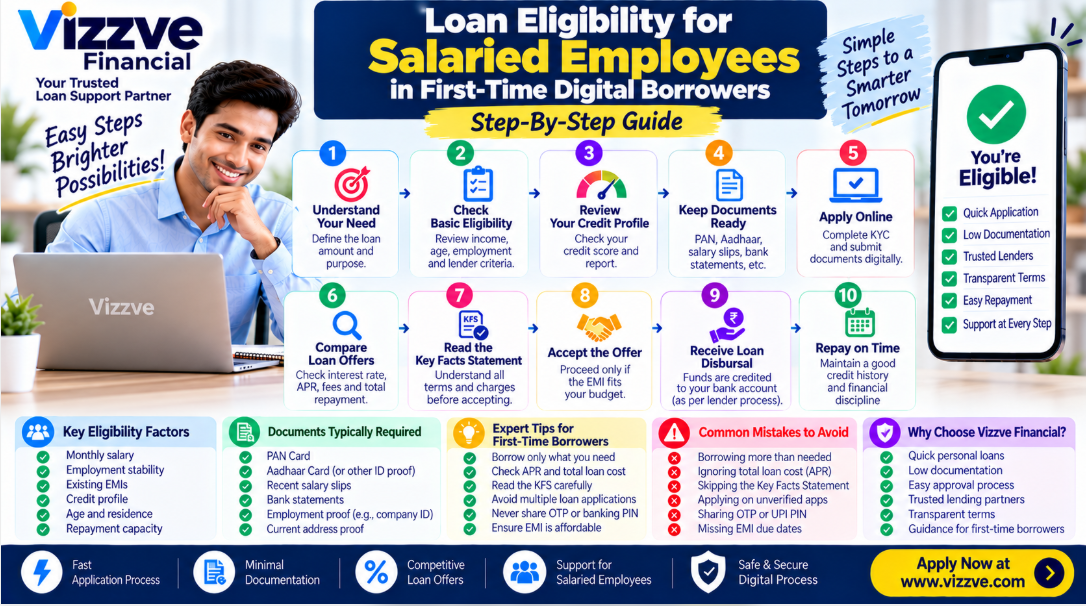
Introduction
Getting a first digital loan can feel easier than visiting a branch. You can check eligibility, submit documents and receive a loan decision online. But convenience should not mean rushing into borrowing.
For salaried employees applying for their first digital loan, the most important questions are simple:
- Am I eligible?
- How much can I comfortably repay?
- What documents will I need?
- Does my credit history matter?
- Is the lender or lending platform genuine?
- What is the actual cost of the loan?
- What should I check before accepting the offer?
The answers depend on the lender's underwriting policy, income, employment profile, existing obligations, credit history and other factors. There is no single salary or credit-score number that guarantees approval for every borrower.
For digital lending, the Reserve Bank of India (RBI) has introduced requirements covering transparency, customer protection, data collection and disclosure of loan costs. RBI's framework also requires regulated entities involved in digital lending to remain responsible for their lending-service-provider arrangements. System Health
This guide explains the process from checking eligibility to responsible repayment.
AI Answer Box: What Is Loan Eligibility for a First-Time Digital Borrower?
Loan eligibility is the lender's assessment of whether an applicant qualifies for a particular loan and, if so, the amount and terms that may be offered.
For a salaried first-time digital borrower, lenders may consider:
- Monthly income
- Employment stability
- Employer or job profile
- Existing EMIs and other obligations
- Credit history and credit report
- Age and location
- Banking or income information
- KYC information
- Requested loan amount and tenure
- Ability to repay the proposed EMI
Important: Being a first-time digital borrower does not automatically mean rejection. Likewise, having a salary does not guarantee approval.
The actual eligibility decision is made according to the lender's applicable credit policy.
What Does “First-Time Digital Borrower” Mean?
A first-time digital borrower is generally someone applying for credit through a digital channel and who may have little or no previous experience with digital loan applications.
This can include a salaried employee who:
- Has never taken a personal loan online.
- Has borrowed previously but is using a digital lending channel for the first time.
- Has limited credit history.
- Is unfamiliar with digital KYC and electronic loan documentation.
Being new to digital borrowing is different from having no credit history.
First-Time Digital Borrower vs First-Time Borrower
| Situation | Meaning |
|---|---|
| First-time borrower | Has little or no previous borrowing history |
| First-time digital borrower | May have borrowing history but is applying digitally for the first time |
| Existing digital borrower | Has previously used digital credit |
| New-to-credit customer | Has limited or no established credit history |
This distinction matters because a lender can evaluate applicants using different information depending on the product and its underwriting process.
Step 1: Understand Your Financial Requirement
Before checking eligibility, identify why you need the loan.
A loan may be considered for legitimate financial requirements such as:
- Medical or family expenses
- Education-related costs
- Home-related expenses
- Emergency requirements
- Debt consolidation, where appropriate
- Planned personal expenses
Avoid deciding the loan amount only because a lender shows a higher eligible amount.
Ask Yourself Four Questions
- How much do I actually need?
- Can I pay the EMI every month?
- Will the EMI affect rent, food and essential expenses?
- Will I still have money left for savings and emergencies?
A responsible borrowing decision starts with affordability, not the maximum loan amount available.
Step 2: Check Your Basic Loan Eligibility
Eligibility criteria vary between lenders and products. However, salaried applicants are commonly evaluated on several broad factors.
Common Eligibility Factors
| Factor | Why It Matters |
|---|---|
| Monthly salary | Indicates repayment capacity |
| Employment stability | Helps assess income continuity |
| Existing EMIs | Shows current debt burden |
| Credit history | Indicates previous repayment behaviour |
| Age | Must meet lender's applicable criteria |
| KYC | Helps establish identity |
| Bank/income records | May support income verification |
| Loan amount | Determines repayment obligation |
| Tenure | Affects monthly EMI and total interest |
Does Salary Alone Decide Loan Eligibility?
No.
A higher salary can support repayment capacity, but lenders may also consider existing liabilities, credit history, employment profile and other underwriting factors.
For example, two employees earning the same monthly salary could receive different outcomes if one has substantial existing EMIs and the other has lower financial obligations.
Step 3: Check Your Credit Profile
Credit history can be an important part of loan assessment.
RBI's financial-awareness material explains that credit scores and credit histories are used by banks and financial institutions along with other factors when assessing loans. Reserve Bank of India
For eligible individuals with credit history, RBI has also directed Credit Information Companies to provide one free full credit report, including the credit score, once each calendar year. Reserve Bank of India
What Should First-Time Borrowers Check?
Look for:
- Incorrect personal information
- Unknown loan accounts
- Incorrect overdue amounts
- Accounts that should already be closed
- Incorrect repayment records
- Duplicate accounts
- Unauthorised enquiries
If something appears incorrect, contact the relevant credit information company or lender and request correction.
Important Point for New Borrowers
If you have little or no credit history, do not assume that this automatically means a poor credit score.
A thin or limited credit file is different from a history of missed payments.
Step 4: Calculate Your Affordable EMI
This is one of the most important steps.
Suppose a salaried employee earns ₹50,000 per month and already spends ₹25,000 on essential expenses and ₹5,000 on existing debt obligations.
That leaves approximately ₹20,000 before considering savings and other variable expenses.
A new EMI should not simply consume the entire remaining amount.
Example Affordability Table
| Particular | Example Amount |
|---|---|
| Monthly take-home salary | ₹50,000 |
| Essential expenses | ₹25,000 |
| Existing EMI | ₹5,000 |
| Amount remaining | ₹20,000 |
| New EMI considered | ₹8,000 |
| Balance after new EMI | ₹12,000 |
This is only an illustration. A suitable EMI depends on the individual's complete financial situation.
Expert Perspective
A loan should fit into your monthly cash flow rather than forcing your monthly budget to fit around the loan.
A lower loan amount with a comfortable EMI can often be more practical than borrowing the maximum amount offered.
Step 5: Keep Your Documents Ready
Digital lending can reduce paperwork, but KYC and income verification may still be required depending on the lender and product.
Documents That May Be Requested
- PAN or other accepted identity document
- Aadhaar or another accepted KYC document
- Recent salary slips
- Bank statements
- Employment details
- Address information
- Employment ID or other employment proof, where applicable
- Additional documents requested by the lender
The exact documentation varies.
Digital Borrowing Tip
Only provide information requested for a legitimate lending process and understand why it is being collected.
RBI's digital-lending framework requires need-based data collection with explicit borrower consent and requires digital lending apps/lending service providers to follow applicable privacy and data-handling requirements. Reserve Bank of India
Step 6: Verify the Lender Before Applying
This is especially important for first-time digital borrowers.
A professional-looking website or mobile application does not by itself prove that a lending service is legitimate.
RBI announced a public repository to help customers verify the association of digital lending apps with regulated entities. Reserve Bank of India
Before Applying, Check:
- Who is the actual lender?
- Is the lender a regulated entity or working with one?
- Is the lender clearly identified in the application?
- Are loan terms disclosed clearly?
- Are charges explained before acceptance?
- Is there a proper grievance mechanism?
- Does the app request unnecessary permissions?
- Does the offer look unusually attractive compared with normal market terms?
Never share:
- OTPs
- UPI PINs
- Passwords
- ATM PINs
- Internet banking passwords
A legitimate loan process should not require you to disclose confidential authentication credentials.
Step 7: Compare the Actual Cost of the Loan
Do not compare loans using interest rate alone.
The overall cost can include applicable:
- Interest
- Processing charges
- GST or applicable taxes
- Penal charges, where applicable
- Other disclosed fees
- Prepayment or foreclosure-related charges, where applicable under the product terms
For digital lending, RBI requires important loan-cost information such as the Annual Percentage Rate (APR) to be disclosed, and the Key Facts Statement (KFS) provides borrowers with important information before entering into the loan contract. Reserve Bank of India
Interest Rate vs APR
| Term | Meaning |
|---|---|
| Interest rate | Cost of borrowing expressed through the applicable interest rate |
| APR | Broader annualised measure of the cost of credit |
| EMI | Regular instalment paid towards the loan |
| Processing fee | Fee that may be charged according to applicable terms |
| Total repayment | Overall amount paid over the loan period |
What Should You Compare?
Instead of asking only:
"Which loan has the lowest interest rate?"
also ask:
"How much will I actually repay from start to finish?"
Step 8: Read the Key Facts Statement Before Accepting
The KFS is particularly important for digital borrowers because it provides a concise summary of important loan terms.
Before accepting a loan, check:
- Loan amount
- Tenure
- APR
- EMI
- Repayment schedule
- Applicable charges
- Penal charges
- Other important terms
- Grievance-related information where applicable
RBI's digital-lending framework requires the KFS and relevant cost disclosures to be provided to borrowers. Reserve Bank of India
Simple Rule
Never accept a digital loan simply because the money is available quickly. Read the terms first.
Step 9: Complete the Digital Application Carefully
Once you have verified the lender and understood the terms, complete the application.
Typical Digital Loan Process
1. Check eligibility
↓
2. Enter basic information
↓
3. Complete KYC
↓
4. Provide income/employment information
↓
5. Submit required documents
↓
6. Underwriting and verification
↓
7. Review loan offer
↓
8. Read KFS and loan agreement
↓
9. Accept only if comfortable
↓
10. Disbursement, subject to lender approval
The exact process differs between lenders.
Step 10: Review the Loan Offer Before Accepting
Receiving an approval notification does not mean you have to accept the loan.
Review:
- Sanctioned amount
- Net amount disbursed
- Interest rate
- APR
- Processing fee
- EMI
- Number of EMIs
- Total repayment
- Due date
- Late-payment consequences
- Prepayment conditions
- Other contractual terms
A Useful Comparison
| Question | Offer A | Offer B |
|---|---|---|
| Loan amount | ₹1,00,000 | ₹1,00,000 |
| Tenure | 12 months | 18 months |
| Interest/APR | Check offer | Check offer |
| Processing fee | Check offer | Check offer |
| EMI | Check offer | Check offer |
| Total repayment | Check offer | Check offer |
| Prepayment terms | Check offer | Check offer |
Do not select an offer based only on the lowest EMI. A longer tenure may reduce the monthly instalment but can increase the total cost of borrowing.
Step 11: Accept the Loan Only If the EMI Fits Your Budget
This is where many first-time borrowers make a mistake.
An approved loan is not necessarily an affordable loan.
Before Accepting, Confirm:
- Your salary can comfortably support the EMI.
- You have accounted for existing EMIs.
- You have considered rent and household expenses.
- You have considered emergency expenses.
- You understand the total repayment.
- You have read the agreement.
If the EMI creates significant pressure on your monthly finances, consider borrowing less or postponing the loan if possible.
Step 12: Create a Repayment Plan
Once the loan is disbursed, repayment becomes your main responsibility.
Simple Repayment Strategy
Before the Due Date
- Keep sufficient balance in the repayment account.
- Check the EMI date.
- Track your loan statement.
- Keep a small cash-flow buffer.
- Avoid unnecessary new borrowing.
Every Month
- Check the upcoming EMI.
- Maintain sufficient funds.
- Verify that the payment has been processed.
- Save the payment confirmation.
- Review the outstanding balance periodically.
Consistent repayment can help establish a stronger credit history over time.
Common Mistakes First-Time Digital Borrowers Should Avoid
1. Borrowing More Than Needed
A higher eligibility amount is not an invitation to borrow the maximum.
2. Focusing Only on EMI
A low EMI can result from a longer tenure.
3. Ignoring APR
The interest rate alone may not show the complete cost.
4. Skipping the KFS
The KFS should be reviewed before accepting applicable digital loan offers.
5. Applying Through Unverified Apps
Always verify the actual lender and relevant regulated-entity association.
6. Sharing OTP or PIN
Never disclose confidential banking credentials.
7. Taking Multiple Loans at Once
Multiple new obligations can make repayment difficult.
8. Missing EMI Dates
Late repayment can result in additional consequences and may negatively affect credit history.
Pros and Cons of Digital Loans for First-Time Borrowers
| Pros | Cons |
|---|---|
| Convenient application | Easy access can encourage impulsive borrowing |
| Less physical paperwork | Digital fraud risks exist |
| Faster information processing | Terms must be carefully reviewed |
| Online document submission | Eligibility is not guaranteed |
| Easy repayment tracking | Missed payments can create financial stress |
How Salaried Employees Can Improve Loan Eligibility
If you are planning to apply for a loan, focus on financial health rather than trying to manipulate the application.
Practical Steps
- Maintain stable employment where possible.
- Pay existing EMIs on time.
- Keep credit-card utilisation under control.
- Avoid unnecessary credit applications.
- Correct errors in your credit report.
- Keep income documents organised.
- Reduce excessive existing debt.
- Borrow an amount that matches your repayment capacity.
- Maintain a reasonable emergency buffer.
There is no guaranteed "quick fix" that can make every applicant eligible.
Real-World Example
Consider a salaried employee earning ₹60,000 per month.
They have:
- Existing EMI: ₹7,000
- Household expenses: ₹25,000
- Savings contribution: ₹8,000
- Remaining flexible amount: ₹20,000
Suppose the employee wants a digital personal loan.
Instead of asking:
"What is the maximum amount I can get?"
the better question is:
"What EMI can I comfortably manage without disturbing essential expenses and savings?"
If the proposed EMI is ₹12,000, the employee should still consider unexpected expenses, salary interruptions and other financial commitments before accepting.
This example is illustrative. Actual eligibility and loan pricing are determined by the lender.
Key Takeaways
For salaried first-time digital borrowers, loan eligibility depends on more than salary. Income, employment profile, existing obligations, credit history, KYC information and repayment capacity can all matter.
Remember these points:
- Check your actual financial requirement first.
- Understand the lender's eligibility criteria.
- Review your credit report where applicable.
- Keep KYC and income documents ready.
- Verify the lender before sharing personal information.
- Compare APR and total repayment, not just interest rate.
- Read the KFS and loan agreement.
- Never share OTPs, PINs or passwords.
- Borrow only what you can comfortably repay.
- Set up a clear EMI repayment plan.
Vizzve Financial: Support for Your Loan Journey
Vizzve Financial is one of India’s trusted loan support platforms offering quick personal loans, low documentation, and an easy approval process. Apply at www.vizzve.com.
Loan approval and terms remain subject to the applicable lender's eligibility criteria, verification and credit assessment. Borrowers should review all applicable costs and terms before accepting any loan.
Frequently Asked Questions
1. Can a salaried employee apply for a digital loan for the first time?
Yes. Salaried employees can apply for eligible digital loan products, subject to the lender's criteria, verification and credit assessment.
2. Does being a first-time borrower mean my loan will be rejected?
No. Being new to borrowing does not automatically mean rejection. Lenders can use their own eligibility and underwriting criteria.
3. Is salary enough to qualify for a personal loan?
No. Salary is only one potential factor. Lenders may also consider existing obligations, employment profile, credit information and repayment capacity.
4. Can I get a digital loan without a credit history?
Some lenders may consider applicants with limited credit history, but policies differ. Having no credit history is not the same as having a poor repayment history.
5. What documents are usually required for a digital loan?
Depending on the lender and product, you may need KYC documents, salary slips, bank statements, employment information and address details.
6. Does a higher salary guarantee a higher loan amount?
No. Loan amounts are generally determined using multiple factors, including repayment capacity and the lender's credit policy.
7. Should I check my credit report before applying?
It can be useful, especially if you have an existing credit history. It allows you to identify potentially incorrect information before applying.
8. What is the most important thing to check before accepting a digital loan?
Review the KFS, APR, EMI, tenure, applicable charges and total repayment obligation before accepting the loan.
9. Is the lowest EMI always the best loan option?
No. A lower EMI can result from a longer repayment period. Compare the total repayment and overall cost.
10. Can multiple loan applications affect my credit profile?
Multiple credit applications may result in multiple credit enquiries, depending on how lenders report them. Avoid applying indiscriminately.
11. Can I repay a digital loan early?
Possibly, depending on the product and applicable terms. Check the loan agreement and applicable prepayment conditions before making an early repayment.
12. Should I share my OTP with a loan agent?
No. Never disclose OTPs, UPI PINs, passwords or other confidential authentication credentials.
13. How can I verify a digital lending app?
Check who the actual lender is and verify relevant regulated-entity association. RBI has also developed a public repository intended to help customers verify digital lending apps associated with regulated entities. Reserve Bank of India
14. What should I do if I find an error in my credit report?
Contact the relevant credit information company or lender and request correction. Keep supporting documentation and track the complaint through the applicable grievance process.
15. Is digital borrowing safe?
Digital borrowing can be convenient, but borrowers should use verified lending channels, understand the terms, protect their personal credentials and borrow responsibly.
Published on : 14th October 2026
Published by : G REDDY KUMAR
www.vizzve.com || www.vizzveservices.com
Follow us on social media: Facebook || Linkedin || Instagram
🛡 Powered by Vizzve Financial
RBI-Registered Loan Partner | 10 Lakh+ Customers | ₹600 Cr+ Disbursed