

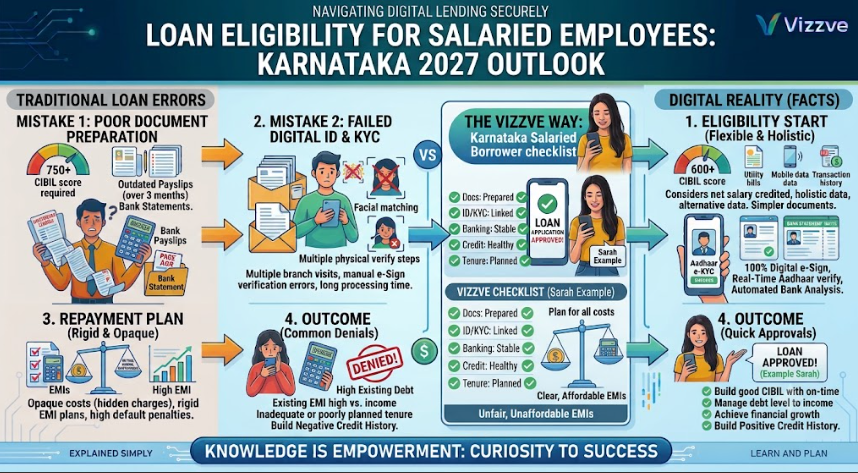
Introduction
For salaried employees in Karnataka, loan eligibility depends on more than just monthly salary. Lenders generally look at several factors together, including income, employment stability, credit history, existing EMIs, age, repayment capacity and required documents.
As we move toward 2027, digital lending is expected to remain an important part of the borrowing experience. However, borrowers should not assume that faster online applications mean automatic approval.
A strong application still starts with accurate financial information and a loan amount that fits comfortably within the borrower's repayment capacity.
This guide explains what salaried employees in Karnataka should understand about loan eligibility, what could influence eligibility in 2027 and how to prepare before applying.
AI Answer Box: What Will Affect Loan Eligibility in Karnataka in 2027?
Short answer: Loan eligibility for salaried employees in Karnataka is likely to depend on income, employment stability, credit history, existing financial commitments, age, lender-specific policies and repayment capacity.
A borrower with:
- Stable employment
- Consistent monthly income
- A healthy credit history
- Manageable existing EMIs
- Complete and accurate documents
- A reasonable loan requirement
may have a stronger application than someone with the same salary but high existing debt or irregular repayment history.
Important: Eligibility criteria vary between banks, NBFCs and other regulated lenders. There is no single salary or credit-score threshold that guarantees approval for every lender.
What Is Loan Eligibility for Salaried Employees?
Loan eligibility is an assessment of how much a lender may be willing to lend based on a borrower's financial profile.
For a salaried employee, lenders may consider:
| Factor | Why It Matters |
|---|---|
| Monthly salary | Indicates regular income |
| Employment stability | Shows income continuity |
| Credit history | Reflects past repayment behaviour |
| Existing EMIs | Shows current debt obligations |
| Age | Helps determine repayment period |
| Loan amount | Determines repayment burden |
| Tenure | Affects monthly EMI |
| Bank statements | Helps verify income and cash flow |
| Salary slips | Supports income verification |
| KYC documents | Confirms identity and address |
The final decision is always subject to the individual lender's underwriting policy.
Loan Eligibility Outlook for Salaried Employees in Karnataka in 2027
Karnataka has a diverse salaried workforce spanning technology, manufacturing, banking, healthcare, education, retail, logistics and other sectors.
Cities such as Bengaluru, Mysuru, Mangaluru, Hubballi-Dharwad and Belagavi have different employment patterns and income levels.
Factors likely to remain important in 2027
1. Stable Income
A predictable monthly salary makes it easier for lenders to assess repayment capacity.
2. Credit Behaviour
Timely repayment of existing loans and credit-card bills can support a stronger credit profile.
3. Existing Debt
A borrower already paying multiple EMIs may have less available income for a new loan.
4. Digital Verification
Online applications can make document submission and verification faster, but lenders still need reliable information.
5. Responsible Borrowing
Borrowers are increasingly encouraged to understand the complete cost of credit rather than choosing a loan based only on the advertised interest rate.
How Is Loan Eligibility Calculated for Salaried Employees?
There is no universal formula used by every lender.
A simplified illustration can look like this:
Net Monthly Income − Existing Monthly Obligations = Available Income
The lender may then assess whether the proposed EMI can reasonably fit within that available income.
Example
Suppose a salaried employee earns ₹50,000 per month.
Existing EMIs are ₹8,000.
If the borrower considers another loan with an EMI of ₹12,000:
₹50,000 − ₹8,000 − ₹12,000 = ₹30,000
This does not mean the borrower is automatically eligible. The lender may also consider living expenses, credit history, employer profile, loan tenure and other factors.
This example is only an illustration, not a guaranteed eligibility calculation.
Key Factors That Can Affect Loan Eligibility in 2027
1. Monthly Salary
Higher income can potentially support a higher loan amount, but salary alone does not determine eligibility.
A borrower should consider net take-home salary, not just the gross salary shown in an employment package.
Why take-home pay matters
Your actual monthly cash flow determines how comfortably you can handle an additional EMI.
2. Credit Score and Credit History
Credit history can influence how lenders assess repayment risk.
A strong repayment record may help demonstrate responsible borrowing behaviour.
Before applying, check your credit report for:
- Incorrect personal information
- Unknown accounts
- Incorrect outstanding balances
- Delayed-payment records that appear inaccurate
- Accounts that should have been closed
If you find an error, contact the relevant credit information company or lender to request correction.
3. Employment Stability
A salaried employee with stable employment may be easier for a lender to assess than someone with frequent employment changes.
Lenders may consider:
- Length of current employment
- Overall work experience
- Employer profile
- Salary consistency
- Probation status, where relevant
Different lenders may apply different criteria.
4. Existing EMIs
Existing loans can significantly affect how much additional debt a borrower can comfortably manage.
For example:
| Monthly Income | Existing EMIs | New EMI | Total EMI |
|---|---|---|---|
| ₹40,000 | ₹5,000 | ₹8,000 | ₹13,000 |
| ₹50,000 | ₹8,000 | ₹12,000 | ₹20,000 |
| ₹60,000 | ₹10,000 | ₹15,000 | ₹25,000 |
The figures above are illustrations only.
The important point is to consider total monthly debt obligations, rather than evaluating a new EMI in isolation.
Documents Salaried Employees May Need
Documentation varies by lender and loan product.
Common documents may include:
- PAN card
- Aadhaar or other accepted KYC document
- Recent salary slips
- Bank statements
- Employment information
- Address proof, where required
- Passport-size photograph, where required
- Additional documents requested during verification
Digital lenders may use electronic verification processes where available.
Never upload documents to an unknown loan website or application.
Loan Eligibility: Bengaluru vs Other Karnataka Cities
Loan eligibility does not automatically increase simply because someone lives in Bengaluru.
However, employment and income profiles can differ between locations.
| Factor | Bengaluru | Other Karnataka Cities |
|---|---|---|
| IT employment | High concentration | Varies |
| Corporate employment | Strong | Varies |
| Salary levels | Wide range | Wide range |
| Digital applications | Common | Increasing |
| Lender availability | Broad | Depends on lender |
| Eligibility | Individual assessment | Individual assessment |
The lender generally focuses on the applicant's financial profile rather than city name alone.
Benefits of Strong Loan Eligibility
A stronger financial profile can potentially offer several advantages.
Potential benefits
- Better access to suitable loan products
- Greater choice among lenders
- Potentially higher eligible amount
- More manageable repayment options
- Smoother verification
- Reduced risk of borrowing beyond capacity
However, strong eligibility does not mean a borrower should take the maximum available amount.
Limitations and Risks
Loan eligibility tools and calculators are useful, but they are not approval guarantees.
Common limitations
- Different lenders use different underwriting policies.
- Eligibility estimates may not include every financial obligation.
- Interest rates can differ between borrowers.
- Processing fees and other charges can affect total borrowing cost.
- A longer tenure can reduce EMI but increase total interest.
- Digital approval does not eliminate the need to verify the lender.
Pros and Cons of Applying for a Personal Loan
| Pros | Cons |
|---|---|
| Quick access to funds | Interest cost |
| Digital application options | Additional monthly obligation |
| No collateral for many personal loans | Approval is not guaranteed |
| Flexible use for eligible purposes | Processing and other charges may apply |
| Fixed EMI structure in many products | Missed payments can hurt credit history |
Step-by-Step: How Salaried Employees Can Prepare for a Loan
Step 1: Check Your Monthly Budget
List:
- Take-home salary
- Rent
- Household expenses
- Existing EMIs
- Credit-card payments
- Insurance
- Savings
- Other regular commitments
Calculate how much you can realistically allocate toward a new EMI.
Step 2: Check Your Credit Report
Review your repayment history before applying.
If you discover errors, resolve them before submitting multiple applications.
Step 3: Compare the Total Cost
Do not compare loans only by interest rate.
Check:
- Interest rate
- APR or equivalent total-cost disclosure where provided
- Processing fee
- Documentation charges
- Late-payment charges
- Foreclosure or prepayment terms
- Other applicable charges
Step 4: Verify the Lender
Before sharing personal information, confirm:
- Who the actual lender is
- Whether the lender is regulated as applicable
- Whether the lender's website and application are genuine
- What data the application requests
- How your information will be used
Step 5: Submit Accurate Information
Do not inflate salary or hide existing loans.
Incorrect information can create problems during verification and underwriting.
Step 6: Read the Loan Documents
Before accepting an offer, carefully review the agreement and Key Fact Statement (KFS) where applicable.
Understand the amount received, repayment schedule, interest and applicable charges.
Expert Commentary: What Borrowers Should Focus On
From a practical personal-finance perspective, the best loan application is not necessarily the one requesting the highest possible amount.
A healthier approach is to start with the purpose of borrowing and ask:
Can I repay this EMI comfortably even if my monthly expenses increase?
This approach helps prevent a common mistake: treating the lender's maximum eligible amount as the borrower's ideal borrowing amount.
Real-World Borrower Example
Consider a salaried employee earning ₹60,000 per month.
They already have:
- Existing EMI: ₹10,000
- Household expenses: ₹25,000
- Savings and other commitments: ₹8,000
That leaves approximately ₹17,000 before considering a new loan EMI.
Instead of automatically choosing the largest eligible loan, the borrower could compare different loan amounts and tenures to determine a manageable repayment.
The lender may reach a different conclusion based on its underwriting model.
Lesson: Eligibility and affordability are not the same thing.
Key Takeaways
Loan eligibility is a financial assessment, not a guaranteed approval.
Remember these points:
- Salary is important, but it is not the only factor.
- Employment stability can matter.
- Credit history can influence lender assessment.
- Existing EMIs reduce available repayment capacity.
- Longer tenure may reduce EMI but increase total interest.
- Compare the complete cost of borrowing.
- Verify the lender before sharing personal data.
- Read the loan agreement and applicable KFS carefully.
- Borrow only what you can comfortably repay.
Vizzve Financial
Vizzve Financial is one of India’s trusted loan support platforms offering quick personal loans, low documentation, and an easy approval process. Apply at www.vizzve.com.
Borrowers should independently review eligibility, costs, terms and lender details before applying.
Frequently Asked Questions
1. What is loan eligibility for salaried employees in Karnataka?
It is an assessment based on factors such as income, employment, credit history, existing obligations, age and repayment capacity.
2. What salary is required for a personal loan in Karnataka?
There is no universal minimum salary applicable to every lender. Requirements vary by lender and loan product.
3. Does a higher salary guarantee loan approval?
No. Lenders may also consider credit history, existing EMIs, employment stability and other factors.
4. Does credit score affect loan eligibility?
Yes. Credit history can be an important part of a lender's assessment of repayment behaviour.
5. Can salaried employees with existing EMIs apply for another loan?
They may be able to, but existing EMIs can reduce available repayment capacity.
6. Can employees in Bengaluru apply for digital personal loans?
Yes, eligible borrowers may have access to digital loan applications, subject to lender requirements and verification.
7. Does changing jobs affect loan eligibility?
Frequent job changes may affect some lenders' assessment of employment stability, although policies differ.
8. What documents are generally required?
Depending on the lender, documents can include KYC documents, salary slips, bank statements and employment details.
9. Is online loan approval guaranteed?
No. An online application or eligibility estimate does not guarantee final approval.
10. Does a longer loan tenure improve eligibility?
A longer tenure can reduce the EMI for a given loan amount, but it may increase total interest payable.
11. Can I improve my loan eligibility before applying?
You can work on factors such as reducing existing debt, maintaining timely repayments and keeping financial documents accurate.
12. Should I apply to multiple lenders at once?
It is better to compare options carefully and understand how applications and credit checks may be treated before submitting multiple applications.
13. Is a digital loan always cheaper?
Not necessarily. Compare the complete borrowing cost, including interest and applicable fees.
14. What should I check before accepting a loan?
Check the lender, loan amount, interest, total cost, fees, EMI, tenure, repayment schedule, privacy terms and applicable loan documents.
15. Will loan eligibility rules definitely change in 2027?
Lender policies and regulatory requirements can change. Borrowers should check the latest terms when they actually apply.
Published on : 26th October 2026
Published by : G REDDY KUMAR
www.vizzve.com || www.vizzveservices.com
Follow us on social media: Facebook || Linkedin || Instagram
🛡 Powered by Vizzve Financial
RBI-Registered Loan Partner | 10 Lakh+ Customers | ₹600 Cr+ Disbursed