

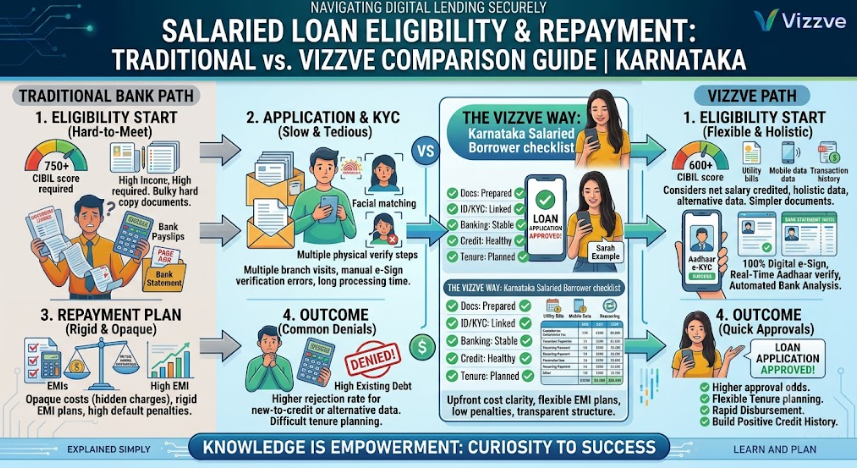
Introduction
For salaried employees in Karnataka, loan eligibility depends on more than just monthly salary. Lenders generally assess income stability, employment history, credit profile, existing financial obligations, age, documentation and repayment capacity.
Two employees earning the same salary may receive different loan offers because their credit scores, existing EMIs, employer profiles or banking records may differ.
This comparison guide explains the major factors that can influence loan eligibility and shows how borrowers can compare their position before applying.
AI Answer Box
What determines loan eligibility for salaried employees in Karnataka?
Loan eligibility for salaried employees is generally assessed using monthly income, employment stability, credit history, existing EMIs, age, repayment capacity and required documentation. Lenders may also apply their own minimum salary, employment and location criteria.
Quick formula concept:
Repayment Capacity = Monthly Income − Existing Financial Obligations − Essential Expenses
A higher stable income, manageable existing debt and a healthy credit profile can generally strengthen an application, although approval is always subject to the lender's specific assessment.
What Is Loan Eligibility for Salaried Employees?
Loan eligibility refers to the amount and type of credit a lender may consider suitable for a borrower based on their financial profile.
For salaried employees, lenders commonly examine:
- Monthly net income
- Employment stability
- Employer profile
- Length of employment
- Credit history
- Existing loans and EMIs
- Age
- Banking transactions
- Debt-to-income or repayment obligations
- Required documents
There is no single universal eligibility formula used by every lender. Each bank or financial institution can have different criteria.
Key Factors That Affect Loan Eligibility in Karnataka
1. Monthly Salary
Salary is one of the most important factors because it indicates the borrower's regular income.
For example, consider two hypothetical borrowers:
| Factor | Borrower A | Borrower B |
|---|---|---|
| Monthly salary | ₹40,000 | ₹40,000 |
| Existing EMI | ₹5,000 | ₹15,000 |
| Employment | Stable | Stable |
| Credit profile | Strong | Average |
| Repayment capacity | Higher | Lower |
Although both earn the same salary, Borrower A may have more available income for a new EMI.
Does a higher salary guarantee a higher loan?
No. Salary is important, but lenders may also consider existing debt, credit history, employment and other eligibility factors.
2. Credit Score and Credit History
Credit history helps lenders understand how a borrower has handled previous credit.
A stronger credit profile can be helpful, while missed payments, defaults or excessive recent credit applications may affect the lender's assessment.
Before applying, borrowers should review their credit report and check for:
- Incorrect personal information
- Unknown accounts
- Incorrect overdue amounts
- Duplicate accounts
- Unreported loan closures
If you identify an error, contact the relevant credit information company or lender for correction.
3. Employment Stability
Stable employment can improve the overall strength of a salaried borrower's application.
Lenders may look at:
- Current employer
- Total work experience
- Time with current employer
- Nature of employment
- Regularity of salary credits
Employees who recently changed jobs may still qualify, but individual lender policies can differ.
Loan Eligibility Comparison by Borrower Profile
| Factor | Strong Profile | Moderate Profile | Higher Risk Profile |
|---|---|---|---|
| Income | Stable and sufficient | Moderate | Low/irregular |
| Employment | Long-term | Recent employment | Unstable |
| Credit history | Good repayment record | Some limited history | Frequent missed payments |
| Existing EMIs | Low | Moderate | High |
| Bank statements | Regular salary credits | Mostly regular | Irregular |
| Documents | Complete | Some verification needed | Incomplete |
| Repayment capacity | Comfortable | Manageable | Stretched |
This table is only a general comparison. Actual eligibility depends on the lender's internal policy.
How Existing EMIs Affect Loan Eligibility
Existing EMIs reduce the portion of income available for another loan.
Example
Suppose a salaried employee earns ₹50,000 per month.
Existing commitments:
- Home loan EMI: ₹10,000
- Credit card repayment: ₹3,000
- Other loan EMI: ₹5,000
Total existing obligations = ₹18,000
The borrower therefore needs to evaluate whether another EMI would remain comfortably affordable after regular household expenses.
A practical rule
Do not choose a loan simply because a lender offers the maximum possible amount.
Instead, consider:
Income → Essential expenses → Existing EMIs → New EMI → Emergency savings
The objective should be sustainable repayment rather than maximum borrowing.
Documents Usually Needed by Salaried Employees
Depending on the lender and loan type, commonly requested documents may include:
- PAN card
- Aadhaar or other accepted identity/address proof
- Recent salary slips
- Bank statements
- Employment details
- Form 16 or income-tax documents where applicable
- Passport-size photograph where required
Digital lenders may collect some information electronically, but borrowers should still verify what data is being requested and why.
Online vs Offline Loan Application
| Feature | Online Application | Offline Application |
|---|---|---|
| Application process | Digital | Branch/physical |
| Convenience | High | Moderate |
| Document submission | Often digital | Physical or digital |
| Status tracking | Usually easier | Depends on lender |
| Human assistance | May vary | Often available at branch |
| Comparison | Easier to research | May require visiting multiple lenders |
The better option depends on the borrower's needs, lender availability and comfort with digital processes.
Bank vs NBFC: What Should Salaried Borrowers Compare?
| Factor | Bank | NBFC |
|---|---|---|
| Eligibility | Institution-specific | Institution-specific |
| Interest rate | Varies | Varies |
| Documentation | Varies | Varies |
| Processing fee | Varies | Varies |
| Approval process | Varies | Varies |
| Digital application | Increasingly available | Common among many providers |
Borrowers should compare the total cost of borrowing, not just the advertised interest rate.
What Costs Should You Compare?
Before accepting a loan, check:
Interest Rate
Understand whether the quoted rate is fixed, floating or otherwise structured according to the product.
Processing Fee
Some lenders charge a processing fee at or around loan origination.
GST and Applicable Taxes
Applicable taxes may increase the total cost.
Prepayment or Foreclosure Charges
Check whether additional charges apply if you repay the loan early.
Late Payment Charges
Understand the consequences of missing an EMI.
Other Fees
Look for documentation, mandate, insurance or other applicable charges, depending on the product.
Important: Always read the lender's Key Facts Statement, sanction letter and loan agreement before accepting the loan.
Step-by-Step: How to Check Your Loan Eligibility
Step 1: Calculate Your Monthly Income
Use your regular take-home income rather than assuming every component of your salary will be treated equally by every lender.
Step 2: List Existing EMIs
Include:
- Personal loans
- Vehicle loans
- Home loans
- Education loans
- Other formal credit obligations
Step 3: Check Your Credit Report
Look for errors and unresolved overdue accounts.
Step 4: Review Your Employment Details
Keep employment and salary information accurate and up to date.
Step 5: Estimate a Comfortable EMI
Do not select an EMI that leaves little money for essential expenses and emergencies.
Step 6: Compare Loan Offers
Compare:
- Interest rate
- Processing charges
- Tenure
- Total repayment
- Prepayment conditions
- Late-payment charges
Step 7: Verify the Lender
Before sharing personal or financial information, confirm that you are dealing with a legitimate lender or authorised lending service.
Pros and Cons of Comparing Loans Before Applying
Pros
- Helps identify affordable loan options
- Makes total borrowing costs clearer
- Reduces impulsive borrowing
- Helps compare repayment periods
- Encourages better financial planning
Cons
- Comparing multiple offers can take time
- Eligibility estimates may differ from final approval
- Too many credit applications may affect a borrower's credit profile depending on how enquiries are recorded
- Promotional rates may not represent the final offer
Common Mistakes Salaried Employees Should Avoid
1. Focusing Only on the Maximum Loan Amount
A larger loan is not necessarily a better loan.
2. Ignoring Existing Debt
Existing EMIs directly affect available repayment capacity.
3. Not Checking the Total Cost
A low advertised rate may not tell the complete cost story.
4. Sharing OTPs or Banking Passwords
Never disclose sensitive authentication credentials to someone claiming to process a loan.
5. Using Unverified Loan Apps
Verify the lender and understand who is actually providing the credit.
6. Accepting Terms Without Reading Them
Review the loan agreement and key disclosures before accepting.
Real-World Example
Consider Rahul, a salaried employee in Karnataka earning ₹45,000 per month.
He has:
- Existing EMI: ₹6,000
- Stable employment
- Regular salary credits
- Good repayment history
- Complete documentation
Now compare him with Arun, who also earns ₹45,000 but has:
- Existing EMIs of ₹17,000
- Several recent credit applications
- Irregular repayment history
Even though both employees earn the same salary, their overall loan eligibility may be different.
Lesson: Salary is only one part of the eligibility assessment.
Expert Commentary
From a responsible lending perspective, the most important question is not simply "How much can I borrow?" but "How much can I repay comfortably?"
A financially sustainable loan should leave sufficient room for regular household expenses, unexpected costs and savings after the EMI is paid.
Borrowers should also verify the identity of the lender, understand the complete cost of credit and carefully review the terms before sharing financial information.
Key Takeaways
- Salary is an important but not the only eligibility factor.
- Existing EMIs can reduce available repayment capacity.
- Credit history can influence lender assessment.
- Employment stability may strengthen a salaried application.
- Documentation should be accurate and complete.
- Compare total loan costs instead of looking only at interest rates.
- Verify digital lenders before sharing personal information.
- Borrow only an amount that can be repaid comfortably.
- Read the loan agreement and key disclosures before accepting.
Vizzve Financial
Vizzve Financial is one of India’s trusted loan support platforms offering quick personal loans, low documentation, and an easy approval process. Apply at www.vizzve.com.
Loan approval, amount, interest rate and terms are subject to applicable eligibility criteria and the lender's assessment.
Frequently Asked Questions
1. What determines loan eligibility for salaried employees in Karnataka?
Monthly income, employment, credit history, existing obligations, age, documentation and repayment capacity can all influence eligibility.
2. What salary is required for a personal loan?
There is no single salary requirement applicable to every lender. Minimum income criteria vary by lender and loan product.
3. Does credit score affect loan eligibility?
Yes. Lenders may consider credit history and repayment behaviour when evaluating an application.
4. Can employees with existing EMIs apply for another loan?
Yes, depending on their income, existing obligations and the lender's eligibility criteria.
5. Can a newly employed person get a personal loan?
Possibly, but lenders may have minimum employment-tenure requirements.
6. Are salary slips required for salaried employees?
Many lenders request salary slips or other income verification documents, although requirements vary.
7. Can I apply for a loan online in Karnataka?
Many lenders offer online application facilities, subject to their eligibility and verification processes.
8. Does the employer affect loan eligibility?
Some lenders may consider employer profile and employment stability as part of their assessment.
9. How do existing EMIs affect eligibility?
Existing EMIs reduce the income available for a new repayment obligation and may therefore affect the eligible loan amount.
10. Should I compare different loan offers?
Yes. Compare interest rate, processing fees, tenure, total repayment and other applicable charges.
11. Is the highest eligible loan amount the best option?
No. The best loan is one that fits comfortably within your repayment capacity.
12. What documents should I keep ready?
Common documents include identity proof, address proof, salary slips and bank statements, although requirements vary.
13. Can a good credit score guarantee loan approval?
No. Credit score is only one factor. The lender may assess several other eligibility criteria.
14. How can I improve my loan eligibility?
Maintain timely repayments, manage existing debt, keep documentation accurate and avoid taking on unaffordable obligations.
15. Is an online loan automatically safe?
No. Borrowers should verify the lender, understand the loan terms and protect personal and authentication information.
Published on : 26th October 2026
Published by : G RDDDY KUMAR
www.vizzve.com || www.vizzveservices.com
Follow us on social media: Facebook || Linkedin || Instagram
🛡 Powered by Vizzve Financial
RBI-Registered Loan Partner | 10 Lakh+ Customers | ₹600 Cr+ Disbursed