

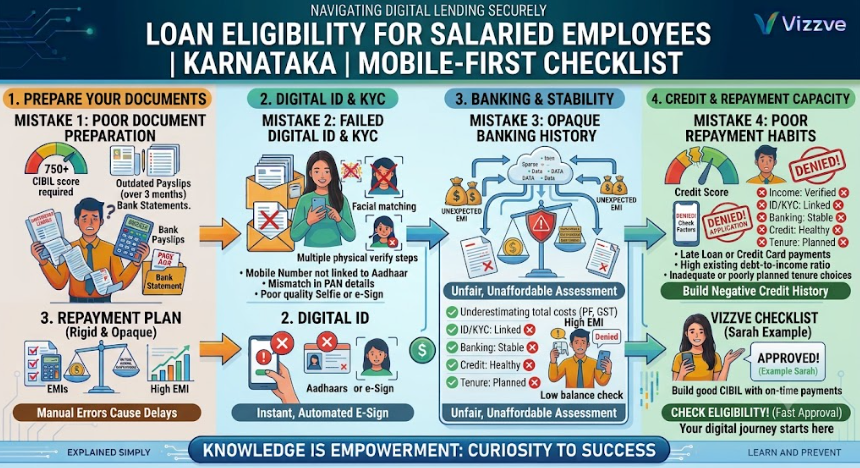
Introduction
For salaried employees in Karnataka, loan eligibility usually depends on more than just monthly salary. Lenders may consider income, employment stability, credit history, existing EMIs, age, repayment capacity, employer profile and the documents submitted with the application.
A salaried employee with a stable income and manageable financial commitments may have a stronger loan application than someone earning the same salary but carrying several existing loans.
The good news is that borrowers can improve several of these factors before applying.
AI Answer Box: What Determines Loan Eligibility for Salaried Employees in Karnataka?
Short answer: Loan eligibility for a salaried employee in Karnataka is generally assessed using income, employment stability, credit history, existing financial obligations, age, repayment capacity and lender-specific policies.
Key factors include:
- Monthly net salary
- Employment and income stability
- Credit score and repayment history
- Existing loans and EMIs
- Age and remaining working period
- Employer profile
- Bank-account transactions
- Required documents
- Requested loan amount and tenure
Important: Eligibility criteria, interest rates, fees and maximum loan amounts vary between lenders. Meeting basic criteria does not guarantee loan approval.
What Is Loan Eligibility for Salaried Employees?
Loan eligibility is an assessment of whether a borrower is financially capable of repaying a proposed loan.
For salaried employees, lenders may look at:
| Factor | Why It Matters |
|---|---|
| Monthly income | Indicates repayment capacity |
| Employment stability | Shows income continuity |
| Credit history | Indicates past repayment behaviour |
| Existing EMIs | Shows current financial commitments |
| Age | Helps assess loan tenure and repayment period |
| Employer profile | May be considered as part of underwriting |
| Bank statements | Help verify income and transactions |
| Loan amount requested | Determines expected repayment burden |
| Loan tenure | Influences monthly EMI |
There is no single salary or credit-score rule that applies to every lender.
How Is Personal Loan Eligibility Calculated for Salaried Employees?
1. Monthly Income
Monthly income is one of the most important factors.
A higher stable income can provide greater repayment capacity, but lenders may consider net take-home salary rather than simply looking at the gross salary.
For example, an employee earning ₹50,000 per month but already paying several EMIs may have less available income than an employee earning ₹45,000 with minimal debt.
2. Existing EMIs
Existing financial obligations can reduce the amount available for a new loan.
Lenders may evaluate:
- Current personal-loan EMIs
- Home-loan EMIs
- Vehicle-loan EMIs
- Credit-card obligations
- Other reported liabilities
Real-world point: Borrowers sometimes focus only on their salary and forget that existing EMIs can significantly affect the amount they can comfortably repay.
3. Credit History
Your credit report provides lenders with information about previous borrowing and repayment behaviour.
Factors that can influence your credit profile include:
- Timely repayment
- Credit utilisation
- Number of active accounts
- Recent loan applications
- Outstanding dues
- Length of credit history
A healthy credit history can strengthen a loan application, although lenders use their own underwriting criteria.
What Credit Score Is Needed for a Personal Loan in Karnataka?
There is no universal credit-score cutoff applicable to every lender.
Many lenders consider a stronger credit history more favourably, but approval can depend on several factors together.
Before applying, check:
- Whether existing accounts are reported correctly
- Whether any payments are overdue
- Your credit-card utilisation
- Recent credit enquiries
- Outstanding balances
If you discover an error in your credit report, consider raising a dispute with the relevant credit information company before applying for new credit.
Employment Stability and Loan Eligibility
Stable employment can make a loan application easier to assess because it indicates a more predictable source of repayment.
Lenders may consider:
- Current employer
- Length of employment
- Nature of employment
- Salary consistency
- Probation status
- Industry or employer profile, depending on lender policy
An employee who recently changed jobs may still qualify, but the lender may apply different criteria.
How Much Loan Can a Salaried Employee Get?
There is no fixed loan amount based solely on salary.
A lender may consider the relationship between:
Income + existing obligations + credit profile + requested tenure + lender policy
For example, two employees with identical salaries may receive different eligibility assessments because one has multiple existing EMIs while the other has fewer financial commitments.
Simple illustration
Suppose:
- Monthly take-home salary: ₹50,000
- Existing EMIs: ₹10,000
- Other regular commitments: ₹5,000
The employee has ₹35,000 remaining before considering the proposed new EMI and other household expenses.
This is only an illustration—not a lender's eligibility formula.
Documents Usually Required for Salaried Employees
Depending on the lender and loan product, applicants may be asked for:
Identity and Address
- PAN
- Aadhaar or another accepted identity document
- Address proof, where required
Income Documents
- Recent salary slips
- Bank statements
- Form 16 or income-tax documents, where applicable
Employment Information
- Employer details
- Employment history
- Official work email or other verification, depending on the lender
Tip: Submit accurate and consistent information. Differences between application details, salary records and bank transactions can lead to additional verification.
Step-by-Step: How to Check Loan Eligibility Before Applying
Step 1: Check Your Monthly Take-Home Salary
Use your actual monthly income rather than estimating from annual CTC.
Step 2: List All Existing EMIs
Write down every active loan and monthly repayment.
Step 3: Review Your Credit Report
Check for overdue payments, incorrect information and unfamiliar accounts.
Step 4: Estimate Affordable EMI
Don't choose an EMI simply because a lender offers the amount.
Consider:
- Rent or home expenses
- Food and utilities
- Family commitments
- Insurance
- Existing EMIs
- Emergency savings
Step 5: Prepare Your Documents
Keep salary slips, bank statements and identity documents ready.
Step 6: Compare the Total Cost
Don't compare loans only by interest rate. Check:
- Interest rate
- Processing fee
- GST or applicable taxes
- Prepayment or foreclosure charges, if applicable
- Late-payment charges
- Other disclosed fees
Step 7: Apply Through a Verified Lender or Platform
Before submitting personal information, verify who is actually providing the credit and review the applicable terms and privacy information.
Loan Eligibility: Salary vs Existing EMI
| Situation | Possible Effect |
|---|---|
| Stable salary + low existing EMI | Generally stronger repayment capacity |
| Higher salary + high existing EMI | New-loan capacity may be reduced |
| Stable salary + good repayment history | Can strengthen application |
| Recently started employment | May require additional eligibility checks |
| Irregular income records | May require additional verification |
| High credit-card utilisation | May affect credit assessment |
Factors That Can Improve Loan Eligibility
1. Maintain Timely Repayments
Pay EMIs and credit-card dues on time.
2. Keep Debt Manageable
Avoid taking a new loan when existing obligations already consume a large portion of your income.
3. Maintain Accurate Financial Records
Make sure your salary credits and financial documents are consistent.
4. Avoid Unnecessary Loan Applications
Applying for several loans within a short period can result in multiple credit enquiries and may affect how lenders assess your application.
5. Choose a Suitable Loan Amount
Borrow only what you can realistically repay.
Benefits and Limitations of Salaried Employee Loans
Benefits
- Predictable monthly income
- Easier income verification
- Regular salary credits
- Potentially simpler documentation
- EMI-based repayment structure
Limitations
- Existing EMIs can reduce eligibility
- Job changes may affect assessment
- Credit history matters
- Eligibility differs between lenders
- Approval is not guaranteed based on salary alone
What Should Salaried Employees in Karnataka Check Before Applying?
Use this quick checklist:
- Monthly take-home salary
- Existing loan EMIs
- Credit report
- Credit-card balances
- Employment stability
- Required documents
- Proposed loan amount
- Expected EMI
- Interest rate
- Processing fee
- Other applicable charges
- Prepayment/foreclosure conditions
- Privacy policy and data permissions
- Lender/platform verification
Expert Commentary: Don't Judge Affordability by Salary Alone
From a responsible lending perspective, the key question is not simply "How much do I earn?"
The better question is:
"How much can I comfortably repay every month without damaging my regular household finances?"
A loan should fit within the borrower's overall financial situation. A larger approved amount is not necessarily a better outcome if the resulting EMI creates financial pressure.
Common Mistakes Salaried Borrowers Should Avoid
Mistake 1: Applying Without Checking Existing Debt
Existing EMIs can materially affect affordability.
Mistake 2: Looking Only at Interest Rate
A loan's total cost can include fees and other charges.
Mistake 3: Entering Incorrect Information
Never inflate income or employment details to improve eligibility.
Mistake 4: Ignoring Data Privacy
Read what information an application requests and why it is required.
Mistake 5: Borrowing the Maximum Available Amount
Eligibility and affordability are not the same thing.
Key Takeaways
- Loan eligibility depends on more than salary.
- Existing EMIs can reduce borrowing capacity.
- Credit history is an important part of loan assessment.
- Stable employment can support income verification.
- Documents should be accurate and consistent.
- Compare the total cost of borrowing, not just the interest rate.
- Borrow only an amount that fits comfortably within your repayment capacity.
- Always verify the lender and understand how your personal data will be used.
Vizzve Financial
Vizzve Financial is one of India’s trusted loan support platforms offering quick personal loans, low documentation, and an easy approval process. Apply at www.vizzve.com.
Before applying, borrowers should review the applicable loan terms, eligibility requirements, charges and privacy information carefully.
FAQs
1. What is loan eligibility for salaried employees in Karnataka?
It is an assessment of a salaried borrower's ability to repay a proposed loan based on factors such as income, credit history, existing obligations and lender-specific criteria.
2. Does salary determine personal loan eligibility?
Salary is an important factor, but lenders may also consider credit history, existing EMIs, employment stability, age and other information.
3. Can salaried employees apply for personal loans online?
Yes, many lenders and digital lending platforms provide online application processes, subject to their eligibility requirements and verification procedures.
4. Does a credit score affect loan eligibility?
Yes. Credit history can influence how a lender assesses repayment risk, although the importance and minimum requirements vary by lender.
5. Do existing EMIs reduce personal loan eligibility?
They can. Existing EMIs reduce the income available for another repayment obligation and may therefore affect the eligible loan amount.
6. What documents are needed for a salaried personal loan?
Depending on the lender, documents may include identity proof, address proof, salary slips, bank statements and employment or income-related documents.
7. Can a recently employed person get a personal loan?
Possibly. Eligibility depends on the lender's employment-tenure requirements and other factors.
8. Is there a minimum salary requirement?
Some lenders may specify minimum income requirements, but these differ by lender, location, loan product and applicant profile.
9. How can I improve my loan eligibility?
Maintain timely repayments, keep existing debt manageable, maintain accurate financial records and choose a loan amount that matches your repayment capacity.
10. Does changing jobs affect loan eligibility?
It can. Lenders may consider employment tenure and income stability as part of their assessment.
11. Can I get a loan with an average credit score?
It may be possible, but the available loan amount, pricing or approval decision can vary depending on the lender's overall assessment.
12. Should I apply to several lenders at once?
It is generally better to compare suitable options first and avoid unnecessary applications, as multiple formal credit enquiries may affect your credit profile.
13. How do I calculate an affordable EMI?
Start with your take-home income, subtract essential expenses and existing obligations, and then determine an EMI that leaves sufficient room for savings and unexpected expenses.
14. Is online loan application safe?
It can be safe when you use a verified lender or legitimate platform, check the website/application permissions and understand how your personal information will be handled.
15. Does loan eligibility guarantee approval?
No. Eligibility checks are only one part of the process. Final approval depends on the lender's underwriting, verification and applicable policies.
Published on : 27th October 2026
Published by : G REDDY KUMAR
www.vizzve.com || www.vizzveservices.com
Follow us on social media: Facebook || Linkedin || Instagram
🛡 Powered by Vizzve Financial
RBI-Registered Loan Partner | 10 Lakh+ Customers | ₹600 Cr+ Disbursed