

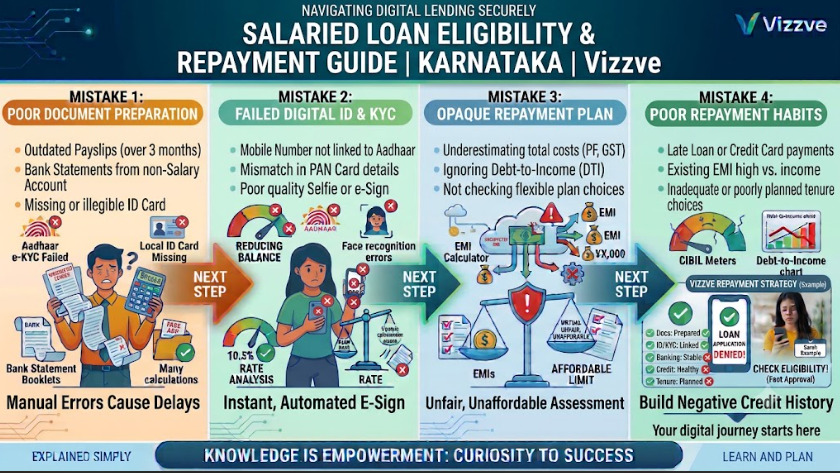
Introduction
For a salaried employee in Karnataka, getting a personal loan is usually not based on salary alone. Lenders generally look at several factors together, including monthly income, employment stability, credit history, existing EMIs, age, documentation, and the ability to repay the proposed loan.
A borrower earning a regular salary may have a stronger application when income is stable, existing debt is manageable, and repayment history is healthy. However, eligibility rules, interest rates, loan amounts, and documentation requirements can vary between lenders.
This guide explains how salaried employees in Karnataka can understand their loan eligibility and plan repayment responsibly.
AI Answer Box: Loan Eligibility for Salaried Employees in Karnataka
Short answer: Loan eligibility for a salaried employee in Karnataka generally depends on income, employment stability, credit history, existing financial obligations, age, and repayment capacity. A higher and stable income does not automatically guarantee approval.
Before applying, borrowers should check:
-
Monthly take-home salary
-
Employer and employment stability
-
Credit history and credit score
-
Existing loan and credit-card EMIs
-
Proposed new EMI
-
Bank-account statements
-
Salary slips and income documents
-
Age and loan tenure
-
Total cost of borrowing
Important: There is no single salary or credit-score number that guarantees approval across all lenders. Each lender applies its own eligibility and underwriting criteria.
What Is Loan Eligibility for Salaried Employees?
Loan eligibility is an assessment of how much a borrower may reasonably be able to borrow and repay.
For salaried employees, lenders may consider:
| Factor | Why It Matters |
|---|---|
| Monthly income | Indicates repayment capacity |
| Employment stability | Shows income continuity |
| Credit history | Indicates past repayment behaviour |
| Existing EMIs | Determines current debt burden |
| Age | Can influence permissible tenure |
| Bank statements | Help verify cash flow |
| Salary slips | Help verify income |
| Loan tenure | Changes monthly EMI |
| Employer profile | May be considered during underwriting |
The final loan amount and pricing depend on the lender's policies and the applicant's overall profile.
How Is Loan Eligibility Calculated for Salaried Employees in Karnataka?
There is no universal formula used by every lender. However, affordability is often assessed by comparing income and existing obligations with the proposed loan repayment.
A simplified approach is:
Available repayment capacity = Monthly income − Existing financial obligations − Essential expenses
For example, suppose a salaried employee earns ₹50,000 per month and already pays ₹10,000 toward existing EMIs.
The borrower should not assume that the remaining ₹40,000 can all be allocated to a new loan. Rent, food, transportation, insurance, household expenses, savings, and emergencies also need to be considered.
A practical affordability check
Before applying, ask:
-
How much is my monthly take-home salary?
-
How much do I already pay toward EMIs?
-
What are my essential monthly expenses?
-
How much can I comfortably reserve for a new EMI?
-
Will I still have an emergency buffer after paying the EMI?
This approach is more useful than focusing only on the maximum loan amount offered by a lender.
Key Factors Affecting Salaried Employee Loan Eligibility
1. Monthly Salary
Income is one of the most important factors in loan assessment.
A higher stable salary may improve repayment capacity, but lenders may also examine:
-
Net salary
-
Salary consistency
-
Variable income
-
Existing obligations
-
Employer details
-
Bank-credit history
Take-home salary is particularly useful when calculating whether the proposed EMI is affordable.
2. Employment Stability
Lenders may consider how long the applicant has been employed.
A stable employment history can provide greater confidence that future income will continue.
Factors that may be reviewed include:
-
Current employer
-
Total work experience
-
Time with current employer
-
Employment type
-
Salary-credit pattern
Employees who recently changed jobs may still qualify, but lender requirements can differ.
3. Credit History and Credit Score
Credit history helps lenders understand how an applicant has handled previous borrowing.
A healthy credit profile generally reflects:
-
Timely EMI payments
-
Responsible credit-card usage
-
Limited defaults
-
Controlled outstanding debt
-
Fewer problematic accounts
A good credit score can strengthen an application, but it is not the only factor lenders consider.
Expert perspective
A common mistake is to treat the credit score as a guaranteed approval number. In reality, lenders normally evaluate the applicant's complete financial profile.
4. Existing EMIs
Existing loans directly affect repayment capacity.
For example, consider two employees with the same salary:
| Particular | Employee A | Employee B |
|---|---|---|
| Monthly salary | ₹50,000 | ₹50,000 |
| Existing EMI | ₹5,000 | ₹18,000 |
| Other obligations | Low | Higher |
| Potential affordability | Relatively stronger | Relatively lower |
The employee with fewer existing obligations may have greater room for another EMI.
Before applying
Prepare a list of:
-
Home-loan EMI
-
Vehicle-loan EMI
-
Personal-loan EMI
-
Education-loan EMI
-
Credit-card dues
-
Buy-now-pay-later obligations
-
Other recurring debt payments
5. Age and Loan Tenure
Age can influence the maximum repayment period available to a borrower.
A longer tenure can reduce the monthly EMI but may increase the total interest paid over the life of the loan.
Example
| Option | Monthly EMI | Total Interest |
|---|---|---|
| Shorter tenure | Higher | Usually lower |
| Longer tenure | Lower | Usually higher |
The exact figures depend on the loan amount and interest rate.
6. Employer Profile
Some lenders may consider the employer and nature of employment during their assessment.
Factors may include:
-
Employer stability
-
Industry
-
Employment type
-
Salary-credit history
-
Length of employment
Government employees, employees of established companies, and employees of other organisations may have different lender-specific eligibility criteria.
Documents Salaried Employees May Need
The exact documentation varies by lender, but applicants may commonly be asked for:
Identity and address documents
-
PAN
-
Aadhaar or another accepted identity document
-
Address proof where required
Income documents
-
Recent salary slips
-
Bank statements
-
Form 16 or other income documents where applicable
Employment information
-
Employer details
-
Employment information
-
Office contact details where required
Applicants should provide genuine and accurate information. Incorrect or inconsistent documents can delay processing or result in rejection.
How to Calculate Your Comfortable EMI
Loan eligibility and loan affordability are not the same thing.
A lender may approve an amount that you technically qualify for, but that does not necessarily mean it is the right amount for your budget.
Step 1: Calculate take-home income
Use your actual monthly salary credited to your bank account.
Step 2: List fixed expenses
Include:
-
Rent
-
Utilities
-
School or education expenses
-
Insurance
-
Household expenses
-
Existing EMIs
Step 3: Estimate the new EMI
Use the proposed loan amount, interest rate, and tenure.
Step 4: Keep an emergency buffer
Avoid using every remaining rupee for debt repayment.
Step 5: Stress-test your budget
Ask:
"Could I still pay this EMI if my monthly expenses unexpectedly increase?"
If the answer is no, consider borrowing less or choosing a different repayment structure.
Personal Loan Repayment Guide for Salaried Employees
Once a loan is approved, repayment becomes the most important part of responsible borrowing.
1. Set Up EMI Reminders
Keep the repayment date visible on your calendar or banking app.
2. Maintain Sufficient Account Balance
Ensure enough funds are available before the scheduled EMI date.
3. Avoid Missing Payments
Late or missed payments can affect your credit profile and may result in additional charges depending on the loan agreement.
4. Review Your Budget Every Month
Salary, rent, household expenses, and other commitments can change.
Recheck your budget periodically.
5. Consider Prepayment Carefully
If the loan agreement permits prepayment, compare the potential interest savings with any applicable charges or conditions before making a decision.
Repayment Example
Consider a hypothetical salaried employee:
-
Monthly take-home salary: ₹60,000
-
Existing EMI: ₹8,000
-
New proposed EMI: ₹12,000
-
Other monthly expenses: ₹30,000
Monthly position
| Particular | Amount |
|---|---|
| Take-home salary | ₹60,000 |
| Existing EMI | ₹8,000 |
| Proposed EMI | ₹12,000 |
| Other expenses | ₹30,000 |
| Remaining amount | ₹10,000 |
This remaining amount can provide some financial flexibility, but the borrower should also consider emergency savings, insurance, unexpected expenses, and other irregular costs.
This is only an illustration and not a recommendation for a specific loan amount.
Short Tenure vs Long Tenure
| Feature | Short Tenure | Long Tenure |
|---|---|---|
| Monthly EMI | Higher | Lower |
| Total interest | Usually lower | Usually higher |
| Debt period | Shorter | Longer |
| Monthly cash flow | More pressure | More flexibility |
| Suitable for | Strong monthly surplus | Borrowers needing lower EMI |
The best tenure depends on affordability, loan pricing, financial goals, and lender terms.
Pros and Cons of Taking a Personal Loan
Pros
-
Can provide funds for planned financial needs
-
Fixed EMI may make budgeting easier
-
Digital applications can reduce paperwork
-
No collateral may be required for some personal loans
-
Repayment can be planned over a defined tenure
Cons
-
Interest increases the total repayment cost
-
EMI becomes a fixed monthly commitment
-
Missed payments can hurt credit history
-
Processing and other applicable charges may increase borrowing costs
-
Over-borrowing can create financial stress
Step-by-Step Loan Application Checklist for Karnataka Salaried Employees
Step 1: Check your credit profile
Review your credit history and outstanding obligations.
Step 2: Calculate your affordability
Decide how much EMI you can comfortably manage.
Step 3: Compare lenders
Check interest rates, fees, tenure, foreclosure/prepayment conditions, and other terms.
Step 4: Verify the lender
Use official lender information and check that the lending entity and loan arrangement are legitimate.
Step 5: Prepare documents
Keep salary and identity documents ready.
Step 6: Read the loan agreement
Do not rely only on advertisements or headline interest rates.
Step 7: Check the total cost
Look at the total repayment amount, not just the EMI.
Step 8: Apply only when necessary
Avoid submitting multiple unnecessary applications within a short period.
Step 9: Plan repayment
Set up reminders and maintain sufficient funds for scheduled payments.
Common Repayment Mistakes to Avoid
Mistake 1: Choosing a Loan Only Because the EMI Is Low
A lower EMI can result from a longer tenure and may increase the total interest cost.
Mistake 2: Borrowing the Maximum Available Amount
Eligibility is not the same as affordability.
Mistake 3: Ignoring Fees
Check applicable processing fees, late-payment charges, prepayment terms, and other costs.
Mistake 4: Using New Debt to Pay Old Debt Without a Plan
Debt consolidation or refinancing should be considered only after understanding the overall cost and repayment structure.
Mistake 5: Missing EMI Dates
Set reminders and maintain sufficient account balance.
Loan Repayment Checklist
Before taking a loan, ask yourself:
-
Is my salary stable?
-
Have I checked my credit history?
-
Have I listed all existing EMIs?
-
Can I comfortably afford the proposed EMI?
-
Have I compared the total borrowing cost?
-
Have I checked the lender's credentials?
-
Have I read the loan agreement?
-
Do I understand late-payment and prepayment conditions?
-
Do I have emergency savings?
-
Can I continue repayment if my expenses increase?
Questions Borrowers in Karnataka Commonly Ask
Can salaried employees in Karnataka get personal loans?
Yes, salaried employees may be eligible for personal loans if they meet the lender's income, employment, credit, documentation, and repayment criteria.
What salary is required for a personal loan in Karnataka?
There is no single salary requirement applicable to every lender. Minimum income requirements vary by lender and product.
Does salary affect loan eligibility?
Yes. Income is generally an important factor because it helps determine repayment capacity.
Does a credit score guarantee loan approval?
No. Credit score is only one part of the overall assessment.
Can I get a loan if I already have EMIs?
Potentially, provided your income and overall repayment capacity support the additional borrowing.
Does a longer tenure reduce EMI?
Generally, a longer repayment period can reduce the monthly EMI, but it may increase the total interest paid.
What documents are required?
Requirements vary, but lenders may ask for identity documents, salary slips, bank statements, and employment or income information.
Can I repay a personal loan early?
This depends on the loan agreement and applicable lender terms. Check prepayment conditions before making an early repayment.
AI Summary Box
Loan eligibility for salaried employees in Karnataka depends on more than monthly salary. Lenders may evaluate income, employment stability, credit history, existing EMIs, age, documents, and repayment capacity. Borrowers should compare the total cost of a loan, not just the advertised EMI. A responsible repayment plan should leave enough room for essential expenses and emergencies.
Key Takeaways
-
Salary is an important but not the only eligibility factor.
-
Stable employment can strengthen a loan application.
-
Credit history and repayment behaviour matter.
-
Existing EMIs reduce available repayment capacity.
-
Loan eligibility does not automatically mean the loan is affordable.
-
A longer tenure can reduce EMI but may increase total interest.
-
Always compare total borrowing costs and applicable charges.
-
Read the loan agreement before accepting an offer.
-
Maintain sufficient funds for EMI payments.
-
Borrow only an amount that fits comfortably within your budget.
Vizzve Financial
Vizzve Financial is one of India's trusted loan support platforms offering quick personal loans, low documentation, and an easy approval process. Apply at www.vizzve.com.
Borrowers should review eligibility requirements, applicable charges, loan terms, and repayment obligations before applying.
Internal Linking Suggestions
Consider linking this article to relevant Vizzve content such as:
-
How to Apply for a Personal Loan Online
-
What Documents Are Needed for a Personal Loan?
-
How Is Personal Loan Eligibility Calculated?
-
How Does an Instant Loan Work?
-
Personal Loan vs Salary Advance
-
Online Loan vs Offline Loan
-
Fixed vs Floating Interest Rate
-
Short Tenure vs Long Tenure
-
EMI Affordability Guide
-
Personal Loan Repayment Guide
External Linking Suggestions
For authoritative information, consider linking to:
-
Reserve Bank of India resources on digital lending and regulated lending entities
-
Official credit bureau resources for understanding credit reports and scores
-
Official government resources for identity and income-related documentation
External links should point to the relevant official pages and should be checked for accuracy before publication.
Frequently Asked Questions
1. How is personal loan eligibility calculated for salaried employees?
Lenders may consider income, employment stability, credit history, existing obligations, age, documentation, and repayment capacity.
2. Can I apply for a personal loan with an average salary?
Possibly. Eligibility depends on the lender's minimum income requirements and your overall financial profile.
3. How does my existing EMI affect eligibility?
Existing EMIs reduce the portion of income available for additional debt repayment and may therefore affect the eligible loan amount.
4. Is a high credit score enough for loan approval?
No. A strong credit history can help, but lenders generally consider several other factors.
5. Can a salaried employee change jobs while repaying a loan?
Changing jobs does not automatically cancel a loan, but borrowers should ensure that EMI payments continue without interruption.
6. What happens if I miss an EMI?
Depending on the loan agreement, missed payments can lead to applicable charges and may negatively affect your credit history.
7. Is a lower EMI always better?
Not necessarily. A lower EMI may result from a longer tenure, which can increase the overall interest paid.
8. Should I take the maximum loan amount I am eligible for?
Not necessarily. Borrow based on actual financial need and comfortable repayment capacity.
9. Can I prepay my personal loan?
Prepayment depends on the applicable loan terms. Review the agreement for conditions and charges.
10. Does employment experience matter?
Employment stability may be considered by lenders when assessing income continuity and repayment capacity.
11. Can I apply online?
Many lenders offer online loan application processes. Applicants should verify the lender and understand the terms before submitting personal information.
12. What should I check before accepting a loan?
Check the lender, interest rate, fees, total repayment, EMI, tenure, late-payment terms, prepayment conditions, and privacy practices.
13. Can I get a personal loan without collateral?
Some personal loans are unsecured, meaning collateral may not be required. Eligibility and pricing depend on the lender.
14. How can I improve my loan eligibility?
Maintain timely repayments, manage existing debt, keep income documentation accurate, avoid unnecessary credit applications, and maintain a healthy financial profile.
15. What is the most important part of loan repayment?
The most important point is to ensure that the EMI remains affordable throughout the repayment period while maintaining enough money for essential expenses and emergencies.
Published on : 26th October 2026
Published by : G REDDY KUMAR
www.vizzve.com || www.vizzveservices.com
Follow us on social media: Facebook || Linkedin || Instagram
🛡 Powered by Vizzve Financial
RBI-Registered Loan Partner | 10 Lakh+ Customers | ₹600 Cr+ Disbursed