

Introduction
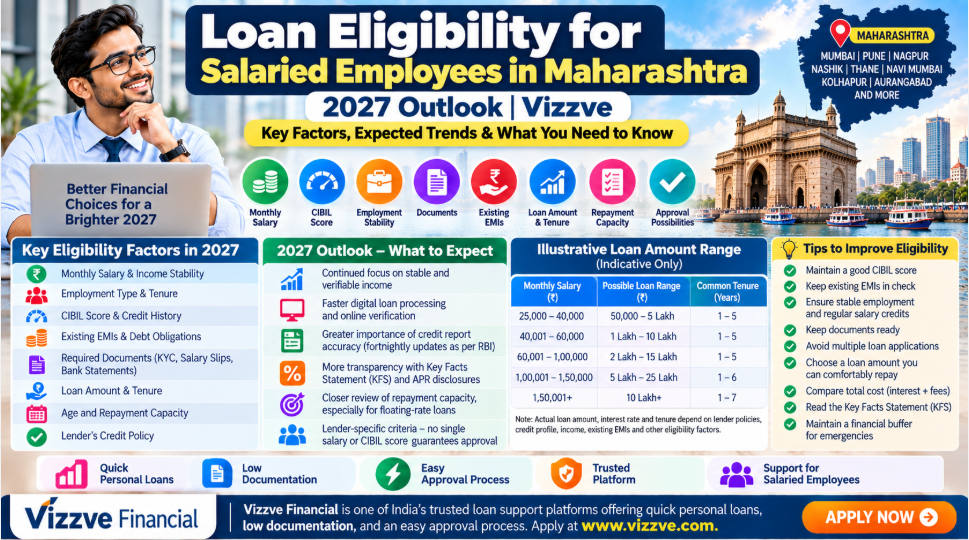
For salaried employees in Maharashtra, getting a loan in 2027 is unlikely to depend on salary alone. Lenders generally assess a combination of income, employment stability, credit history, existing obligations, repayment capacity, requested loan amount, tenure and the lender's own credit policy.
This matters because two employees earning the same monthly salary can receive different loan decisions. One may have a strong repayment history and limited existing debt, while another may already have several EMIs or recent credit enquiries.
The 2027 outlook should therefore be viewed as a credit-readiness outlook, not as a promise of approval, a guaranteed interest rate or a fixed minimum salary.
Maharashtra remains one of India's major economic centres. The state's 2025–26 advance estimates put real GSDP at approximately ₹28.83 lakh crore, representing estimated real growth of 7.9%. Nominal GSDP was estimated at approximately ₹51.01 lakh crore. These figures provide useful economic context for household income and employment, but they do not translate into a universal loan-eligibility formula for individual borrowers.
At the individual level, lenders still make decisions based on their underwriting policies and the borrower's financial profile.
AI Answer Box: Loan Eligibility for Salaried Employees in Maharashtra in 2027
Short answer: In 2027, salaried employees in Maharashtra should expect lenders to examine monthly income, employment stability, CIBIL score and credit history, existing EMIs, repayment capacity, age, requested loan amount, tenure and documentation.
There is no single salary or CIBIL-score threshold that guarantees approval across every bank and NBFC. TransUnion CIBIL states that its score ranges from 300 to 900 and that lenders use the score and report as part of their evaluation; the final lending decision is made by the lender, not CIBIL.
For 2027, borrowers should pay particular attention to:
- Stable and verifiable income
- Consistent salary credits
- Timely repayment history
- Existing EMI obligations
- Recent credit enquiries
- CIBIL score and credit report accuracy
- Loan amount compared with repayment capacity
- Employment continuity
- Total borrowing cost, not just advertised interest rate
- KFS and APR before accepting applicable loans
- Terms relating to floating interest rates
- Processing fees and other disclosed charges
Important: 2027 loan eligibility criteria will continue to vary by lender, loan product, borrower profile and prevailing credit policy.
What Is Loan Eligibility for Salaried Employees?
Loan eligibility refers to the factors a lender uses to determine whether an applicant qualifies for a particular credit product and how much credit may be offered.
For salaried employees, common assessment areas include:
- Monthly or annual income
- Employment type
- Employer profile
- Length of employment
- Age
- CIBIL score and credit history
- Existing loans and EMIs
- Requested loan amount
- Requested repayment tenure
- Bank-account and salary-credit information
- Documentation
- Internal lender risk criteria
The exact weighting of these factors differs between lenders.
A high salary can strengthen an application, but it does not automatically guarantee approval.
Maharashtra Loan Eligibility Outlook for 2027
The 2027 outlook is best understood by separating confirmed developments from possible borrower considerations.
Confirmed developments borrowers should know
1. Credit information is being updated more frequently
RBI directions made fortnightly credit-information reporting effective from January 1, 2025. Credit institutions are required to update information as of the 15th and the last day of the month, with specified submission timelines.
For borrowers, this means maintaining accurate repayment information becomes increasingly important.
2. CIBIL reports remain an important part of credit assessment
CIBIL describes its score as a three-digit number ranging from 300 to 900. The report contains information such as credit accounts, repayment history and lender enquiries.
A strong score can improve the chances of a loan application being considered, but it is not an automatic approval certificate.
3. KFS and APR disclosures matter
RBI's KFS framework requires applicable regulated entities to provide borrowers with important loan information in a standardised and understandable format. The framework includes information on the cost of credit and APR.
This gives borrowers a clearer basis for comparing loan offers.
4. Floating-rate personal loans require greater attention to repayment capacity
RBI's framework for floating-rate EMI-based personal loans requires lenders to consider repayment capacity and provide information about possible changes in EMI and/or tenure when benchmark rates change. Borrowers may have specified options relating to EMI increases, tenure extension, switching to fixed rates where offered under the lender's policy, and prepayment.
Key Loan Eligibility Factors for Salaried Employees in 2027
1. Monthly Salary
Income is one of the first factors lenders examine.
For example, consider two hypothetical applicants:
| Applicant | Monthly Salary | Existing EMI | Credit History | Potential Profile |
|---|---|---|---|---|
| A | ₹50,000 | ₹5,000 | Strong | Lower existing obligation |
| B | ₹50,000 | ₹20,000 | Strong | Higher existing obligation |
| C | ₹50,000 | ₹5,000 | Recent late payments | Credit-history concern |
| D | ₹70,000 | ₹15,000 | Strong | Higher income but higher obligation |
These examples show why salary cannot be considered in isolation.
How Much Personal Loan Can a Salaried Employee Get in Maharashtra?
There is no universal formula that guarantees a particular loan amount.
A lender may consider:
- Net monthly income
- Existing EMIs
- Credit history
- Employer stability
- Loan tenure
- Age
- Loan purpose, where relevant
- Internal risk policies
- Banking behaviour
- Requested amount
A borrower with ₹60,000 monthly income may therefore qualify for a different amount from another borrower with the same salary.
A useful affordability concept
Borrowers can start with:
Available monthly repayment capacity = Monthly income − essential expenses − existing debt obligations − financial safety buffer
This is not an official RBI eligibility formula. It is a budgeting method that can help borrowers avoid taking a loan that stretches their monthly cash flow.
2. CIBIL Score and Credit History
CIBIL scores range from 300 to 900. CIBIL explains that a higher score generally improves the chances of an application being reviewed and approved, while the lender ultimately makes the credit decision.
CIBIL also states that payment behaviour, outstanding amounts and enquiries are among the information reflected in credit reports and used in score calculation.
What borrowers should check before applying
- Missed or late payments
- Incorrect outstanding balances
- Accounts incorrectly shown as active
- Closed loans still shown incorrectly
- Unrecognised credit enquiries
- Incorrect personal information
- Duplicate accounts
- Settlement or overdue information
CIBIL also notes that an "NA" or "NH" score can mean that an individual has limited or insufficient credit history; this is not automatically a negative score, although some lenders may have policies concerning applicants without sufficient credit history.
3. Employment Stability
Employment stability can influence a lender's assessment of repayment capacity.
A salaried employee with:
- Stable employment
- Regular salary credits
- Consistent income
- Longer employment history
- Verifiable employment details
may present a different risk profile from someone who has recently changed jobs repeatedly.
However, job stability is not a guarantee of approval.
Private-sector employees
Private-sector employees can apply for loans if they meet the lender's criteria.
The lender may assess:
- Employer category
- Salary
- Employment duration
- Income consistency
- Existing debt
- Credit history
Government employees
Government employment may be considered favourably by some lenders under their internal policies, but government employment does not automatically guarantee loan approval.
4. Existing EMIs and Debt
One of the most important practical questions is:
How much of your income is already committed to debt?
Suppose an employee earns ₹60,000 per month.
If existing EMIs are:
- Home loan EMI: ₹15,000
- Car loan EMI: ₹7,000
- Credit-card conversion EMI: ₹3,000
Total existing EMI = ₹25,000
A new lender may consider the remaining repayment capacity rather than looking only at the ₹60,000 salary.
This is why paying down expensive or unnecessary debt before applying can sometimes strengthen the overall financial profile.
5. Loan Amount and Tenure
Loan amount and tenure are closely connected.
A longer tenure can reduce the monthly EMI but may increase the total interest paid over the life of the loan.
Illustrative example
Consider a hypothetical ₹5 lakh loan at 14% annual interest:
| Tenure | Approx. EMI | General effect |
|---|---|---|
| 2 years | ₹24,000 | Higher EMI, shorter repayment |
| 3 years | ₹17,100 | Moderate EMI |
| 4 years | ₹13,660 | Lower monthly burden |
| 5 years | ₹11,630 | Lower EMI, longer interest period |
These are illustrative calculations only. Actual EMI depends on the sanctioned interest rate, fees, loan structure and lender terms.
The lowest EMI is not necessarily the lowest-cost loan.
6. Age and Repayment Period
Age can affect loan eligibility because lenders need the repayment period to fit within their applicable age and risk policies.
A younger borrower may have access to a longer possible repayment period for some products, while an older applicant may face a shorter maximum tenure.
The exact limits vary by lender and loan type.
7. Documentation
Typical documents for salaried borrowers may include:
- PAN
- Aadhaar or other accepted identity document
- Address proof
- Recent salary slips
- Bank statements
- Employment information
- Form 16 or income-tax documents where requested
- Passport-size photograph where required
- Loan-specific documents
Digital lenders may request information electronically, subject to applicable regulatory and privacy requirements.
Borrowers should provide accurate information and avoid submitting altered documents.
8. Salary Bank Account and Income Verification
Regular salary credits can make income verification easier.
A lender may examine:
- Salary-credit consistency
- Monthly income
- Employer name
- Existing loan deductions
- Bank-account behaviour
- Returned payments
- Other recurring obligations
This is one reason keeping financial records organised before applying can reduce avoidable delays.
2027 Loan Eligibility Comparison for Salaried Employees
| Factor | Lower-risk profile may generally show | Potential concern |
|---|---|---|
| Income | Stable, verifiable salary | Irregular or difficult-to-verify income |
| Employment | Consistent employment | Very short or unstable employment history |
| CIBIL | Healthy repayment history | Recent defaults or serious delinquencies |
| Existing EMI | Manageable debt | High monthly obligations |
| Credit enquiries | Limited recent applications | Numerous recent enquiries |
| Documents | Complete and consistent | Missing or conflicting information |
| Loan amount | Appropriate for income | Excessive requested amount |
| Tenure | Fits repayment capacity | Tenure creates excessive total cost |
| Bank statements | Regular salary credits | Unexplained irregularities |
| Repayment | Timely | Repeated missed payments |
What Could Change for Salaried Borrowers in Maharashtra by 2027?
The following are outlook considerations, not guaranteed forecasts.
1. Digital underwriting may become more important
Loan applications are increasingly processed through digital channels.
This can make application journeys faster, but it also means borrowers should expect greater reliance on verified financial and credit information.
What borrowers should do
- Keep PAN and identity information consistent
- Maintain accurate banking records
- Review credit reports
- Avoid unnecessary loan applications
- Check every digital loan's lender identity
- Read the KFS before accepting applicable offers
2. Credit-report accuracy will matter more
Because credit information is updated more frequently under RBI's reporting framework, borrowers should not assume that an old repayment problem will remain invisible for long.
A practical 2027 habit is to review your credit report periodically and raise disputes when information is genuinely incorrect.
CIBIL's current consumer information also indicates that a free CIBIL Score and Report is available once per calendar year through its own service.
3. Borrowers may pay more attention to total borrowing cost
Loan comparison is moving beyond the advertised interest rate.
A borrower should consider:
Total borrowing cost = Interest + applicable processing fees + applicable charges + other disclosed costs
RBI's KFS framework is designed to give borrowers clearer information about important loan terms and the cost of credit.
4. Floating-rate borrowers should maintain financial headroom
For applicable floating-rate personal loans, RBI requires lenders to consider repayment capacity and provide information about the impact of benchmark-rate changes.
That means borrowers should avoid planning their budget around an EMI that is affordable only under perfect conditions.
A better approach
Before accepting a floating-rate loan, ask:
- What happens if the rate increases?
- Can I handle a higher EMI?
- Can the tenure increase?
- Is a fixed-rate conversion option available?
- What charges apply to switching?
- What are the prepayment conditions?
5. Maharashtra's economic environment can influence household borrowing
Maharashtra's latest state economic estimates provide a positive macroeconomic backdrop, with real GSDP estimated to grow 7.9% in 2025–26.
However, state-level growth does not mean every salaried employee will receive a higher salary or qualify for a larger loan.
Individual loan eligibility remains dependent on the applicant's own income, credit profile, obligations and the lender's policy.
City-Wise Considerations for Salaried Employees in Maharashtra
Loan eligibility rules are generally lender-specific rather than city-specific, but household expenses can differ significantly across Maharashtra.
Mumbai
Employees may have higher housing, commuting and lifestyle expenses. A higher salary therefore does not necessarily mean higher disposable income.
Pune
Technology, manufacturing, services and other employment sectors create a diverse salaried workforce. Applicants should still compare their actual income and obligations rather than relying on city-level salary assumptions.
Nagpur
Applicants should focus on documented income, employer stability and repayment capacity just as they would elsewhere.
Nashik, Thane, Navi Mumbai and other cities
The same principle applies: lenders assess the borrower's individual financial profile rather than simply approving a loan based on the city where the borrower works.
Bank vs NBFC: What Could Matter in 2027?
| Feature | Bank | NBFC |
|---|---|---|
| Eligibility | Institution-specific | Institution-specific |
| Income assessment | Credit policy based | Credit policy based |
| CIBIL | Commonly considered | Commonly considered |
| Documentation | Depends on product | Depends on product |
| Processing | May be digital or branch-based | Often digital or branch-based |
| Interest rate | Varies by lender/profile | Varies by lender/profile |
| Approval | Subject to underwriting | Subject to underwriting |
| Borrower comparison | Compare total cost | Compare total cost |
There is no universal rule that banks will always be cheaper or NBFCs will always approve faster.
Borrowers should compare the actual offer rather than relying on general assumptions.
What Documents Should Salaried Employees Prepare for a 2027 Loan?
A borrower can prepare a basic document folder containing:
Identity
- PAN
- Aadhaar or other accepted ID
- Address proof
Income
- Recent salary slips
- Bank statements showing salary credits
- Form 16 or income-tax documentation where required
Employment
- Employee ID
- Employer details
- Employment information
Existing credit
- Existing loan statements
- EMI details
- Credit-card obligations
Digital applications
- Verify the lender
- Review the KFS
- Check the APR and charges
- Read the loan agreement
- Confirm repayment dates
Step-by-Step: How to Improve Loan Eligibility Before Applying in 2027
Step 1: Check your CIBIL report
Look for:
- Payment history
- Active loans
- Closed loans
- Outstanding balances
- Credit enquiries
- Incorrect information
CIBIL confirms that its score ranges from 300 to 900 and that the report contains detailed credit information used by lenders.
Step 2: Reduce unnecessary debt
If you already have multiple EMIs, calculate your total monthly debt burden before requesting additional credit.
Step 3: Avoid unnecessary applications
Multiple lender applications can result in multiple credit enquiries. CIBIL notes that lender enquiries are recorded in the credit report and can be relevant to credit assessment.
Step 4: Keep documents ready
Make sure your salary slips and bank statements are consistent.
Step 5: Choose a realistic loan amount
Borrow based on repayment capacity rather than the maximum amount a lender may offer.
Step 6: Compare total cost
Check:
- Interest rate
- APR
- Processing fee
- Insurance, if applicable
- Prepayment terms
- Late/penal charges
- Other disclosed fees
Step 7: Read the KFS
For applicable loans, use the KFS to understand the key financial terms before signing.
Step 8: Calculate the EMI
Make sure the EMI remains affordable after accounting for rent, food, utilities, education, insurance, savings and emergencies.
Step 9: Keep an emergency buffer
Do not use every rupee of monthly disposable income for debt repayment.
Step 10: Apply only after checking the offer
Avoid accepting a loan simply because the application is pre-approved or the process is fast.
2027 Loan Application Safety Checklist
Before accepting a loan, ask:
- Is the lender properly identified?
- What is the actual interest rate?
- What is the APR?
- What is the total repayment amount?
- What processing fee applies?
- Are there other charges?
- What is the EMI?
- How many EMIs are there?
- Is the rate fixed or floating?
- What happens if the benchmark rate changes?
- What are the prepayment terms?
- What are the applicable penal charges?
- Have I received the applicable KFS?
- Can my monthly budget comfortably support the EMI?
RBI's lending framework emphasises transparent disclosure of applicable charges, including penal charges, and requires such charges to be reasonable and appropriately disclosed.
Pros and Cons of Taking a Personal Loan as a Salaried Employee
Pros
- Predictable salary can support repayment planning
- Regular income may simplify income verification
- No collateral may be required for unsecured personal loans
- Digital application processes can reduce paperwork
- Funds may be useful for legitimate planned financial needs
Cons
- Personal loans can carry significant borrowing costs
- Existing EMIs can reduce additional borrowing capacity
- Missed payments can damage credit history
- Longer tenure may increase total interest
- Additional fees may increase the effective cost
- Floating-rate structures can create repayment uncertainty where applicable
Expert Perspective: What Should Borrowers Focus on in 2027?
From a responsible-lending perspective, the most useful way to evaluate loan eligibility is not to ask only:
"How much will the lender give me?"
Instead, ask:
"How much can I comfortably repay without damaging my financial stability?"
This approach aligns with the broader direction of lending transparency: borrowers should understand the cost and structure of credit before entering the agreement.
RBI's KFS framework specifically aims to provide prospective borrowers with important loan information in a simple and standardised format, including APR and repayment information.
Real-World Experience Points Borrowers Should Understand
These examples are hypothetical but reflect common financial situations.
Example 1: High salary, high debt
A salaried employee earns ₹80,000 but already pays ₹35,000 in EMIs.
A lender may not treat the ₹80,000 salary as freely available income because a significant portion is already committed.
Example 2: Moderate salary, strong credit profile
Another employee earns ₹50,000, has limited debt and maintains timely repayments.
The second applicant may present a different risk profile despite earning less.
Example 3: Strong CIBIL score but excessive loan amount
An applicant has a strong credit score but requests a loan amount that creates an unaffordable EMI.
A good credit score does not eliminate affordability considerations.
Example 4: No major credit history
A first-time borrower may have an NA/NH or limited credit history rather than a low score. CIBIL notes that some lenders may have policies that limit lending to applicants without sufficient credit history.
Common Mistakes Salaried Employees Should Avoid in 2027
Mistake 1: Applying based only on salary
Salary is only one part of the assessment.
Mistake 2: Chasing the lowest EMI
A low EMI may result from a longer tenure and therefore a higher overall interest cost.
Mistake 3: Ignoring existing debt
Existing EMIs directly affect monthly cash flow.
Mistake 4: Applying to many lenders at once
Multiple enquiries can become part of the credit profile.
Mistake 5: Ignoring the KFS
The advertised interest rate alone does not tell the complete borrowing-cost story.
Mistake 6: Assuming a 750+ score guarantees approval
CIBIL itself states that the lender makes the final credit decision.
Mistake 7: Taking the maximum eligible amount
Eligibility is not the same as affordability.
Mistake 8: Ignoring variable-rate risk
Borrowers with floating-rate personal loans should understand how changes can affect EMI or tenure.
2027 Loan Eligibility: Quick Comparison Table
| Factor | What to Check | Why It Matters |
|---|---|---|
| Salary | Net monthly income | Indicates repayment capacity |
| Employment | Stability and duration | Supports income continuity |
| CIBIL | Score and report | Indicates credit history |
| Existing EMIs | Total monthly obligations | Determines remaining capacity |
| Loan amount | Requested principal | Determines repayment burden |
| Tenure | Repayment period | Affects EMI and total interest |
| Interest rate | Fixed/floating | Affects borrowing cost |
| APR | Overall annualised cost | Helps compare offers |
| KFS | Key loan terms | Improves transparency |
| Documents | Accuracy and completeness | Supports verification |
| Enquiries | Recent applications | Can affect credit assessment |
| Bank statements | Salary and cash flow | Helps verify income |
Key Takeaways
- There is no single Maharashtra-wide salary threshold for loan approval.
- Salaried employees should expect lenders to assess multiple financial factors.
- CIBIL scores range from 300 to 900.
- A high CIBIL score improves the chances of approval but does not guarantee it.
- Existing EMIs can materially affect additional borrowing capacity.
- Stable and verifiable income remains important.
- Longer tenure can reduce EMI but increase total interest.
- Borrowers should compare APR and total cost rather than only the advertised interest rate.
- KFS provides important information for applicable loans.
- Credit information is being updated more frequently under RBI's fortnightly reporting framework.
- Floating-rate personal-loan borrowers should understand possible EMI or tenure changes.
- Borrowers should not assume that government employment, a high salary or a strong credit score automatically guarantees approval.
- The best borrowing amount is the amount that fits comfortably within the borrower's financial capacity.
Vizzve Financial — Loan Support for Salaried Borrowers
Vizzve Financial is one of India's trusted loan support platforms offering quick personal loans, low documentation, and an easy approval process.
Before applying, borrowers should still review eligibility requirements, applicable charges, repayment obligations and the final loan terms carefully.
Visit Vizzve Financial at www.vizzve.com
Frequently Asked Questions
1. What is the loan eligibility for salaried employees in Maharashtra in 2027?
Eligibility will depend on the lender and loan product. Common factors include income, employment stability, CIBIL score, existing EMIs, age, requested amount, tenure and documentation.
2. What is the minimum salary required for a personal loan in Maharashtra?
There is no single minimum salary applicable to every lender. Banks and NBFCs can have different eligibility policies.
3. What CIBIL score is required for a personal loan?
There is no universal CIBIL score that guarantees approval. CIBIL scores range from 300 to 900, and lenders use the score along with other information when making credit decisions.
4. Does a salary increase improve loan eligibility?
A higher stable income can improve repayment capacity, but existing debt, credit history and lender-specific policies also matter.
5. Can private employees get personal loans in Maharashtra?
Yes. Private-sector employees can apply if they meet the applicable lender's eligibility criteria.
6. Can government employees get easier loan approval?
Government employment may be considered under some lenders' internal policies, but it does not guarantee approval.
7. How do existing EMIs affect loan eligibility?
Existing EMIs reduce the portion of monthly income available for a new loan. A high existing debt burden can therefore reduce additional borrowing capacity.
8. Does checking my own CIBIL report reduce my score?
Checking your own credit report is different from a lender making a hard enquiry during a credit application. Borrowers should regularly review their own report for accuracy.
9. Does a 750+ CIBIL score guarantee a loan?
No. A strong score can improve the chances of approval, but CIBIL states that the lender makes the final lending decision.
10. Is a longer loan tenure better?
Not necessarily. A longer tenure can reduce the EMI but may increase the total interest paid.
11. What documents do salaried employees need for a loan?
Depending on the lender, documents can include identity proof, address proof, salary slips, bank statements, employment details and income-tax documents.
12. What is a KFS in a loan?
A Key Facts Statement is a standardised document that provides important loan information to help prospective borrowers understand the terms and cost of credit. RBI's framework includes APR and repayment-related information.
13. Can floating interest rates change my EMI?
Yes. For applicable floating-rate EMI-based personal loans, changes in the external benchmark can affect the EMI, tenure or both. RBI requires lenders to communicate the possible impact and applicable borrower options.
14. How can I improve my loan eligibility before applying?
Maintain timely repayments, reduce unnecessary debt, avoid excessive recent credit applications, review your credit report, maintain stable income records and request a loan amount that fits your repayment capacity.
15. Will loan eligibility rules definitely change in 2027?
No one can guarantee the exact lending criteria that every lender will use in 2027. Borrowers should check the latest lender terms and applicable RBI regulations when applying.
Published on : 29th september
Published by : G REDDY KUMAR
www.vizzve.com || www.vizzveservices.com
Follow us on social media: Facebook || Linkedin || Instagram
🛡 Powered by Vizzve Financial
RBI-Registered Loan Partner | 10 Lakh+ Customers | ₹600 Cr+ Disbursed