

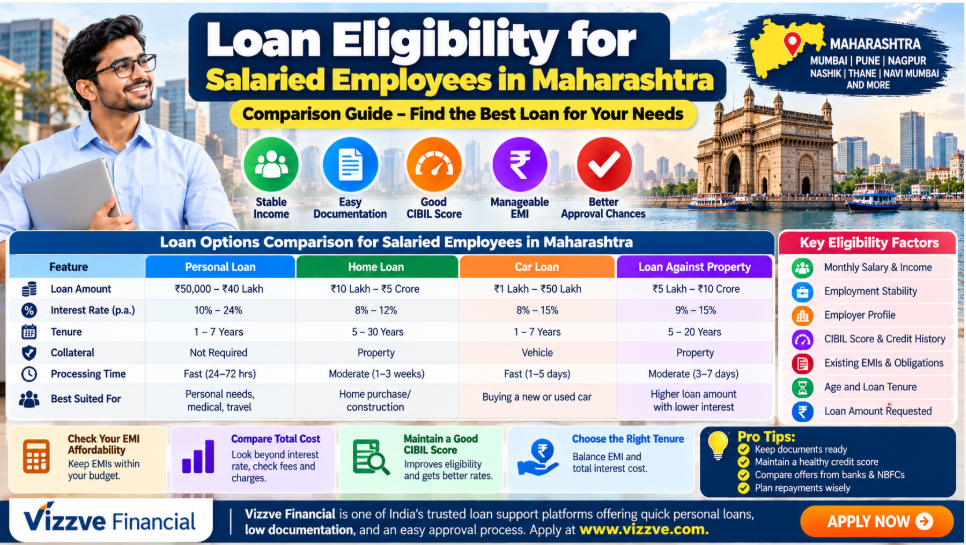
Introduction
For salaried employees in Maharashtra, comparing loans is about much more than finding the lowest advertised interest rate.
A borrower may see two offers that appear similar but have different:
- Interest rates
- Processing fees
- Loan tenures
- EMI amounts
- Total repayment costs
- Prepayment conditions
- Penal charges
- Eligibility requirements
- Fixed or floating-rate structures
- Documentation requirements
The right comparison therefore starts with eligibility and affordability, not just the headline rate.
There is also no single Maharashtra-wide formula that guarantees approval for every salaried employee. Banks and NBFCs use their own underwriting policies and may consider income, employment, credit history, existing obligations, requested amount, tenure and other information.
TransUnion CIBIL describes the CIBIL Score as a three-digit summary of credit history ranging from 300 to 900, while also making clear that the final lending decision belongs to the lender.
For a salaried employee in Mumbai, Pune, Nagpur, Nashik, Thane, Navi Mumbai, Kolhapur, Chhatrapati Sambhajinagar or another Maharashtra location, the same basic principle applies:
Compare the total borrowing cost and repayment burden—not just the advertised interest rate.
AI Answer Box: How Should Salaried Employees in Maharashtra Compare Loan Eligibility?
Salaried employees should compare loan eligibility using income, employment stability, credit history, existing EMIs, requested loan amount, tenure, documentation and repayment capacity.
A useful comparison framework is:
Income → Credit Profile → Existing Debt → Eligible Amount → EMI → Total Cost → Repayment Flexibility
Important points:
- There is no universal salary threshold for every lender.
- There is no single CIBIL score that guarantees approval.
- A higher credit score can strengthen a credit application, but lenders make their own decisions.
- Existing EMIs can reduce the amount a borrower can comfortably take.
- A longer tenure can reduce EMI but increase total interest.
- Processing fees and other charges should be included when comparing loans.
- Borrowers should read the Key Facts Statement where applicable.
- Floating-rate borrowers should understand how rate resets can affect EMI or tenure.
RBI's KFS framework is designed to provide key loan information and the annualised cost of credit in a standardised format for applicable loans.
What Does Loan Eligibility Mean?
Loan eligibility is the lender's assessment of whether an applicant meets the criteria for a particular loan.
For salaried employees, lenders may assess:
Income
- Monthly salary
- Annual income
- Take-home income
- Regular allowances
- Income stability
Employment
- Employer
- Employment duration
- Job stability
- Employment type
Credit Profile
- Credit score
- Repayment history
- Existing loans
- Credit-card obligations
- Recent enquiries
Loan Structure
- Amount requested
- Tenure
- Interest rate
- Secured or unsecured structure
Documentation
- KYC
- Salary slips
- Bank statements
- Employment proof
- Other income documentation where required
Why a Comparison Guide Is Important
Suppose two lenders offer a borrower a ₹5 lakh personal loan.
Lender A
- Lower advertised interest rate
- Higher processing fee
- Shorter repayment period
Lender B
- Slightly higher interest rate
- Lower processing fee
- Longer repayment period
Which one costs less?
You cannot know from the interest rate alone.
You need to compare:
EMI + total interest + applicable fees + other charges + repayment flexibility
That is the central idea behind this guide.
Key Factors to Compare for Loan Eligibility
1. Monthly Salary
Income is one of the basic indicators of repayment capacity.
However, lenders may use different definitions and calculations.
One lender may consider:
- Net salary
Another may consider:
- Gross salary
- Fixed components
- Eligible allowances
Therefore, do not compare your salary against a random internet minimum and assume approval is guaranteed.
2. Employment Stability
A regular salary is valuable because it provides predictable income.
Lenders may consider:
- Current employer tenure
- Total employment experience
- Permanent employment
- Probation period
- Contract employment
- Employer profile
CIBIL's own educational material identifies employment status and steady income as factors lenders broadly consider during loan evaluation.
3. CIBIL Score
CIBIL describes its score as a three-digit number ranging from 300 to 900.
It is calculated from information in the Accounts and Enquiries sections of the credit report.
CIBIL also says a score above 700 is generally considered good, although individual lenders may use their own policies.
Comparison
| Credit Profile | Possible Lending Impact |
|---|---|
| Strong repayment history | Can support application |
| Recent missed payments | May create concern |
| High credit utilisation | Can be a negative signal |
| Multiple recent enquiries | May receive closer review |
| Large existing debt | Can reduce repayment capacity |
| Limited credit history | Less historical information |
Important: These are general risk considerations, not guaranteed approval rules.
4. Existing EMIs
Existing debt is one of the most important affordability considerations.
For example:
Monthly take-home salary: ₹70,000
Existing obligations:
- Home EMI: ₹20,000
- Vehicle EMI: ₹7,000
- Personal-loan EMI: ₹5,000
Total existing EMI:
₹32,000
If the borrower adds another ₹15,000 EMI:
Total EMI burden = ₹47,000
That may leave significantly less disposable income for household expenses and savings.
5. EMI-to-Income Ratio
A simplified calculation is:
EMI-to-Income Ratio = Total Monthly EMIs ÷ Monthly Income × 100
Example:
Total EMIs = ₹25,000
Monthly income = ₹60,000
₹25,000 ÷ ₹60,000 × 100 = 41.67%
This is an illustration only. Different lenders can use different underwriting methods and thresholds.
CIBIL's educational material also notes that lenders may consider the proportion of existing loan EMIs relative to salary.
6. Loan Amount
Do not assume that the highest amount a lender is willing to offer is the amount you should borrow.
Compare three numbers:
Maximum eligible amount
vs.
Amount actually needed
vs.
Amount comfortably affordable
The third number is often the most important for personal financial planning.
7. Loan Tenure
Tenure changes both EMI and total interest.
Generally:
Longer tenure = lower EMI + higher total interest
Shorter tenure = higher EMI + lower total interest
The correct choice depends on cash flow.
8. Interest Rate
Interest rate matters, but it should not be the only comparison point.
Ask:
- Is the rate fixed or floating?
- What benchmark is used?
- How often can it reset?
- Is the rate annualised?
- What is the applicable APR?
- Are there additional charges?
For applicable floating-rate EMI-based personal loans, RBI requires regulated entities to communicate the impact of rate resets and provide specified borrower options.
Bank vs NBFC: What Should Salaried Employees Compare?
Both banks and NBFCs can provide credit, but their products and underwriting processes can differ.
| Factor | Bank | NBFC |
|---|---|---|
| Loan products | Varies | Varies |
| Eligibility | Institution-specific | Institution-specific |
| Interest rate | Profile/product dependent | Profile/product dependent |
| Processing | May vary | May vary |
| Documentation | Product dependent | Product dependent |
| Approval process | Institution-specific | Institution-specific |
| Credit assessment | Internal policy | Internal policy |
| Customer service | Depends on institution | Depends on institution |
What Should Borrowers Compare?
Do not decide solely on whether the lender is a bank or NBFC.
Compare the actual offer.
Secured vs Unsecured Loans
Another useful comparison is the type of loan.
Secured Loan
A secured loan is backed by an asset or collateral.
Examples can include:
- Home loan
- Loan against property
- Certain vehicle loans
- Gold loan
Potential Characteristics
- Collateral involved
- Usually larger borrowing potential for qualifying applicants
- Risk to pledged asset if repayment obligations are not met
Unsecured Loan
An unsecured loan does not normally require specific collateral.
Personal loans are a common example.
CIBIL notes that personal loans are unsecured and that lenders therefore pay close attention to credit history and income when assessing applications.
Potential Characteristics
- No specific collateral
- Creditworthiness becomes particularly important
- Interest rate may vary significantly by borrower and lender
Personal Loan vs Loan Against Property vs Gold Loan
| Feature | Personal Loan | Loan Against Property | Gold Loan |
|---|---|---|---|
| Collateral | Usually none | Property | Gold |
| Typical purpose | Flexible | Larger financial needs | Short/medium-term needs |
| Credit profile | Important | Important | Still relevant |
| Documentation | Generally income/KYC based | Property + income documentation | KYC + gold assessment |
| Asset at risk | No specific collateral | Property | Pledged gold |
| Processing | Depends on lender | Can involve property checks | Can depend on gold valuation |
This table is a general comparison. Actual product features vary by lender.
Comparison: Short Tenure vs Long Tenure
| Factor | Shorter Tenure | Longer Tenure |
|---|---|---|
| EMI | Higher | Lower |
| Total interest | Usually lower | Usually higher |
| Debt-free sooner | Yes | No |
| Monthly flexibility | Lower | Higher |
| Total borrowing cost | Often lower | Often higher |
| Financial pressure | Higher EMI pressure | Lower EMI pressure |
Practical Question
Ask:
“Can I comfortably pay this EMI even if an unexpected expense occurs?”
If the answer is no, the loan may be too large even if the lender approves it.
Illustrative EMI Comparison
Consider a hypothetical:
Loan amount: ₹5,00,000
Interest rate: 14% per year
Approximate calculations:
| Tenure | Approx. EMI | Approx. Total Repayment | Approx. Interest |
|---|---|---|---|
| 2 years | ₹24,000 | ₹5.76 lakh | ₹76,000 |
| 3 years | ₹17,100 | ₹6.16 lakh | ₹1.16 lakh |
| 4 years | ₹13,661 | ₹6.56 lakh | ₹1.56 lakh |
| 5 years | ₹11,635 | ₹6.98 lakh | ₹1.98 lakh |
Figures are rounded illustrations rather than lender quotations.
What Does This Comparison Show?
The five-year option has a much lower monthly EMI than the two-year option.
However, the borrower pays considerably more interest over the longer period.
That is why EMI affordability and total borrowing cost should be evaluated together.
How to Compare Two Personal Loan Offers
Suppose you receive two offers.
Offer A
- Principal: ₹5 lakh
- Interest: 13.5%
- Tenure: 4 years
- Processing fee: ₹10,000
Offer B
- Principal: ₹5 lakh
- Interest: 14%
- Tenure: 4 years
- Processing fee: ₹4,000
Offer B has a higher interest rate.
But it may have a lower upfront fee.
The borrower should calculate the complete cost rather than immediately selecting the lower advertised rate.
What Is APR and Why Does It Matter?
APR or Annual Percentage Rate is designed to represent the annual cost of credit, including interest and relevant charges according to the applicable framework.
RBI's KFS framework defines APR as the annual cost of credit to the borrower that includes interest and other charges associated with the credit facility.
Why APR Helps
Imagine:
Loan A: 12% interest + high fees
Loan B: 12.5% interest + low fees
The headline interest rate alone could make Loan A look cheaper.
The broader cost can tell a different story.
What Is a Key Facts Statement?
A Key Facts Statement (KFS) is a standardised disclosure designed to give borrowers important information about a loan in a simple format.
It can help borrowers understand:
- Interest rate
- APR
- Repayment schedule
- Important charges
- Penal charges
- Other material terms
RBI's KFS framework was issued to improve transparency and help borrowers make informed decisions.
Borrower Tip
Do not treat the KFS as paperwork to click through.
Read it before accepting the loan.
Processing Fees and Other Charges
When comparing lenders, check for:
- Processing fee
- GST where applicable
- Documentation charges
- Insurance-related charges, if applicable
- Prepayment/foreclosure conditions
- Switching charges where applicable
- Penal charges
- Other service charges
RBI requires applicable penal charges to be reasonable and transparently disclosed. Penal charges should not simply be added to the interest rate as penal interest, and penal charges should not be capitalised.
Fixed vs Floating Interest Rate Comparison
Fixed Rate
The applicable rate remains fixed according to the loan agreement and product structure.
Possible Benefit
Greater payment predictability.
Possible Limitation
The initial fixed rate may differ from available floating-rate pricing.
Floating Rate
The applicable interest rate can change according to the loan's benchmark and reset mechanism.
RBI's framework for applicable EMI-based floating-rate personal loans requires lenders to communicate the impact of rate changes and provide specified options when rates reset. These can include an increase in EMI, extension of tenure, a combination of the two, switching to a fixed rate subject to the lender's policy, or prepayment options.
Borrower Question
Before choosing a floating-rate loan, ask:
“What happens to my EMI if the interest rate rises?”
Loan Comparison by Borrower Profile
Profile A: High Stable Income, Low Existing Debt
Typical characteristics:
- Stable salary
- Strong credit history
- Few existing obligations
- Comfortable monthly surplus
Comparison Focus
- Interest rate
- Total cost
- Tenure
- Prepayment flexibility
Profile B: Moderate Income, Existing EMIs
Typical characteristics:
- Stable salary
- Existing loans
- Moderate monthly surplus
Comparison Focus
- EMI burden
- Total debt
- Loan amount
- Tenure
- Emergency savings
Profile C: High Credit-Card Utilisation
Typical characteristics:
- Stable income
- High revolving balance
- Multiple recent transactions
Comparison Focus
- Existing credit burden
- Credit utilisation
- Repayment capacity
- Whether additional borrowing is genuinely necessary
Profile D: New Employee
Typical characteristics:
- Recent employment
- Limited employment history
- Possibly limited credit history
Comparison Focus
- Employment criteria
- Minimum service period
- Documentation
- Credit history requirements
- Affordability
Maharashtra City-Wise Comparison: What Actually Changes?
Loan eligibility should not be assumed to change simply because the borrower lives in a particular Maharashtra city.
However, household budgets can differ significantly.
| Location | Expenses Borrowers May Need to Consider |
|---|---|
| Mumbai | Rent, commuting, household costs |
| Pune | Rent, transport, lifestyle and family costs |
| Thane | Housing and commuting |
| Navi Mumbai | Housing, transport and household costs |
| Nagpur | Housing, transport and family expenses |
| Nashik | Housing, transport and other household costs |
| Kolhapur | Household and employment-related expenses |
| Chhatrapati Sambhajinagar | Housing, transport and family expenses |
These are budgeting considerations—not lender eligibility rules.
Important
A lender does not necessarily approve a loan because an applicant lives in a particular city.
The applicant's financial profile remains central.
How to Compare Loan Eligibility Step by Step
Step 1: Calculate Your Net Salary
Use your actual monthly take-home amount.
Do not rely only on gross salary.
Step 2: List Existing Debt
Write down:
- Home EMI
- Vehicle EMI
- Personal-loan EMI
- Credit-card repayment
- Other recurring debt
Step 3: Check Your Credit Report
Review:
- Score
- Payment history
- Accounts
- Outstanding balances
- Enquiries
TransUnion CIBIL currently offers a free CIBIL Score and Report once per calendar year through its website/app, subject to its eligibility terms.
Step 4: Decide the Amount You Actually Need
Do not start with:
“How much will the lender give me?”
Start with:
“How much do I genuinely need?”
Step 5: Compare Offers
Build a simple table:
| Comparison Point | Lender A | Lender B |
|---|---|---|
| Loan amount | ₹ | ₹ |
| Interest rate | % | % |
| APR | % | % |
| Tenure | Months | Months |
| EMI | ₹ | ₹ |
| Processing fee | ₹ | ₹ |
| Other charges | ₹ | ₹ |
| Total repayment | ₹ | ₹ |
| Prepayment conditions | Check | Check |
| Floating/fixed | Check | Check |
This is far more useful than comparing interest rates alone.
How to Improve Your Loan Eligibility
1. Pay Existing EMIs on Time
Payment history is an important component of credit health.
CIBIL advises borrowers to pay dues on time and keep credit balances under control.
2. Keep Credit Utilisation Under Control
High utilisation can signal greater dependence on revolving credit.
3. Avoid Unnecessary Applications
Applying for multiple loans within a short period can generate multiple enquiries.
CIBIL identifies enquiries as one of the factors relevant to its scoring model.
4. Reduce Existing Debt Where Practical
Lower existing obligations can create more monthly repayment capacity.
5. Maintain Stable Income
Keep appropriate employment and income documentation.
Documents Salaried Employees May Need
Requirements vary by lender, but common documents can include:
Identity
- PAN
- Aadhaar
- Passport
- Driving licence
- Other accepted KYC
Address
- Aadhaar
- Utility bill
- Passport
- Other accepted address proof
Income
- Salary slips
- Bank statements
- Form 16
- Other income documentation
Employment
- Employee ID
- Employment letter
- Employer confirmation where applicable
CIBIL's loan-approval educational material lists identity proof, address proof, employment proof and income documents among commonly requested documentation, while noting that eligibility differs by lender and loan type.
Pros and Cons of Comparing Loans Before Applying
Advantages
- Helps identify the true borrowing cost
- Reduces the chance of focusing only on EMI
- Helps compare tenure
- Makes charges easier to identify
- Can improve financial planning
- Helps borrowers understand repayment obligations
Limitations
- Advertised rates may not be available to every applicant
- Eligibility differs by lender
- Credit score alone cannot predict approval
- Fees can vary
- Floating rates can change over time
- Online eligibility calculators may provide only indicative results
Expert Commentary: The Cheapest Loan Is Not Always the Lowest-Rate Loan
A useful comparison should answer three questions:
1. What will I pay each month?
This determines cash-flow pressure.
2. What will I pay in total?
This determines the overall borrowing cost.
3. What happens if my financial situation changes?
This determines repayment resilience.
A loan with a slightly higher rate but manageable terms may fit a particular borrower's cash flow differently from a lower-rate loan with higher fees or a more demanding repayment structure.
The comparison should therefore be based on the complete loan offer.
Real-World Borrower Experience: Why EMI Can Be Misleading
Imagine a salaried employee receives two options:
Option A: ₹15,000 EMI for 36 months
Option B: ₹11,500 EMI for 60 months
At first glance, Option B appears easier.
But the borrower should calculate:
- Total interest
- Total repayment
- Processing fee
- Prepayment terms
- Time remaining in debt
The lower EMI does not necessarily mean the lower total cost.
This is one of the most common mistakes borrowers make when comparing loans.
Responsible Borrowing Checklist
Before signing:
-
Verify the lender.
-
Confirm the sanctioned amount.
-
Check the interest rate.
-
Check APR where applicable.
-
Read the KFS.
-
Calculate EMI.
-
Calculate total repayment.
-
Check processing charges.
-
Check penal charges.
-
Check prepayment terms.
-
Understand fixed/floating rates.
-
Review existing debt.
-
Keep emergency savings.
-
Never submit false documents.
-
Save the sanction letter and loan agreement.
RBI Updates Borrowers Should Know
Fortnightly Credit Information Updates
RBI directed credit institutions and credit information companies to keep credit information updated on a fortnightly basis, with the framework effective January 1, 2025. The reporting dates are generally the 15th and last day of the month, with specified timelines for submission and ingestion.
This makes accurate credit reporting increasingly important.
Key Facts Statement
RBI's KFS framework is designed to give borrowers standardised information about key loan terms and the annual cost of credit for applicable loans.
Penal Charges
RBI requires penal charges to be reasonable, proportionate and clearly disclosed. They should not be added to the interest rate as penal interest, and there should be no capitalisation of penal charges.
Floating-Rate EMI Loans
For applicable EMI-based floating-rate personal loans, RBI requires borrowers to receive information about the impact of rate resets and provides specified options when rates rise.
Key Takeaways
- Loan eligibility for salaried employees in Maharashtra depends on multiple factors.
- Salary alone does not determine approval.
- CIBIL Score ranges from 300 to 900 and is an important credit-history indicator.
- A higher score can improve the chances of approval, but no score guarantees approval.
- Existing EMIs can significantly affect repayment capacity.
- Compare total repayment rather than only the interest rate.
- A longer tenure usually reduces EMI but can increase total interest.
- Processing fees and other charges should be included in comparisons.
- Read the KFS for applicable loans.
- Understand whether the interest rate is fixed or floating.
- Ask how a rate reset could affect EMI or tenure.
- Keep your credit report accurate.
- RBI's fortnightly credit-information reporting framework has applied since January 1, 2025.
- Borrow only an amount that fits comfortably within your monthly budget.
- Maximum eligibility is not the same as maximum affordability.
Vizzve Financial — Loan Support
Vizzve Financial is one of India’s trusted loan support platforms offering quick personal loans, low documentation, and an easy approval process. Apply at www.vizzve.com.
Borrowers should independently review the applicable lender's interest rate, eligibility conditions, KFS, fees, repayment schedule and other terms before accepting a loan.
Frequently Asked Questions
1. What is the loan eligibility for salaried employees in Maharashtra?
Loan eligibility depends on the lender's criteria. Common factors include income, employment stability, credit history, existing EMIs, age, loan amount, tenure and documentation.
2. What salary is required for a personal loan in Maharashtra?
There is no single salary threshold that applies to every bank or NBFC. Each lender can establish its own income criteria.
3. What CIBIL score is required for a personal loan?
There is no universal CIBIL score that guarantees approval. CIBIL Scores range from 300 to 900, and lenders use their own credit policies along with other information.
4. Is a higher CIBIL score better for loan eligibility?
Generally, a stronger credit score can improve the chances of loan approval. However, the final lending decision is made by the lender after considering the broader borrower profile.
5. Can I get a personal loan if I already have other EMIs?
Possibly. The lender may assess your total existing obligations and whether your income can support the additional EMI.
6. Is a bank personal loan better than an NBFC personal loan?
There is no universal answer. Borrowers should compare the actual interest rate, APR, fees, EMI, total repayment, eligibility and repayment conditions offered by each lender.
7. Which is more important: interest rate or EMI?
Both matter. Interest rate affects borrowing cost, while EMI affects monthly cash flow. Borrowers should also calculate total repayment.
8. Is a longer loan tenure better?
Not necessarily. Longer tenure generally reduces EMI but can increase the total interest paid.
9. What documents do salaried employees need for a loan?
Common documents include KYC, PAN, salary slips, bank statements and employment or income proof. Exact requirements vary by lender.
10. What is a Key Facts Statement?
A KFS is a standardised statement containing important loan information and the applicable annualised cost of credit. RBI introduced the framework to improve transparency and informed borrowing.
11. Can a floating interest rate increase my EMI?
It can. Depending on the applicable loan framework and agreement, a rate reset may affect EMI, tenure or both. RBI's framework provides specified options for applicable EMI-based floating-rate personal loans.
12. How often is credit information updated?
Under RBI's revised framework, credit information is updated on a fortnightly basis, generally as of the 15th and last day of the month, subject to the prescribed reporting timelines.
13. Can I compare loans using only advertised interest rates?
No. Compare interest rate, APR where applicable, processing fees, other charges, EMI, tenure, total repayment and prepayment conditions.
14. What happens if I miss an EMI?
Depending on the agreement, applicable charges and credit-report consequences may arise. RBI requires applicable penal charges to be reasonable and transparently disclosed.
15. How can I improve my loan eligibility?
Maintain timely repayments, control existing debt and credit utilisation, avoid unnecessary credit applications, maintain accurate credit information and demonstrate stable income.
Published on : 29th september
Published by : G REDDY KUMAR
www.vizzve.com || www.vizzveservices.com
Follow us on social media: Facebook || Linkedin || Instagram
🛡 Powered by Vizzve Financial
RBI-Registered Loan Partner | 10 Lakh+ Customers | ₹600 Cr+ Disbursed