

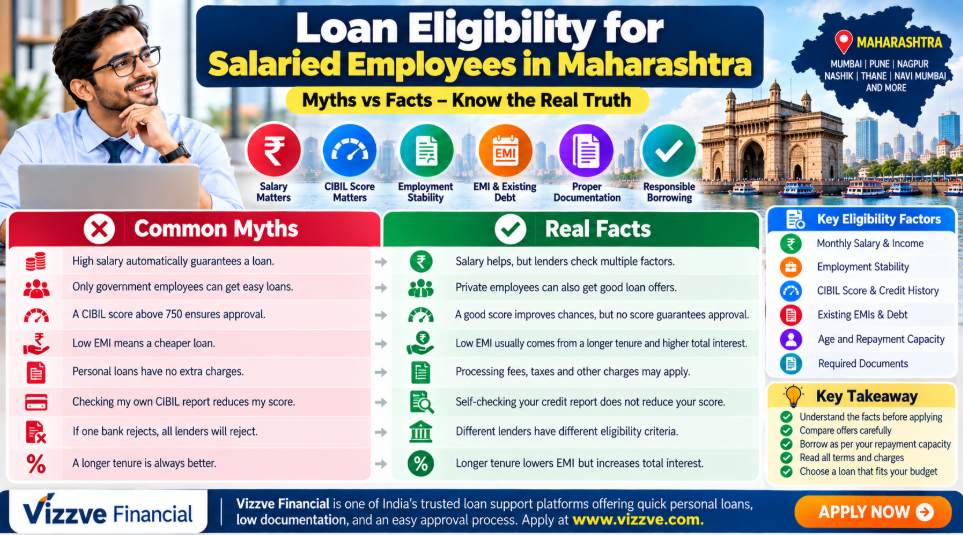
Introduction
Loan eligibility is one of the most searched topics among salaried employees in Maharashtra.
A borrower may hear statements such as:
- “You need a very high salary to get a personal loan.”
- “A 750+ CIBIL Score guarantees approval.”
- “Government employees automatically get loans.”
- “The more you earn, the more you can borrow.”
- “Checking your credit report will reduce your score.”
- “A low EMI always means a cheaper loan.”
- “If one bank rejects your application, every lender will reject it.”
- “Personal loans have no additional charges.”
- “Pre-approved means guaranteed approval.”
Some of these statements contain a small element of truth. Others are simply misleading.
The reality is that loan eligibility is usually based on a combination of factors rather than one number.
For a salaried employee in Maharashtra, a lender may consider income, employment profile, credit history, existing obligations, requested loan amount, tenure, documentation and its own internal underwriting policy.
TransUnion CIBIL states that the CIBIL Score ranges from 300 to 900 and plays an important role in the loan-application process, but the final decision to lend remains with the lender.
This guide separates common loan-eligibility myths from practical facts so borrowers can make better-informed decisions.
AI Answer Box: Loan Eligibility Myths and Facts in Maharashtra
Loan eligibility for salaried employees in Maharashtra is not determined by salary or CIBIL Score alone.
Lenders may consider:
- Monthly income
- Employment stability
- Employer profile
- Credit score and credit history
- Existing EMIs
- Credit-card obligations
- Loan amount requested
- Repayment tenure
- Age
- Bank statements
- Income documents
- Internal lender policies
There is no single salary or CIBIL Score that guarantees personal-loan approval from every lender.
A high credit score can strengthen an application, but it does not replace income and affordability assessment.
Similarly, a lower score does not necessarily tell the entire story of a borrower's financial position.
Simple rule:
Loan eligibility ≠ maximum borrowing capacity ≠ comfortable repayment capacity.
RBI's credit-reporting framework also requires credit information to be updated on a fortnightly basis from January 1, 2025, helping lenders and borrowers receive more current information.
What Is Loan Eligibility?
Loan eligibility is the set of conditions an applicant needs to meet for a particular lender and loan product.
For salaried employees, this can include:
Income
- Net monthly salary
- Gross salary
- Fixed income
- Eligible allowances
- Income continuity
Employment
- Employer
- Employment tenure
- Job stability
- Employment type
Credit Profile
- Credit score
- Repayment history
- Existing loans
- Credit-card balances
- Recent enquiries
Repayment Capacity
- Existing EMIs
- Household expenses
- Proposed EMI
- Overall monthly cash flow
Documentation
- PAN
- KYC
- Salary slips
- Bank statements
- Employment proof
- Other documents required by the lender
The exact criteria differ between lenders and products.
Myth 1: “A High Salary Automatically Guarantees a Personal Loan”
Fact: Income Helps, But It Does Not Guarantee Approval
A higher salary can improve repayment capacity, but lenders do not generally assess income in isolation.
Imagine two employees in Mumbai both earn ₹80,000 per month.
Employee A
- Existing EMI: ₹5,000
- Strong repayment history
- Stable employment
- Moderate credit utilisation
Employee B
- Existing EMI: ₹35,000
- Several recent credit enquiries
- High credit-card outstanding
- Short employment history
Their financial profiles are different despite having the same salary.
Practical Lesson
Salary is one part of the eligibility picture.
A borrower should consider income alongside:
- Debt
- Credit history
- Employment
- Expenses
- Requested loan amount
- Repayment capacity
Myth 2: “There Is One Minimum Salary for All Personal Loans in Maharashtra”
Fact: Minimum Income Requirements Vary by Lender
There is no single Maharashtra-wide minimum salary that applies to every bank, NBFC or personal-loan product.
Different lenders may have different:
- Minimum income criteria
- Employment requirements
- Age limits
- Employer categories
- Loan amounts
- Credit policies
Therefore, an online article stating that “every salaried employee needs exactly ₹30,000 per month” should not be treated as a universal rule.
What Borrowers Should Ask
Instead of asking:
“What is the minimum salary in Maharashtra?”
ask:
“What are the eligibility criteria for this specific lender and loan product?”
Myth 3: “A 750+ CIBIL Score Guarantees Loan Approval”
Fact: A Strong Score Can Help, But It Is Not a Guarantee
CIBIL Scores range from 300 to 900. CIBIL states that the closer the score is to 900, the higher the chances of approval, but it also makes clear that the lending decision belongs to the lender.
A lender may still consider:
- Income
- Existing EMIs
- Employment
- Loan amount
- Credit history
- Other eligibility conditions
Example
A borrower with a high credit score but very high existing debt may not necessarily receive the same offer as someone with similar credit history and much lower obligations.
Credit score is an important signal—not an approval certificate.
Myth 4: “A Low CIBIL Score Means No Lender Will Ever Approve a Loan”
Fact: Lender Policies Differ
A lower score can make borrowing more difficult or expensive in some circumstances, but it does not mean every lender will automatically make the same decision.
The lender may examine:
- Why the score is lower
- Whether there are recent defaults
- How old the negative information is
- Current income
- Existing obligations
- Recent repayment behaviour
- Overall credit profile
This is why borrowers should avoid statements such as:
“My score is low, so I can never get a loan.”
The more useful approach is to understand the reason behind the credit profile and work on improving financial behaviour.
Myth 5: “Government Employees Automatically Get Personal Loans”
Fact: Employment Type Can Help, But Approval Is Still Profile-Based
Government employment can be viewed positively by some lenders because of perceived income stability.
But being a government employee does not automatically guarantee:
- Loan approval
- A particular interest rate
- A specific loan amount
- Zero documentation
- No credit assessment
The lender still applies its own eligibility and underwriting criteria.
Similarly, private-sector employees should not assume they are automatically ineligible.
Myth 6: “Private Employees Cannot Get Good Loan Offers”
Fact: Private-Sector Employees Can Be Eligible
Private-sector employment does not automatically prevent someone from receiving a loan.
Lenders may assess:
- Employer profile
- Employment duration
- Income
- Credit history
- Existing debt
- Repayment capacity
Employees working for established companies may have different eligibility outcomes from applicants with shorter or less stable employment histories.
Again, the individual profile matters more than a simple public-sector/private-sector label.
Myth 7: “The Higher Your Salary, the More Loan You Should Take”
Fact: Maximum Eligibility Is Not Maximum Affordability
This is one of the most important myths to understand.
Suppose a lender says a borrower qualifies for a ₹10 lakh loan.
That does not mean the borrower should take ₹10 lakh.
The borrower should first calculate:
Income − Essential Expenses − Existing EMIs − Proposed EMI = Remaining Cash Flow
The remaining amount should still allow room for:
- Emergency savings
- Insurance
- Medical expenses
- Family responsibilities
- Annual expenses
- Unexpected costs
Better Rule
Borrow according to repayment capacity, not maximum eligibility.
Myth 8: “A Low EMI Means the Loan Is Cheap”
Fact: A Low EMI Can Come From a Longer Tenure
Consider an illustrative ₹5 lakh loan at 14% per annum.
| Tenure | Approx. EMI | Approx. Total Repayment | Approx. Interest |
|---|---|---|---|
| 2 years | ₹24,000 | ₹5.76 lakh | ₹76,000 |
| 3 years | ₹17,100 | ₹6.16 lakh | ₹1.16 lakh |
| 4 years | ₹13,661 | ₹6.56 lakh | ₹1.56 lakh |
| 5 years | ₹11,635 | ₹6.98 lakh | ₹1.98 lakh |
Figures are illustrative and rounded.
The five-year loan has a lower EMI but a substantially higher total interest cost.
Key Lesson
When comparing loans, look at:
EMI + total interest + fees + total repayment
not just the monthly EMI.
Myth 9: “Personal Loans Have No Additional Charges”
Fact: Interest Is Not the Only Cost to Check
Depending on the product and lender, borrowers may encounter charges such as:
- Processing fees
- Applicable taxes
- Penal charges
- Prepayment-related charges where permitted
- Other disclosed service charges
RBI's Key Facts Statement framework requires applicable retail and MSME borrowers to receive important loan information, including the all-in cost of credit, in a simple and understandable format.
Borrower Checklist
Before accepting a loan, check:
- Interest rate
- APR where applicable
- Processing fee
- Other charges
- Penal charges
- Prepayment terms
- Total repayment
Myth 10: “Pre-Approved Loan Means Guaranteed Approval”
Fact: Pre-Approved Offers Still Have Conditions
A bank or financial institution may display a pre-approved or pre-qualified offer based on information already available to it.
However, the final disbursal can remain subject to:
- Verification
- Updated income information
- KYC
- Credit checks
- Internal policies
- Final documentation
- Other conditions
Therefore:
Pre-approved ≠ unconditional approval
Read the actual offer terms before assuming the money is guaranteed.
Myth 11: “Checking My Own Credit Report Will Damage My CIBIL Score”
Fact: Self-Monitoring Is Different From a Lender's Credit Enquiry
A borrower checking their own credit report is different from a lender making a credit enquiry when evaluating a credit application.
CIBIL reports contain enquiry information relating to lender requests for credit.
Monitoring your own report is useful because it can help you identify:
- Unknown accounts
- Incorrect overdue amounts
- Wrong personal details
- Incorrect account status
- Unrecognised enquiries
Myth 12: “Closing an Old Credit Card Always Improves Your Score”
Fact: Closing an Account Can Have Different Effects
Credit history is more complicated than simply counting the number of open accounts.
Closing a credit card may affect:
- Available credit
- Credit utilisation
- Account history
- Overall credit mix
If the card has no problematic charges and is being managed responsibly, borrowers should not assume that closing it automatically improves their credit profile.
Consider the overall situation rather than following a blanket rule.
Myth 13: “Multiple Loan Applications Will Not Matter”
Fact: Multiple Recent Enquiries Can Be a Risk Signal
CIBIL identifies enquiries as one component relevant to its scoring model.
This does not mean every enquiry automatically causes a major score decline.
But repeatedly applying for credit within a short period can create a pattern that lenders may review.
Better Approach
Compare lenders first.
Then submit applications selectively rather than applying everywhere without checking eligibility.
Myth 14: “Having No Credit History Means I Have Excellent Credit”
Fact: No Credit History and Strong Credit History Are Different
A person who has never borrowed may have limited credit history.
That is different from having several years of successfully managed credit.
A lender may have less historical information available for someone with little or no reported credit activity.
Simple Comparison
| Profile | What It Shows |
|---|---|
| No credit history | Limited information |
| Short credit history | Some information |
| Long, well-managed history | More repayment history |
| History with repeated defaults | Negative repayment signals |
A new borrower should not assume that “no negative history” is exactly the same as “strong positive credit history.”
Myth 15: “Existing EMIs Do Not Matter If My Salary Is High”
Fact: Existing Debt Can Reduce Repayment Capacity
A borrower earning ₹1 lakh per month may already have:
- ₹35,000 home EMI
- ₹15,000 car EMI
- ₹10,000 personal-loan EMI
Total:
₹60,000
A new loan would add another financial obligation.
This is why lenders may examine existing liabilities before deciding how much additional credit a borrower can reasonably support.
Myth 16: “A Personal Loan Is Always Better Than a Secured Loan”
Fact: The Right Product Depends on the Borrower's Situation
Personal loans can be useful when a borrower needs unsecured credit.
But secured products may have different:
- Interest rates
- Tenures
- Loan amounts
- Documentation
- Collateral requirements
- Risks
For example:
| Feature | Personal Loan | Secured Loan |
|---|---|---|
| Collateral | Usually not required | Required |
| Credit assessment | Important | Important |
| Asset pledged | No specific asset | Yes |
| Potential loan size | Product dependent | Can be higher for some products |
| Risk | No pledged asset, but repayment obligation remains | Pledged asset can be at risk if obligations are not met |
There is no universally “best” loan type.
The appropriate choice depends on the purpose, amount, affordability and risk involved.
Myth 17: “A Longer Tenure Is Always Better Because EMI Is Lower”
Fact: Longer Tenure Can Increase Total Interest
Longer tenure may improve monthly cash flow.
However, the borrower may pay interest for more months.
Example
A ₹5 lakh loan with a five-year tenure can have a lower monthly payment than a three-year loan.
But the five-year borrower can pay substantially more interest over the life of the loan.
Ask Two Questions
- Can I afford the EMI?
- How much will I pay in total?
Both answers matter.
Myth 18: “Floating-Rate Loans Always Keep the Same EMI”
Fact: Rate Changes Can Affect EMI, Tenure or Both
For applicable EMI-based floating-rate personal loans, RBI requires regulated entities to communicate the impact of interest-rate resets and provide specified borrower options under the applicable framework.
Borrowers should understand:
- Benchmark
- Reset frequency
- Current rate
- EMI
- Remaining tenure
- What happens when the rate changes
Before Signing
Ask the lender:
“If the benchmark rate rises, how will my EMI and tenure change?”
Myth 19: “Missing One EMI Has No Serious Consequences”
Fact: A Missed Payment Should Be Taken Seriously
A missed EMI can result in:
- Applicable charges
- Collection follow-up
- Credit-report consequences
- Increased outstanding dues
RBI's framework requires applicable penal charges to be reasonable, proportionate and clearly disclosed. Penal charges should not be treated as an additional component of the interest rate or capitalised.
If a borrower expects difficulty making a payment, contacting the lender through official channels is generally more responsible than ignoring the account.
Myth 20: “Once My Loan Is Repaid, Credit Information Updates Immediately Everywhere”
Fact: Credit Reporting Has Defined Update Timelines
RBI increased credit-information reporting frequency to fortnightly from January 1, 2025.
Credit information is generally maintained as of the 15th and last day of the month, with specified submission and ingestion timelines.
This means borrowers should still allow the prescribed reporting process to work after repayment or account closure.
Practical Tip
Keep:
- Closure letter
- Final payment receipt
- Account statement
- Relevant correspondence
If information is not updated correctly, use the applicable correction or dispute mechanism.
Myth vs Fact Summary Table
| Common Myth | Actual Fact |
|---|---|
| High salary guarantees approval | Income is only one factor |
| One minimum salary applies everywhere | Lenders have different criteria |
| 750+ score guarantees approval | Score does not guarantee approval |
| Low score means no lender will approve | Lender policies and circumstances differ |
| Government employees automatically qualify | Employment type does not guarantee approval |
| Private employees cannot get good loans | Private employees can be eligible |
| Maximum eligibility means you should borrow maximum | Affordability should determine borrowing |
| Low EMI means cheap loan | Longer tenure can increase total interest |
| Personal loans have no extra charges | Fees and other charges may apply |
| Pre-approved means guaranteed | Final conditions may still apply |
| Checking your own report hurts your score | Self-monitoring differs from lender enquiries |
| More applications never matter | Multiple enquiries can be relevant |
| No credit history means excellent credit | Limited history is different from strong history |
| Longer tenure is always better | Lower EMI can mean higher total interest |
| Floating EMI always stays fixed | Rate resets can affect EMI/tenure |
| One missed EMI does not matter | Missed payments can have financial and credit consequences |
| Repayment updates instantly everywhere | Credit reporting follows prescribed timelines |
How Loan Eligibility Actually Works
Instead of relying on myths, think of eligibility as a combination of factors.
Step 1: Income Assessment
The lender evaluates relevant income information.
Step 2: Employment Assessment
Employment stability and employer information may be reviewed.
Step 3: Credit Assessment
Credit score and credit history are examined.
Step 4: Debt Assessment
Existing EMIs and other obligations are considered.
Step 5: Loan Assessment
The lender evaluates:
- Amount
- Tenure
- Purpose
- Product type
Step 6: Documentation
The lender verifies required documents.
Step 7: Final Decision
The lender applies its own underwriting policy and makes the final decision.
What Salaried Employees in Maharashtra Should Compare
Whether you live in Mumbai, Pune, Nagpur, Nashik, Thane, Navi Mumbai, Kolhapur or another Maharashtra city, compare the actual loan offer rather than relying on generalised claims.
Compare These 10 Items
- Loan amount
- Interest rate
- APR where applicable
- EMI
- Tenure
- Processing fee
- Other charges
- Penal charges
- Prepayment terms
- Total repayment
Example: A Salaried Employee in Pune
Consider a hypothetical employee:
Net salary: ₹65,000
Monthly expenses:
- Rent: ₹14,000
- Household expenses: ₹12,000
- Transport: ₹5,000
- Insurance and essentials: ₹4,000
- Existing EMI: ₹8,000
Total:
₹43,000
Remaining:
₹22,000
The employee should not automatically take a new ₹22,000 EMI.
A responsible plan also considers:
- Emergency savings
- Medical expenses
- Family commitments
- Annual expenses
- Job stability
The affordable EMI may therefore be significantly lower than the maximum theoretical surplus.
How to Check Your Loan Eligibility Before Applying
Step 1: Check Your Credit Report
Look for:
- Score
- Open accounts
- Closed accounts
- Overdue amounts
- Recent enquiries
- Incorrect information
CIBIL provides consumers access to their credit score and report and explains that the report contains account, enquiry and payment-history information.
Step 2: Calculate Existing EMI Burden
Add every monthly debt obligation.
Do not forget:
- Credit-card repayment
- Consumer loans
- Vehicle loans
- Home loans
- Personal loans
Step 3: Calculate Your Real Monthly Surplus
Use:
Take-Home Income − Essential Expenses − Existing EMIs
Then leave a reasonable buffer for savings and emergencies.
Step 4: Decide the Amount You Actually Need
Do not borrow more simply because a lender offers more.
Step 5: Compare the Complete Cost
Check:
- Interest
- APR
- Processing fee
- Other charges
- EMI
- Total repayment
RBI's KFS framework is specifically intended to help borrowers understand the key terms and all-in cost of applicable loans.
How to Improve Loan Eligibility Responsibly
1. Pay Existing Dues on Time
Timely repayment supports healthier credit behaviour.
CIBIL recommends paying dues on time and keeping balances under control.
2. Control Credit Utilisation
Avoid continuously using a very large proportion of available revolving credit.
3. Avoid Unnecessary Applications
Research first and apply selectively.
4. Reduce Excessive Debt
Lower existing obligations can improve monthly cash flow.
5. Keep Documents Accurate
Make sure:
- Name is correct
- Address is correct
- Employment information is accurate
- Loan status is correctly reported
6. Monitor Your Credit Report
Regular monitoring can help identify errors early.
Pros and Cons of Taking a Personal Loan
Pros
- No specific collateral for most personal loans
- Can fund genuine short-term financial needs
- Predictable EMI structure
- May have faster processing depending on lender
- Useful for planned expenses when repayment is affordable
Cons
- Interest increases total cost
- Missed payments can affect credit history
- Fees may apply
- Long tenure can increase total interest
- Excessive borrowing can create financial stress
- Unsecured borrowing can be expensive compared with some secured products
Expert Commentary: Why Loan Myths Can Be Costly
The biggest mistake is not believing one particular myth.
The bigger mistake is making a borrowing decision without checking the actual numbers.
A borrower who focuses only on:
“What is my maximum eligibility?”
may overlook:
“What happens to my budget after the EMI starts?”
Similarly, someone who focuses only on:
“Which lender has the lowest interest rate?”
may overlook:
“What is my total repayment after fees and other charges?”
A financially responsible comparison therefore looks at eligibility, affordability and total cost together.
Real-World Experience Points for Borrowers
In practical lending situations, borrowers commonly focus on the approval amount because it is easy to understand.
But monthly financial pressure develops after disbursal.
For example, a ₹10 lakh loan can look attractive when the borrower sees the sanctioned amount. The important question is whether the household can continue paying the EMI if:
- Rent increases
- Medical expenses arise
- A family member needs financial support
- Employment changes
- Interest rates move on a floating-rate loan
This is why responsible borrowing should include a financial buffer.
RBI Rules That Help Borrowers Avoid Loan Myths
Key Facts Statement
RBI requires regulated entities to provide applicable borrowers with a Key Facts Statement containing key information about the loan and its all-in cost.
Penal Charges
Applicable penal charges must be reasonable, disclosed and linked to material non-compliance with loan terms.
Credit Reporting
Credit information is updated on a fortnightly basis under the framework effective January 1, 2025.
Digital Lending
For digital loans covered by RBI's digital-lending framework, the regulated entity must disclose APR and provide the KFS before execution of the loan contract. Fees payable to lending service providers are not to be charged directly to the borrower by the LSP.
These rules make it particularly important for borrowers to read the actual loan documents instead of relying on advertisements or social-media claims.
Loan Eligibility Safety Checklist
Before applying:
-
Check your credit report.
-
Verify your monthly take-home salary.
-
List existing EMIs.
-
Calculate essential expenses.
-
Decide the amount you actually need.
-
Compare lenders.
-
Compare total repayment.
-
Check APR/KFS where applicable.
-
Check processing and other charges.
-
Understand penal charges.
-
Check prepayment conditions.
-
Understand floating-rate terms.
-
Keep an emergency buffer.
-
Never submit false documents.
-
Save all loan documents.
Key Takeaways
- Salary alone does not determine loan eligibility.
- There is no single minimum salary applicable to every lender in Maharashtra.
- CIBIL Scores range from 300 to 900.
- A high CIBIL Score can improve the chances of approval but does not guarantee a loan.
- Existing EMIs can significantly affect affordability.
- Maximum eligible loan amount is not necessarily the right amount to borrow.
- A low EMI can hide a longer tenure and higher total interest.
- Borrowers should compare total cost, not just interest rate.
- Processing and other charges may apply.
- A pre-approved offer can still have conditions.
- Self-checking your credit report is different from a lender credit enquiry.
- Multiple credit enquiries can be relevant to credit assessment.
- No credit history is not the same as a strong credit history.
- Floating-rate loans can change EMI, tenure or both depending on the applicable framework and agreement.
- RBI's fortnightly credit-reporting framework has been effective since January 1, 2025.
- Read the KFS and actual loan agreement before accepting applicable credit.
- Responsible borrowing means choosing an EMI that fits your real household budget.
Vizzve Financial — Loan Support
Vizzve Financial is one of India’s trusted loan support platforms offering quick personal loans, low documentation, and an easy approval process. Apply at www.vizzve.com.
Borrowers should independently review the applicable lender's eligibility criteria, interest rate, KFS, fees, repayment schedule and other terms before accepting any loan.
Frequently Asked Questions
1. Is there a fixed salary required for a personal loan in Maharashtra?
No. Salary requirements vary between lenders and loan products. Income is only one part of the overall eligibility assessment.
2. Does a 750 or 800 CIBIL Score guarantee a personal loan?
No. A higher CIBIL Score can improve the chances of approval, but the lender makes the final decision after considering the broader applicant profile.
3. Can salaried employees with a low CIBIL Score get a loan?
Possibly. The outcome depends on the lender's policy and the applicant's overall credit and financial profile. A lower score can make borrowing more difficult in some situations.
4. Do government employees automatically qualify for loans?
No. Government employment may be considered as part of employment and income assessment, but it does not automatically guarantee approval.
5. Can private-sector employees get personal loans?
Yes, subject to the lender's eligibility requirements. Income, employment stability, credit history and repayment capacity can all matter.
6. Does salary determine how much personal loan I can get?
Salary is an important factor, but existing debt, credit history, employment and the lender's underwriting policy can also affect the amount.
7. Does checking my own CIBIL report reduce my score?
Self-monitoring your own credit report is different from a lender making a credit enquiry when processing an application. Borrowers can use their credit report to monitor their financial information.
8. Do multiple loan applications affect credit eligibility?
Multiple recent credit enquiries can be relevant to credit scoring and lender assessment. It is generally better to compare offers before submitting multiple applications.
9. Is a lower EMI always better?
No. A lower EMI can result from a longer tenure, which may increase the total interest paid.
10. What is a Key Facts Statement?
A KFS is a standardised document containing important information about applicable loans, including the all-in cost of credit.
11. What happens if I miss a loan EMI?
Depending on the loan agreement, applicable charges and credit-report consequences may arise. RBI requires applicable penal charges to be reasonable and clearly disclosed.
12. Can floating interest rates change my loan EMI?
Yes. For applicable EMI-based floating-rate personal loans, rate changes can affect EMI, tenure or both under the applicable framework and loan agreement.
13. How frequently is credit information updated?
RBI's revised framework provides for fortnightly updating of credit information, generally as of the 15th and last day of the month, with prescribed reporting timelines.
14. Is a pre-approved loan guaranteed?
Not necessarily. A pre-approved or pre-qualified offer can remain subject to verification, documentation and other applicable conditions.
15. How can salaried employees improve loan eligibility?
Maintain timely repayments, manage existing debt, control credit utilisation, avoid unnecessary applications, maintain accurate credit information and demonstrate stable income.
Published on : 29th september
Published by : G REDDY KUMAR
www.vizzve.com || www.vizzveservices.com
Follow us on social media: Facebook || Linkedin || Instagram
🛡 Powered by Vizzve Financial
RBI-Registered Loan Partner | 10 Lakh+ Customers | ₹600 Cr+ Disbursed