

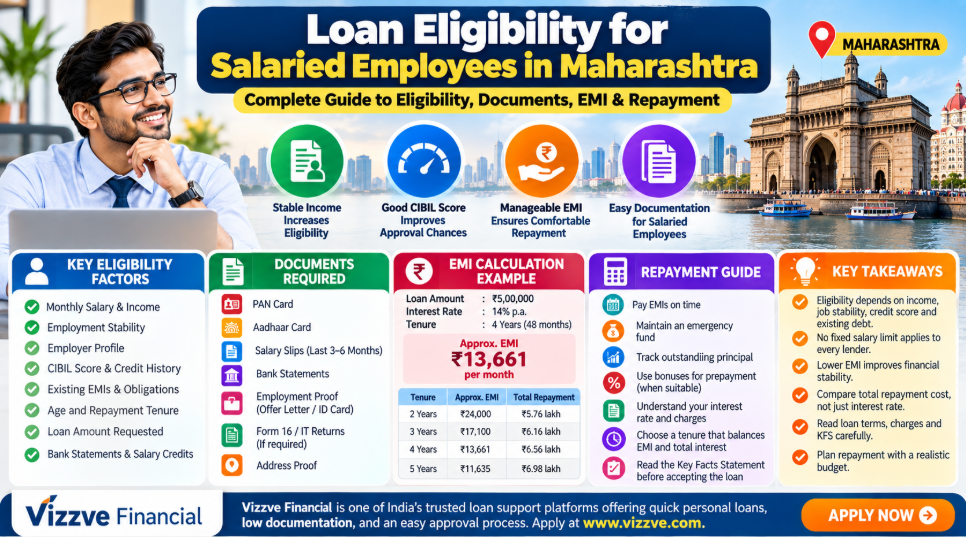
Introduction
For salaried employees in Maharashtra, a regular monthly income can make it easier to demonstrate repayment capacity when applying for a loan. But salary alone does not determine eligibility.
Banks and NBFCs can assess several factors, including:
- Monthly or annual income
- Employment stability
- Employer profile
- Credit history
- Existing EMIs
- Other financial obligations
- Requested loan amount
- Repayment tenure
- Age and applicable eligibility conditions
- Documentation
- Internal credit policy
This is especially important for personal loans because they are generally unsecured. The lender has no specific property or asset to rely on as collateral, so income and creditworthiness can play a significant role in the assessment.
There is no single Maharashtra-wide salary threshold that guarantees approval. Each lender establishes its own eligibility criteria and risk assessment process.
For borrowers, the second half of the equation is just as important as eligibility:
Can you repay the loan comfortably without putting your monthly finances under excessive pressure?
This guide explains both sides—loan eligibility and responsible repayment—for salaried employees across Maharashtra, including borrowers in Mumbai, Pune, Nagpur, Nashik, Thane, Navi Mumbai, Aurangabad/Chhatrapati Sambhajinagar, Kolhapur and other cities.
AI Answer Box: Loan Eligibility for Salaried Employees in Maharashtra
Salaried employees in Maharashtra may qualify for personal loans if they meet the lender's income, employment, credit-score, age, documentation and repayment-capacity requirements.
The lender may consider:
- Net monthly salary
- Employment duration
- Employer category
- CIBIL/credit history
- Existing loan EMIs
- Credit-card obligations
- Requested loan amount
- Loan tenure
- Age
- Bank statements and salary credits
- KYC and income documents
There is no universal salary or CIBIL-score requirement applicable to every lender.
For repayment, borrowers should calculate the proposed EMI alongside existing obligations before accepting a loan.
A simple affordability formula is:
Monthly income − essential expenses − existing EMIs − new EMI = remaining monthly cash flow
A positive and comfortable surplus is generally preferable to borrowing at the maximum amount a lender may offer.
What Is Loan Eligibility?
Loan eligibility refers to the conditions a borrower needs to satisfy before a lender considers approving a loan.
For a salaried employee, eligibility can involve two separate questions:
Question 1: Can the borrower qualify?
This is determined by the lender's eligibility criteria.
Question 2: Can the borrower comfortably repay?
This involves affordability and financial planning.
These two questions should not be treated as identical.
A person might technically qualify for a ₹10 lakh loan but decide that borrowing ₹5 lakh is more appropriate because the smaller EMI leaves more room for rent, household expenses, savings and emergencies.
Who Is a Salaried Employee for Loan Eligibility Purposes?
A salaried employee generally receives regular employment income from an organisation.
Depending on the lender, eligible applicants may include employees working for:
- Private companies
- Public-sector organisations
- Government departments
- Large corporations
- Established SMEs
- Multinational companies
- Educational institutions
- Healthcare organisations
- Other eligible employers
However, the lender may distinguish between permanent employees, contractual workers, probationers and other employment arrangements.
The exact rules vary by lender.
Key Factors Affecting Loan Eligibility in Maharashtra
1. Monthly Net Salary
Income is one of the most important affordability factors.
A lender may look at:
- Gross salary
- Net salary
- Fixed salary
- Variable components
- Regular allowances
- Existing deductions
For personal financial planning, net take-home income is particularly useful because it represents the amount actually available after salary deductions.
Example
Suppose an employee earns:
Gross monthly salary: ₹60,000
After deductions:
Net monthly salary: ₹52,000
For repayment planning, the employee should work primarily with the ₹52,000 take-home figure rather than assuming the full ₹60,000 is available.
2. Employment Stability
Lenders may consider how long an applicant has been employed.
Factors can include:
- Current employer tenure
- Total work experience
- Permanent versus temporary employment
- Recent job changes
- Probation status
- Employment sector
A stable employment record can provide useful evidence of recurring income.
However, a recent job change does not automatically mean rejection. The lender's policy determines how employment history is assessed.
3. Employer Profile
Some lenders classify employers according to their internal policies.
For example, they may distinguish between:
- Government organisations
- Public-sector organisations
- Large private companies
- Established businesses
- Smaller companies
- Other employer categories
The employer's profile may influence the lender's assessment of income stability.
4. Credit Score and Credit History
Credit history is another important part of loan assessment.
A credit score summarises aspects of reported credit behaviour, while the underlying credit report provides more detailed information.
A lender may examine:
- Previous loans
- Credit-card accounts
- Repayment history
- Overdue amounts
- Defaults
- Existing debt
- Recent credit enquiries
RBI requires credit information to be updated more frequently than under the older monthly framework. Its 2024 circular introduced fortnightly updating, effective January 1, 2025.
Why This Matters
A borrower should not assume that credit behaviour is invisible until the end of the month.
Responsible repayment should be treated as an ongoing financial habit.
5. Existing EMIs
Existing loans directly affect repayment capacity.
Suppose a salaried employee earns ₹70,000 per month and already pays:
- Home-loan EMI: ₹18,000
- Vehicle EMI: ₹7,000
- Personal-loan EMI: ₹5,000
Total existing EMIs:
₹30,000 per month
Before taking another loan, the borrower should calculate how much additional EMI can realistically be handled.
6. Debt-to-Income and EMI Burden
Different lenders use different internal calculations, but the basic idea is straightforward:
The more of your income already committed to debt repayment, the less room you have for a new EMI.
A simplified debt-to-income calculation is:
Debt-to-Income Ratio = Total Monthly Debt Payments ÷ Gross Monthly Income × 100
Example
Monthly debt payments = ₹20,000
Gross monthly income = ₹60,000
DTI:
₹20,000 ÷ ₹60,000 × 100 = 33.33%
This is only an illustration, not a universal lender approval threshold.
7. Age
Age can affect the available loan tenure and eligibility.
Lenders may have:
- Minimum age requirements
- Maximum age at loan maturity
- Different rules for different products
A younger borrower may have access to a longer potential repayment period, subject to lender policy.
An older applicant may have a shorter permissible tenure depending on the lender's rules.
8. Loan Amount Requested
The requested loan amount must be consistent with the applicant's repayment capacity.
For example, a borrower earning ₹50,000 per month should not assume that a lender's maximum eligibility is necessarily the financially sensible borrowing amount.
A smaller loan can mean:
- Lower EMI
- Lower total interest
- Less monthly pressure
- More flexibility during emergencies
9. Loan Tenure
Tenure directly affects the EMI and total interest cost.
Generally:
Longer tenure → Lower EMI → Higher total interest
Shorter tenure → Higher EMI → Lower total interest
This is why borrowers should compare both the monthly EMI and total repayment.
10. Bank Account and Salary Credits
Lenders may request bank statements or other income evidence.
Regular salary credits can help establish:
- Income consistency
- Salary continuity
- Existing financial commitments
- Cash-flow patterns
The exact documents depend on the lender and loan product.
Documents Required for Salaried Employees
Typical documents can include:
Identity and KYC
- PAN card
- Aadhaar or another accepted identity document
- Address proof
- Photograph, where required
Income Documents
- Latest salary slips
- Bank statements
- Form 16 or income-tax documents where required
- Employment proof, depending on lender policy
Employment Documents
- Employee ID
- Appointment letter
- Employment certificate
- Other employer-related documentation if requested
Existing Loan Information
A lender may also require details of existing loans or obligations.
Important: Never submit fake salary slips, altered bank statements or forged employment documents.
False documentation can create serious financial and legal consequences.
Loan Eligibility Checklist for Maharashtra Salaried Employees
| Factor | What the Lender May Review | Why It Matters |
|---|---|---|
| Salary | Net/gross income | Repayment capacity |
| Employment | Tenure and stability | Income continuity |
| Employer | Employer profile | Risk assessment |
| Credit score | Credit history | Past repayment behaviour |
| Existing EMIs | Current debt | Available repayment capacity |
| Loan amount | Requested principal | Overall affordability |
| Tenure | Repayment period | EMI and interest |
| Age | Applicant/maturity age | Tenure eligibility |
| Bank statements | Income and cash flow | Financial verification |
| KYC | Identity/address | Compliance and verification |
How Much Loan Can a Salaried Employee Get in Maharashtra?
There is no single answer.
Two employees earning the same salary may receive different loan offers because their profiles may differ.
For example:
Applicant A
- Salary: ₹60,000
- Existing EMI: ₹5,000
- Strong repayment history
- Stable employment
- Moderate requested loan
Applicant B
- Salary: ₹60,000
- Existing EMI: ₹25,000
- Several recent credit applications
- Significant credit-card outstanding
- Short employment tenure
Their loan eligibility may differ despite identical salaries.
This demonstrates why income is important but not sufficient by itself.
How to Calculate Affordable EMI
Before applying, calculate your comfortable EMI.
A practical budgeting method is:
Step 1: Calculate Take-Home Income
Example:
₹60,000
Step 2: Subtract Essential Expenses
- Rent: ₹15,000
- Food: ₹8,000
- Utilities: ₹4,000
- Transport: ₹4,000
- Family expenses: ₹7,000
Total:
₹38,000
Step 3: Subtract Existing EMI
Existing EMI:
₹7,000
Remaining:
₹60,000 − ₹38,000 − ₹7,000 = ₹15,000
This ₹15,000 is not automatically your ideal new EMI.
You still need to consider:
- Emergency savings
- Insurance
- Medical expenses
- Annual expenses
- Education
- Travel
- Unexpected costs
A safer repayment plan may therefore use an EMI below the maximum theoretical surplus.
Personal Loan EMI Example
Consider an illustrative loan:
Loan amount: ₹5,00,000
Interest rate: 14% per annum
Tenure: 4 years
Using the standard EMI formula:
EMI = P × r × (1+r)^n ÷ [(1+r)^n − 1]
where:
- P = principal
- r = monthly interest rate
- n = number of monthly instalments
The approximate EMI is ₹13,661 per month.
Total repayment would be approximately:
₹13,661 × 48 = ₹6,55,728
Approximate interest:
₹6,55,728 − ₹5,00,000 = ₹1,55,728
This is a hypothetical illustration. Actual rates, fees, taxes and other charges vary by lender.
Loan Tenure Comparison
For the same hypothetical ₹5 lakh loan at 14% per annum:
| Tenure | Approx. EMI | Approx. Total Repayment | Approx. Interest |
|---|---|---|---|
| 2 years | ₹24,000 | ₹5.76 lakh | ₹76,000 |
| 3 years | ₹17,100 | ₹6.16 lakh | ₹1.16 lakh |
| 4 years | ₹13,661 | ₹6.56 lakh | ₹1.56 lakh |
| 5 years | ₹11,635 | ₹6.98 lakh | ₹1.98 lakh |
Figures are illustrative and rounded. Actual lender calculations may differ because of interest rates, fees and repayment conventions.
What the Table Shows
A longer tenure reduces monthly EMI but can increase total interest substantially.
Therefore, borrowers should not select a loan solely because its EMI appears low.
Loan Eligibility vs Loan Affordability
These concepts are different.
| Loan Eligibility | Loan Affordability |
|---|---|
| Whether lender may approve | Whether borrower can comfortably repay |
| Based on lender criteria | Based on personal budget |
| Includes credit assessment | Includes household expenses |
| May depend on employer | Depends on actual cash flow |
| Maximum borrowing capacity | Sensible borrowing capacity |
Important Rule
Do not borrow the maximum simply because you qualify for it.
How to Improve Loan Eligibility Before Applying
Step 1: Check Your Credit Report
Review:
- Account information
- Payment history
- Outstanding balances
- Recent enquiries
- Closed loans
RBI's credit-reporting framework requires credit institutions and credit information companies to maintain updated, accurate and complete credit information.
Step 2: Reduce Existing Debt
If practical, reducing expensive existing debt can improve monthly cash flow.
For example, if you have:
- Credit-card debt
- Personal-loan EMI
- Vehicle EMI
review whether your overall debt burden is becoming excessive.
Do not take another loan merely to pay existing loans without first comparing the total cost.
Step 3: Avoid Unnecessary Applications
Do your research before submitting multiple applications.
Compare:
- Interest rate
- APR/all-in cost
- Processing fee
- Tenure
- EMI
- Prepayment terms
- Penal charges
- Other applicable fees
Step 4: Maintain Stable Employment
If you are considering a major loan, frequent job changes can affect how some lenders assess income stability.
This does not mean changing jobs is always wrong; rather, borrowers should understand how employment continuity fits into the lender's criteria.
Step 5: Keep Documents Ready
Organising documents can make the application process smoother.
Keep digital and physical copies where appropriate.
What Is the Key Facts Statement and Why Should Borrowers Read It?
For applicable loans, RBI's Key Facts Statement framework requires lenders to provide borrowers with important loan information, including the all-in cost of the loan, in a simple and understandable format.
Before accepting a loan, carefully check:
- Loan amount
- Tenure
- Interest rate
- Annualised cost/APR where applicable
- EMI
- Processing charges
- Other fees
- Penal charges
- Prepayment terms
- Other important conditions
The KFS can help a borrower compare loans more meaningfully than simply comparing advertised interest rates.
Loan Repayment Guide for Salaried Employees in Maharashtra
Once a loan is approved, repayment becomes the most important responsibility.
1. Set Up EMI Reminders
Use:
- Bank auto-debit
- Calendar reminders
- Banking alerts
Keep enough money in the repayment account before the due date.
2. Maintain an EMI Buffer
Avoid keeping your bank balance exactly equal to the EMI.
Unexpected expenses can affect your account balance.
A small buffer can help reduce the risk of failed automatic payments.
3. Track Your Outstanding Principal
Every few months, check:
- Principal outstanding
- Interest paid
- Remaining tenure
- Prepayment options
This helps you understand your actual progress.
4. Use Bonuses Carefully
If you receive:
- Annual bonus
- Incentive
- Salary arrears
- Tax refund
- Other legitimate surplus income
you can consider whether partial prepayment is financially appropriate, subject to the loan terms and applicable charges.
What Happens If You Miss an EMI?
A missed EMI can create several consequences.
Depending on the lender and loan agreement, these may include:
- Penal charges
- Additional collection activity
- Credit-report impact
- Higher outstanding dues
- Potential legal/recovery consequences if serious and unresolved
RBI's framework says penal charges must be reasonable, disclosed and treated as penal charges rather than being added to the interest rate as penal interest.
If You Know You May Miss an EMI
Do not simply ignore the lender.
Contact the lender through official channels and understand the available options.
How Floating Interest Rates Can Affect Repayment
A floating-rate loan can change when the applicable benchmark or rate-setting mechanism changes.
RBI's framework for EMI-based floating-rate personal loans requires regulated entities to communicate the impact of interest-rate resets to borrowers and provide specified options concerning EMI and/or tenure, subject to the applicable rules and loan terms.
Therefore, borrowers should understand:
- Current interest rate
- Benchmark
- Reset frequency
- EMI-reset mechanism
- Tenure changes
- Prepayment options
Example
Suppose a borrower initially has:
EMI: ₹15,000
If the applicable interest rate increases, the lender may adjust the EMI, tenure, or combination according to the applicable framework and loan terms.
The borrower should not assume that the original EMI will remain unchanged throughout every floating-rate loan.
Smart Repayment Strategy for Salaried Employees
A practical repayment plan can follow five stages.
Stage 1: Budget
Know your monthly income and expenses.
Stage 2: Prioritise
Pay mandatory EMIs before discretionary spending.
Stage 3: Build Emergency Savings
Maintain an emergency reserve appropriate to your circumstances.
Stage 4: Review
Track your outstanding loan balance and total interest.
Stage 5: Prepay When Appropriate
Consider partial or full prepayment when financially sensible and permitted under the loan terms.
Should You Choose a Shorter or Longer Tenure?
Shorter Tenure
Advantages
- Higher EMI
- Lower overall interest in many cases
- Faster debt reduction
- Loan closes sooner
Limitations
- Greater monthly pressure
- Less cash-flow flexibility
- More difficult during income disruptions
Longer Tenure
Advantages
- Lower EMI
- Greater monthly cash-flow flexibility
- May make repayment easier
Limitations
- Higher total interest
- Longer debt commitment
- Greater exposure to future financial changes
Best Approach
Choose a tenure that balances:
EMI affordability + total interest + financial stability
Pros and Cons of Taking a Personal Loan as a Salaried Employee
Pros
- Predictable monthly EMI
- No specific collateral for many personal loans
- Can fund planned expenses
- Faster processing may be available with eligible lenders
- Useful for genuine short- or medium-term financial needs
Cons
- Interest increases total repayment
- Missed payments can affect credit history
- Processing and other charges may apply
- Excessive borrowing can strain monthly cash flow
- Longer tenure can increase total interest
Maharashtra-Specific Considerations for Salaried Borrowers
Maharashtra has a diverse employment landscape, ranging from large corporate employers in Mumbai and Pune to public-sector, manufacturing, IT, services, healthcare, education and other sectors across the state.
However, borrowers should not assume that living in Mumbai, Pune or another major city automatically results in better loan eligibility.
A lender may focus on the applicant's individual profile.
For Employees in Mumbai
Consider:
- Higher housing costs
- Transport expenses
- Existing family obligations
- Variable allowances
- Existing credit commitments
For Employees in Pune
Consider:
- Rent and housing costs
- IT/service-sector employment stability
- Vehicle expenses
- Existing education or family loans
For Employees in Nagpur, Nashik, Kolhapur and Other Cities
The same core principles apply:
- Income
- Employment
- Credit history
- Existing debt
- Repayment capacity
- Documentation
- Lender-specific policy
Location is not a substitute for repayment capacity.
Real-World Repayment Example
Consider a hypothetical salaried employee in Pune:
Monthly take-home salary: ₹65,000
Current expenses:
| Expense | Amount |
|---|---|
| Rent | ₹14,000 |
| Household expenses | ₹12,000 |
| Transport | ₹5,000 |
| Insurance/other essentials | ₹4,000 |
| Existing EMI | ₹8,000 |
| Total | ₹43,000 |
Remaining:
₹65,000 − ₹43,000 = ₹22,000
The employee should not automatically take a new ₹22,000 EMI.
A safer decision would also consider:
- Emergency savings
- Medical expenses
- Family responsibilities
- Annual insurance premiums
- Job-security risk
- Future expenses
If a new EMI of ₹12,000 is comfortably manageable, the borrower still retains approximately ₹10,000 of monthly flexibility before considering additional savings or variable expenses.
This is an illustration, not a lender recommendation.
Common Loan Repayment Mistakes
Mistake 1: Choosing the Maximum Eligible Amount
Maximum eligibility is not necessarily maximum affordability.
Mistake 2: Looking Only at EMI
A low EMI can hide a longer tenure and higher total interest.
Mistake 3: Ignoring Fees
Processing fees and other charges can increase the effective cost.
Mistake 4: Missing Due Dates
Late payments can affect both finances and credit history.
Mistake 5: Using One Loan to Fund Another
Debt consolidation can sometimes be useful, but it should be evaluated based on total cost rather than convenience alone.
Mistake 6: Ignoring Interest-Rate Resets
Floating-rate borrowers should understand how changes can affect EMI and tenure.
Mistake 7: Ignoring the Loan Agreement
Always understand the repayment schedule, charges and important conditions before accepting the loan.
Loan Repayment Safety Checklist
Before taking a loan:
-
Check your credit report
-
Calculate net monthly income
-
List all existing EMIs
-
Calculate essential expenses
-
Decide your comfortable EMI
-
Compare lenders
-
Check the total cost
-
Read the KFS where applicable
-
Check penal charges
-
Check prepayment conditions
-
Understand fixed/floating interest
-
Keep repayment funds ready
-
Maintain emergency savings
Expert Commentary: Eligibility Is Only Half the Decision
A financially responsible borrower should think beyond the question:
“How much loan can I get?”
The better question is:
“How much loan can I repay comfortably while continuing to save and handle unexpected expenses?”
This distinction becomes especially important for salaried employees because a fixed monthly salary can create a false sense of certainty.
Job changes, medical expenses, family responsibilities, rent increases or other unexpected costs can reduce disposable income.
A loan should therefore fit the borrower's broader financial plan.
How Credit Risk and Repayment Are Connected
From a lender's perspective:
Income + Credit History + Existing Debt + Loan Terms → Credit Risk Assessment
From a borrower's perspective:
Income − Expenses − Existing EMIs − New EMI → Financial Flexibility
Both perspectives matter.
A lender needs to assess repayment risk.
A borrower needs to assess financial sustainability.
Current RBI Rules Borrowers Should Know
Several RBI measures are particularly relevant when evaluating and repaying loans.
Credit Information
Credit information is required to be updated on a fortnightly basis under the revised framework effective January 1, 2025.
Key Facts Statement
Applicable retail and MSME loans must provide a KFS containing key loan information and the all-in cost in an understandable format.
Penal Charges
RBI requires penal charges to be reasonable and transparently disclosed rather than being structured as additional penal interest.
Floating-Rate Personal Loans
RBI's framework requires regulated entities to communicate the impact of interest-rate resets and provide specified borrower options for applicable EMI-based floating-rate personal loans.
These rules do not mean every lender offers identical products. Individual loan agreements and lender policies still matter.
Key Takeaways
- Loan eligibility for salaried employees in Maharashtra depends on more than salary.
- Income, employment stability, credit history, existing debt and lender policy all matter.
- There is no universal Maharashtra-wide minimum salary that guarantees personal-loan approval.
- A good credit profile can strengthen an application but does not guarantee approval.
- Existing EMIs directly affect how much additional debt may be manageable.
- Longer tenure can reduce EMI but increase total interest.
- Borrowers should compare total repayment cost rather than only the advertised interest rate.
- Read the Key Facts Statement where applicable.
- Understand penal charges and prepayment conditions.
- Keep sufficient funds available before every EMI due date.
- Review floating-rate loan terms if interest rates change.
- RBI's fortnightly credit-reporting framework has applied since January 1, 2025.
- Responsible repayment protects both household cash flow and credit history.
Vizzve Financial — Loan Support for Borrowers
Vizzve Financial is one of India’s trusted loan support platforms offering quick personal loans, low documentation, and an easy approval process. Apply at www.vizzve.com.
Borrowers should review the applicable lender's eligibility criteria, interest rate, KFS, fees, repayment schedule and other terms before accepting any loan.
Frequently Asked Questions
1. What is the loan eligibility for salaried employees in Maharashtra?
Eligibility depends on the lender. Common factors include salary, employment stability, credit history, existing EMIs, age, requested loan amount, tenure and documentation.
2. What salary is required for a personal loan in Maharashtra?
There is no single salary requirement applicable to all lenders. Each bank or NBFC can set its own minimum income and eligibility criteria.
3. What CIBIL score is required for a personal loan?
There is no single CIBIL score that guarantees approval from every lender. Lenders may use credit score along with income, debt, employment and other factors.
4. How much personal loan can I get based on my salary?
The amount depends on the lender's assessment of income, existing obligations, credit history, employment and repayment capacity. Two people earning the same salary can have different eligibility.
5. Can a salaried employee with existing EMIs get another loan?
Possibly. The lender may consider the total existing debt and whether sufficient repayment capacity remains after adding the proposed EMI.
6. Does employment tenure affect loan eligibility?
Yes, employment stability can be one of the factors considered by lenders. The exact minimum employment period varies by lender and product.
7. What documents are required for salaried employees?
Common documents include identity/address proof, PAN, salary slips, bank statements and employment or income documents. Requirements vary by lender.
8. How should a salaried employee calculate affordable EMI?
Start with take-home income, subtract essential expenses and existing EMIs, then determine how much surplus remains. Keep room for savings and unexpected expenses instead of allocating the entire surplus to a new EMI.
9. Is a longer loan tenure better?
Not necessarily. A longer tenure usually lowers the EMI but can increase total interest. The appropriate tenure depends on affordability and financial goals.
10. What happens if I miss a loan EMI?
Depending on the loan agreement and lender, missed payments can result in applicable charges, collection activity and potential negative credit-report consequences. RBI requires applicable penal charges to be transparently disclosed.
11. Can I prepay my personal loan?
Prepayment depends on the loan terms and applicable rules. For applicable floating-rate personal loans, RBI's framework provides borrower options concerning prepayment, subject to extant instructions and the loan arrangement.
12. What is a Key Facts Statement?
A KFS is a document containing important loan information, including the all-in cost for applicable loans, presented in a simple and understandable format.
13. Does a good credit score guarantee loan approval?
No. Credit score is only one component of lending assessment. Income, existing debt, employment, loan amount and lender-specific criteria can also affect the decision.
14. How can I improve my loan eligibility?
Maintain timely repayments, manage existing debt, avoid unnecessary credit applications, maintain accurate credit information and demonstrate stable income.
15. Is loan eligibility the same as loan affordability?
No. Eligibility describes whether a lender may approve a loan. Affordability asks whether the borrower can comfortably repay it without putting excessive pressure on monthly finances.
Published on : 29th september
Published by : G REDDY KUMAR
www.vizzve.com || www.vizzveservices.com
Follow us on social media: Facebook || Linkedin || Instagram
🛡 Powered by Vizzve Financial
RBI-Registered Loan Partner | 10 Lakh+ Customers | ₹600 Cr+ Disbursed