

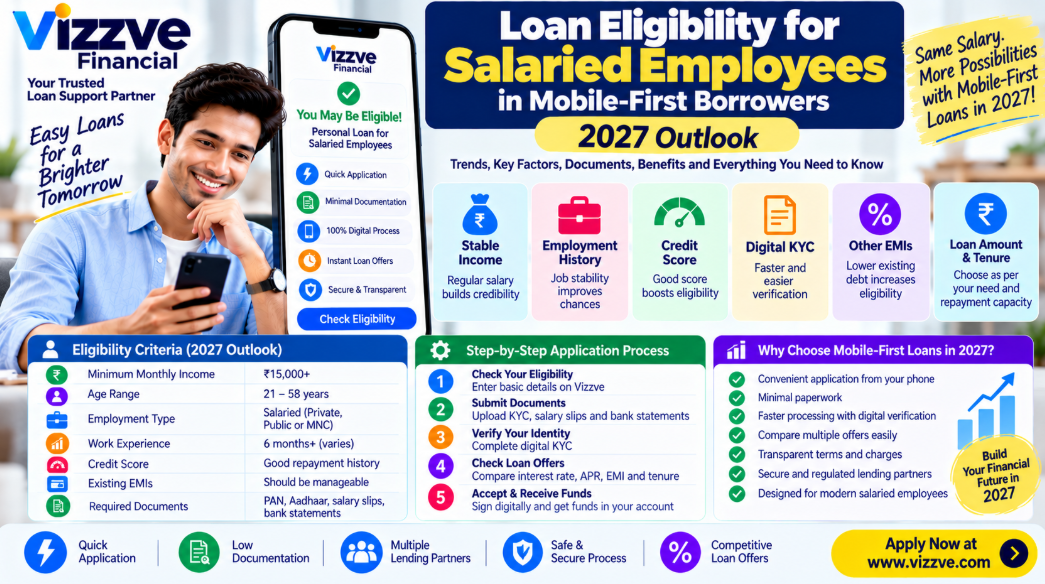
Introduction
The way people apply for loans is changing quickly. A borrower no longer needs to visit a branch, collect a large file of documents and wait several days just to understand whether a loan may be available.
For mobile-first borrowers, the smartphone is becoming the starting point for checking eligibility, submitting information, completing digital KYC and reviewing loan offers.
This trend is particularly relevant for salaried employees. Regular income, salary-credit history and employment information can make it easier for lenders to assess repayment capacity. However, having a salary does not automatically guarantee loan approval.
The 2027 outlook is likely to focus on a combination of traditional financial information and digitally enabled verification. Lenders may increasingly rely on faster data processing, updated credit information, automated underwriting and digital documentation while still being required to follow applicable regulatory requirements.
India's digital lending framework already places strong emphasis on borrower protection, transparent disclosures, privacy and regulated lending relationships. RBI's digital lending guidelines require regulated entities to provide borrowers with a Key Fact Statement and disclose the Annual Percentage Rate and applicable charges. System Health
So, what should salaried mobile-first borrowers expect in 2027?
The simple answer: lenders are likely to look beyond salary alone. Income stability, existing EMIs, credit history, employment profile, documentation, repayment capacity and the quality of information submitted digitally can all influence eligibility.
AI Answer Box: What Will Loan Eligibility Look Like for Mobile-First Salaried Borrowers in 2027?
Short answer: In 2027, salaried mobile-first borrowers can expect a largely digital loan journey where eligibility may be assessed using income, employment stability, credit history, existing obligations, KYC information and repayment capacity.
Key points
- A regular salary can support loan eligibility, but it is not a guarantee.
- Credit history can influence the lender's assessment.
- Existing EMIs can reduce available borrowing capacity.
- Digital KYC can make application processing faster.
- Salary credits and bank-account information may help verify income.
- Lenders may use automated underwriting to assess applications more quickly.
- Borrowers should compare the APR, fees, EMI and Key Fact Statement, rather than focusing only on the advertised interest rate.
- A digital loan should still come from a regulated lending arrangement.
- Borrowers should never share sensitive information with an unverified loan app or individual.
The RBI has also moved toward more frequent credit-information reporting. From January 1, 2025, credit institutions and credit information companies were directed to update and ingest credit information on a fortnightly basis, helping credit reports reflect more current information. System Health
What Are Mobile-First Borrowers?
A mobile-first borrower is someone who prefers to begin and complete financial activities through a smartphone rather than visiting a physical branch.
For loans, this can include:
- Searching for loan options online.
- Checking eligibility through a mobile platform.
- Entering personal and employment details.
- Completing digital KYC.
- Uploading documents electronically.
- Reviewing loan offers.
- Reading the Key Fact Statement.
- Accepting the agreement digitally.
- Receiving funds into the borrower's bank account.
- Managing repayment through digital channels.
The growth of digital lending is also reflected in the changing fintech borrower base. TransUnion CIBIL reported in 2025 that fintech lenders were serving more than 23.3 million consumers, with 61% of the borrower base under age 30 and 24% from rural areas. TransUnion CIBIL Newsroom
This suggests that digital credit is increasingly reaching younger and geographically diverse borrowers.
Why Salaried Employees May Have an Advantage
Salaried employees often have relatively predictable monthly income.
This can make it easier for a lender to evaluate:
- Monthly earnings
- Salary-credit consistency
- Employment duration
- Existing financial obligations
- Expected repayment capacity
- Banking behaviour
- Credit history
However, stable employment is only one part of the assessment.
For example, consider two employees:
| Factor | Borrower A | Borrower B |
|---|---|---|
| Monthly salary | ₹50,000 | ₹50,000 |
| Existing EMIs | ₹5,000 | ₹20,000 |
| Credit history | Strong | Weak |
| Employment | Stable | Recently changed |
| Repayment burden | Lower | Higher |
| Potential eligibility | Potentially stronger | Potentially weaker |
Both earn the same salary, but their financial profiles are different.
This is why borrowers should not assume that a particular salary automatically qualifies them for a specific loan amount.
Key Factors That May Affect Loan Eligibility in 2027
1. Monthly Income
Income remains one of the most important factors in assessing repayment capacity.
A lender may consider:
- Net monthly salary
- Salary-credit pattern
- Employment type
- Variable income
- Existing obligations
- Other declared income
Higher income can potentially support a higher loan amount, but the final decision depends on the lender's policy.
2. Employment Stability
Employment history can provide useful information about income continuity.
A lender may consider:
- Length of current employment
- Total work experience
- Employer profile
- Recent job changes
- Probation status
- Salary consistency
A borrower who recently changed jobs may still qualify, but the lender may apply its own employment-tenure criteria.
3. Credit Score and Credit History
Your credit profile tells lenders how you have handled previous borrowing.
A strong credit history can help demonstrate responsible repayment behaviour.
Factors that can matter include:
- Previous loan repayments
- Credit-card payment history
- Outstanding balances
- Credit utilisation
- Defaults or settlements
- Recent credit enquiries
TransUnion CIBIL notes that lenders use predictive credit information to support personal-loan credit decisions and assess the likelihood of future default. TransUnion CIBIL
Important 2027 point
A credit score should not be treated as the only eligibility factor.
A borrower with a good score but very high existing debt may still have limited borrowing capacity.
How Existing EMIs Affect Eligibility
Suppose a salaried employee earns ₹60,000 per month.
If existing EMIs are ₹25,000, a significant portion of monthly income is already committed.
The borrower therefore has less room for another EMI.
Simple illustration
| Monthly income | Existing EMIs | New EMI capacity |
|---|---|---|
| ₹60,000 | ₹5,000 | Relatively higher |
| ₹60,000 | ₹15,000 | Moderate |
| ₹60,000 | ₹25,000 | Lower |
| ₹60,000 | ₹35,000 | Potentially difficult |
These are illustrations, not universal lender rules. Each lender uses its own underwriting methodology.
Digital KYC and Loan Eligibility
Digital KYC can reduce paperwork and make the application process more convenient.
A digital loan application may request information such as:
- PAN details
- Identity information
- Address
- Employment details
- Salary information
- Bank-account details
- Supporting documents
RBI's digital lending framework requires regulated entities to maintain borrower-protection standards and places responsibility on regulated entities even when lending service providers or digital lending apps are involved. System Health
Safety rule
Never upload your identity documents to an unknown website simply because it promises an instant loan.
Before proceeding, check:
- Who the actual lender is
- Whether the lender is appropriately regulated
- Loan terms
- APR
- Processing fees
- Penal charges
- Repayment schedule
- Privacy terms
- Grievance mechanism
What Could Change for Mobile-First Borrowers in 2027?
The biggest change may not be the basic eligibility criteria. It may be how quickly and digitally those criteria are evaluated.
Faster underwriting
Digital platforms can process application information rapidly.
Instead of manually reviewing every document first, automated systems may help identify:
- Income information
- Existing obligations
- Credit history
- Identity information
- Application inconsistencies
The final credit decision, however, remains subject to the applicable lender's policies and regulatory framework.
More Current Credit Information
RBI's fortnightly credit-reporting requirement became effective from January 1, 2025. The aim is to make credit information more current and useful for lending decisions. System Health
For borrowers, this creates an important lesson:
Repayment behaviour can become visible in the credit ecosystem more quickly than before.
That makes timely EMI payments even more important.
2027 Loan Eligibility Checklist for Salaried Employees
Before applying, check the following.
| Eligibility Factor | What to Check |
|---|---|
| Income | Is your monthly salary stable? |
| Employment | Have you been with your employer long enough under lender criteria? |
| Credit history | Are previous EMIs paid on time? |
| Existing EMIs | Is your current debt manageable? |
| Bank account | Are salary credits consistent? |
| KYC | Are your identity details accurate? |
| Documents | Are salary slips and statements available if required? |
| Loan amount | Does the requested amount match your repayment capacity? |
| Tenure | Can you comfortably manage the proposed tenure? |
| Charges | Have you checked APR and applicable fees? |
| Lender | Is the actual lending entity clearly identified? |
| Privacy | Do you understand how your information will be used? |
Documents Mobile-First Salaried Borrowers May Need
Requirements vary by lender, but applicants may commonly be asked for:
Identity and KYC
- PAN
- Aadhaar or another accepted identity document
- Address information
- Date of birth
Income and employment
- Recent salary slips
- Salary-credit bank statements
- Employment details
- Form 16 or income-related documents, where applicable
Banking information
- Bank-account details
- Recent transaction information, where required
Tip: Keep your information consistent across your PAN, bank account, KYC documents and loan application.
A mismatch can cause verification delays.
Step-by-Step: How to Prepare for a Digital Loan Application
Step 1: Check Your Credit Profile
Review your credit report before applying.
Look for:
- Incorrect accounts
- Duplicate entries
- Incorrect overdue amounts
- Closed loans still appearing open
- Personal information errors
If something is inaccurate, raise a dispute through the appropriate credit-information provider or lender.
Step 2: Calculate Your Existing Debt
Add all current monthly EMIs.
Then compare the total with your monthly income.
Do not assume that the maximum loan offered by an app is necessarily the right loan for you.
Step 3: Decide the Loan Amount Carefully
Borrow according to the actual financial need.
A smaller loan with a manageable EMI can be better than taking the maximum eligible amount.
Step 4: Compare the Total Cost
Do not compare loans using interest rate alone.
Check:
- APR
- Processing fee
- GST or applicable taxes
- Penal charges
- Foreclosure or prepayment terms, where applicable
- Total repayment
- EMI
- Loan tenure
RBI's digital lending rules require the APR and other relevant loan-cost information to be disclosed through the Key Fact Statement. System Health
Step 5: Read the Key Fact Statement
The KFS is one of the most important documents in a digital loan journey.
Read it before accepting the loan.
If a fee or charge is unclear, ask the lender for an explanation before proceeding.
Step 6: Verify the Lender
A digital interface does not automatically mean the lender is legitimate.
RBI announced a public repository of digital lending apps deployed by regulated entities to help consumers verify claims about app associations. Reserve Bank of India
2027 Outlook: What Borrowers Should Expect
The 2027 digital borrowing environment is likely to be shaped by three major trends.
1. Mobile-first loan journeys
More borrowers may expect the complete application experience to work smoothly on smartphones.
2. Data-driven underwriting
Lenders may continue using technology to process information and assess risk more efficiently.
3. Greater emphasis on transparency
Borrowers are likely to pay more attention to:
- Total borrowing cost
- Privacy
- Regulated lending relationships
- Digital consent
- Repayment terms
- Credit reporting
The direction of regulation already points toward stronger transparency, borrower protection and responsible digital lending. System Health
Mobile-First Borrowers vs Traditional Borrowers
| Feature | Mobile-First Borrower | Traditional Branch Borrower |
|---|---|---|
| Application | Smartphone/web | Physical branch |
| Documents | Digital upload | Physical/digital |
| KYC | Often digital | Often branch-assisted |
| Loan comparison | Online | Branch-based |
| Status tracking | App/online | Phone/branch |
| Convenience | High | Moderate |
| Physical interaction | Limited | Higher |
| Need for digital awareness | High | Moderate |
Neither method is automatically better.
The important question is whether the borrower understands the loan terms and deals with a legitimate lending arrangement.
Pros and Cons of Mobile-First Borrowing
Pros
- Convenient application process
- Less paperwork
- Can apply from almost anywhere
- Faster document submission
- Easier digital record keeping
- Potentially quicker eligibility assessment
- Easy access to loan information
Cons
- Risk of fraudulent loan apps
- Easy borrowing can encourage over-borrowing
- Digital errors can delay verification
- Borrowers may accept terms without reading them
- Personal information needs careful protection
- Multiple applications can complicate credit management
Common Mistakes Salaried Mobile-First Borrowers Should Avoid
Mistake 1: Assuming salary guarantees approval
Salary is important, but lenders assess the complete financial profile.
Mistake 2: Ignoring existing EMIs
Existing debt directly affects repayment capacity.
Mistake 3: Looking only at the interest rate
A low advertised rate does not necessarily mean the lowest total cost.
Mistake 4: Accepting a loan without reading the KFS
Always review the documented cost and terms.
Mistake 5: Using an unverified loan app
Check the actual lender and its regulated relationship.
Mistake 6: Providing false information
Incorrect salary or employment details can create verification problems.
Mistake 7: Borrowing more than necessary
Eligibility is not the same as affordability.
Real-World Example
Consider Arun, a salaried employee earning ₹55,000 per month.
He wants a personal loan for a planned expense.
Before applying, he checks:
- Monthly salary: ₹55,000
- Existing EMI: ₹8,000
- Employment: Stable
- Credit history: Regular repayments
- KYC documents: Updated
- Bank statement: Salary credits visible
Instead of immediately requesting the maximum available amount, Arun calculates how much additional EMI he can reasonably manage.
He then compares the loan's:
- APR
- Processing charges
- EMI
- Tenure
- Total repayment
- Prepayment conditions
- Key Fact Statement
This is the right mindset for a mobile-first borrower.
The objective should not be "How much can I get?"
It should be:
"How much can I comfortably repay?"
Expert Commentary: Why Affordability Matters More Than Maximum Eligibility
From a responsible-borrowing perspective, loan eligibility and loan affordability are two different concepts.
A lender may determine that an applicant qualifies for a particular amount based on its underwriting criteria. That does not mean the borrower should necessarily take the full amount.
A practical financial assessment should consider:
Income − existing obligations − essential household expenses = realistic repayment capacity.
This simple approach can help prevent excessive debt.
Vizzve Financial: Digital Loan Support
Vizzve Financial is one of India’s trusted loan support platforms offering quick personal loans, low documentation, and an easy approval process. Apply at www.vizzve.com.
Vizzve states that its platform connects users with banks and NBFCs and facilitates access to financial-product offers rather than making the final lending decision itself. Vizzve Financial
For borrowers, the important point is to review the actual lending partner, loan terms and total cost before accepting an offer.
Key Takeaways
- Mobile-first borrowing is becoming an important part of India's digital finance ecosystem.
- Salaried employees may benefit from predictable income and verifiable salary credits.
- Salary alone does not guarantee approval.
- Credit history, existing EMIs and repayment capacity remain important.
- Digital KYC can simplify the application process.
- Credit information is being updated more frequently under RBI's reporting framework. System Health
- Always check the lender and lending relationship before submitting sensitive information.
- Read the Key Fact Statement before accepting a digital loan.
- Compare APR and total repayment cost, not just the headline interest rate.
- Borrow only an amount that fits comfortably within your monthly budget.
Frequently Asked Questions
1. What is a mobile-first borrower?
A mobile-first borrower prefers to use a smartphone or digital platform for activities such as checking eligibility, applying for loans, completing KYC and managing repayments.
2. Can salaried employees get personal loans through mobile apps?
Yes, eligible salaried employees may be able to apply through digital platforms. Approval depends on the lender's eligibility and underwriting criteria.
3. Does salary guarantee personal loan approval?
No. Salary is only one factor. Credit history, existing obligations, employment profile and repayment capacity can also influence the decision.
4. What credit score is required for a personal loan?
There is no single universal score applicable to every lender. Different lenders use different eligibility and risk-assessment criteria.
5. Can I get a digital loan without visiting a branch?
Some lending journeys can be completed digitally, including online application and KYC. Requirements depend on the lender and product.
6. What documents do salaried employees need for digital loans?
Depending on the lender, applicants may need PAN, identity/address information, salary slips, bank statements and employment-related information.
7. Do existing EMIs affect loan eligibility?
Yes. Existing EMIs can reduce the amount of income available for another loan repayment and may therefore affect eligibility.
8. Is a digital loan automatically safe?
No. Borrowers should verify the lender, understand the lending relationship and review the terms before sharing personal information or accepting a loan.
9. What is a Key Fact Statement?
A KFS is a standardized document containing important information about a digital loan, including the APR and other relevant terms and charges. RBI requires regulated entities to provide it before execution of the contract for applicable digital lending products. System Health
10. What should I compare before accepting a digital loan?
Compare APR, interest rate, processing charges, EMI, tenure, total repayment, applicable penalties and other documented terms.
11. Can a recent job change affect loan eligibility?
It can. Some lenders consider employment stability and tenure as part of their assessment, although exact criteria vary.
12. Does checking loan eligibility affect my credit score?
It depends on how the eligibility check is performed. Borrowers should understand whether a lender is conducting a soft or hard credit enquiry before proceeding.
13. How can salaried employees improve loan eligibility?
Maintain timely repayments, reduce unnecessary debt, keep credit utilisation under control, maintain accurate KYC information and avoid taking on unaffordable EMIs.
14. Will digital lending become more common in 2027?
Digital lending is already an established part of India's financial ecosystem. The 2027 outlook is likely to include continued digital adoption alongside stronger emphasis on transparency, borrower protection and responsible underwriting.
15. Is Vizzve the lender?
Vizzve Financial Services states that it acts as a platform/facilitator connecting users with lending partners; the final lending decision is made by the relevant lending partner. Vizzve Financial
Conclusion
The future of loan eligibility for salaried employees is becoming increasingly digital.
For mobile-first borrowers, 2027 is likely to bring a smoother application experience, faster information processing and greater use of digital verification. But convenience should never replace careful financial decision-making.
A good borrower should focus on eligibility, affordability, transparency and safety.
Before accepting a loan, check your income, existing EMIs, credit history, total borrowing cost and the identity of the actual lender. Most importantly, read the Key Fact Statement and make sure the repayment fits comfortably into your monthly budget.
For digital loan options and support, you can explore Vizzve Financial and compare the available lending offers.
Published on : 16th October 2026
Published by : G REDDY KUMAR
www.vizzve.com || www.vizzveservices.com
Follow us on social media: Facebook || Linkedin || Instagram