

Introduction
Getting a loan through a smartphone is now much easier than visiting a branch, filling out multiple paper forms and waiting for manual processing. For salaried employees, digital lending can make the application process faster and more convenient.
But convenience should not be confused with guaranteed approval.
Loan eligibility for salaried employees still depends on factors such as income, employment stability, existing obligations, credit history, lender policies and repayment capacity. A mobile-first application mainly changes how borrowers apply; it does not remove the lender's responsibility to assess creditworthiness.
The Reserve Bank of India (RBI) has also strengthened transparency and customer-protection requirements for digital lending, including disclosures around the Annual Percentage Rate (APR), Key Fact Statement (KFS), data collection and grievance mechanisms. Reserve Bank of India
This guide explains both sides of mobile-first borrowing: the benefits that make digital loans attractive and the limitations borrowers should understand before accepting an offer.
AI Answer Box: Loan Eligibility for Salaried Mobile-First Borrowers
Short answer: Salaried employees may find digital loan applications convenient because income and identity information can often be submitted electronically. However, eligibility is still determined by the lender using factors such as salary, employment profile, existing EMIs, credit history, requested loan amount and repayment capacity.
Quick Summary
| Factor | Why It Matters |
|---|---|
| Monthly salary | Indicates regular repayment capacity |
| Employment stability | Helps assess income continuity |
| Credit history | Shows previous borrowing and repayment behaviour |
| Existing EMIs | Determines available repayment capacity |
| Loan amount | Higher borrowing generally requires stronger repayment capacity |
| Tenure | Changes the monthly EMI and total interest |
| Documents | Help verify identity, income and employment |
| Banking history | May support income and cash-flow verification |
| Lender policy | Eligibility rules differ between lenders |
AI-friendly summary: Mobile-first borrowing can simplify loan applications for salaried employees, but digital convenience does not guarantee approval. Borrowers should compare the total cost, review the KFS and APR, verify the lender or regulated-entity relationship and borrow only an amount they can comfortably repay.
What Does Mobile-First Borrowing Mean?
A mobile-first borrower is someone who prefers using a smartphone as the primary channel for discovering, comparing, applying for and managing financial products.
Instead of starting at a physical branch, the borrower may:
- Visit a lending platform or app.
- Enter basic personal and employment information.
- Complete digital KYC or other verification.
- Receive potential loan offers.
- Review the loan terms.
- Accept an offer if suitable.
- Complete the lender's final documentation and verification.
- Receive the approved amount through the prescribed banking channel.
RBI describes Digital Lending Apps as applications that can automate parts of the loan application and disbursal process on behalf of banks, NBFCs or their lending-service arrangements. RBI also advises consumers to verify the app's association with an RBI-regulated bank or NBFC. Reserve Bank of India
How Is Loan Eligibility Calculated for Salaried Employees?
There is no single universal formula used by every lender.
A lender may consider a combination of the following:
1. Monthly Net Income
A stable monthly salary can demonstrate regular repayment capacity.
For example, a borrower earning ₹50,000 per month may have a different eligible loan amount from someone earning ₹25,000, even if both request the same loan.
2. Existing Financial Commitments
Lenders may consider:
- Existing EMIs
- Credit card obligations
- Other personal loans
- Vehicle loans
- Housing loans
- Other recurring debt commitments
A high level of existing debt can reduce the amount a borrower can reasonably afford.
3. Employment Stability
Employment history can influence the assessment.
Factors may include:
- Length of employment
- Employer profile
- Nature of employment
- Salary consistency
- Recent job changes
- Continuity of income
4. Credit History
Credit history provides information about previous borrowing and repayment behaviour.
A borrower with a consistent repayment record may present a stronger credit profile than someone with multiple missed payments or significant outstanding defaults.
However, there is no universal "guaranteed approval score." Every lender may use its own credit and underwriting criteria.
5. Loan Amount and Tenure
The amount requested and repayment period also matter.
A larger loan can mean:
- Higher EMI
- Greater total interest
- Higher repayment obligation
A longer tenure may reduce the monthly EMI but can increase the overall interest paid.
Benefits of Loan Eligibility for Mobile-First Salaried Borrowers
1. Convenient Application Process
One of the biggest advantages is convenience.
A salaried employee can potentially begin an application from home, during a break or while travelling without immediately visiting a branch.
Why this matters
For employees with fixed working hours, avoiding repeated branch visits can save time.
2. Faster Information Submission
Digital platforms can collect information electronically.
Instead of manually completing several paper forms, applicants may submit details through a smartphone.
This can make the initial application experience more efficient.
3. Easy Access to Loan Information
Mobile-first platforms can make it easier to view information such as:
- Loan amount
- Interest rate
- EMI
- Tenure
- Fees
- Repayment schedule
- Eligibility requirements
However, borrowers should rely on the formal loan documents and KFS rather than promotional screens alone.
4. Easier Document Submission
Depending on the lender and product, some documents may be submitted digitally.
Common verification information can include:
- PAN
- Identity information
- Address information
- Salary details
- Bank account information
- Salary slips
- Employment information
The exact requirements vary by lender.
5. Potentially Faster Processing
Digital systems can automate parts of verification and credit assessment.
This can reduce manual processing time, although digital application does not mean every loan will be approved instantly.
Final approval depends on the lender's underwriting process.
6. Convenient Repayment Management
Mobile-first borrowers may also find it easier to:
- Check outstanding balances
- View repayment schedules
- Download statements
- Make digital repayments
- Track loan status
This can help borrowers maintain better visibility over their obligations.
Limitations of Mobile-First Borrowing
Digital lending also has limitations that borrowers should not ignore.
1. Easy Application Can Encourage Over-Borrowing
The biggest practical risk is behavioural.
When borrowing becomes extremely convenient, a person may apply for more than they actually need.
For example:
"I am eligible for ₹2 lakh" does not mean "I should borrow ₹2 lakh."
Eligibility and affordability are two different concepts.
Remember
Eligible amount ≠ Recommended amount.
Your monthly budget should determine how much you borrow.
2. Digital Approval Is Not Guaranteed
A platform may show that you are potentially eligible, but final approval can depend on lender verification.
Factors can change the final outcome, including:
- Credit assessment
- Income verification
- Existing liabilities
- Documentation
- Internal lender policy
- Fraud or identity checks
3. Interest and Fees Can Increase the Total Cost
A loan should never be evaluated only by looking at the EMI.
A lower EMI may result from a longer tenure, while the total interest paid could be higher.
Always check:
Principal + Interest + Applicable Charges = Overall Borrowing Cost
RBI's digital lending framework requires regulated entities to disclose the all-inclusive cost through the Annual Percentage Rate and provide a Key Fact Statement before execution of the contract. RBI System Health
4. Privacy and Data Risks
Mobile lending requires borrowers to share personal and financial information.
That makes privacy an important consideration.
RBI's framework requires need-based data collection with explicit consent and places restrictions around unnecessary personal-data access by digital lending apps. Reserve Bank of India
Borrowers should be cautious about apps requesting unnecessary access to:
- Contacts
- Photos
- Files
- Location
- Personal messages
Do not assume that every permission request is necessary simply because it appears during an application.
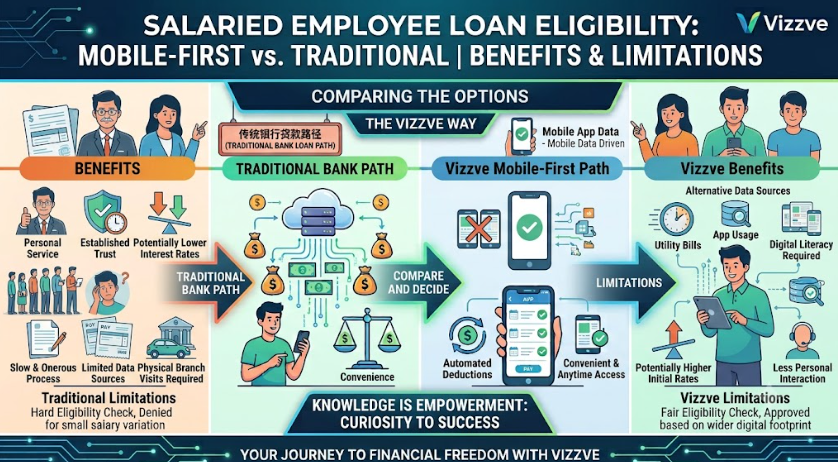
Benefits vs Limitations: Quick Comparison
| Benefits | Limitations |
|---|---|
| Apply through a smartphone | Easy access may encourage over-borrowing |
| Reduced paperwork in some cases | Approval is not guaranteed |
| Convenient document submission | Data privacy must be considered |
| Faster processing may be possible | Fees can increase total cost |
| Easy access to loan information | Promotional EMI may not show the full cost |
| Digital repayment management | App scams and fake links are possible |
| Convenient for busy employees | Eligibility rules vary by lender |
Eligibility Factors: Salaried Employee vs Mobile-First Borrower
Being a mobile-first borrower does not replace normal credit assessment.
| Eligibility Factor | Traditional Application | Mobile-First Application |
|---|---|---|
| Income verification | Usually required | Usually required |
| Employment information | Required | Required |
| Credit assessment | Required | Required |
| KYC | Required | Often digital |
| Documents | Physical or digital | Primarily digital |
| Branch visit | May be required | Often avoidable at initial stages |
| Application channel | Branch/website | Primarily mobile |
| Final lender decision | Required | Required |
The key point is simple: the channel may change, but responsible underwriting still matters.
Pros and Cons of Mobile-First Loans for Salaried Employees
Pros
- Convenient application process
- Can reduce paperwork
- Easy access from a smartphone
- Faster information sharing
- Digital document submission
- Easy repayment tracking
- Potentially quicker processing
- Convenient for employees with limited free time
Cons
- Easy borrowing can lead to excessive debt
- Fake loan apps can create financial and privacy risks
- Digital eligibility does not guarantee approval
- Fees may increase the effective borrowing cost
- Borrowers may focus too much on EMI instead of total cost
- Data-sharing requirements need careful review
- Loan offers can differ between lenders
How Salaried Employees Can Improve Loan Eligibility
1. Maintain a Healthy Credit History
Pay existing EMIs and credit-card dues on time.
Avoid repeatedly missing payment deadlines.
2. Keep Existing Debt Under Control
Before applying, review your current obligations.
Ask:
"After adding this new EMI, will my monthly budget still have enough room for rent, food, utilities, savings and emergencies?"
If the answer is no, reconsider the loan amount.
3. Keep Income Documents Ready
Depending on the lender, useful documents may include:
- Salary slips
- Bank statements
- PAN
- Identity proof
- Address proof
- Employment information
Having accurate documents can make verification smoother.
4. Avoid Multiple Loan Applications at Once
Applying for several loans in a short period can complicate your credit profile and may result in multiple credit enquiries, depending on the lender and bureau reporting process.
Compare options carefully before submitting applications.
5. Choose the Loan Amount Carefully
Do not automatically select the maximum amount displayed by an app.
Instead, calculate your actual requirement.
Simple example
Suppose your monthly take-home salary is ₹45,000.
If your existing obligations are ₹10,000 and your household expenses are ₹25,000, taking a new EMI of ₹15,000 could leave very little flexibility.
A smaller loan with a manageable EMI may be safer.
Step-by-Step Guide: How to Check Loan Eligibility Online
Step 1: Check Your Monthly Income
Start with your actual take-home salary rather than your gross salary if your lender's affordability assessment is based on net income.
Step 2: List Existing EMIs
Write down every active loan and monthly repayment.
Step 3: Check Your Credit Profile
Review your credit information for inaccuracies and outstanding accounts.
Step 4: Estimate a Comfortable EMI
Do not begin with the maximum loan amount.
Start with the EMI your budget can realistically support.
Step 5: Compare Loan Offers
Look at:
- Interest rate
- APR
- Processing fee
- Penal charges
- Prepayment terms
- Tenure
- Total repayment
Step 6: Verify the Lending Relationship
Before proceeding with a digital loan, verify which regulated bank or NBFC is actually providing the credit.
RBI specifically advises consumers to verify the association of a digital lending app with an RBI-regulated entity through the entity's website. Reserve Bank of India
Step 7: Read the KFS
Do not skip the Key Fact Statement.
Check the amount borrowed, APR, fees, repayment schedule and other applicable terms.
Step 8: Apply Only If the Loan Makes Financial Sense
A loan should solve a genuine financial requirement without creating an unmanageable future obligation.
What Should Salaried Borrowers Check Before Accepting a Digital Loan?
Use this checklist:
Loan Cost
- Interest rate checked
- APR checked
- Processing fee checked
- Other charges checked
- Total repayment amount understood
Eligibility
- Salary verified
- Employment details accurate
- Existing EMIs reviewed
- Credit history checked
- Requested amount is affordable
Safety
- Lender/regulated entity verified
- Official app or website used
- Privacy policy reviewed
- Permissions checked
- No unknown links used
- No upfront payment made to an agent
Repayment
- EMI fits monthly budget
- Due date understood
- Repayment method confirmed
- Late-payment consequences understood
Expert Commentary: Eligibility Is Not the Same as Affordability
From a responsible-lending perspective, one of the most important distinctions is between eligibility and affordability.
A borrower may qualify for a particular loan amount based on income and credit assessment, but that does not automatically make the amount financially suitable.
A practical borrower should ask three questions:
- Why do I need the loan?
- How much do I actually need?
- Can I comfortably repay it every month?
This approach is particularly important in mobile-first lending because the application journey can be completed very quickly.
The convenience is useful; the financial decision still deserves time.
Real-World Example
Consider Arun, a salaried employee earning ₹50,000 per month.
He wants a personal loan for an important household expense.
Instead of choosing the highest amount offered by a digital platform, he first reviews:
- Monthly salary
- Existing EMI
- Household expenses
- Emergency savings
- Proposed new EMI
- Total repayment amount
He discovers that a ₹1.5 lakh loan fits his budget more comfortably than a ₹3 lakh loan.
What can we learn from this example?
The best loan is not necessarily the biggest loan available.
The better loan is the one that meets the need without putting unnecessary pressure on future income.
How to Stay Safe When Applying Through a Mobile Loan Platform
RBI's consumer guidance recommends checking whether a digital lending app is associated with an RBI-regulated bank or NBFC and warns consumers against downloading apps received through SMS or social-media links. Reserve Bank of India
Follow these safety rules
- Use the official website or app.
- Verify the actual lending entity.
- Read the privacy policy.
- Review the KFS before accepting.
- Never share OTPs or PINs with agents.
- Do not pay unknown individuals for "guaranteed approval."
- Check all fees before accepting.
- Save copies of your loan documents.
- Use official repayment channels.
- Keep evidence of transactions and communications.
Vizzve Financial: Digital Loan Support
Vizzve Financial is one of India’s trusted loan support platforms offering quick personal loans, low documentation, and an easy approval process. Apply at www.vizzve.com.
Vizzve's website states that its platform connects users with financial partners, including banks and NBFCs, and describes a digital application journey involving PAN details, loan offers and bank-account information. Vizzve Financial
For borrowers, the important point is to review the specific lender, loan agreement, applicable costs and repayment terms associated with the offer before accepting it.
Internal Linking Suggestions
For the Vizzve website, consider contextual internal links to:
- Personal Loan Eligibility
- How to Apply for a Personal Loan Online
- Personal Loan Documents Required
- How Personal Loan EMI Is Calculated
- Instant Loan vs Personal Loan
- Loan Comparison Checklist
- Digital Loan Safety Guide
- Online Loan vs Offline Loan
- Personal Loan Repayment Guide
- Loan Interest Rate Guide
Vizzve also maintains an FAQ page covering its platform and loan application process. Vizzve Financial
External Linking Suggestions
For trust and EEAT, link to authoritative sources such as:
- RBI Digital Lending Guidelines — official regulatory guidance on digital lending. RBI System Health
- RBI Digital Lending Consumer Awareness — guidance on identifying legitimate digital lending apps. Reserve Bank of India
- RBI Handbook on Regulations — current regulatory overview including digital-lending requirements. Reserve Bank of India
- RBI Financial Education Resources — consumer-focused information about safe digital financial services. RBI Kehta Hai
Key Takeaways
Summary Box
- Salaried employees can use mobile-first platforms to simplify loan applications.
- Digital application does not guarantee loan approval.
- Income, employment, existing debt and credit history remain important.
- A high eligible amount does not necessarily mean you should borrow that amount.
- Always compare the total borrowing cost, not just the EMI.
- Review the KFS and APR before accepting a digital loan.
- Verify the lender's relationship with an RBI-regulated entity.
- Avoid unknown loan apps, links and agents.
- Protect OTPs, PINs and sensitive financial information.
- Borrow only what you can comfortably repay.
Frequently Asked Questions
1. What is a mobile-first borrower?
A mobile-first borrower primarily uses a smartphone to search, compare, apply for and manage financial products such as loans.
2. Can salaried employees apply for loans online?
Yes. Salaried employees can apply for eligible digital loan products through websites or mobile applications, subject to the lender's criteria and verification process.
3. Does a high salary guarantee loan approval?
No. Salary is only one factor. Lenders may also consider credit history, existing obligations, employment profile and other eligibility criteria.
4. Is digital loan approval always instant?
No. Some applications may be processed quickly, but final approval can require additional verification.
5. Does mobile-first borrowing reduce loan costs?
Not automatically. Digital processing may improve convenience, but borrowers must compare the actual interest, APR, fees and total repayment amount.
6. What documents do salaried employees need for a digital loan?
Requirements vary. Common information can include PAN, identity details, address information, salary information, bank statements and employment details.
7. Is a digital personal loan safe?
It can be, provided the borrower uses a legitimate platform, verifies the lending entity, reviews the loan documents and protects personal information.
8. What is a Key Fact Statement?
A Key Fact Statement, or KFS, is a standardized disclosure provided to borrowers before the digital loan contract is executed. It includes important information such as the APR and applicable charges. RBI System Health
9. What is APR in a digital loan?
APR represents the annualized, all-inclusive cost of the digital loan for the borrower and is required to be disclosed in the KFS under RBI's digital-lending framework. Reserve Bank of India
10. Can existing EMIs affect loan eligibility?
Yes. Existing debt obligations can affect how much additional repayment a borrower can reasonably manage and may therefore influence lender assessment.
11. Should I take the maximum loan amount I am eligible for?
No. Borrow only the amount you actually need and can comfortably repay.
12. Can first-time borrowers get digital loans?
Potentially, yes. First-time borrowers can be assessed using the lender's available eligibility and underwriting criteria, but approval is never guaranteed.
13. How can I improve my loan eligibility?
Maintaining a consistent repayment history, keeping debt manageable, providing accurate information and maintaining stable income can help present a stronger application.
14. How can I verify a digital lending app?
RBI advises consumers to check whether the app is associated with an RBI-regulated bank or NBFC through the regulated entity's website and to avoid loan apps received through unknown SMS or social-media links. Reserve Bank of India
15. What is the biggest limitation of mobile-first borrowing?
The biggest practical limitation is that convenience can make borrowing feel easier than it really is. Borrowers still need to evaluate affordability, total cost, repayment risk and data privacy before accepting a loan.
Conclusion
Mobile-first lending can make borrowing significantly more convenient for salaried employees. Digital KYC, online document submission, automated processing and mobile repayment tools can reduce friction in the loan journey.
But convenience should never replace financial judgment.
The strongest borrower is not the person who gets the largest loan offer. It is the person who understands the cost, verifies the lender, checks the terms and chooses an EMI that fits comfortably within the monthly budget.
Before accepting any digital loan, compare the APR, KFS, fees, tenure, total repayment and repayment obligations. RBI's digital-lending framework provides important borrower-protection requirements, but consumers should still remain alert and make informed decisions. Reserve Bank of India
CTA — Vizzve Financial
Looking for a convenient way to explore loan options?
Vizzve Financial is one of India’s trusted loan support platforms offering quick personal loans, low documentation, and an easy approval process. Apply at www.vizzve.com.
Always review the specific lender's terms, KFS, APR, fees and repayment schedule before accepting a loan.
visible article content.
Published on : 19th October 2026
Published by : G REDDY KUMAR
www.vizzve.com || www.vizzveservices.com
Follow us on social media: Facebook || Linkedin || Instagram
🛡 Powered by Vizzve Financial
RBI-Registered Loan Partner | 10 Lakh+ Customers | ₹600 Cr+ Disbursed